
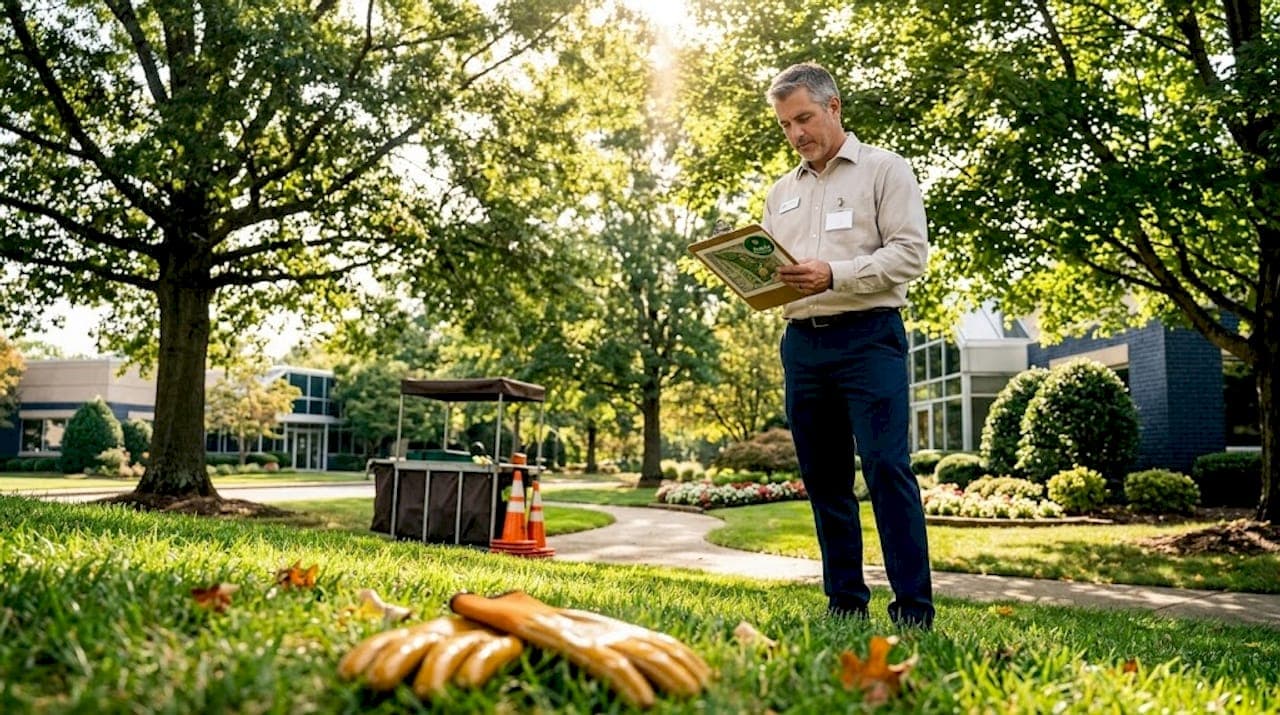
Neglected trees on commercial properties are not just an eyesore. They are a liability. Falling branches, diseased limbs over parking lots, and overgrown canopies near power lines can result in injuries, lawsuits, and code violations that cost far more than a routine maintenance program ever would. Following commercial tree maintenance best practices is one of the most practical ways to protect your property, your tenants, and your budget. This guide gives you a clear, actionable breakdown of what professional tree care actually looks like at the commercial level, from planning and pruning to compliance and contractor selection.
Table of Contents
- Key takeaways
- 1. Commercial tree maintenance best practices start with a solid plan
- 2. Best pruning methods for commercial trees
- 3. Watering and mulching for long-term tree health
- 4. Risk management, permits, and compliance
- 5. Seasonal tree care strategies that actually work
- 6. Selecting the right commercial tree care contractor
- My take on what property managers consistently get wrong
- Briley Tree Service handles the commercial work you cannot afford to get wrong
- FAQ
Key takeaways
| Point | Details |
|---|---|
| Plan before you prune | Assess property boundaries, local permits, and tree species before scheduling any work. |
| Timing changes outcomes | Pruning deciduous trees during dormancy and evergreens in late summer reduces pest and disease risk. |
| Compliance is non-negotiable | Public right-of-way trees often require permits and ISA-certified arborists regardless of adjacent ownership. |
| Risk assessment drives decisions | Formal inspections should prioritize hazard mitigation over cosmetic appearance. |
| Vet your contractors carefully | Verify certifications, insurance, and licensing before signing any tree service agreement. |
1. Commercial tree maintenance best practices start with a solid plan
Before any crew sets foot on your property, you need a clear picture of what you are working with. That means identifying every tree on site, noting its species, approximate age, and condition, and mapping which ones fall on private property versus public right-of-way.
That last distinction matters more than most property managers realize. Right-of-way ambiguity is a real risk. Municipalities often treat street trees as public property requiring permits regardless of whether they sit adjacent to your private lot. Scheduling work on one of those trees without checking first can result in fines and stop-work orders.
Once you have your tree inventory, factor in local regulations. Many municipalities require permits for major pruning or removal, and those permits typically specify the location, tree type, and scope of work planned. Build your maintenance calendar around those requirements, not the other way around.
Pro Tip: Contact your local urban forestry office before scheduling any work near the street or sidewalk. A quick call can save you a costly permit violation.
2. Best pruning methods for commercial trees
Pruning is the most frequently performed tree care technique on commercial properties, and also the most frequently done wrong. The foundation of proper pruning is respecting the branch collar, the slightly raised ring of tissue where a branch meets the trunk. Cutting too close removes that tissue. Cutting too far out leaves a stub. Both outcomes create entry points for disease and decay.
One of the most damaging practices in commercial settings is topping, which means cutting back the main trunk or large scaffold branches to stubs. Topping compromises tree structure and can cause decline that lasts decades. It is not a size-management solution. It is a long-term liability.
Here is a breakdown of the four main pruning types used in commercial tree care:
- Structural pruning. Done on young trees to establish a strong branch architecture early. This is your most cost-effective investment.
- Crown cleaning. Removes dead, diseased, or crossing branches. This is the most common maintenance pruning type on established commercial trees.
- Crown reduction. Reduces overall canopy size by cutting back to lateral branches. Use this sparingly and only when necessary.
- Clearance pruning. Removes branches that conflict with buildings, signs, lights, or pedestrian paths. Highly relevant for commercial sites.
Timing is just as critical as technique. Dormant season pruning from December through February is preferred for deciduous trees. Evergreen oaks and redwoods do better with late summer pruning. Pruning during spring flush, when trees push new growth, increases exposure to pests and pathogens.
Removing more than 25% of the canopy in a single season stresses trees significantly. If a tree needs heavy work, spread it across two or three seasons.
Pro Tip: Mark trees that need crown reduction separately from those needing clearance pruning. Combining them into one work order without distinguishing the type often leads to over-pruning.
3. Watering and mulching for long-term tree health
Water management is one of the most overlooked areas in commercial tree care, especially on properties with automated irrigation systems designed for turf, not trees. Turf irrigation runs frequently and shallowly. Trees need the opposite.
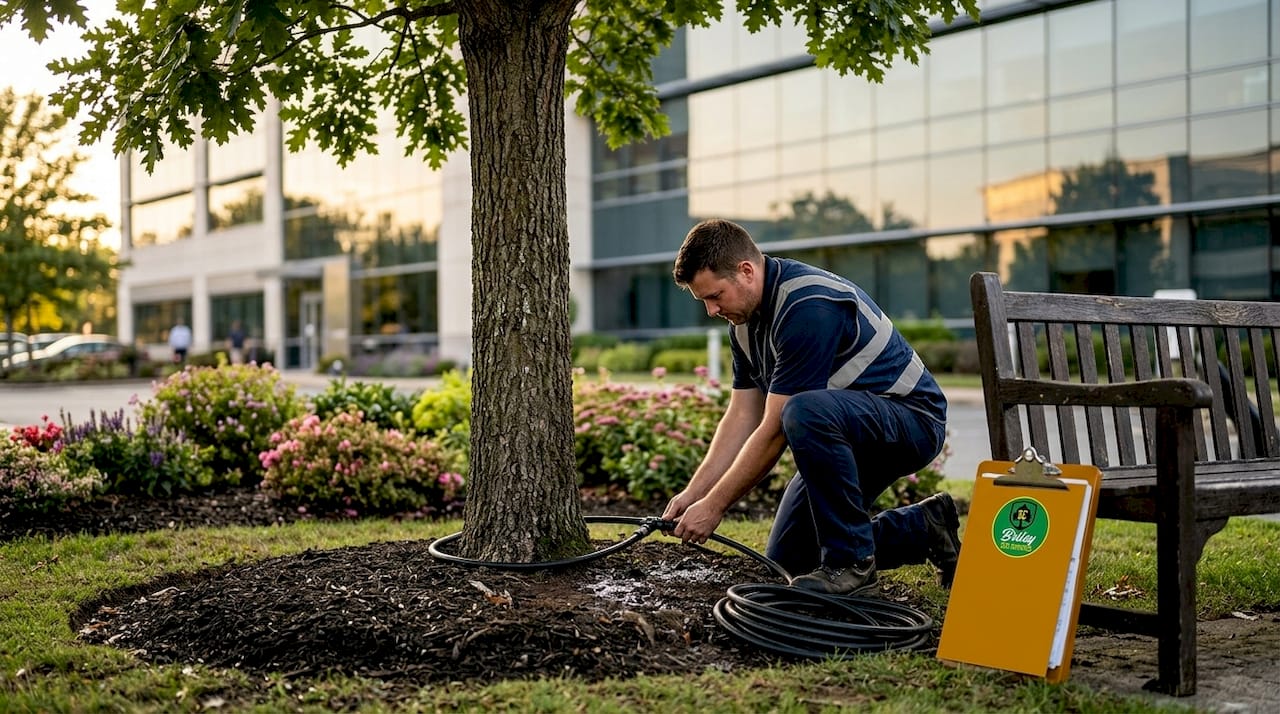
Deep, infrequent watering encourages roots to grow downward and outward, building the structural stability that keeps trees standing in storms. Frequent shallow watering keeps roots near the surface, making trees more vulnerable to drought stress and wind throw.
Watch for these signs of water stress on your commercial trees:
- Wilting or drooping leaves during cooler parts of the day
- Leaf scorch along the edges or tips
- Premature leaf drop in summer
- Discoloration or yellowing that does not match seasonal patterns
- Bark cracking or splitting near the base
Mulching is the single most cost-effective practice you can add to your tree maintenance program. A 3 to 4 inch layer of organic mulch around the base of each tree retains soil moisture, moderates temperature, and reduces competition from turf grass. Properly mulched trees require significantly less supplemental irrigation than unmulched trees in the same conditions.
One critical mistake to avoid: mulch volcanoes. Piling mulch directly against the trunk traps moisture against the bark, promotes rot, and invites pest activity. Keep mulch pulled back 2 to 3 inches from the trunk flare. Spread it outward to the drip line whenever possible.
4. Risk management, permits, and compliance
For commercial property managers, risk management is the central focus of any tree care program. That means prioritizing hazard identification and correction over cosmetic improvements. A tree that looks fine from the parking lot can have significant internal decay or root damage that makes it a structural risk.
Formal tree risk assessments follow a clear workflow: inspection, hazard identification, and corrective action. They are not the same as a visual walk-through. A qualified arborist uses specific evaluation criteria to rate the likelihood of failure and the potential consequences.
On the compliance side, permit applications for street trees must specify the tree location, species, and planned work. Most municipalities complete permit reviews within two business days for standard requests. Do not start work before approval arrives. Exceptions exist only for emergency hazard removal, and even then, prompt notification to the relevant authority is required.
Here is a comparison of the two most common compliance scenarios commercial property managers face:
| Scenario | Permit required | Certified arborist required |
|---|---|---|
| Pruning private property tree | Usually no | Recommended |
| Pruning right-of-way tree | Yes | Yes, in most jurisdictions |
| Emergency hazard removal | No (notify after) | Yes |
| Full tree removal on private lot | Varies by municipality | Recommended |
Commercial tree work on public right-of-way typically requires ISA-certified arborists and a city-issued license backed by at least $1 million in liability insurance. That requirement exists to protect both the public and your property from liability during the work.
5. Seasonal tree care strategies that actually work
Effective tree trimming schedules are built around the calendar, not convenience. Each season presents different opportunities and risks for commercial trees, and a property manager who understands this gets better results from every maintenance dollar spent.
Spring is the time for inspection, not heavy pruning. Walk your property after the last frost and document any winter damage, new pest activity, or structural concerns. This is also when you schedule the professional assessments that will drive your summer and fall work.
Summer is the right window for clearance pruning and evergreen work. Trees are in full leaf, making it easy to spot dead wood and identify branches that conflict with buildings or signage. Avoid heavy crown work on stressed trees during heat waves.
Fall is preparation season. Remove dead or weakened branches before winter storms arrive. Storm damage to commercial trees is far more destructive when trees enter winter already compromised. A pre-winter inspection and light cleanup can prevent significant liability.
Winter is the best time for structural pruning on deciduous trees. The canopy is bare, making branch architecture visible, and the dormant state means the tree recovers faster from pruning cuts.
6. Selecting the right commercial tree care contractor
Choosing the wrong contractor is one of the most expensive mistakes a property manager can make. Poor pruning can compromise a tree's structure for decades, and no contract clause will undo that damage once it is done.
When evaluating tree service providers for commercial work, check for the following:
- ISA certification. The International Society of Arboriculture credential confirms that the arborist has passed a standardized exam and maintains continuing education. It is not optional for complex commercial work.
- Licensing and insurance. Contractor qualifications must match the specific hazard type and work method. Verify that their license covers the scope of work you need and that their liability insurance meets your municipality's minimums.
- References from commercial clients. Residential experience does not automatically translate to commercial competence. Ask for references from property managers specifically.
- Written scope of work. Every job should have a written description of what will be done, what will not be done, and how debris will be handled.
For guidance on evaluating specific providers, the tree service selection guide from Briley Tree Service covers the key questions to ask before signing anything.
Pro Tip: Ask every contractor how they handle unexpected findings during a job. A professional will have a clear process for notifying you and getting approval before expanding the scope of work. A less experienced crew will just keep cutting.
My take on what property managers consistently get wrong
I have seen a lot of commercial properties where tree maintenance gets treated like lawn care. Schedule it once a year, send a crew out, check the box. That approach works fine for grass. For trees, it creates problems that compound quietly for years before they become expensive.
The biggest gap I see is the absence of a formal risk assessment. Most property managers rely on visual inspections done by their own staff or a general landscaping crew. That is not the same as a qualified arborist evaluating structural integrity, root zone health, and decay indicators. By the time a problem is obvious to an untrained eye, it has usually been developing for two or three seasons.
The second issue is reactive maintenance. Trees get attention after a storm, after a complaint, or after a branch falls. Proactive seasonal tree care strategies cost a fraction of emergency response and removal. One well-timed pruning cycle can eliminate three or four future emergency calls.
My practical advice: build a two-year tree maintenance plan with a certified arborist, not a landscaping company. Get a formal written assessment of every significant tree on your property. Then schedule maintenance around what the trees actually need, not what fits the budget cycle. The cost difference between proactive and reactive commercial tree care is not close.
— Tatum
Briley Tree Service handles the commercial work you cannot afford to get wrong
If you manage a commercial property in Northwest Louisiana, Briley Tree Service provides the professional tree services that protect your investment and keep you compliant. The team handles tree trimming, tree removal, stump grinding, and risk assessments for commercial clients throughout the region.
Whether you need a full property assessment or a specific hazardous tree addressed, Briley Tree Service brings certified expertise and the right equipment to every job. Commercial clients in Vivian, Ruston, Minden, and across the full service area can request a free estimate today. The crew shows up on time, works safely, and cleans up completely after every job.
FAQ
What is the best time of year to prune commercial trees?
Dormant season pruning from December through February is best for deciduous trees. Evergreen species do better with late summer pruning. Avoid pruning during spring flush, as it increases pest and disease exposure.
Do commercial property managers need permits for tree work?
It depends on the tree's location. Trees on public right-of-way typically require permits before work begins, while private property trees may not. Always verify with your local municipality before scheduling any major pruning or removal.
How often should commercial trees be inspected?
Commercial trees should receive a formal risk assessment at least once a year, with additional inspections after major storms. Relying solely on visual checks by non-certified staff is not sufficient for identifying structural or disease-related hazards.
What certifications should a commercial tree service contractor have?
Look for ISA-certified arborists and verify that the contractor holds a valid city or state license for commercial tree work. Liability insurance of at least $1 million is standard for right-of-way work in most jurisdictions.
What is a mulch volcano and why does it matter?
A mulch volcano is when mulch is piled directly against the tree trunk. It traps moisture against the bark, promotes rot, and attracts pests. Keep mulch pulled back 2 to 3 inches from the trunk and spread it outward instead.