

The top alternatives to arbormanagementtreeservice.com are ArboStar, Arborgold, SingleOps, Jobber, and ServiceTitan. Each addresses a different operational need: ArboStar for tree-inventory workflows, Arborgold for arborist-focused business management, SingleOps for job costing, Jobber for simple scheduling on small crews, and ServiceTitan for enterprise-scale operations. Here is a quick shortlist to orient your search:
- ArboStar — Purpose-built for tree specialists; supports tree inventory, jobsite photos, and arborist-specific estimating.
- Arborgold — Arboriculture-focused CRM and estimating with mapping; scales with company growth.
- SingleOps — Strong job costing and production analytics; best for mid-size companies tracking profitability per job.
- Jobber — Fast setup, clean scheduling and invoicing; suited to single-owner or small-crew operations.
- ServiceTitan — Enterprise reporting, custom workflows, and deep integrations for large fleets.
- Housecall Pro — Integrated payments and customer self-service for small-to-mid teams.
- QuoteIQ — Photo-based estimating with fast proposal turnaround.
- Service Autopilot — Recurring billing and route optimization for route-heavy businesses.
- RealGreen — Route and recurring-service management for lawn, landscape, and tree companies.
- Zuper — Configurable mobile forms and routing for teams that need flexible field data capture.
- WorkWave Service — Stable routing and territory scheduling for multi-user operations.
The International Society of Arboriculture (ISA) recommends that tree-care decisions start with a certified arborist assessment. That same logic applies to software: match the platform to your actual workflows before committing to a subscription.
Table of Contents
- How do these alternatives compare at a glance?
- Detailed reviews: which platform fits your operation?
- How do you choose the right tree-service management software?
- How we picked and compared these alternatives
- What is the final recommendation by use case?
- Key Takeaways
- What the feature lists miss about field software adoption
- Brileytreeservice: a direct alternative for North Louisiana properties
- Authoritative sources and further reading
How do these alternatives compare at a glance?
| Software | Best For | Tree-Focused Features | Estimating | Scheduling & Dispatch | Routing / GPS | Mobile / Offline | Job Costing | Invoicing & Payments | Integrations | Pricing Model |
|---|---|---|---|---|---|---|---|---|---|---|
| Brileytreeservice | Professional tree care in North Louisiana | Full-service arborist team: removal, trimming, stump grinding, land clearing, emergency cleanup | On-site licensed arborist estimates | Direct crew dispatch, licensed & insured | Local routing, Shreveport/Bossier City/Ruston | Field crew on-site | Per-job costing included in service quote | Direct invoicing and insurance claim support | Permit support, insurance coordination | Per-job contracting, free estimate |
| ArboStar | Tree specialists needing inventory & photo estimating | Tree inventory, map views, jobsite photos | ✓ (photo/video, measurements) | ✓ | ✓ | ✓ | ✓ | ✓ | ✓ | Subscription |
| Arborgold | Arborist-focused companies needing CRM + mapping | Arborist modules, mapping, CRM | ✓ | ✓ | ✓ | ✓ | ✓ | ✓ | ✓ | Subscription |
| SingleOps | Mid-size companies tracking job profitability | Production tracking, job costing | ✓ | ✓ | ✓ | ✓ | ✓ (strong) | ✓ | ✓ | Subscription |
| Jobber | Small crews and single-owner companies | Basic scheduling, invoicing | ✓ (mobile) | ✓ | ✓* | ✓ | — | ✓ | ✓ | Subscription/per-user |
| Housecall Pro | Small-to-mid teams wanting integrated payments | Customer self-service, payment flows | ✓ (mobile) | ✓ | ✓* | ✓ | — | ✓ (strong) | ✓ | Subscription |
| QuoteIQ | Photo-estimate-driven operations | Fast photo-based proposals | ✓ (strong) | — | — | ✓ | — | ✓* | — | Subscription |
| ServiceTitan | Large fleets and multi-location businesses | Enterprise workflows, deep reporting | ✓ | ✓ | ✓ | ✓ | ✓ | ✓ | ✓ (strong) | Enterprise/custom |
| Service Autopilot | Recurring route-based businesses | Recurring billing, route optimization | ✓ | ✓ | ✓ (strong) | ✓ | ✓ | ✓ | ✓ | Subscription |
| RealGreen | Route-heavy lawn/landscape/tree companies | Recurring service, route tools | ✓ | ✓ | ✓ (strong) | ✓ | ✓ | ✓ | ✓ | Subscription |
| Zuper | Teams needing configurable mobile forms | Custom mobile forms, field data capture | ✓ | ✓ | ✓ | ✓ | ✓* | ✓ | ✓ | Subscription |
| WorkWave Service | Multi-user routing and territory scheduling | Territory scheduling, routing | ✓ | ✓ | ✓ (strong) | ✓ | ✓* | ✓ | ✓ | Subscription |

Legend: ✓ = supported natively, ✓* = supported via third-party add-on or limited, — = limited or not a core feature.
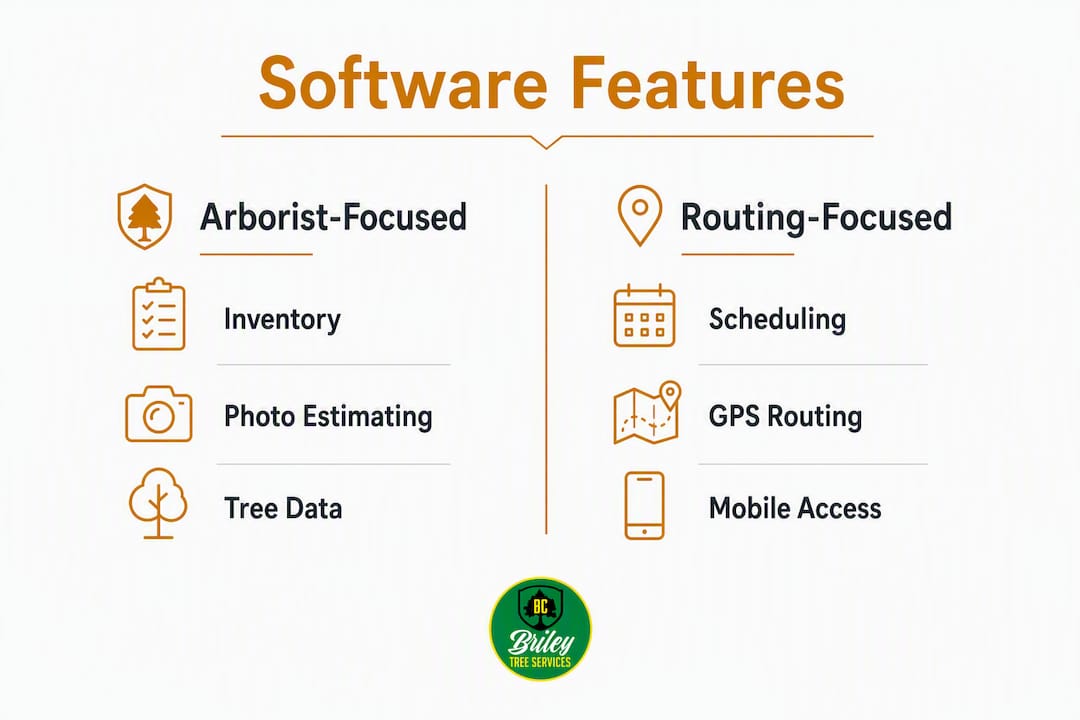
Pricing across all these platforms follows a subscription model, typically billed per user, per location, or as a flat monthly tier. Add-on modules (advanced reporting, GPS tracking, inventory management) increase costs. Before signing, confirm whether tree-inventory features, offline mobile access, and photo estimating are included in the base plan or priced separately. Most vendors offer a free trial or demo period. Use that window to run real jobs, not sample data.
Detailed reviews: which platform fits your operation?
ArboStar and Arborgold: built for arborists
ArboStar is the most tree-specific platform on this list. Its tree inventory module lets crews log species, condition ratings, and GPS coordinates for individual trees on a property. Photo and video estimating is built in, not bolted on. For companies doing large commercial contracts or municipal work where inventory documentation is required, this is a meaningful operational advantage. Pricing is subscription-based; exact tiers are not publicly listed, so confirm during a demo.
- Best for: Tree specialists with inventory-heavy workflows and photo-based estimating.
- Pros: Purpose-built arborist features, strong mobile app, jobsite photo capture.
- Cons: Steeper learning curve than general field-service tools; pricing requires direct inquiry.
Arborgold takes a broader business-management approach. It covers CRM, estimating, mapping, and scheduling in one platform, with modules designed around arborist workflows rather than generic field service. Companies that need to manage customer relationships alongside job production will find it more complete than ArboStar for that use case.
- Best for: Growing arborist companies that need CRM plus estimating and mapping.
- Pros: Arborist-focused modules, scalable, good mapping features.
- Cons: Feature depth can mean a longer onboarding period for smaller teams.
SingleOps: the job-costing choice
SingleOps stands out for production tracking and job costing. If you need to know whether a specific job made money after labor, equipment, and materials, SingleOps gives you that visibility. Mid-size companies running multiple crews on varied job types benefit most. It handles scheduling and dispatch well, though its tree-inventory features are less specialized than ArboStar or Arborgold.
- Best for: Companies with 5–25 employees that need profitability data by job.
- Pros: Strong job costing, production analytics, solid scheduling.
- Cons: Less tree-specific than ArboStar; inventory tools are more generic.
Jobber and Housecall Pro: simple and fast
Jobber is the go-to for single-owner operators and small crews. Setup is fast, the interface is clean, and it handles scheduling, invoicing, and basic mobile estimating without a steep learning curve. It does not offer native tree inventory or advanced routing, but for a two-person crew doing residential trimming and removal, those gaps rarely matter.
- Best for: Solo operators and crews under five people.
- Pros: Easy setup, reliable invoicing, good mobile app.
- Cons: Limited job costing, no native tree inventory.
Housecall Pro adds customer-facing automation and integrated payment processing. Customers can book online, receive automated reminders, and pay by card through the platform. For companies that want to reduce phone-tag and speed up collections, that workflow is a real operational gain. Routing is available but not as strong as dedicated route-optimization tools.
- Best for: Small-to-mid teams prioritizing customer communication and fast payments.
- Pros: Strong payment flows, customer self-service, clean mobile experience.
- Cons: Job costing is limited; routing is basic compared to Service Autopilot or RealGreen.
QuoteIQ: fast proposals from photos
QuoteIQ focuses on one thing: generating estimates quickly from photos taken on site. If your sales process depends on converting leads at the property visit, QuoteIQ speeds that step. It is not a full field-service management platform, so expect to pair it with a separate scheduling or invoicing tool.
- Best for: Operations where fast, photo-based proposals drive conversion.
- Pros: Fastest photo-to-quote workflow on the list.
- Cons: Limited scheduling, routing, and job costing; works best as a point solution.
ServiceTitan: enterprise scale
ServiceTitan is built for large, multi-location operations. Custom workflows, deep reporting, and a wide integration library make it the most capable platform here, but also the most complex and expensive. Small crews will find it over-engineered. For companies running 20-plus trucks across multiple markets, the reporting and workflow customization justify the investment.
- Best for: Large fleets and multi-location tree service businesses.
- Pros: Enterprise reporting, custom workflows, strong integrations.
- Cons: High cost, long implementation timeline, overkill for small operations.
Service Autopilot and RealGreen: route-first platforms
Both platforms are designed for businesses with recurring service routes. Service Autopilot handles recurring billing, route optimization, and customer communication for companies that run the same routes week after week. RealGreen covers similar ground with a focus on lawn, landscape, and tree businesses that need route density and recurring-contract management.
- Service Autopilot: Best for companies with high recurring-service volume and complex routing needs.
- RealGreen: Best for route-based businesses that also manage lawn and landscape alongside tree work.
Neither platform is tree-inventory-focused. If inventory and photo estimating are priorities, ArboStar or Arborgold will serve you better.
Zuper and WorkWave Service: flexible and routing-strong
Zuper is the most configurable option for mobile forms. If your crews need to capture custom field data (species notes, condition ratings, site hazards) without a tree-specific platform, Zuper's form builder can replicate much of that workflow. It is a general field-service tool, so tree-specific features require configuration rather than out-of-the-box support.

WorkWave Service delivers stable routing and territory scheduling for multi-user teams. It is a solid operational choice for companies that have outgrown Jobber but do not need the full complexity of ServiceTitan.
Pro Tip: Before your demo, map your three most common job types (for example: residential removal, commercial trimming, stump grinding) and ask each vendor to walk through those exact workflows. Generic demos hide gaps that show up on day one.
How do you choose the right tree-service management software?
Match the platform to your operational scale and tree-specific needs first. A solo operator does not need enterprise reporting. A company doing municipal tree inventories cannot function without a mapping and inventory module. Start there, then work through the criteria below.
Buyer checklist:
- Tree inventory and mapping — Can the platform log individual trees with GPS coordinates, species, and condition ratings?
- Photo and video estimating — Can estimators capture and attach photos to quotes from a mobile device in the field?
- Offline mobile app — Does the app function without a cell signal? Many job sites have poor coverage.
- Crew dispatch and crew sheets — Can dispatchers assign jobs to specific crew members and share job details digitally?
- Routing and GPS — Does the platform optimize daily routes, and does it track crew location in real time?
- Job costing and profitability reporting — Can you see labor, equipment, and material costs against revenue per job?
- Invoicing and integrated payments — Can customers pay by card through the platform, and does it sync with your accounting software?
- Integrations — Does it connect to QuickBooks, Xero, or your CRM without a manual export?
- Data ownership and backups — Can you export your customer and job data if you switch platforms?
- Security and support SLAs — What is the vendor's uptime commitment, and how fast do they respond to support tickets?
Ten questions to ask during a vendor demo:
- How does the platform handle tree inventory, and can I attach photos to individual tree records?
- Can estimators create a quote from a photo taken on a mobile device, without returning to the office?
- Does the mobile app work offline, and how does it sync when connectivity returns?
- How does crew dispatch work when a job changes scope on site?
- What does the routing engine do when a job is added or cancelled mid-day?
- Can I see job-level profitability, including labor hours and material costs, in a standard report?
- How does the platform handle recurring contracts and recurring billing?
- What accounting integrations are available, and how does the sync work?
- Who owns the data if I cancel, and how do I export it?
- What is your average response time for support tickets, and is phone support included?
Red flags to walk away from:
- Tree inventory is listed as a "coming soon" feature.
- The offline app requires a workaround or is not fully functional.
- Pricing for core features (routing, job costing) requires an add-on purchase.
- The vendor cannot demonstrate the platform on your actual job types during the demo.
Pro Tip: Run a 30-day pilot on one crew using real jobs, not sample data. Measure three things: time to create an estimate from a photo, crew adoption rate after two weeks, and time from job completion to invoice sent. Those three metrics will tell you more than any feature checklist.
How we picked and compared these alternatives
The selection process prioritized platforms that address tree-service workflows specifically, not generic field-service tools that happen to work for tree companies.
- Feature matrix review — Vendor documentation, product pages, and published feature lists were reviewed for tree-specific capabilities: inventory/map views, photo estimating, offline mobile, and crew dispatch.
- User review sampling — Published reviews on platforms such as Capterra's arborist software listings were reviewed for recurring complaints and strengths.
- Industry standards reference — ISA guidance on certified arborist services and preventative care informed which software features support inspection-led workflows.
- Exclusion rules — Platforms without mapping or inventory capabilities, or lacking a functional mobile estimating workflow, were deprioritized. General-purpose CRM tools with no field-service module were excluded entirely.
- Weighting — Tree-specific features (inventory, photo estimating, arborist workflows) were weighted above generic field-service features (basic scheduling, invoicing) when ranking options.
Pricing varies with company size, user count, and add-on modules. Confirm current pricing directly with each vendor during your demo. Published pricing changes frequently, and the figures that appear on review sites are often outdated.
What is the final recommendation by use case?
- Best overall for tree-specific workflows: ArboStar. Purpose-built inventory, photo estimating, and arborist workflows in one platform.
- Best for small crews and budget-conscious operators: Jobber. Fast setup, clean interface, and reliable invoicing without the complexity or cost of enterprise tools.
- Best for tree-inventory-heavy work: ArboStar or Arborgold. Both offer arborist-focused modules; ArboStar edges ahead on inventory depth, Arborgold on CRM and scalability.
- Best for enterprise fleets: ServiceTitan. Custom workflows, deep reporting, and the integration library to support large, multi-location operations.
- Honorable mention: SingleOps, for mid-size companies that need job costing and production analytics above all else.
Key Takeaways
The strongest tree-service software match depends on three factors: operational scale, whether tree inventory is a core workflow, and how your team estimates jobs in the field.
| Point | Details |
|---|---|
| Prioritize tree-specific features | Platforms built for arborists (ArboStar, Arborgold) outperform generic field-service tools for inventory and photo estimating. |
| Run a real-job pilot | Measure estimate creation time, offline reliability, and crew adoption rate after two weeks before committing. |
| Confirm pricing in demos | Published pricing is frequently outdated; add-on costs for routing, job costing, and inventory can significantly change the total. |
| Match scale to platform | Small crews fit Jobber or Housecall Pro; mid-size companies benefit from SingleOps; enterprise operations need ServiceTitan. |
| Brileytreeservice for North Louisiana | For tree removal, trimming, stump grinding, and emergency cleanup in Shreveport, Bossier City, and Ruston, Brileytreeservice provides licensed, insured, on-site service with a free estimate. |
What the feature lists miss about field software adoption
Software selection articles focus on features. The harder problem is adoption. A platform with a perfect tree-inventory module that your crew refuses to use on day three is worth nothing. The vendors that win in the field are the ones with the fastest path from "job created" to "estimate sent" to "invoice paid," with the fewest taps on a phone screen in poor cell coverage.
ArboStar and Arborgold are genuinely impressive for arborist workflows, but they require real onboarding investment. Jobber wins on adoption speed precisely because it does less. For a two-person crew doing residential work, that trade-off is often the right one. The mistake most buyers make is selecting the most feature-complete platform rather than the one their crew will actually use consistently.
There is also a gap between what software promises and what it delivers for tree-specific jobs. "Photo estimating" on a generic field-service platform often means attaching a photo to a note. On ArboStar, it means a structured workflow tied to a tree record. Those are not the same thing. Ask vendors to show you the exact workflow, not a slide about the feature.
Finally, consider what happens when a job changes scope on site. A storm-damaged tree that looked like a trim job turns into a full removal. The platforms that handle mid-job scope changes cleanly (updating the estimate, notifying dispatch, adjusting the invoice) save significant administrative time. That workflow question belongs in every demo.
Brileytreeservice: a direct alternative for North Louisiana properties
Software platforms manage the business of tree care. Brileytreeservice delivers the tree care itself. For property owners and managers in Shreveport, Bossier City, Ruston, and surrounding North Louisiana areas, Brileytreeservice provides tree removal, trimming and pruning, stump grinding, land clearing, forestry mulching, and 24/7 emergency storm cleanup. Every job is handled by a licensed and insured arborist team. Permit support and insurance claim assistance are included when needed.
The difference from hiring a software-managed contractor is straightforward: Brileytreeservice handles the job directly, with no platform intermediary. You get a free estimate, a clear scope, and a crew that cleans up after every job. For residential homeowners and commercial property managers who need reliable, professional tree care without coordinating through a third-party platform, contact Brileytreeservice for a free estimate and see what the team can do for your property.
Authoritative sources and further reading
Use these resources to support both your software evaluation and your broader tree-care decisions.
Industry and professional standards:
- TreesAreGood (International Society of Arboriculture) — ISA guidance on tree preservation options including pruning, cabling, bracing, and when removal is the right call. Supports inventory and inspection workflow requirements in software selection.
- Tree Care Industry Association (TCIA) — Industry standards, safety guidelines, and contractor credentialing for tree care professionals.
- Capterra — Arborist Software Listings — Published user reviews and feature comparisons for arborist and field-service platforms. Useful for cross-referencing vendor claims.
Tree care alternatives and DIY references:
- TreeMais — Biochar stump removal — Biochar can clear a stump in roughly three weeks; DIY material costs typically run $20–$60 per stump versus several hundred dollars for professional grinding. Species, climate, and moisture management affect results significantly.
- Pantree — community yard and tree coordination — Community-marketplace approach connecting property owners with local expertise; relevant for buyers evaluating lower-cost or hybrid service models.
Briley Tree Service blog resources:
- What Is Preventive Tree Care for Your Property — Explains ISA-certified arborist assessments and how regular diagnostics reduce emergency removals. Directly relevant to software buyers evaluating inspection and inventory workflows.
- Benefits of Professional Arborist Consultation Explained — Supports the case for integrating arborist inspection notes into software job records.
- How to Set Up a Recurring Tree Trimming Service — Operational guidance that pairs with recurring scheduling and billing features in field-service platforms.
- Top 5 budgettreeremovalservice.com alternatives 2026 — Related comparison article for buyers researching budget-focused tree service options.
Note: ISA and TCIA resources support tree-care decision-making and help define what inspection and inventory features software should support. Capterra and vendor demo sessions are the primary tools for software evaluation. For tree-health decisions on your property, consult a certified arborist before acting on any DIY method or removal alternative.