
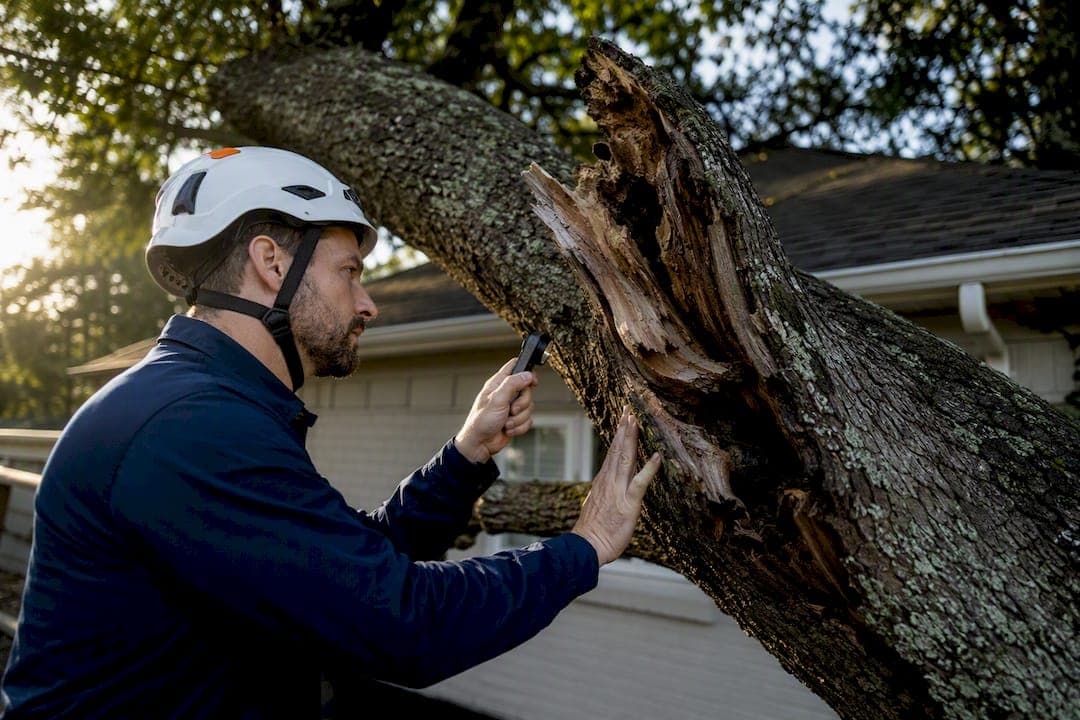
A credentialed, on-site arborist report is often the deciding piece of documentation insurers rely on to approve mitigation, tree retention, or claim payment. If your insurer flagged a tree or storm damage has already happened, schedule a Level 2 inspection with a certified arborist now,, using standards from the International Society of Arboriculture and Purdue Extension as your benchmark for what "insurer ready" actually means.
TL;DR:
- An insurer-ready arborist report must include credential details, precise measurements, visual evidence, and clearly identify the cause of damage or failure.
- Reports should follow recognized standards like ANSI A300 Part 9 or the CTLA Trunk Formula to ensure their findings are credible and defensible.
- Cost varies depending on the number of trees, access difficulty, and report complexity, with timely scheduling crucial to support claim approval.
- Homeowners should prioritize hiring arborists with ISA and TRAQ certification, professional liability insurance, and experience in insurance claims.
- Submitting a well-structured, standard-compliant report along with supporting photos and policy documents increases chances of claim acceptance and faster resolution.
Table of Contents
- When You Need an Arborist Report for Insurance Claims
- What a Competent Arborist Report Includes
- How to Hire a Qualified Arborist for an Insurance Report
- Cost and Timeline for an Insurance-Focused Arborist Report
- Submitting an Arborist Report to Your Insurance Company
- Sample Report Checklist for Homeowners
- Briley Tree Service and the Story Behind This Guide
- Why Most Homeowners Get the Documentation Backwards
- Get an Insurance-Ready Inspection Scheduled
- Sources
- FAQ
When You Need an Arborist Report for Insurance Claims
Not every tree situation calls for a formal report, but several common triggers make one necessary.
Insurers increasingly send demand letters based on aerial imagery, flagging trees they believe pose a risk to a structure. Those automated flags are often wrong. On-site inspections by a credentialed arborist regularly overturn hazards that satellite or drone screening misidentified, which is exactly why the insurer usually accepts a professional counter-assessment over its own aerial data.
Beyond insurer demands, you'll want a report when:
- Storm damage has already struck a structure and you need to document a covered peril before cleanup erases the evidence
- A city or parish permit process requires proof of condition before removing a protected or heritage tree
- You're applying for a variance or contesting a municipal tree ordinance decision
- You want a pre-loss appraisal on a high-value or specimen tree, so you have a documented baseline before anything happens
That last point matters more than most homeowners realize. A tree assessment report filed before a loss gives you something to compare against later, and insurers respond far better to a documented history than a report written in the panic of a claim.
What a Competent Arborist Report Includes
An insurance company doesn't reward vague opinions. It rewards documentation that mirrors accepted arboricultural methodology, because that's what a claims examiner can defend upward to a supervisor or, if it comes to that, to a court.
A report built for insurance purposes should contain:
- Author credentials, purpose, and scope. The report should state who wrote it, their certification number, and exactly what question the inspection answers.
- Tree identification and measurements. Species, diameter at breast height (DBH), height, and distance to the nearest structure, all recorded precisely, not estimated.
- Visual documentation. Dated photos and, where relevant, a sketch showing the tree's position relative to the structure or property line.
- Condition assessment and cause of failure. For damage claims, this section explains what caused the failure, whether it was decay, root failure, wind load, or something else, and whether that cause points to a covered peril.
- Risk rating with a defined timeframe. A likelihood-of-failure and likelihood-of-impact rating tied to a specific window, following the framework in ISA's annotated TRAQ sample report.
- Recommended scope of work. Removal, pruning, or monitoring, with fair-market pricing and, where a monetary claim is involved, appraisal figures based on CTLA trunk formula methodology.
Pro Tip: Ask the arborist to state the methodology by name in the report itself, phrases like "per ANSI A300 Part 9" or "using the CTLA Trunk Formula Method." That single sentence tells an adjuster the report follows a recognized standard, not a private opinion.
Well-prepared documentation of this kind is what most insurance claims processes expect as baseline evidence, and it's the difference between a report that gets read carefully and one that gets skimmed and denied.
How to Hire a Qualified Arborist for an Insurance Report
The credentials behind the signature matter as much as the words on the page. An ISA Certified Arborist is the baseline, but not every certified arborist holds the Tree Risk Assessment Qualification (TRAQ), and that distinction affects how much weight an insurer gives the findings.
Before you hire, ask directly:
- Do you hold ISA certification and TRAQ, and can you provide your credential numbers?
- Are you carrying professional liability insurance, and can you show proof?
- Do you also carry workers' compensation coverage for anyone climbing or operating equipment on my property?
- Can you send a sample report so I can see the format before I commit?
- Have you written reports used in insurance claims or municipal permit hearings before, and can you speak to how those turned out?
Pro Tip: If you're weighing removal against retention, hire a consulting arborist who has no financial stake in the removal job. An independent evaluation carries far more weight with an adjuster than one written by the same company that stands to profit from taking the tree down.
Purdue's extension guidance on appraisal and consulting standards backs this up directly: consulting arborists with liability coverage function as objective third parties, and their reports hold up better under dispute than assessments from a contractor with removal incentive.
Cost and Timeline for an Insurance-Focused Arborist Report
Price depends on what the insurer or permit office actually needs, and that scope varies more than most homeowners expect.
- Number of trees inspected. A single-tree risk assessment costs far less than a multi-tree property survey.
- Complexity of access. Trees requiring climbing gear, aerial lifts, or difficult terrain add labor cost.
- Type of report. A basic risk assessment is cheaper than a formal monetary appraisal using trunk formula methodology, which requires more documentation and calculation time.
- Turnaround speed. Emergency or fast-turn inspections after storm damage typically carry a premium over a scheduled, non-urgent visit.
A detailed breakdown of what drives tree risk assessment pricing walks through specific ranges by scope. What matters most for insurance purposes is timing: most policies impose a duty to mitigate further damage, so delaying an inspection can complicate a claim even when the underlying tree issue is legitimate. Get the report scheduled as soon as the hazard or damage is identified, not after you've already tried to negotiate with the adjuster over the phone.
Submitting an Arborist Report to Your Insurance Company
A strong report loses value if it's submitted poorly or without the right supporting documents. Build your claim package methodically.
- Assemble the full package. Include the arborist report, dated photos of the damage or hazard, any repair invoices, and the relevant excerpts from your policy that cover the peril in question.
- Walk the adjuster through the methodology. Reference the arborist's credentials and the standard used, ISA TRAQ or ANSI A300 Part 9, so the adjuster understands this isn't a casual opinion.
- Request re-inspection if the adjuster disputes the findings. You're entitled to ask for a second look, especially when the denial rests on an automated or aerial assessment rather than someone who walked the property.
- Address the denial reason directly. Most denials cite lack of maintenance, a pre-existing condition, or a peril the policy excludes. Your report's cause-of-failure section should speak to that exact issue with specifics, not generalities.
- Escalate if needed. If the adjuster still won't move, ask about mediation or request an independent appraisal, which many policies allow as a formal dispute step.
Adjusters are trained to control payouts, and a report lacking measurements, species identification, or a documented cause of failure gives them an easy reason to deny or lowball a claim. A detailed claim-filing guide covers the exact sequence for packaging documentation, and it's worth reading alongside your policy's coverage terms for tree removal before you submit anything.
If your claim involves damage to a structure, coordinating the arborist's findings with a restoration contractor's estimate can also speed up the adjuster's review, since it shows the two assessments align on cause and scope.
Sample Report Checklist for Homeowners
Before you accept a report as insurer-ready, run it against this list, adapted from ISA's sample formats and Purdue's appraisal guidance.
- Cover letter stating client, purpose, and date of inspection
- Stated inspection level (Level 1 limited visual, Level 2 basic assessment, or Level 3 advanced)
- DBH, height, and species clearly recorded
- Dated photographs showing the tree, defects, and proximity to structures
- A risk rating tied to a specific timeframe, not an open-ended warning
- A recommendation with at least one alternative to outright removal, where retention is feasible
- A monetary appraisal section, if the claim involves tree value, using trunk formula or replacement-cost methodology
| Report Element | What It Tells the Adjuster |
|---|---|
| Species and DBH | Confirms the tree's baseline value and typical failure patterns |
| Cause of failure | Links the damage to a specific, checkable mechanism |
| Risk rating and timeframe | Shows urgency without overstating the hazard |
| Recommended scope of work | Gives the adjuster a defensible action to approve |
A monetary appraisal is only necessary when the claim itself hinges on the tree's dollar value, storm loss of a specimen tree, for example. A basic risk assessment covers hazard disputes and permit questions where no valuation is at stake.
Briley Tree Service and the Story Behind This Guide
Professional tree care companies handle tree removal, trimming, stump grinding, land clearing, forestry mulching, and storm cleanup services across local regions. The team includes licensed, insured arborists who support homeowners through permit questions and insurance claim documentation, not just the physical work of taking a tree down.
This guide was written by Tatum, a contributor to the Briley Tree Service blog focused on translating arboriculture standards into steps homeowners can actually follow. The goal here wasn't to write another generic explainer. It was to map each report element back to how an adjuster actually reads it, so you're not guessing what "insurer ready" means when you're staring at a demand letter.
Why Most Homeowners Get the Documentation Backwards
Most advice on this topic treats the arborist report like a formality, something to grab quickly so the insurance paperwork has a signature attached. That's backwards. The report is the argument. Everything else in the claim package, the photos, the invoices, the policy excerpts, exists to support what the report already establishes.
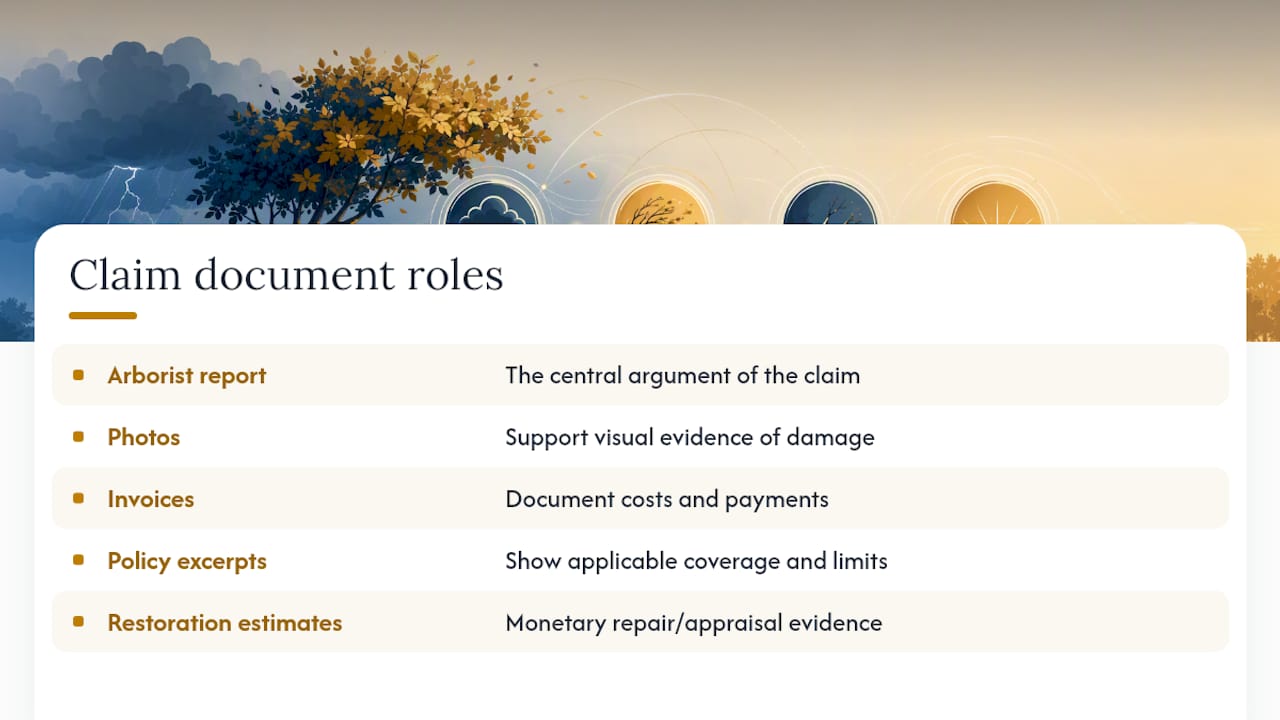
The bigger mistake I see in typical guidance is treating risk assessments and monetary appraisals as interchangeable. They're not. A risk assessment tells the insurer whether a tree is dangerous. An appraisal tells them what it's worth. Submitting the wrong one, or a report that blends both without clarity, gives an adjuster an easy reason to stall.
If you take one thing from this guide, prioritize credentials over price when you're hiring. A $150 report from someone without TRAQ or liability insurance will not carry the same weight as a $400 report that references ANSI A300 Part 9 by name. Insurers don't grade on effort. They grade on whether the paperwork matches a standard they recognize.
— Tatum
Get an Insurance-Ready Inspection Scheduled
Homeowners who need an on-site tree inspection rather than dealing with lengthy claims desk processes can contract a local licensed, insured team that handles inspections, documentation of condition and cause of failure, and coordinates any required removal or mitigation work, eliminating the need to locate separate contractors after the report.
If your insurer flagged a tree or storm damage already happened, the fastest path forward is a free estimate and an on-site look from a licensed, insured team. Contact Briley Tree Service today to schedule an inspection before your claim deadline closes in.
Sources
- Tree Appraisal and the Value of Trees (Purdue Extension)
- ISA sample reports (International Society of Arboriculture)
- TRAQ sample report (ISA annotated sample)
FAQ
How Much Does an Arborist Report Cost for an Insurance Claim?
Cost depends on scope. A single-tree risk assessment costs less than a multi-tree survey, and a formal monetary appraisal using trunk formula methodology costs more than a basic hazard assessment.
What Is an Arborist Report, Exactly?
An arborist report is a written, credentialed assessment of a tree's species, measurements, condition, and risk, prepared according to standards like ANSI A300 Part 9 for use in insurance claims, permits, or legal disputes.
What Does a Sample Arborist Tree Report Look Like?
ISA publishes annotated sample reports showing inspection level, measurements, photos, a risk matrix, and a final recommendation, which is the format most insurers expect to see.
What Insurance Should an Arborist Carry?
A credible arborist should carry professional liability insurance to protect the accuracy of their findings, plus workers' compensation coverage if their crew performs any climbing or removal work on your property.
Can Briley Tree Service Help With an Insurance-Related Arborist Report?
Yes. Briley Tree Service's licensed, insured arborists conduct on-site inspections and support homeowners through the documentation and permit process tied to insurance claims in the North Louisiana service area.