
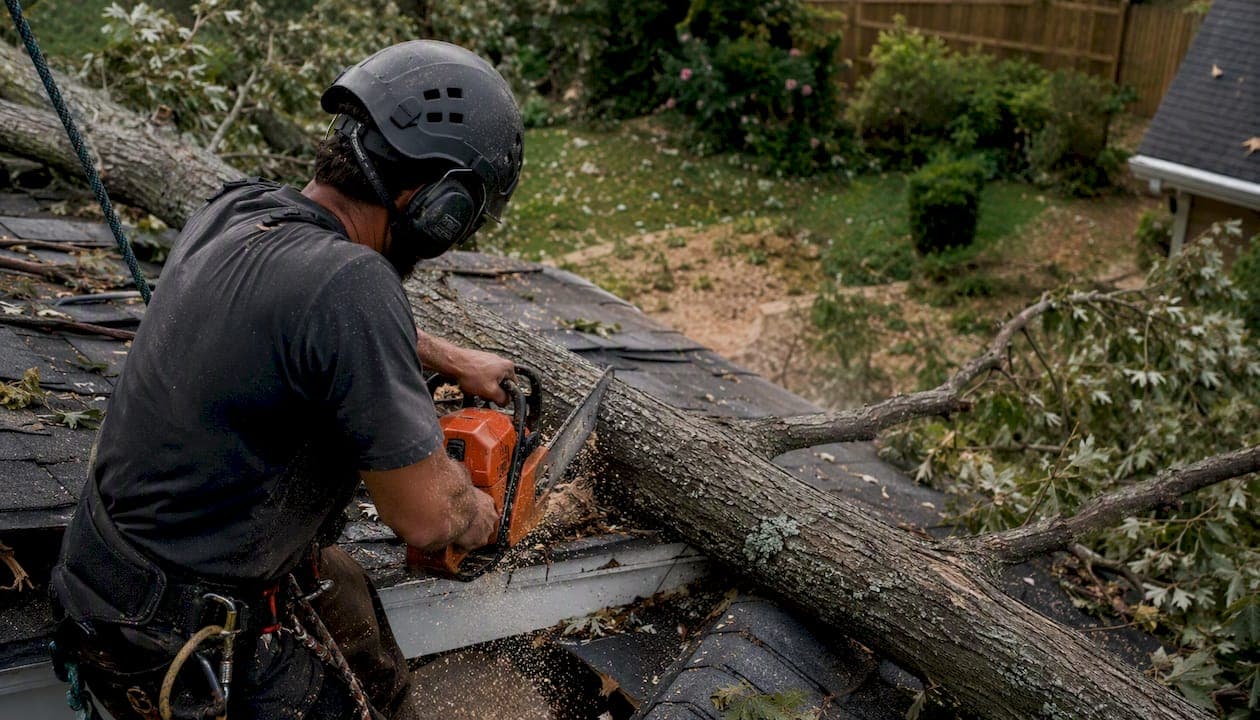
A standard U.S. homeowners policy typically covers structural damage when a tree falls on your home, garage, fence, or other covered structure — as long as a covered peril (wind, lightning, hail, or ice and snow) caused the fall. Three situations commonly lead to a denial: the tree fell because of rot, disease, or neglect; no insured structure was hit; or the loss stems from an excluded peril such as a flood or earthquake. The Insurance Information Institute confirms this framework, and FEMA operates under separate public-assistance rules that rarely cover private-property tree removal. Brileytreeservice works with homeowners in North Louisiana through every step of this process, from emergency cleanup to arborist documentation.
- Covered perils: wind, lightning, hail, ice, snow
- Common denials: neglect/rot, no structure hit, excluded perils
- FEMA does not generally reimburse private-property tree removal
Key Takeaways
A standard homeowners policy covers tree-fall damage to insured structures caused by wind, lightning, or hail, but denials follow neglect, rot, or no structure being hit.
| Point | Details |
|---|---|
| Document before any cleanup | Photograph the root plate, trunk base, and impact zone from multiple angles before cutting begins. |
| Removal cap is typically $500–$1,000 | Most policies limit tree removal reimbursement per event; check your declarations page for the exact figure. |
| File with your own insurer first | Ownership of the tree does not change your filing obligation; your insurer handles subrogation later. |
| Weigh deductible before filing | For losses near or below your deductible, paying out of pocket avoids a potential premium increase at renewal. |
| Brileytreeservice supports your claim | The licensed, insured crew provides arborist reports and itemized invoices that support insurer reimbursement in North Louisiana. |
Table of Contents
- What homeowners insurance typically covers after a tree falls
- Common exclusions and why insurers deny tree-damage claims
- Step-by-step: what to do from the storm to the claim payout
- When a neighbor's tree falls on your property — who pays?
- How insurers handle debris removal fees and policy limits
- When to call a professional tree service or arborist
- How deductible and policy limits affect payouts
- Tips for negotiating with adjusters and handling a denied or undervalued claim
- Common pitfalls to avoid during the claims process
- Role and benefits of hiring a public adjuster
- What the claims process looks like from the field
- Brileytreeservice handles emergency cleanup and insurer documentation
- Sources
What homeowners insurance typically covers after a tree falls
Your policy is divided into coverage sections, and each one handles a different part of a tree-fall loss.
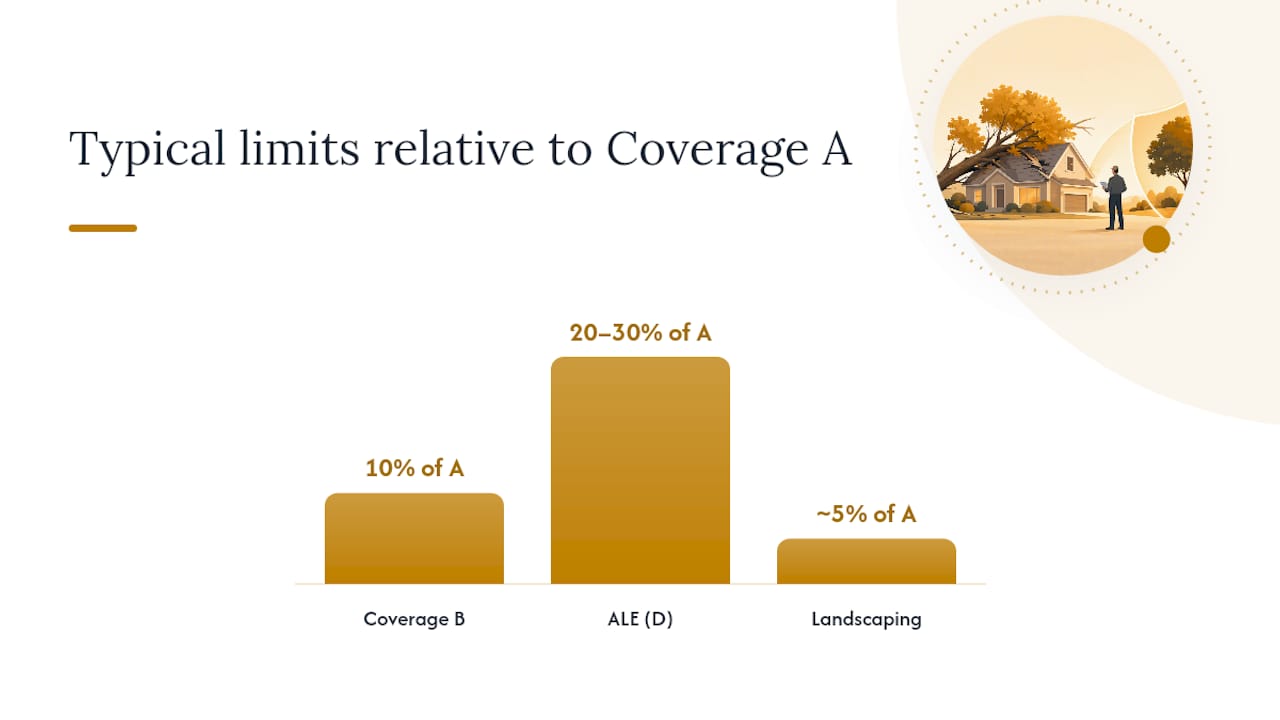
Dwelling (Coverage A) pays for damage to the home itself: roof punctures, broken rafters, crushed walls. Other Structures (Coverage B) covers detached garages, fences, and sheds. Personal Property (Coverage C) applies when the tree crushes a room and damages furniture or electronics inside. Additional Living Expenses (Coverage D or ALE) covers hotel and meal costs if the home is uninhabitable while repairs are underway.
Tree removal is a separate line item. According to the III, insurers commonly cap removal reimbursement at roughly $500–$1,000 per event, and landscaping coverage is often limited to about 5% of your Coverage A limit. GEICO's consumer guidance echoes this: removal is covered when a covered peril causes a tree to hit an insured structure, but preventive removal and routine maintenance are not.
Quick scenario: A windstorm drops a 40-foot oak onto your roof. Your Coverage A limit is set with a deductible. Roof repairs cost a certain amount and removal costs may approach or exceed the deductible. Your payout will be the repair cost minus the deductible and subject to your policy's removal cap.
| Loss Item | Policy Section | Typical Limit |
|---|---|---|
| Roof and wall repairs | Coverage A (Dwelling) | Policy limit minus deductible |
| Detached garage or fence | Coverage B (Other Structures) | Usually 10% of Coverage A |
| Furniture or electronics damaged inside | Coverage C (Personal Property) | Policy sublimit |
| Hotel costs while uninhabitable | Coverage D (ALE) | Usually 20–30% of Coverage A |
| Tree removal (structure hit) | Debris removal sublimit | Typically capped at a limited amount per event |
| Landscaping replacement | Landscaping sublimit | Often ~5% of Coverage A |
State consumer guidance reinforces filing with your own insurer first, regardless of which tree fell or who owns it.
Common exclusions and why insurers deny tree-damage claims
Insurers apply a "sudden and accidental" standard. A tree that snaps in a 70 mph wind meets it, but a tree that slowly rotted over three years and finally toppled on a calm day usually does not. Treelaws that rot, disease, and neglect are the most common grounds for denial, because the insurer treats the loss as a foreseeable maintenance failure rather than a sudden event.
Common exclusion reasons:
- Neglect or deferred maintenance: visible rot, hollow trunk, or known lean that the homeowner did not address
- Pre-existing damage: decay or pest infestation documented before the storm
- Excluded perils: flood, earthquake, or mudslide (these require separate policies)
- No structure hit: a tree that falls in the yard without touching any insured structure is generally not covered for removal
- Preventive work: elective removal of a healthy tree is not reimbursable
Homeowner self-check before the next storm: Walk your property and note any tree showing visible rot at the base, a significant lean toward the house, a hollow trunk, exposed or heaving roots, or dead limbs in the upper canopy. Addressing these proactively also reduces your denial risk. Regular trimming is one of the most direct ways to keep a future claim defensible.
Pro Tip: If your insurer questions whether the tree was already diseased, order an independent arborist assessment immediately. An arborist's written report distinguishing storm-fail characteristics from pre-existing rot can be the difference between a paid claim and a denial.
Step-by-step: what to do from the storm to the claim payout
The first 48 hours after a tree falls set the foundation for your claim. Work through these steps in order.
- Confirm safety first. If a downed line is involved, call your utility company before anyone approaches the tree. Recognize types of emergency tree situations that require immediate professional response.
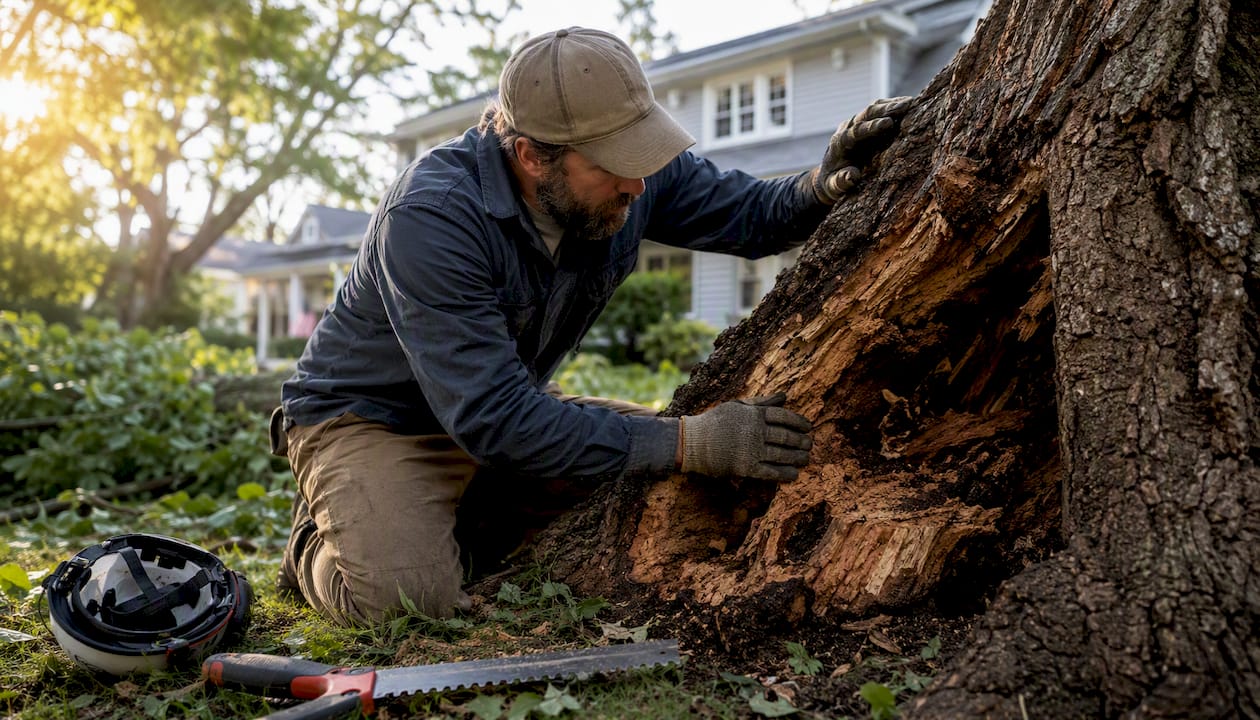
- Document everything before cleanup. Photograph the full scene from multiple angles: the fallen tree, the point of impact, the root plate, and any visible decay. Shoot video as well. Record the date and time on each file.
- Make temporary repairs to prevent further damage. Tarp exposed roofing, board broken windows, and place buckets under active leaks. Save every receipt. Documenting roof damage thoroughly at this stage strengthens your position with the adjuster.
- Call your insurer to open a claim. Most carriers have 24-hour claim lines. Provide your policy number, a brief description of the damage, and your contact information. Ask for a claim number immediately.
- Request a licensed tree service for a written estimate. Get at least two estimates. Ask each contractor for proof of insurance and a written scope of work before signing anything.
- Meet the adjuster with your documentation ready. Walk the adjuster through the damage with your photos and any contractor estimates in hand. Point out the root plate and trunk base.
- Compare the adjuster's estimate to your contractor quotes. If the insurer's figure is lower, submit the contractor estimates and request a re-inspection or a supplemental review.
- Track the timeline. Most states require insurers to acknowledge a claim within 10–15 days and issue a decision within 30–45 days, though timelines vary by state law and claim complexity.
Mitigation checklist:
- Tarp or board any opening in the structure within 24 hours
- Keep all receipts for emergency materials (tarps, plywood, fasteners)
- Photograph mitigation work before and after
- Do not discard any debris until the adjuster has inspected
Bankrate advises weighing the repair cost against your deductible and the likely premium impact before filing. For a $900 removal job with a $1,000 deductible, paying out of pocket is often the smarter move.
When a neighbor's tree falls on your property — who pays?
File with your own insurer first. The Insurance Information Institute and state consumer guidance both confirm that tree ownership does not change your initial filing obligation. Your insurer pays your covered losses, then may pursue subrogation against the neighbor's carrier if negligence can be shown.
Evidence that tends to establish neighbor negligence:
- A written notice you sent the neighbor about a visibly dangerous or diseased tree (keep a copy)
- An arborist report documenting rot or structural failure that predated the storm
- Photographs of visible decay taken before the tree fell
- Any prior complaints to the municipality or HOA about the tree
Pursuing the neighbor directly vs. letting insurers handle it: Small claims court is an option for losses below your state's threshold (often $5,000–$10,000), but it requires you to prove negligence yourself. Letting your insurer handle subrogation is simpler: they absorb the legal effort, and if they recover funds, your deductible may be refunded. The tradeoff is that subrogation can take months or longer to resolve.
How insurers handle debris removal fees and policy limits
Tree removal costs and debris hauling are covered when a covered peril causes a tree to strike an insured structure. When no structure is hit, removal is generally not covered, with two narrow exceptions: the fallen tree is blocking a driveway or doorway required for access, or it is blocking a handicap ramp. GEICO's guidance notes these access-blocking exceptions explicitly.
| Removal Scenario | Typically Covered? |
|---|---|
| Tree hits the house or attached structure | Yes, up to policy cap |
| Tree hits detached garage or fence | Yes, up to policy cap |
| Tree falls in yard, no structure hit | Generally no |
| Tree blocks only driveway or access ramp | Sometimes, check policy |
| Stump grinding after covered removal | Rarely; usually excluded |
| Preventive removal of healthy tree | No |
FEMA and private-property removal: FEMA's public assistance program is not a substitute for homeowners insurance. FEMA appeal decisions have denied private-property limb removal costs when applicants could not demonstrate a public-interest justification. FEMA eligibility guidance uses specific hazard criteria, such as a trunk diameter of at least 6 inches measured at 4.5 feet above grade, a split trunk, broken canopy, or excessive lean, to screen trees for public-assistance removal. If you receive both FEMA assistance and an insurance payout for the same loss, FEMA requires you to credit the insurance proceeds to avoid a duplication of benefits.
Pro Tip: Stump grinding is almost always excluded from insurance reimbursement. If your insurer covers the tree removal itself, ask your contractor to itemize the stump grinding separately on the invoice so the covered removal cost is clearly distinct and not reduced by the excluded line item.
When to call a professional tree service or arborist
An arborist's role after a tree fall goes beyond cutting wood. A licensed arborist can assess whether remaining trees are structurally sound, identify the cause of the fall, and produce a written report that carries weight with adjusters.
Arborist deliverables that strengthen a claim:
- A cause-of-fall report distinguishing storm failure from pre-existing rot or disease
- Photographs of the root plate, trunk cross-section, and canopy break point
- Written safety recommendations for remaining trees on the property
- An itemized estimate separating covered removal from non-covered work
Contractor checklist before you sign anything:
- Verify current liability insurance and workers' compensation certificates
- Confirm ISA (International Society of Arboriculture) certification or equivalent credential
- Get a written, itemized estimate before work begins
- Ask who handles permit applications if required by your municipality
- Read any Right-of-Entry form carefully before signing
- Confirm the cleanup scope in writing (chip, haul, or leave wood)
Understanding arborist certification helps you verify credentials quickly. Also review tree service insurance requirements so you know exactly what certificates to request.
Storm-chaser warning signs: unsolicited door-knocking immediately after a storm, pressure to sign before your insurer has inspected, requests for large cash deposits upfront, and no local business address. A legitimate contractor welcomes your questions and provides documentation without hesitation.
How deductible and policy limits affect payouts
Your deductible comes off the top of every claim. If your dwelling deductible is $2,500 and the adjuster values the damage at $3,000, your payout is $500. For many tree-fall events, that math makes filing pointless.
Some policies carry a separate wind or hurricane deductible, often expressed as a percentage of Coverage A rather than a flat dollar amount. A 2% wind deductible on a $250,000 home equals $5,000 out of pocket before the insurer pays anything. Homeowners in storm-prone states, including Louisiana, should check their declarations page specifically for this figure.
Policy limits cap the total payout. If your Coverage A limit is $200,000 and the structural damage plus removal totals $210,000, you absorb the $10,000 gap. Carrying replacement-cost coverage rather than actual cash value coverage closes that gap for most residential losses, because actual cash value policies depreciate the payout based on the structure's age.
Bankrate's analysis adds another variable: filing a claim can trigger a premium increase at renewal. For losses close to your deductible, paying out of pocket preserves your claims-free discount.
Tips for negotiating with adjusters and handling a denied or undervalued claim
Adjusters work for the insurer, but they are not adversaries by default. Preparation is your strongest tool.
Bring your own contractor estimates to the adjuster inspection. If the insurer's estimate is lower, submit the contractor quotes in writing and ask for a line-by-line explanation of the difference. Insurers use estimating software (Xactimate is the industry standard) that sometimes undervalues local labor rates. A written rebuttal citing local contractor pricing often prompts a supplemental payment.
If a claim is denied, request the denial in writing with the specific policy exclusion cited. Review that language against your actual policy. Insurers sometimes cite the wrong exclusion or apply it incorrectly. A professional arborist consultation that contradicts the insurer's cause-of-loss finding is grounds for a formal appeal.
For a denied or significantly undervalued claim, your options in order of escalation: written appeal to the insurer, complaint to your state insurance department, hiring a public adjuster, or retaining an attorney specializing in property insurance disputes.
Common pitfalls to avoid during the claims process
Most claim problems are self-inflicted and preventable.
Cleaning up before documenting is the single most common mistake. Once debris is removed, the adjuster has no physical evidence of the cause or extent of damage. Photograph everything first, including the root plate and trunk base, before any chainsaw touches the tree.
Signing a contractor's assignment of benefits (AOB) form transfers your claim rights to the contractor. This is legal in some states but removes your control over the settlement. Read every form before signing.
Missing the filing deadline is another avoidable error. Most policies require prompt notice, and some states set a hard deadline of one to two years from the date of loss. Filing late gives the insurer grounds to deny on procedural grounds alone.
Discarding receipts for emergency repairs eliminates reimbursable costs. Tarps, plywood, and labor for temporary boarding are all recoverable if documented. Keep every receipt in a dedicated folder, physical or digital.
Accepting the first estimate without comparison leaves money on the table. Always get at least two contractor quotes and compare them to the adjuster's figure before accepting a settlement.
Role and benefits of hiring a public adjuster
A public adjuster is a licensed professional who represents the homeowner, not the insurer. They assess the damage independently, prepare the claim documentation, and negotiate directly with the insurer's adjuster on your behalf.
Public adjusters typically charge a percentage of the final settlement, commonly 10–15%, though state regulations cap fees in many jurisdictions. For large or complex claims, that fee is often recovered through a higher settlement than the homeowner would have negotiated alone.
The strongest cases for hiring one: the insurer's initial estimate is significantly lower than contractor quotes; the claim involves multiple damage types (roof, structure, contents, ALE) that are difficult to document without expertise; or the claim has already been denied and you are preparing an appeal. For straightforward, well-documented claims with a cooperative adjuster, a public adjuster may not add enough value to justify the fee.
What the claims process looks like from the field
Storm calls reveal a consistent pattern: homeowners who document before cleanup and call a licensed tree service within 24 hours consistently have smoother claim outcomes than those who wait. Two actions within the first 72 hours make the biggest difference.
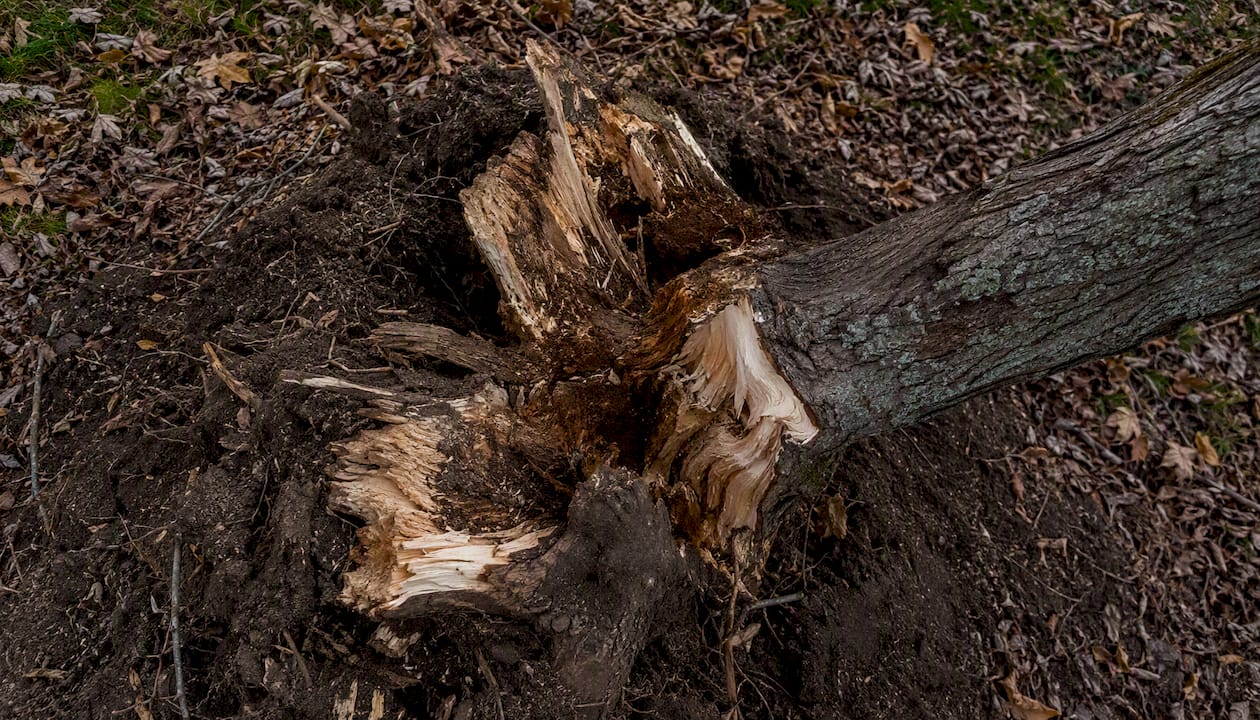
First, photograph the root plate and trunk base from at least four angles before any cutting begins. The root plate is where adjusters and arborists look for evidence of pre-existing rot versus storm-caused failure. Once the tree is cut and hauled, that evidence is gone.
Second, do not remove debris from the impact zone until the adjuster has physically inspected the site. Temporary mitigation (tarping, boarding) is expected and reimbursable. Full cleanup before inspection is not.
Brileytreeservice handles emergency cleanup and insurer documentation
After a storm drops a tree on your property in Shreveport, Bossier City, Ruston, or anywhere across North Louisiana, the first call that matters is to a licensed, insured crew that can respond fast and document correctly.
Brileytreeservice provides 24/7 emergency storm cleanup, written arborist cause-of-fall reports, itemized invoices formatted for insurer reimbursement, stump grinding, debris hauling, and permit support. The team arrives with the documentation homeowners need: photographs of the root plate and trunk, a written assessment of remaining tree hazards, and a line-item estimate that separates covered removal from non-covered work. That paperwork protects your claim. Request a free estimate and get a licensed crew on-site with the documentation your insurer expects.
Sources
These primary sources cover the rules, limits, and processes discussed throughout this article.
- How to File a Tree Damage Insurance Claim (Step-by-Step)
- Public interest: private property debris removal (FEMA appeal decision)
- Emilms
- Does Homeowners Insurance Cover Tree Removal? | GEICO
- Fallen Tree (Maryland Insurance Administration)
- Will tree damage be covered by your home insurance? | Bankrate