
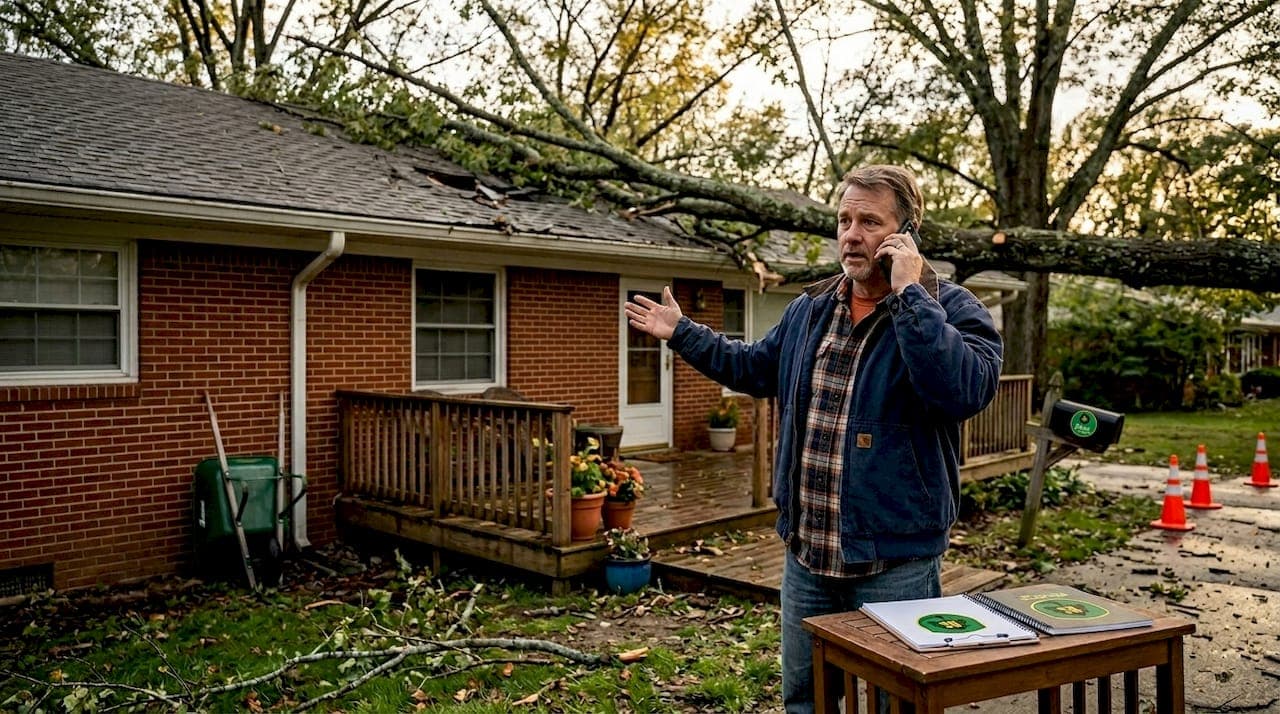
A fallen tree at 2 a.m. is not the time to start researching your options. Understanding what is tree emergency response before disaster strikes puts you in control. Tree emergencies cover everything from a storm-toppled oak blocking your driveway to a half-split limb hanging over your roof after high winds. Some situations demand immediate action. Others can wait for a scheduled crew. Knowing the difference protects your family, your property, and your wallet. This guide breaks down what qualifies as a genuine tree emergency, how professionals respond, and what you should do while you wait.
Table of Contents
- Key Takeaways
- What counts as a tree emergency
- How professional emergency tree services respond
- Safety steps for homeowners during tree emergencies
- Insurance, costs, and what to expect after an emergency
- How to prepare before the next tree emergency
- My take on tree emergencies after years in this field
- Get fast, professional emergency tree help
- FAQ
Key Takeaways
| Point | Details |
|---|---|
| Not every damaged tree is an emergency | Prioritizing by actual risk saves money and can preserve trees that would otherwise be removed. |
| Professional response is fast | Certified crews can dispatch within 1 to 2 hours for high-hazard situations. |
| DIY storm cleanup is dangerous | Storm cleanup injuries and fatalities are common; leave technical work to trained professionals. |
| Insurance often covers tree damage | Coverage applies in many situations, but specific exclusions depend on your policy. |
| Prevention reduces risk significantly | Regular professional tree inspections catch structural problems before storms turn them into crises. |
What counts as a tree emergency
Not every broken branch or leaning trunk triggers an emergency call. A tree emergency is any situation where a tree or its parts create an immediate, unacceptable risk to people, structures, utilities, or public access. That definition matters because it draws a clear line between what needs a crew tonight and what can be scheduled next week.
The most common scenarios that qualify as genuine tree emergencies include:
- A tree that has fully fallen on a structure, vehicle, or roadway
- Large limbs hanging partially broken overhead, sometimes called "widow makers" because they drop without warning
- A tree that has uprooted and is leaning against a building or power line
- Visible trunk splits or major cracks after a storm, especially on large trees near occupied areas
- A tree with extensive root exposure that is visibly shifting toward a structure
Typical causes include severe thunderstorms, high winds, ice loading, and underlying structural weakness from disease or rot. Louisiana and Northwest Louisiana in particular see intense storm seasons that produce all of these conditions regularly.
The risks go beyond the obvious. A tree leaning on a power line is a fire and electrocution hazard. A blocked driveway can prevent emergency vehicle access. Saturated soil after heavy rain makes even previously stable trees unstable. Not every storm-damaged tree requires immediate removal, but the ones that pose active risks to life or property do.
Warning signs to watch for even before a storm:
- Visible cracks running vertically down the trunk
- Sections of bark that are dead or missing on one side
- Mushroom growth at the base, which signals internal decay
- Roots that are lifting pavement or pulling away from the soil
- Any large tree that has noticeably shifted its lean over a period of weeks
Catching these early lets you address the problem on your schedule rather than at midnight in a thunderstorm.
How professional emergency tree services respond
Speed matters in a tree emergency, but precision matters more. Professional emergency tree care is not just about showing up fast. It follows a structured process designed to eliminate hazards safely while minimizing additional damage to your property.
Here is how a qualified emergency crew typically works through a job:
- Rapid dispatch. Emergency providers dispatch teams within 1 to 2 hours for high-priority hazards. Many reputable companies now offer 24/7 availability including nights and holidays, which has become a standard expectation in storm-prone regions.
- Hazard assessment. The crew evaluates the full scope of the situation. They identify what is structurally compromised, what threatens power lines or structures, and what can be stabilized versus what must come down immediately. This step determines the work sequence.
- Prioritization. Not all damage gets addressed in the same order. Immediate threats to life and power come first. Secondary damage, like scattered debris or minor limb breakage, gets handled after the primary hazard is cleared.
- Technical removal or trimming. Depending on the situation, crews use rigging systems, bucket trucks, and chainsaws to remove or trim trees safely. Emergency services focus on eliminating dangers to life, property, and public safety before anything else.
- Debris cleanup. A professional job includes clearing and hauling debris. Leaving a pile of logs and branches is not a finished job in emergency tree care.
ISA-certified arborists bring documented technical knowledge for complex rigging and removal work that standard laborers simply do not have. When you are hiring for an emergency, ask whether the crew includes a certified arborist, not just a chainsaw operator.
Pro Tip: Ask any emergency tree service whether they own their equipment outright. Companies that rely on subcontractors for heavy equipment can face delays and complications, especially during widespread storm events when every crew in the region is booked.
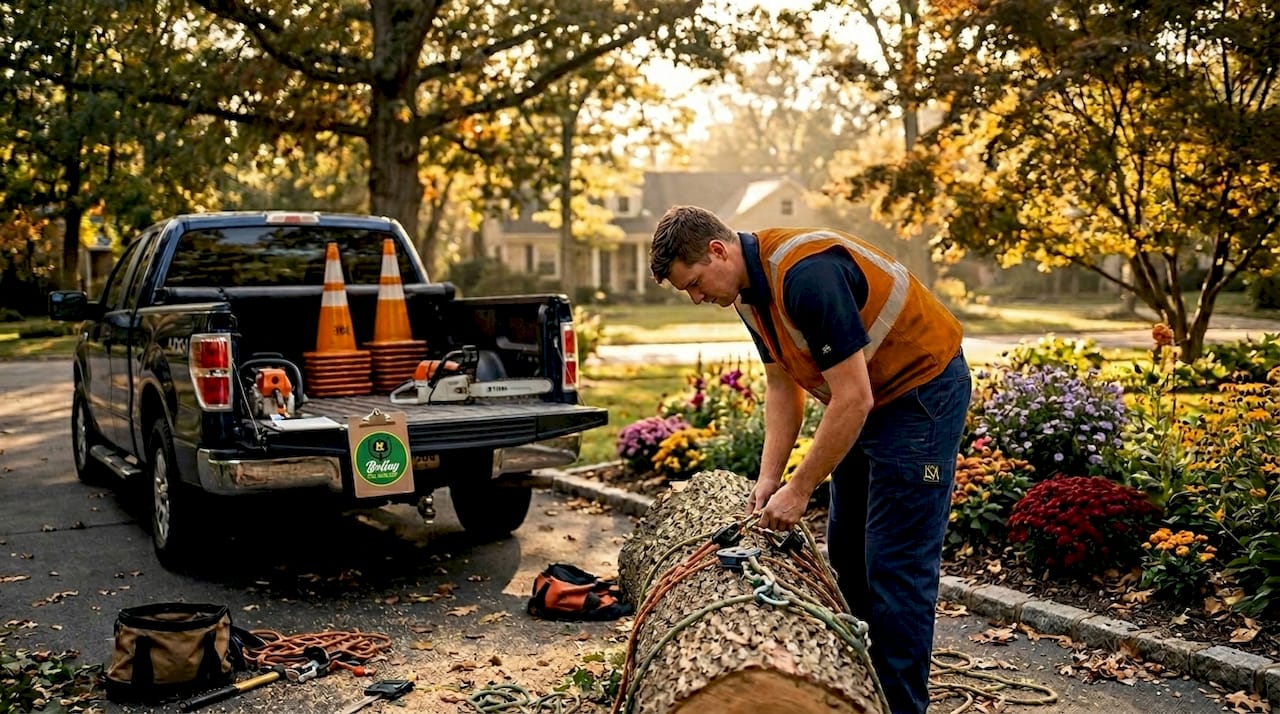
Choosing a company with its own equipment and full liability insurance also simplifies your insurance claim process. Own-equipment providers streamline both the work and the paperwork.
Before you call anyone, review this tree service hiring checklist so you know exactly what questions to ask.
Safety steps for homeowners during tree emergencies
Your first priority in any tree emergency is to get yourself and everyone else away from the affected area. That sounds obvious, but homeowners frequently underestimate the secondary hazards still present after the initial damage.
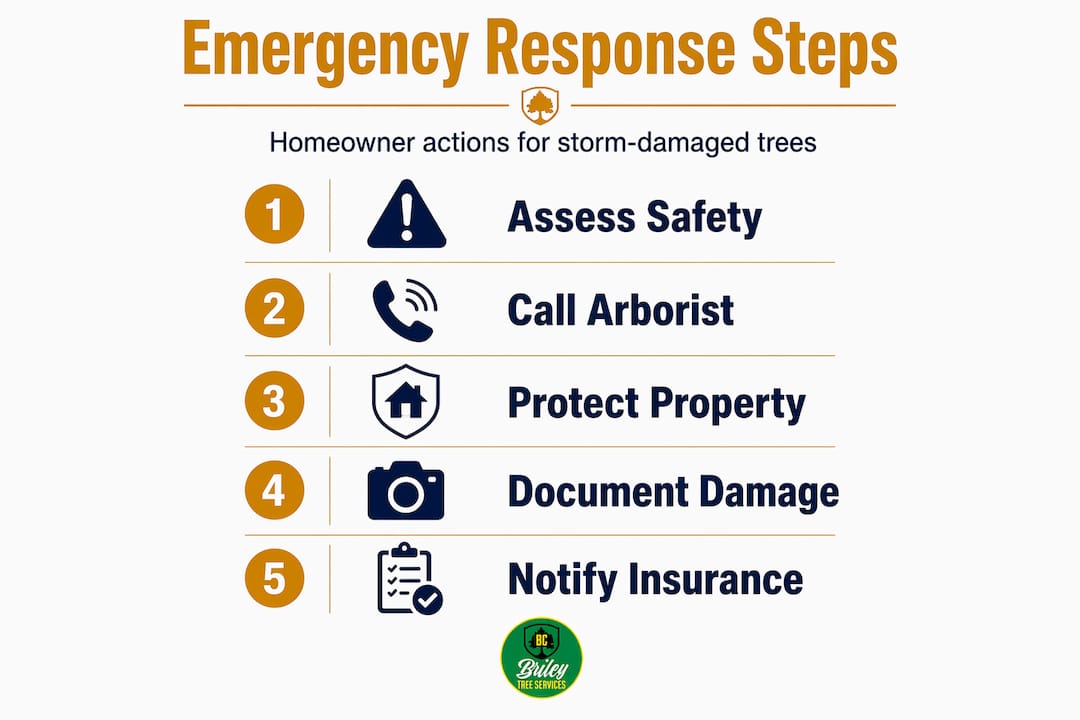
Here is what you should and should not do before the crew arrives:
- Stay back from the fallen tree. Tension in broken wood can cause sections to shift suddenly. A tree that looks stable may not be.
- Do not attempt DIY removal. Storm cleanup injuries are a leading cause of post-storm fatalities. Chainsaws under tension, unstable logs, and overhead hazards create conditions that injure experienced workers. For homeowners, the risk is even higher.
- Secure the perimeter. Use rope, cones, or furniture to block off the hazard zone. If the tree is blocking a street or driveway, contact your local city or county.
- Document everything. Photograph the damage before anything is moved. You need this for your insurance claim.
- Contact your utility company if power lines are involved. Power line hazards require line-clearance arborists coordinating directly with utility companies. Do not let any tree service crew touch a downed line without utility company involvement first. For more on what this process looks like, see trimming near power lines safely.
Pro Tip: Treat any downed power line as live, even if the lights in your house are off. Electricity can still be present. Keep a 30-foot clearance and call your utility company immediately.
Property managers dealing with multiple trees across a large site have additional responsibility. The best practice for commercial properties is to have a written emergency contact list and a designated area coordinator who knows the protocol before any storm hits.
Insurance, costs, and what to expect after an emergency
The financial side of a tree emergency catches many homeowners off guard. Understanding how coverage and costs work before an event helps you avoid surprises.
| Scenario | Typically Covered | Notes |
|---|---|---|
| Tree falls on your house | Yes | Homeowners insurance usually covers damage and debris removal when a tree hits a structure. |
| Tree falls in your yard without hitting anything | Often not covered | Debris removal alone may not be reimbursed. |
| Neighbor's tree falls on your property | Your policy applies | You typically file with your own insurer, not your neighbor's. |
| Fallen tree blocks access only | Partial or no coverage | Coverage depends on your specific policy language. |
| Tree falls due to neglect | May be denied | If the tree was visibly diseased and ignored, insurers can deny the claim. |
Cost factors for urgent tree services vary based on tree size, location, time of day, equipment required, and the complexity of access. Emergency rates are always higher than scheduled work. You are paying for availability, speed, and specialized equipment.
Understanding your policy's nuances before filing a claim can prevent unexpected expenses. Call your insurer as soon as it is safe to do so and get a claim number before any removal work begins. Most policies require this step to guarantee reimbursement.
If storm damage also affects your roof, temporary protection matters before permanent repairs are completed. Emergency roof tarping can prevent water intrusion while you coordinate the full scope of repairs.
How to prepare before the next tree emergency
The best tree emergency response is the one you almost never need. Proactive tree care reduces the likelihood that a storm turns a tree problem into a crisis.
Here are practical steps to take now:
- Schedule an annual tree inspection. A certified arborist can identify structural weakness, disease, and root problems before they become hazards. This is especially worth doing before storm season in Louisiana.
- Prioritize trees over structures. Any tree within falling distance of your home, vehicle, or power line deserves close attention. Size and proximity together determine risk, not size alone.
- Remove dead wood regularly. Dead branches do not need a storm to fall. Regular trimming eliminates the most common source of sudden tree damage. Review what homeowners should know about professional tree service scope before booking maintenance work.
- Create a simple emergency contact list. Write down your tree service number, utility company number, and insurance claim number. Post it somewhere accessible before you need it at 11 p.m. in a thunderstorm.
- Watch for warning signs after storms, not just during them. Root damage from saturated soil often appears days after heavy rain as visible soil movement or new leaning.
A staged approach recommended by arborists separates trees requiring immediate removal from those that can be monitored and managed over time. This distinction saves trees and reduces unnecessary costs.
My take on tree emergencies after years in this field
I have seen homeowners spend twice as much money as necessary because they panicked and demanded full tree removal on trees that could have been saved with proper trimming and monitoring. I have also seen the opposite: families who waited too long on a leaning tree because they assumed it would hold. Neither extreme serves you well.
What I have learned is that the best outcome comes from a calm, fast assessment rather than a rushed reaction. Call a professional quickly, yes. But choose one who will give you an honest evaluation, not just quote you a removal because it is the highest-ticket job. A reputable arborist will tell you when a tree can be saved. A less reputable one will not.
I also think homeowners underestimate how much their own preparation matters. A 15-minute annual walkthrough of your property with a trained eye does more to prevent tree emergencies than any reactive response plan. The trees that cause the worst emergencies are usually ones that showed warning signs for months or years.
My recommendation on choosing a service provider: look for full liability insurance, ISA certification, and the ability to respond with their own equipment. Those three factors separate capable emergency crews from ones that will leave you waiting.
— Tatum
Get fast, professional emergency tree help
When you need urgent tree services in Northwest Louisiana, Brileytreeservice is ready to respond. The team serves Shreveport, Bossier City, and surrounding areas with certified emergency tree care for residential and commercial properties.
Brileytreeservice handles fallen tree removal, hazardous limb trimming, debris cleanup, and storm tree response. The crew shows up with the right equipment, handles the job safely, and cleans up completely before leaving. Free estimates are available, and the team is equipped to respond when you need it most. Do not wait on a hazardous tree. Contact Brileytreeservice today.
FAQ
What is tree emergency response?
Tree emergency response is the immediate professional assessment and removal or stabilization of trees that pose active risks to people, property, utilities, or access. It covers fallen trees, hanging limbs, uprooted roots, and other storm or structural damage requiring urgent action.
How quickly does an emergency tree crew arrive?
Most professional emergency tree services dispatch within 1 to 2 hours for high-priority hazards, with many companies offering 24/7 availability including nights and holidays.
Does homeowners insurance cover emergency tree removal?
Insurance typically covers damage and debris removal when a tree falls on a structure, but coverage for trees that fall in the yard without hitting anything is often excluded. Always check your specific policy and call your insurer before removal begins.
Should I try to remove a fallen tree myself?
No. Storm cleanup DIY attempts are a documented cause of serious injury and death. Tension in broken wood, unstable ground, and overhead hazards make this work dangerous even for experienced crews. Wait for a certified professional.
How do I know if a tree is an emergency or can wait?
Any tree actively threatening a structure, blocking emergency access, or contacting a power line is an emergency. Trees with visible damage that are not in immediate contact with hazards can often be evaluated and scheduled rather than addressed urgently.