
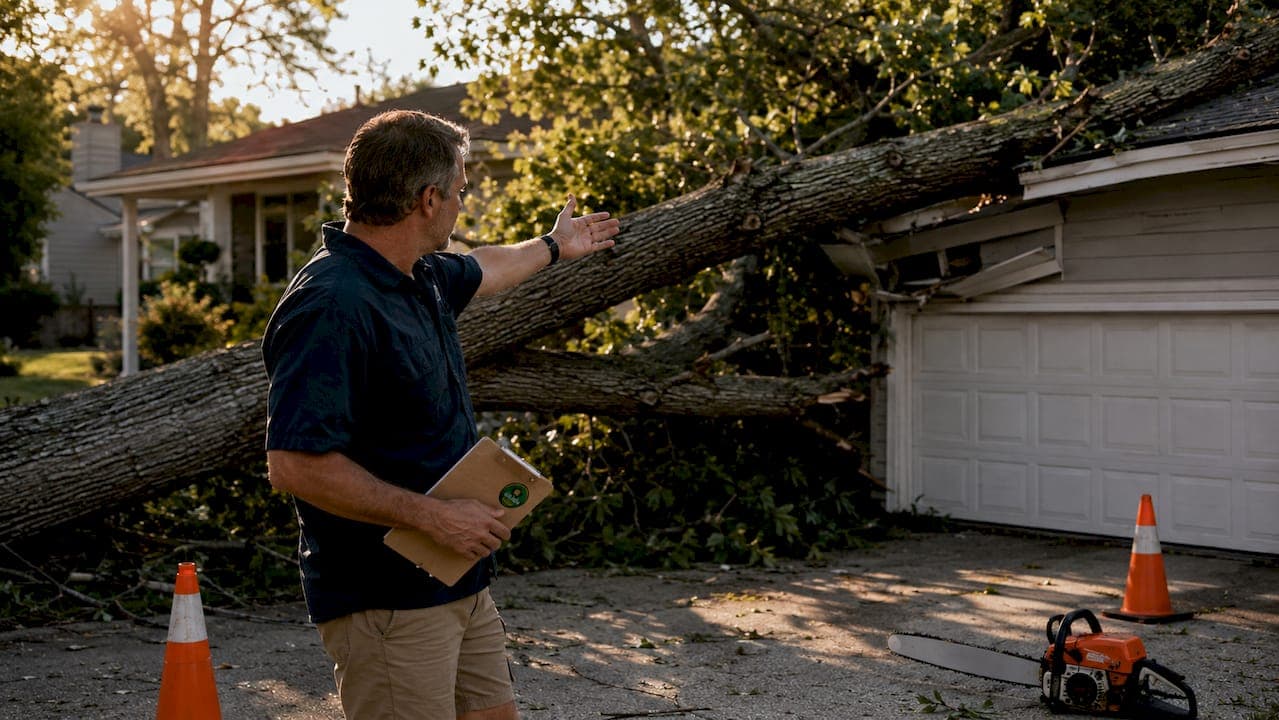
Emergency tree situations are defined as tree-related hazards that pose an immediate threat to life, property, utilities, or emergency access and require swift professional intervention. The most critical types of emergency tree situations include fallen trees on structures, trees entangled with power lines, hanging limbs, blocked access routes, and sudden leaning or structural failure. 2026 industry guidance classifies all of these as requiring immediate professional response, not a wait-and-see approach. Recognizing which type of hazard you are facing determines every decision you make next. Brileytreeservice responds to all of these scenarios across Shreveport, Bossier City, and Northwest Louisiana.
1. Types of emergency tree situations: Fallen trees on structures
A tree fallen on a house, garage, shed, or vehicle is one of the most visible and dangerous tree emergency scenarios a homeowner can face. The risks go beyond the obvious: structural collapse, water intrusion through a breached roof, and injury from unstable debris all compound quickly.
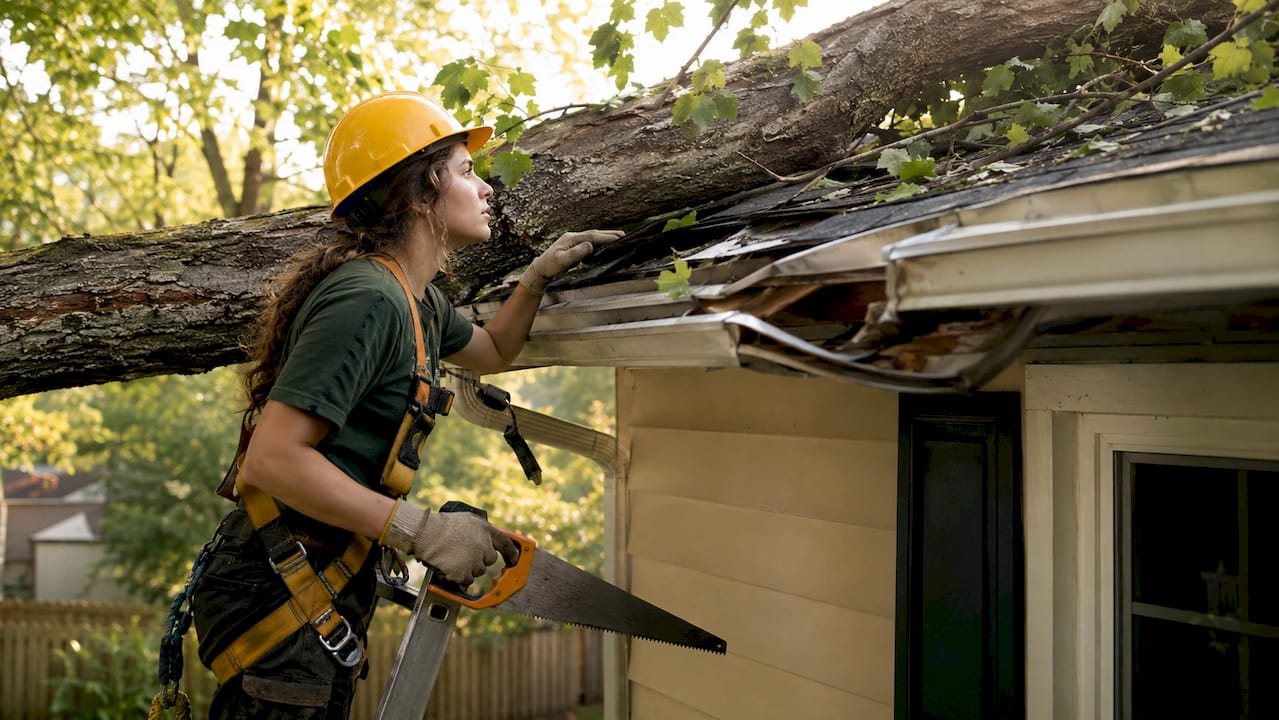
The most critical safety fact is this: a fallen tree on a roof may appear stable but can settle and collapse further at any time. Evacuation is not optional until a professional confirms the structure is safe.
Signs that a fallen tree is still dangerous include:
- Visible cracking or sagging in the roof or walls beneath the tree
- The tree resting at an angle with no solid ground contact
- Broken limbs still suspended above the impact zone
- Sounds of creaking or shifting from the structure
Immediate steps after a tree falls on a structure:
- Evacuate everyone from the affected area of the building.
- Call 911 if anyone is injured or if power lines are involved.
- Contact a certified arborist or emergency tree service for professional removal.
- Do not attempt to move the tree yourself.
Pro Tip: Photograph all damage from a safe distance before any debris is removed. Documenting damage before cleanup is an industry-recommended step that supports insurance claims and disaster assistance eligibility.
A tree fallen on a structure can also affect the foundation. If the impact was significant, foundation damage after a storm is a real secondary risk worth assessing once the tree is removed.
2. Trees or limbs in contact with power lines
Trees touching power lines represent one of the most dangerous types of tree hazards a property owner can encounter. The hazards include electrocution, fire, and widespread power outages affecting entire neighborhoods.
Never touch, cut, or attempt to move a tree or limb that is in contact with a power line. Utility providers must confirm that the line is fully de-energized before any tree work begins. No exception exists to this rule, regardless of whether the line appears dead.
The danger extends beyond the wire itself. Wet ground or wood near a fallen tree contacting a power line can be energized and lethal even without direct wire contact. This is called energized ground, and it is invisible to the eye.
The correct emergency response protocol for power line contact:
- Call 911 immediately and report the downed or contacted line.
- Contact your utility provider directly so they can dispatch a crew.
- Keep everyone, including pets, at least 30 feet away from the area.
- Do not drive over a downed line, even in a vehicle.
- Wait for utility confirmation before allowing any tree service crew on site.
Standard emergency protocols require utility clearance before tree removal begins. Brileytreeservice coordinates directly with utility companies when power line hazards are part of an emergency call.
3. Hanging or partially detached large limbs
Hanging limbs, known in the arborist industry as "widowmakers," are one of the most unpredictable types of tree hazards. Widowmakers can fall without warning and cause serious injury or significant property damage.
The danger with a hanging limb is that it looks like it might hold. It often does not. Wind, rain, or even vibration from a passing vehicle can trigger a drop. The limb does not need to be large to be lethal.
Common locations where hanging limbs create urgent risk:
- Over driveways and parking areas
- Above walkways, porches, and entry points
- Directly over rooflines
- Near children's play areas or outdoor seating
Signs that a branch is dangerously unstable:
- The limb is visibly cracked at the attachment point
- Bark is stripped or peeling away from the break
- The limb hangs at an unnatural downward angle
- The wood appears split or splintered along its length
Professional removal is the only safe response. Trees under tension, such as limbs supported by other branches, require controlled sectioning and rigging to safely release tension without the limb snapping or rolling unpredictably. This is not a task for a ladder and a handsaw.
4. Trees blocking access routes
A fallen tree blocking a driveway, road, or sidewalk is more than an inconvenience. It is a genuine emergency when it prevents fire trucks, ambulances, or police from reaching a property. Blocked access routes are a recognized category of urgent tree service situations that demand fast action.
The impact of blocked access includes:
- Delayed emergency response to your property or a neighbor's
- Inability to evacuate during a fire or gas leak
- Blocked utility crews responding to outages
- Stranded vehicles or pedestrians in hazardous conditions
Recommended immediate actions when a tree blocks access:
- Call 911 if the blockage affects a public road or emergency access.
- Contact your local public works department for road obstructions.
- Call a professional tree service for same-day emergency removal to restore access quickly.
- Do not attempt to drag or cut the tree without professional equipment.
Pro Tip: If a tree falls across your driveway at night or on a weekend, after-hours emergency service is available from qualified tree care companies. Do not wait until Monday morning if access is compromised.
Professional tree services aim for same-day response during active emergencies, depending on weather and access conditions. Quick removal reduces the risk of secondary damage and keeps your property accessible to help.
5. Sudden leaning and structural damage to trees
A tree that suddenly leans is a different emergency from one that has leaned gradually over years. Sudden leaning signals root failure or internal structural collapse. This is a tree that can fall at any moment.
The distinction matters. A gradual lean often develops over seasons and may be manageable with professional monitoring. A sudden lean after a storm or heavy rain means the root plate has partially lifted or the trunk has fractured internally.
Structural failure warning signs to watch for:
| Warning Sign | What It Means |
|---|---|
| Visible crack or split in the trunk | Internal wood failure; collapse risk is high |
| Fungal growth at the base | Internal decay weakening the root system |
| Soil heaving or lifting near the base | Root plate failure; tree may fall soon |
| Bark peeling away from the trunk | Cambium damage indicating structural stress |
| Leaning more than 15 degrees suddenly | Root or trunk failure requiring immediate assessment |
Risks do not disappear after the storm passes. A structurally compromised tree can collapse days later when the ground softens further or when wind returns. Prompt professional assessment is the only way to determine whether removal is necessary or whether the tree can be stabilized.
Key takeaways
The most dangerous types of emergency tree situations, including fallen trees, power line contact, hanging limbs, blocked access, and sudden leaning, all require professional response, not DIY action.
| Point | Details |
|---|---|
| Evacuate first | Leave any structure a fallen tree has struck until a professional confirms it is safe. |
| Never touch power line trees | Wait for utility confirmation before allowing any tree work near energized lines. |
| Widowmakers fall without warning | Remove hanging limbs immediately; do not walk or park beneath them. |
| Blocked access is a true emergency | Call 911 and a tree service if a fallen tree prevents emergency vehicle entry. |
| Sudden lean means act now | A tree that leans suddenly after a storm can collapse within hours or days. |
What I've learned from watching homeowners handle tree emergencies
The single most common mistake I see is hesitation. A homeowner looks at a cracked tree leaning toward the house and decides to "wait and see if it gets worse." By the time it gets worse, a car is crushed or a roof is open to the sky.
The first five minutes after a tree failure are the most critical. Premature cleanup attempts in those minutes increase the risk of secondary injury significantly. The right move is to get people out and get professionals on the phone.
The other misconception I encounter regularly is that every damaged tree needs to come down immediately. That is not always true. Homeowners frequently overestimate removal urgency. A certified arborist can assess whether a storm-damaged tree can recover with proper care, which saves money and preserves mature trees worth keeping.
What I tell every property owner: document everything with photos before anyone touches the debris. Your insurance adjuster needs that record. And understand that emergency pricing reflects specialized high-risk work, not price gouging. Controlled sectioning, rigging, and working near live wires requires training and equipment that costs real money to deploy safely.
— Tatum
Brileytreeservice is ready when tree emergencies strike
When a tree falls on your roof, a limb hangs over your driveway, or a storm blocks your only exit, you need a crew that shows up fast and works safely.
Brileytreeservice provides emergency tree removal, storm cleanup, and hazardous limb removal for homeowners and property managers across Shreveport, Bossier City, and Northwest Louisiana. The team coordinates with utility companies on power line hazards and follows established safety protocols on every job. Whether the call comes in at noon or midnight, Brileytreeservice responds. Contact Brileytreeservice today for a free emergency estimate and get a certified crew to your property before the situation gets worse.
FAQ
What counts as an emergency tree situation?
An emergency tree situation is any tree-related hazard that poses an immediate threat to life, property, utilities, or emergency access. Fallen trees on structures, trees contacting power lines, and hanging limbs all qualify.
How do I handle a fallen tree on my house?
Evacuate the affected area immediately and call a certified arborist or emergency tree service. Do not attempt to move the tree yourself, as secondary collapse is a real risk.
Is a tree touching a power line always an emergency?
Yes. Trees or limbs in contact with power lines create electrocution and fire hazards. Call 911 and your utility provider immediately, and keep everyone at least 30 feet away.
Can a leaning tree wait until morning?
A tree that has suddenly leaned after a storm cannot safely wait. Root plate failure can lead to full collapse within hours, especially on wet or softened ground.
Should I cut a hanging limb myself?
No. Hanging limbs require controlled sectioning and rigging by a professional. Cutting without proper technique can cause the limb to snap or roll unpredictably, causing injury or further damage.