
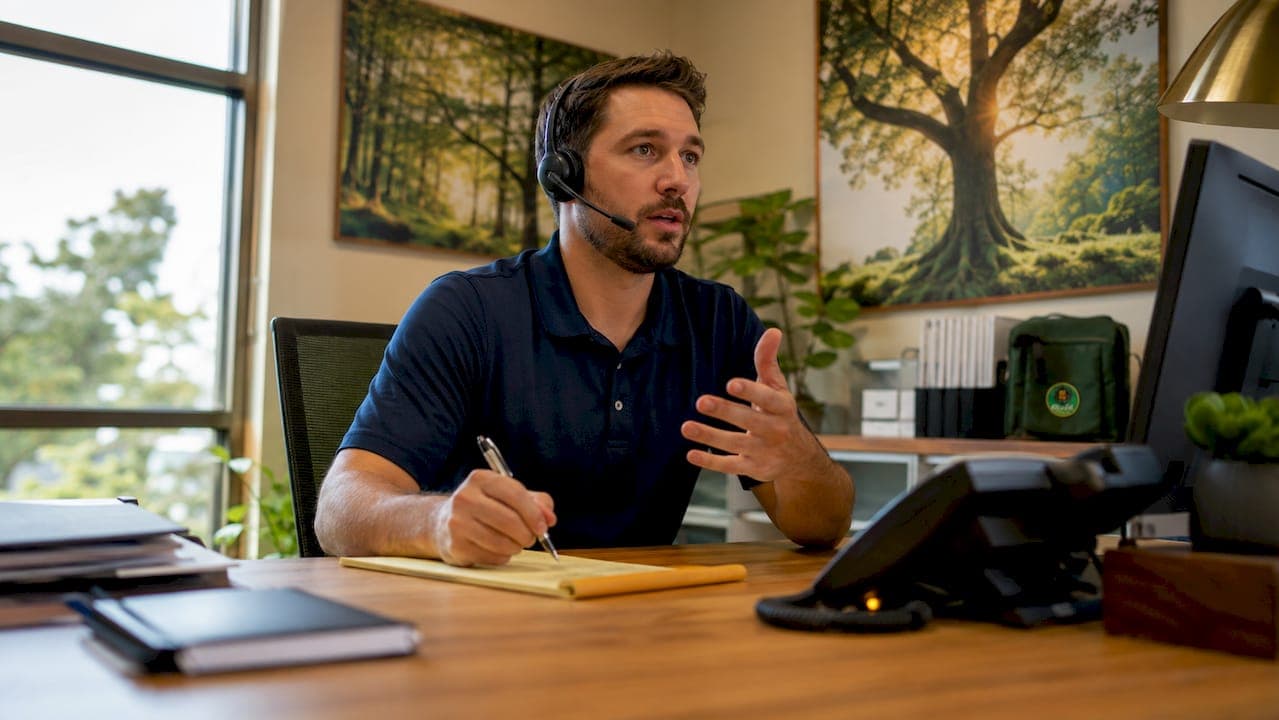
Tree service response time is the interval between your call for help and the moment a professional crew arrives to assess and address a tree emergency or maintenance task. For active threats like a tree on your roof or a limb over a power line, crews typically aim to arrive within 60 to 180 minutes. For planned work like trimming or routine removal, lead times run 3 to 14 days. Knowing what drives these windows helps you set realistic expectations, prepare your property, and avoid costly delays when a tree situation turns urgent.
What is tree service response time, and how is it measured?
Tree service response time is the industry term for the total elapsed time from your initial call or contact through crew arrival and first on-site assessment. It is not the same as job completion time. A crew may arrive within two hours but spend an additional six hours on a complex removal. Understanding this distinction prevents frustration and helps you plan around the full tree service time frame.
The clock starts the moment you reach a dispatcher. From there, a structured workflow begins. A 24/7 emergency workflow typically breaks down as follows: call intake and triage takes 0 to 30 minutes, dispatch and crew mobilization takes 30 to 90 minutes, on-site hazard assessment takes 15 to 45 minutes, and immediate mitigation takes 30 to 180 minutes. Full removal and cleanup follow, ranging from one hour to six or more hours depending on complexity.
Response time is also shaped by whether your situation qualifies as a true emergency. Certified arborists and dispatchers use hazard triage protocols to classify calls. A tree resting on an occupied structure is a life-safety emergency. A leaning tree in your backyard with no immediate target is not, even if it feels urgent to you. That classification determines where your call lands in the queue.
What factors affect how fast tree service arrives?
Several variables determine the expected response time for tree service, and most of them are outside your control once you place the call.
- Severity and risk level. Providers triage calls by safety impact, not call order. A tree threatening life or an occupied structure moves to the front of the line regardless of when you called.
- Weather conditions. High winds, flooding, and icy roads slow crew travel and can make certain removal methods unsafe. No reputable provider can guarantee a fixed arrival window when road conditions are hazardous.
- Geographic proximity. A company based 45 minutes from your property will always have a longer baseline response than a local crew operating in your zip code.
- Current call volume. During a regional storm event, a single provider may receive hundreds of calls within hours. Dispatch software dynamically allocates crews, but volume still stretches timelines.
- Equipment requirements. A job requiring a crane or aerial lift takes longer to mobilize than one requiring only hand tools and a chipper. Providing accurate hazard details upfront helps dispatchers send the right equipment on the first trip.
- Prior service relationships. Pre-established contracts with local providers move those customers ahead in the queue during widespread emergencies. Property managers with ongoing service agreements consistently receive faster responses than first-time callers.
Pro Tip: When you call, state the hazard type immediately. Say "tree on roof" or "limb over power line" rather than "I have a tree problem." Specific language triggers faster triage and correct equipment dispatch.
Emergency vs. non-emergency: what are the typical time frames?
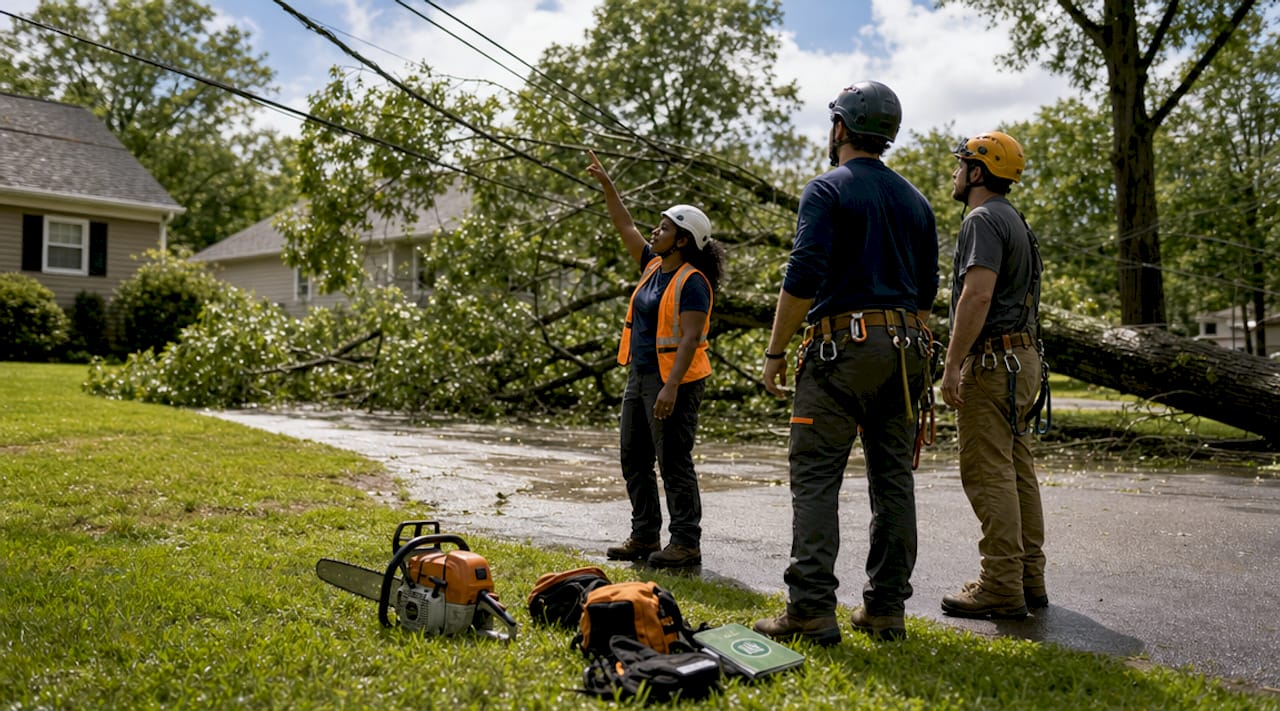
The difference between emergency and non-emergency tree service time frames is significant, and conflating the two leads to misplaced expectations.
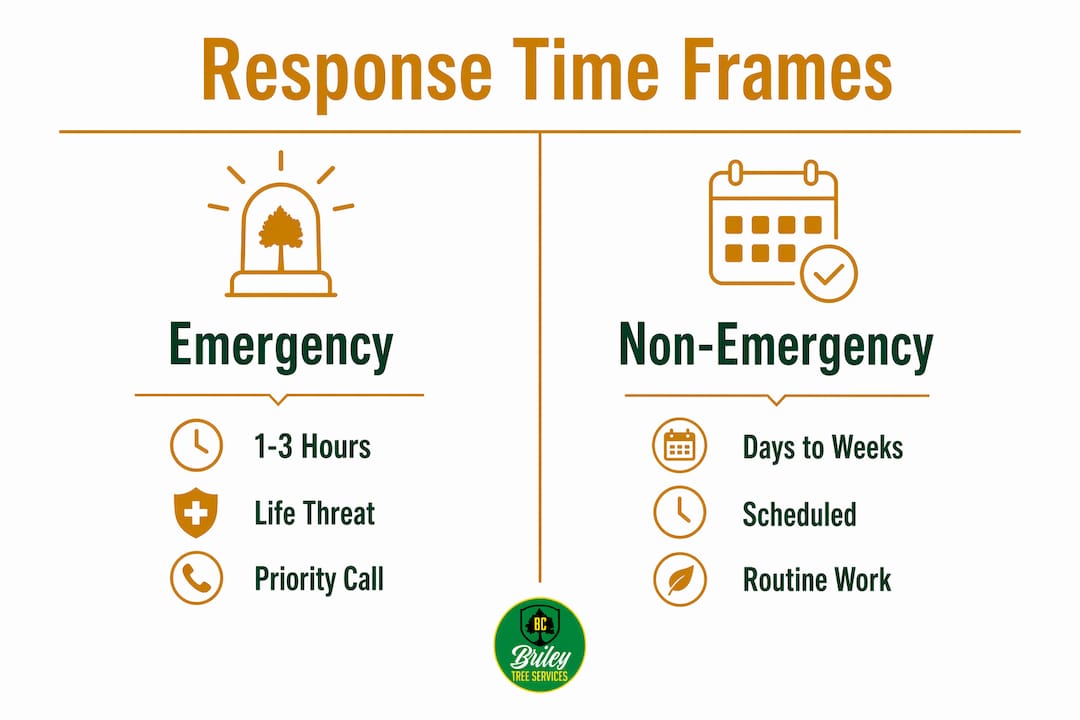
For active, life-threatening situations, the target arrival window is 1 to 3 hours under normal conditions. This covers scenarios like a tree on a structure, a limb blocking a road, or a root failure threatening an occupied building. During major storm events, however, non-critical response times can stretch to 24 to 48 hours as providers prioritize life-safety calls first. That is not a failure of service. It is triage working as designed.
For planned maintenance, trimming, and non-emergency removals, scheduling lead times typically run from a few days to two weeks depending on provider workload and season. Spring and post-storm seasons are the busiest periods for tree companies across the South, including Northwest Louisiana.
On-site work duration is a separate variable entirely. The table below summarizes typical response and work duration by service type.
| Service type | Typical response time | On-site work duration |
|---|---|---|
| Life-safety emergency (tree on structure) | 1 to 3 hours | 2 to 8 hours |
| Storm damage, non-critical | 4 to 24 hours (up to 48 during major events) | 1 to 6 hours |
| Planned small tree removal (under 30 ft) | 3 to 14 days scheduled | 1 to 3 hours |
| Planned medium tree removal (30 to 60 ft) | 3 to 14 days scheduled | 2 to 6 hours |
| Large or complex removal (60 to 100+ ft) | 3 to 14 days scheduled | 6 to 10+ hours |
| Stump grinding or trimming | 3 to 14 days scheduled | 1 to 3 hours |
Large and complex removals often become multi-day projects involving rigging, cranes, and staged debris removal. That extends total time on site well beyond what the initial response window suggests.
How to speed up your tree service response in an emergency
You cannot control how many calls a provider receives during a storm. You can control how prepared you are before one hits and how clearly you communicate when you call.
- Vet a local provider before you need one. Identify a reputable local tree service and save their number. Emergency planning should be proactive, not reactive. Calling a company you have never worked with during a regional storm puts you at the back of the priority list.
- Provide precise information on the first call. Give your full address, describe the hazard type, note whether structures or utilities are involved, and send photos if the provider accepts them. Specific hazard details speed dispatch and prevent equipment mismatches that force a second trip.
- Establish a clear exclusion zone. Keep people and pets away from the hazard area before the crew arrives. Providers assess safety on arrival, and a clear zone speeds that process.
- Contact your utility company if power lines are involved. Tree service crews cannot work on or near energized lines. Your utility provider must de-energize the line first. Calling them simultaneously with your tree service call cuts total resolution time significantly.
- Do not call 911 for non-life-threatening tree situations. Emergency services are for immediate threats to life. Most tree situations are private contractor responsibilities, and 911 dispatch will redirect you to a private provider anyway.
Pro Tip: Take photos of your trees before a storm season. Timestamped images showing pre-existing conditions help with insurance claims and give dispatchers a baseline when you describe new damage.
Reviewing a tree service hiring checklist before storm season helps you identify providers who offer 24/7 availability and have the equipment to handle large removals without subcontracting.
What to expect when the crew arrives
Knowing what happens after the crew pulls up helps you understand why tree removal response time does not end at arrival. The on-site process follows a defined sequence regardless of provider.
- Hazard assessment. A certified arborist or lead climber evaluates the tree, the fall zone, nearby structures, and utility proximity. This takes 15 to 45 minutes and cannot be skipped. Speed is always balanced with safety and correct equipment deployment.
- Mitigation planning. The crew determines the removal method: straight fell, sectional dismantling, crane-assisted lift, or rigging. The method depends on the tree's size, lean, proximity to structures, and ground conditions.
- Stabilization if needed. For trees actively threatening a structure, crews may install temporary cabling or bracing before full removal begins. This adds time but prevents additional damage during the removal process.
- Phased removal. Large trees come down in sections from the top. Each section is rigged and lowered in a controlled sequence. This is slower than a straight fell but far safer in confined spaces.
- Cleanup and stump grinding. Most providers include debris removal in their scope. Stump grinding is often a separate service scheduled after the primary removal. Understanding the full scope of tree service work prevents surprises on the final invoice.
Complex removals involving cranes or multi-day staging are not unusual for large oaks or pines in residential areas. A job that looks straightforward from the street may require significantly more time once the crew assesses root structure, lean angle, and proximity to fencing or foundations.
Key takeaways
Tree service response time is determined by hazard severity, provider proximity, call volume, and equipment availability. Emergency situations receive priority arrival within 1 to 3 hours under normal conditions, while planned work follows a scheduled lead time of days to weeks.
| Point | Details |
|---|---|
| Emergency response window | Active life-safety threats receive crew arrival within 1 to 3 hours under normal conditions. |
| Storm event delays | Non-critical calls can wait 24 to 48 hours during major storms due to triage prioritization. |
| On-site work duration | Large or complex removals take 6 to 10+ hours and may span multiple days. |
| Proactive preparation | Vetting a local provider before an emergency and having their number ready reduces response delay. |
| Information quality matters | Providing specific hazard details and photos on the first call speeds dispatch and prevents equipment mismatches. |
What I have learned about response time expectations
I have worked with enough homeowners after storm events to know that the biggest source of frustration is not slow service. It is the gap between what people expect and what the situation actually allows.
Most callers assume emergency tree service works like a pizza delivery. You call, someone shows up in 30 minutes, and the problem is gone. That model breaks down completely when a single storm drops 200 trees across a metro area in one night. Providers are not slow. They are working through a triage list where your leaning pine ranks below the tree that just crushed someone's bedroom.
The homeowners who handle emergencies best are the ones who prepared before anything went wrong. They had a vetted local provider saved in their phone. They knew their property's tree risks. They had photos on file and understood that utility involvement means a separate call to the power company. When the storm hit, they called immediately, gave precise information, and waited with realistic expectations.
I have also seen the opposite. Homeowners who called three different companies during a storm, gave vague descriptions, and then complained that no one showed up for six hours. In most of those cases, the calls were triaged as non-critical because the caller could not describe an active structural threat. The system worked correctly. The caller just did not know how it worked.
No reputable provider will promise you a 30-minute arrival during a regional storm event. If a company does make that promise, treat it as a red flag rather than a selling point. Understanding how emergency tree care planning works before you need it is the single most useful thing you can do as a property owner.
— Tatum
Reliable tree service response from Briley Tree Service
When a tree comes down on your property in Shreveport, Bossier City, or anywhere in Northwest Louisiana, Brileytreeservice is available around the clock for emergency response. The team handles tree removal, trimming, stump grinding, and storm cleanup for both residential and commercial properties, with rapid dispatch for active hazards and transparent scheduling for planned work.
Brileytreeservice offers free estimates for all services and covers a wide range of local service areas across the region. Whether you need immediate storm damage cleanup or want to schedule a routine removal before the next weather event, the team shows up on time and cleans up completely after every job. Contact Brileytreeservice today to get a free estimate and have a trusted local provider in your contact list before you need one.
FAQ
What is a normal response time for emergency tree service?
Emergency tree service crews typically aim to arrive within 1 to 3 hours for active, life-threatening situations under normal conditions. During major storm events, non-critical calls may wait 24 to 48 hours due to triage prioritization.
How long does tree removal actually take on site?
On-site work duration depends on tree size and complexity. Small trees under 30 feet typically take 1 to 3 hours, while large or complex removals of 60 to 100+ feet can take 6 to 10 hours or span multiple days.
Why does my call get lower priority than someone else's during a storm?
Tree service providers use a triage system where life and safety calls take precedence over yard cleanup or non-structural damage, regardless of call order. A tree on an occupied structure will always rank above a leaning tree with no immediate target.
Can I do anything to get faster tree service response?
Yes. Provide your exact address, describe the specific hazard type, note any utility involvement, and send photos if the provider accepts them. Accurate upfront information speeds dispatch and prevents equipment mismatches that delay arrival.
Should I call 911 if a tree falls on my property?
Call 911 only if there is an immediate threat to human life, such as a person trapped or an active electrical hazard. Most tree situations are private contractor responsibilities, and emergency services will redirect you to a tree service provider.