
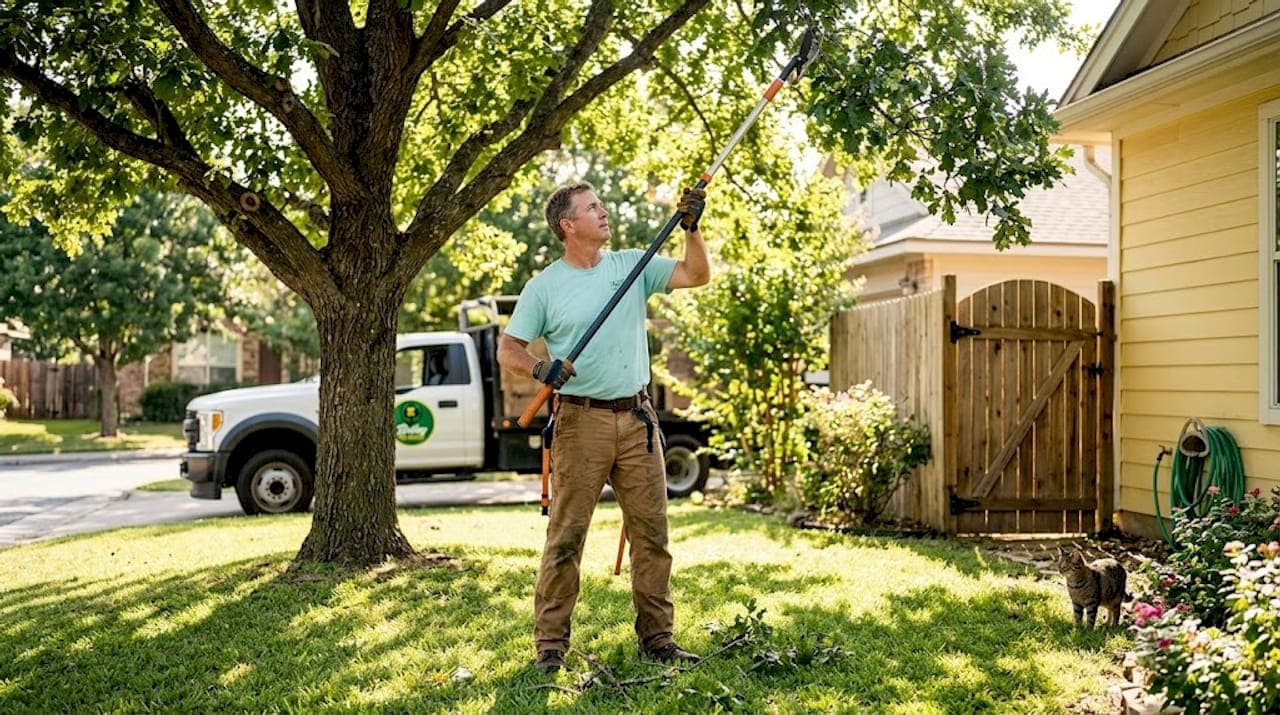
Trees look self-sufficient. They grow for decades without anyone touching them, so it's easy to assume they don't need help. That belief is one of the most common — and costly — mistakes property owners make. Understanding why trees need regular trimming means understanding that what happens above your roofline directly affects your safety, your energy bills, and your property value. This guide covers the health, safety, and aesthetic reasons to trim your trees consistently, plus the timing and techniques that actually work.
Table of Contents
- Key takeaways
- Why trees need regular trimming for health and longevity
- Safety benefits of trimming your trees
- Aesthetic and environmental benefits
- When and how to trim trees safely
- Common mistakes that set trees back
- My take: why proactive trimming matters more than most people realize
- Get professional tree trimming from Brileytreeservice
- FAQ
Key takeaways
| Point | Details |
|---|---|
| Trimming protects tree health | Removing dead and diseased branches stops pathogens from spreading to healthy wood. |
| Wet limbs are a serious hazard | Wet wood can weigh 4x more than dry wood, dramatically increasing storm breakage risk. |
| Late winter is the best time | Pruning during dormancy speeds healing and reduces stress on the tree. |
| Topping does lasting damage | It weakens structure, invites disease, and often accelerates tree death. |
| Annual light pruning beats severe cuts | Regular light pruning prevents the shock that comes from infrequent, heavy removal. |
Why trees need regular trimming for health and longevity
A tree left to grow without any management will still look healthy for years. The problem is structural. Dead, damaged, or diseased branches don't fall off cleanly on their own schedule. They decay from the inside out, and that decay moves. Fungal infections and bacterial pathogens spread from one dead limb into adjacent healthy wood before you ever see visible signs of a problem.
Pruning disrupts that process. When you remove a compromised branch at the right point, you cut off the disease pathway before it reaches the trunk or main scaffold limbs. That single action can add years to a tree's functional life.
There are two primary types of pruning cuts, and each one does something different:
- Thinning cuts remove an entire limb back to its origin point. They preserve the tree's natural form and maintain apical dominance, which is the tree's tendency to grow upward with a strong central leader. These cuts reduce weight and open the canopy without stimulating excessive regrowth.
- Heading cuts remove only the terminal portion of a branch. They stimulate dense, bushy regrowth and are used selectively to shape specific areas, not as a general thinning method.
Structural integrity is just as important as disease control. A tree that develops multiple competing leaders or heavy lateral limbs growing at tight angles is a tree that's building failure points over time. Corrective pruning while the tree is young redirects growth into a stronger form. On mature trees, removing overextended limbs reduces the mechanical load on branch unions before those unions crack.
Pro Tip: Prune deciduous trees during their dormant period in late winter to early spring. You get better visibility into the branch structure, and the tree heals faster when growth resumes.
Safety benefits of trimming your trees
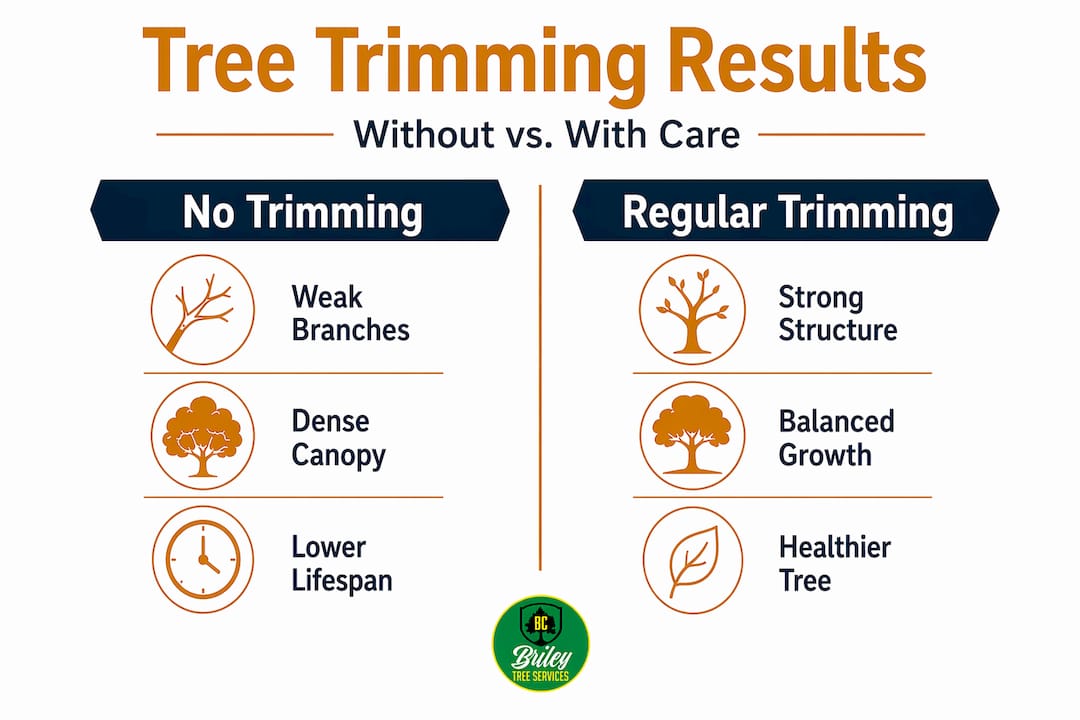
This is the section most homeowners skip until something goes wrong. A fallen limb during a storm that damages a roof, a car, or injures someone is not bad luck. In most cases, it's the result of deferred maintenance on branches that were already compromised.
The physics of storm damage are straightforward. Wet wood can weigh up to 400% more than dry wood. A limb that seems manageable in dry conditions becomes a wrecking ball after a heavy rain or ice event. Without regular trimming to remove weak and overextended branches, the mechanical stress on branch unions during storms multiplies.
Here are the warning signs that a tree needs professional evaluation now, not next season:
- Cracks or splits at branch unions or in the main trunk
- Branches with bark inclusions (bark pinched between two limbs instead of growing around them)
- Deadwood that makes up more than 25% of the canopy
- Excessive leaning that has changed over time
- Rot, fungal growth, or soft spots at the base
Certified arborists recommend annual safety evaluations for any tree showing signs of decline. In hurricane and storm-prone areas like Northwest Louisiana, that evaluation before storm season is not optional. Structural pruning builds resistance to wind loading by reducing canopy density. Less wind resistance means less force transferred to the root system and branch unions during high winds.
Trees near power lines represent a separate category of risk. The safety protocols for trimming near utilities are specific and non-negotiable. Never attempt that work yourself.
Aesthetic and environmental benefits
Regular trimming is not just maintenance. It actively improves your property in ways that show up in curb appeal and on your energy bill.

A well-shaped tree is a visual asset. An overgrown tree with crossing branches, water sprouts growing straight up from limbs, and dead wood throughout the canopy is a liability. The difference between the two is consistent attention, not expensive renovation.
Here's how trimming's aesthetic and environmental benefits compare directly:
| Without regular trimming | With regular trimming |
|---|---|
| Dense canopy blocks sunlight to lawn and understory plants | Open canopy allows light to reach the ground level |
| Overgrown branches reduce curb appeal and perceived property value | Clean structure enhances appearance and landscape quality |
| Unchecked shading creates cool, damp areas favorable to mold and pests | Balanced shade improves airflow and reduces moisture buildup |
| Maximum summer shade in wrong locations can increase cooling costs | Strategic canopy management can reduce air conditioning costs by up to 30% |
That last point deserves attention. The goal isn't to eliminate shade. Healthy trees positioned correctly provide enormous energy savings. The goal is managed shade from structurally sound trees. An overgrown tree that drops a 400-pound limb onto your roof costs far more than the air conditioning savings ever delivered.
Drop-crotching is a useful technique when a large tree has outgrown its space. Rather than topping it (which causes serious damage), thinning back to a lateral branch reduces the tree's size while maintaining its natural form and structural strength. This is one reason having an arborist assess large trees matters. A professional can reduce size without compromising the tree's future.
When and how to trim trees safely
Timing, technique, and knowing your limits are the three pillars of effective tree trimming.
On timing, the window that works for most deciduous trees in the Southeast is late winter to early spring, just before new growth begins. The tree is dormant, so you can see its structure clearly without foliage in the way. Wounds close faster once growth resumes in spring, and the tree faces less stress. Summer pruning has its place for removing active deadwood or managing specific species, but dormant pruning is the standard for structural work.
On technique, follow these steps for any branch removal:
- Use the three-cut method for limbs larger than 1 inch in diameter. Make a partial undercut about 12 inches from the trunk to prevent bark tearing. Make a second cut further out to remove the bulk of the limb. Make the final cut just outside the branch collar.
- Never cut flush to the trunk. The branch collar contains specialized tissue that closes over the wound. Cutting into it eliminates that healing response. Pruning cuts must be made at the branch collar to allow proper wound closure.
- Do not paint or seal the cut. It feels protective, but painting wounds traps moisture and pathogens beneath the surface, which hinders the tree's natural healing process.
- Use clean, sharp tools. Dull blades tear wood fibers and create ragged wounds that take longer to close. Disinfect tools between trees to avoid spreading disease.
- Stay on the ground when possible. Aerial work near the canopy or near structures carries significant risk. Use a pole pruner for moderate heights before escalating to a ladder.
Pro Tip: If a branch is larger than 4 inches in diameter, or if the work puts you near a power line or above a structure, call a professional. The cost of a tree service scope of work is always less than a trip to the emergency room or a roofing repair.
Common mistakes that set trees back
The most damaging tree care mistakes are not random. They follow predictable patterns that homeowners repeat because the harm isn't immediately visible.
- Topping is the single most harmful practice. Cutting a tree back to large stubs removes most of the canopy and triggers weak, fast-growing sprouts called water sprouts. These attach poorly and topping causes weak regrowth, increased disease, and often premature death. If a tree has grown too large for its space, proper size reduction through a certified arborist is the answer, not topping.
- Using climbing spikes for maintenance work damages trees every time. The puncture wounds they leave open infection pathways throughout the canopy. Climbing spikes cause harmful puncture wounds and should only be used during tree removal, never routine trimming.
- Skipping pruning entirely has its own consequences. The belief that trees are better off without human intervention ignores how trees respond to their environment. Without guidance, branch structures develop flaws that compound over time. The worst pruning cuts are the ones never made.
- Making infrequent, severe cuts instead of light annual maintenance shocks the tree and triggers the same stress response as damage. Light annual pruning keeps trees on track without disruption.
My take: why proactive trimming matters more than most people realize
In my experience, the trees that end up being emergency situations are almost never surprises to the homeowners who look back honestly. There were signs. A branch that started leaning further last summer. A spot of rot that seemed minor two years ago. The decision to wait one more season.
What I've learned is that proactive trimming is not about aesthetics first. It's about managing risk on your property before that risk becomes expensive or dangerous. I've seen well-meaning homeowners spend money on topping because they were told it would reduce the tree's size, only to end up with a structurally compromised tree that cost twice as much to remove three years later.
The commercial property managers who handle tree care best treat it the same way they treat roof inspections. Annual evaluations, scheduled maintenance, and documented records of what was done and when. Homeowners benefit from that same approach. You don't need to become an arborist. You need to build a relationship with one and commit to a schedule rather than reacting to crises.
If you're unsure where your trees stand, start with an evaluation this dormant season. Commercial tree maintenance guidance can be useful even for residential properties when multiple trees are involved. The cost of regular attention is always lower than the cost of emergency removal.
— Tatum
Get professional tree trimming from Brileytreeservice
Briley Tree Service provides expert tree trimming for homeowners and property managers throughout Shreveport, Bossier City, and Northwest Louisiana. The team handles everything from routine annual pruning to structural work on mature trees, using proper technique and safety practices on every job. If your trees haven't been evaluated recently, now is the time to schedule a professional assessment before storm season. Briley Tree Service offers free estimates for tree trimming and removal across the Shreveport area. Call today to get on the schedule and protect your property with tree care done right.
FAQ
Why do trees need regular trimming?
Regular trimming removes dead, diseased, and structurally weak branches before they fail. It also controls growth, reduces storm damage risk, and keeps trees healthy for decades longer than neglected trees typically survive.
When is the best time to trim trees?
The best time to trim most trees is late winter to early spring while the tree is dormant. Pruning during dormancy improves healing speed, reduces stress on the tree, and gives you clear visibility into the branch structure.
What happens if you never trim your trees?
Trees that receive no pruning develop structural defects, accumulate deadwood, and become more vulnerable to storm damage and disease over time. Neglecting tree care increases the likelihood of limb failure and costly emergency removal.
Is topping a tree the same as trimming it?
No. Topping removes large portions of the canopy and leaves stubs that produce weak, fast-growing sprouts. It is widely recognized as harmful and often leads to tree decline and premature death. Proper trimming preserves the tree's structure and health.
How often should trees be professionally inspected?
Certified arborists recommend annual safety evaluations, especially for trees showing signs of decline such as rot, excessive leaning, or significant deadwood. Properties in storm-prone regions benefit from evaluations before storm season each year.