
Fence line clearing costs vary widely in the United States depending on vegetation density and access, generally starting from less than a dollar per foot for light brush, rising to several dollars per foot for moderate growth, and increasing further with heavy brush and mature trees.
That range is wide because fence line work isn't standardized like a paved driveway quote. Terrain, tree diameter, and how close a machine can get to the fence all swing the price hard.
- Light overgrowth (grass, weeds, thin brush) typically costs less per foot
- Moderate brush (saplings, thick undergrowth) falls into a middle cost range
- Heavy brush with trees is the most expensive category per foot
Pro Tip: Forestry mulching typically clears dense, woody fence lines faster than hand crews because it grinds vegetation in place instead of cutting and hauling it away.
If your fence line has mature trees, steep grades, or barely enough room for a truck to squeeze through, hire a professional. Short, flat runs choked with grass and light brush are reasonable DIY or small-crew territory.
Key Takeaways
Fence line clearing costs in the US typically range from $0.50 to $12+ per linear foot, with the final number driven by vegetation density, access, and clearing width rather than distance alone.
| Point | Details |
|---|---|
| Cost bands by density | Light brush runs $0.50–$3/ft, moderate $1.50–$8/ft, heavy brush with trees $3–$12+/ft. |
| Method changes the price | Forestry mulching handles dense growth fastest and skips haul-off costs; dozing and hand crews cost more or take longer. |
| Bundling saves money | Combining multiple fence runs into one mobilization can cut per-foot cost by roughly 30 to 40 percent. |
| Compare quotes with a checklist | Ask every contractor about licensing, crew size, equipment, disposal method, and stump treatment before comparing bids. |
| Local hire for North Louisiana | Briley Tree Service provides free, itemized estimates for fence line clearing across Shreveport, Bossier City, and Ruston. |
Where These Numbers Come From
- Bear Claw Land Clearing's Texas fence line guide breaks down per-foot bands by vegetation density and shows how bundling multiple runs lowers mobilization costs.
- Brush Busters' New Jersey field notes offer sample project totals for typical residential and agricultural fence-row jobs.
- Mann Hauling's Indiana cost guide explains hourly versus per-foot billing models and how terrain affects mobilization pricing.
- Ivan's Landscaping's McHenry County fence line page gives another regional example of pricing patterns and method descriptions.
Every published range is a starting point, not a quote. Your actual price depends on what's growing on your property right now, so a walkthrough from a local crew will always beat a national average.
Table of Contents
- How Much Does Fence Line Clearing Cost by Method?
- What Does Fence Line Clearing Cost for Common Property Sizes?
- What Factors Change a Fence Line Clearing Quote?
- Forestry Mulching vs. Hand Clearing vs. Dozing
- Permits, Safety, and Local Rules That Affect Cost
- Briley Tree Service: Fence Line Clearing in North Louisiana
- What Hiring Mistakes Cost You Most
- Get a Free Fence Line Clearing Estimate From Briley Tree Service
- Sources
How Much Does Fence Line Clearing Cost by Method?
The method a contractor uses drives the price more than almost anything else, because it determines equipment cost, crew size, and how debris gets handled.
Forestry mulching
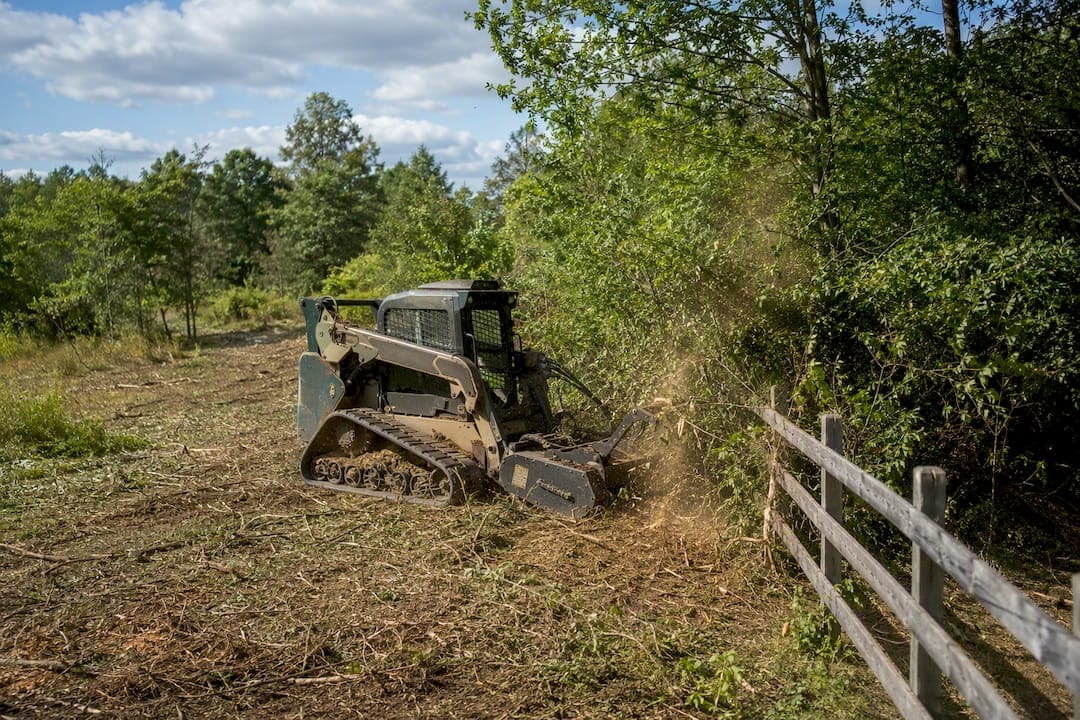
Forestry mulching uses a skid steer or compact track loader fitted with a rotating mulching head. It's the workhorse for dense, woody fence lines because it grinds brush and small trees into mulch that stays on the ground, skipping the cost of hauling debris off-site. Per-foot pricing for mulching commonly falls in the $1.50 to $8 range depending on density, though state-specific guides show light brush running $1 to $5 per foot and heavy growth with trees climbing to $10 to $20 per foot in some markets. Many contractors also bill mulching by the hour, often somewhere in the $150 to $500-plus range depending on machine size and regional labor costs.
Hand clearing and chainsaw crews
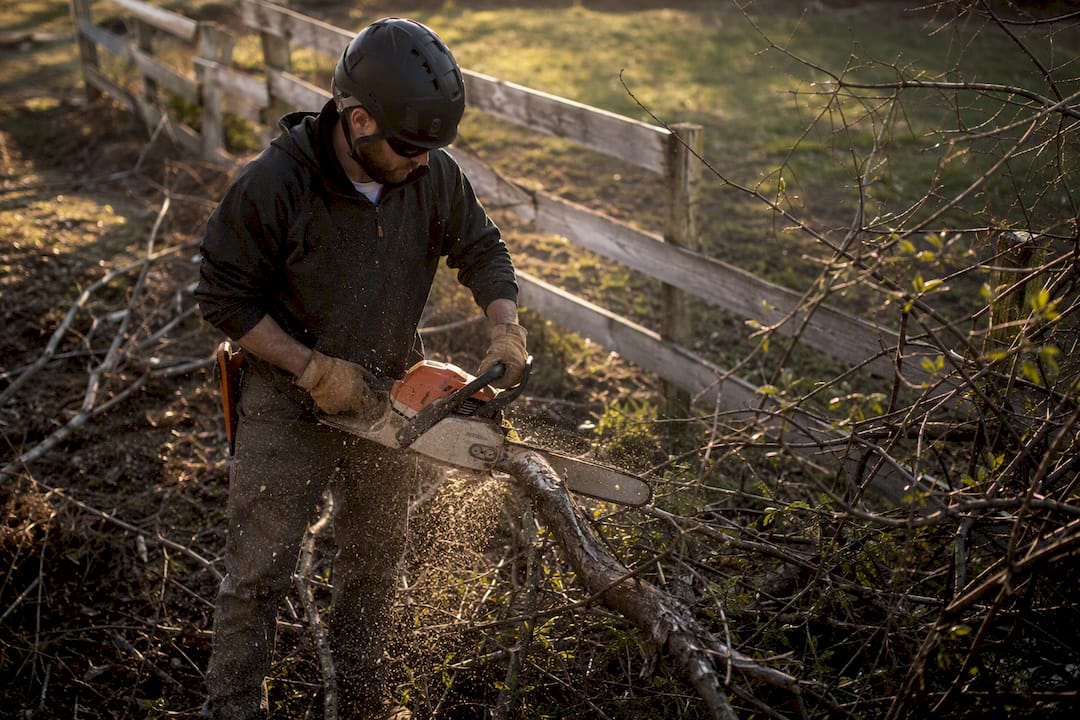
Hand crews with chainsaws and brush cutters make sense for light growth, tight spaces where machinery can't maneuver, or short runs where mobilizing heavy equipment isn't worth the setup cost. Labor-hour costs vary by crew size, but hand clearing is usually priced lower per hour than mulching, offset by slower coverage. A two-person crew might clear a few hundred feet of light brush in a day; the same distance of heavy brush could take several days.
Dozing and heavy equipment
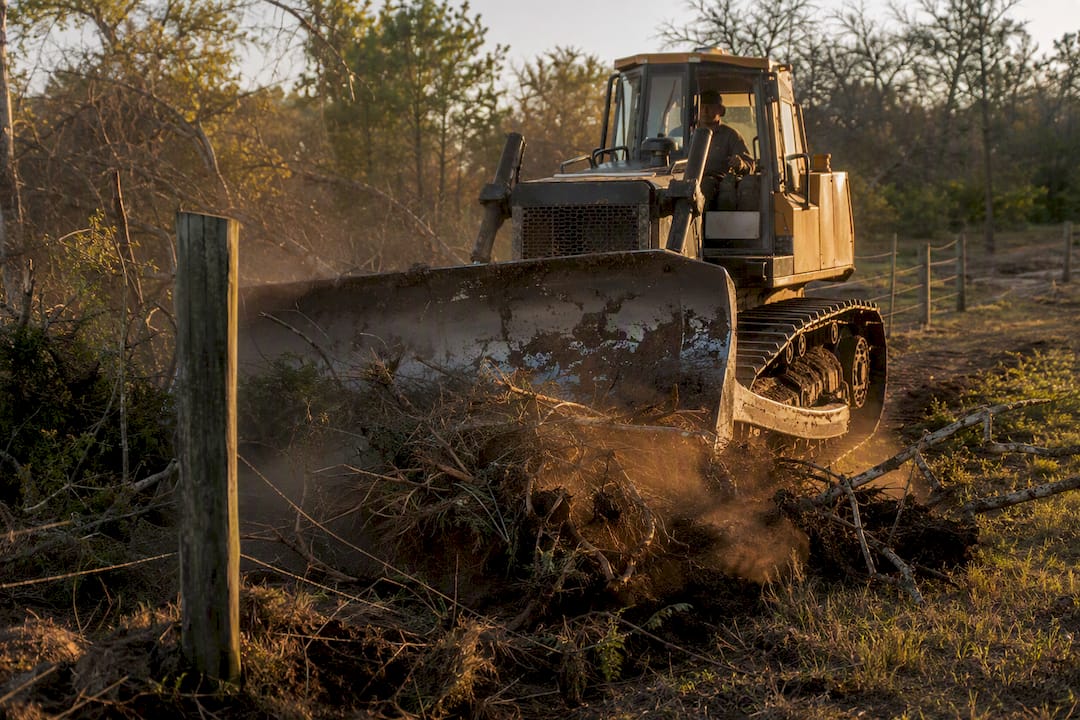
Bulldozers and excavators come into play when a fence line has mature trees that need to be pushed or dug out, or when the ground needs regrading after clearing. Dozing carries the highest per-foot cost on this list because of fuel consumption, operator skill, and the risk of collateral damage. A dozer blade too close to a fence post can knock it over or crush the wire, so contractors typically charge a premium for working near a structure they need to protect rather than remove.
Corridor width and clearing side changes the math
A quote for clearing 10 feet on one side of a fence looks very different from clearing 10 feet on both sides. Doubling the corridor width roughly doubles the vegetation volume, which raises the per-foot price even though the linear footage of fence stays the same. Always confirm whether a quoted per-foot price covers one side, both sides, or a specific total width, because this single variable causes more quote confusion than any other line item.
- One-sided clearing at a fixed width costs less per foot than clearing both sides
- Wider corridors (15–20 ft) cost more than narrow ones (5–10 ft) even at the same vegetation density
- Utility right-of-way clearing often requires wider corridors than a simple property-line fence
What Does Fence Line Clearing Cost for Common Property Sizes?
Real numbers help more than percentages when you're staring down a quote. Here's how the math plays out at four common lengths, using the published per-foot bands most regional contractors quote from.
- 100 feet, light brush ($1.50/ft): roughly $150. This is the kind of small job a landowner might tackle with a rented brush cutter instead of hiring out.
- 500 feet, moderate brush ($4/ft): roughly $2,000. This size matches typical residential and horse-property jobs, which commonly run $2,500 to $6,000 once mobilization, disposal, and any stump work get added.
- 1,000 feet, heavy brush with trees ($8/ft): roughly $8,000. Add $500 to $1,500 more if stump grinding or hauling is needed rather than leaving mulch on-site.
- 1 mile (5,280 ft), moderate to heavy mix ($5/ft average): roughly $26,400. Long agricultural runs like this almost always get a custom, itemized quote rather than a flat per-foot number.
Bundling matters more than most landowners expect. If you have several fence runs on one property, or a fence line that borders a larger land-clearing project, combining them into a single mobilization can cut the per-foot rate by roughly 30 to 40 percent because the crew and equipment only travel and set up once. A landowner clearing 2,000 feet of fence across three separate pastures pays less scheduling all three in one visit than paying for three separate mobilizations weeks apart.
Per-foot pricing breaks down in extreme cases. If your fence line has dozens of mature trees, rock outcrops, or sections buried under decades of sod and soil buildup, expect the contractor to walk the property and hand you an itemized quote instead of a simple rate multiplied by length. At that point, the per-foot model stops reflecting reality, and you're better off comparing full project bids line by line.
What Factors Change a Fence Line Clearing Quote?
Contractors price fence line work off a handful of measurable factors, and knowing them ahead of time helps you get quotes you can actually compare side by side.
- Linear footage of the fence line, measured accurately rather than estimated by eye
- Clearing width requested on each side (5, 10, 20 feet, or more)
- Vegetation species and tree diameter, since hardwoods and larger trunks take longer to process than soft brush
- Fence condition, because a damaged or buried fence adds repair time to the job
- Access points, including whether gates exist and whether equipment can drive the full length
- Terrain, since slopes, wet ground, and uneven footing slow every method down
- Utility presence, since buried lines or overhead wires require extra caution and sometimes extra cost
For remote estimates, photograph the fence line every 50 to 100 feet, along with close-ups of any trees growing into the wire and any spots where the fence disappears under brush or soil. This gives a contractor enough detail to give you a realistic ballpark before ever setting foot on the property.
Pro Tip: Bring the same question list to every walkthrough so bids line up: Are you licensed and insured? How many people are on the crew? What equipment will you bring? Where does the debris go? Do you treat stumps, and is there a warranty on the work? What's your timeline once the contract is signed? Asking each contractor the same six questions turns a pile of confusing quotes into a real comparison.
Forestry Mulching vs. Hand Clearing vs. Dozing
Each method leaves the fence line looking different when the crew packs up, and that difference matters as much as the invoice.
Forestry mulching grinds standing brush and small trees into mulch that stays where it fell. It's fast on dense growth, generates no haul-off cost, and tends to be gentler on an existing fence line because the machine works around the wire rather than pushing against it.
Hand clearing with chainsaws and brush cutters leaves cut material in piles that need hauling, chipping, or burning separately. It's slower on heavy growth but often the only option in tight spots where a machine can't fit, and it gives a crew more control when working within a few inches of an existing fence.
Dozing clears fastest on land that needs regrading, not just brush removal, but it disturbs soil and carries the highest risk of fence damage if the operator isn't careful near posts and corners.
- Forestry mulching: fast on brush, no haul-off, lower fence-damage risk
- Hand clearing: slower, requires debris hauling, best for tight or sensitive areas
- Dozing: fastest for full regrade jobs, higher soil disturbance, needs careful operators near fence lines
One recurring situation deserves its own note: trees that have grown directly through a wire fence over the years. The practical field standard is to cut the tree, remove it, and then re-splice or repair the section of wire, rather than trying to rip the trunk through the mesh. Pulling a tree through fencing it has grown around almost always destroys more fence than it saves in labor.
Permits, Safety, and Local Rules That Affect Cost
Before any equipment touches your fence line, call 811 to get utility lines marked. Buried gas, water, and electric lines change both scheduling and price, and hitting one unmarked is a liability nobody wants. Contractors who plan around confirmed utility locates avoid costly delays that would otherwise get passed to you.
- Call 811 at least a few business days before clearing begins near any buried utility
- Check local burn ordinances if the plan includes burning debris rather than chipping or hauling
- Ask whether a burn permit or debris hauling fee applies before the invoice arrives, not after
- Require a licensed arborist for hazardous trees, especially near structures or power lines
- Confirm insurance coverage, since uninsured crews shift liability for property damage onto you
Disposal method is often the hidden line item that separates a low bid from a realistic one. Mulching leaves material on-site at no extra charge; hauling and chipping off-site adds cost; burning depends entirely on local permits and season. Ask which method a quote assumes before comparing it to another.
Briley Tree Service: Fence Line Clearing in North Louisiana
Briley Tree Service handles fence line clearing as part of a broader land-clearing and forestry mulching offering across Shreveport, Bossier City, and the surrounding North Louisiana area. Our licensed and insured crew works fence lines choked with brush, saplings, and mature trees, and we handle stump grinding and hazardous tree removal when a fence run has grown well past a simple trim.
A typical written estimate breaks the job into clear line items: mobilization, equipment type, labor, disposal method, and any stump grinding or repair work the fence needs afterward. That format lets you compare our numbers directly against any other bid using the same checklist covered earlier in this guide.
- Forestry mulching for dense, overgrown fence rows
- Hazardous tree and stump removal along fence lines
- Cleanup and debris hauling when mulching isn't the right fit
- Service area: Shreveport, Bossier City, Ruston, and surrounding North Louisiana
What Hiring Mistakes Cost You Most
Experience with forestry mulching equipment matters more than most homeowners assume. A crew that has run mulching heads through hundreds of fence lines reads terrain and tree density differently than one still learning the machine, and that shows up in both speed and fence damage risk.
Watch for bids that skip disposal method, skip stump treatment, or come in far below every other quote with no explanation. A price that low usually means something got left out of the fine print, and it surfaces as a change order once the crew arrives.
Simple prep helps every job: mark your property lines, clear personal items near the fence, and confirm gate access ahead of time.
— Tatum
Get a Free Fence Line Clearing Estimate From Briley Tree Service
Briley Tree Service is the local alternative to guessing at a per-foot number off a national price chart. We walk your actual fence line in Shreveport, Bossier City, Ruston, or the surrounding North Louisiana area and price it against what's really growing there, not a regional average that may not reflect your terrain.

A free, no-obligation estimate from our team covers the full walkthrough: linear footage, vegetation density, access points, and whether stump grinding or hazardous tree removal factors into the job. We're licensed and insured, and every crew cleans up after the work is done, whether that means mulch left on-site or debris hauled away. Most estimates can be scheduled within days, not weeks.
Before your appointment, walk your own line first. Photograph problem spots, note gate locations, and jot down any trees growing directly through the wire. That prep speeds up the visit and gets you a tighter, more accurate number on the spot. Ready to see what your fence line actually costs to clear? Request your free estimate and get a written quote built around your property, not a national average.
Sources
- Fence Row Clearing in NJ | Guide for Farmers | Brush Busters
- Fence Row Clearing Cost Guide (Indiana) | Mann Hauling