
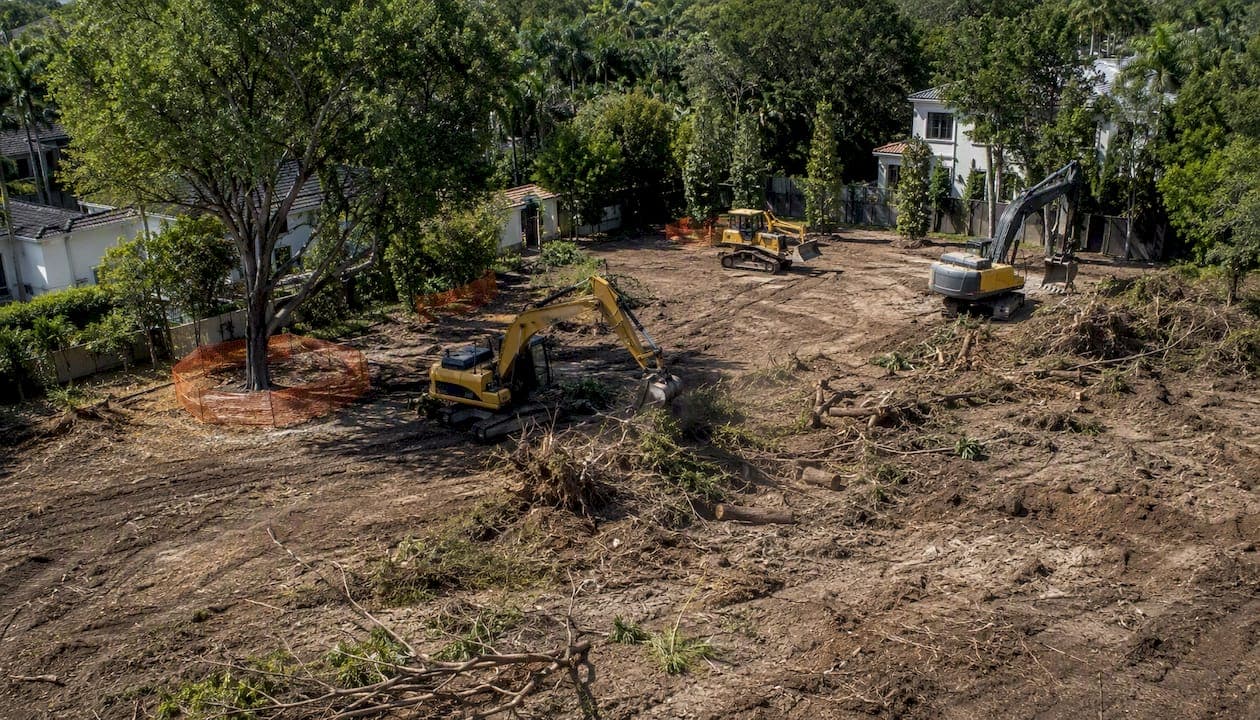
Lot clearing for construction is the site-preparation work that turns raw land into a construction-ready building pad, complete with stump management, rough grading, erosion controls, and safe equipment access. Residential lot clearing costs vary widely depending on tree density, stump counts, and regrading needs, with lighter wooded smaller lots generally costing less and denser or larger lots costing more. The single most important next step before any machine arrives: get a current property survey and call 811 to locate underground utilities.
A construction-ready lot delivers:
- A cleared, compacted building pad at the correct elevation
- Stumps ground to grade or below (typically 6–12 inches below finished grade for slab foundations)
- Silt fence and a gravel construction entrance installed
- Retained trees flagged and protected within their driplines
- Rough drainage established away from the building footprint
Pro Tip: Schedule your survey and 811 utility locate at least two weeks before your clearing date. Utility locates expire, and a re-mark takes time you may not have when your contractor is already mobilized.
Key Takeaways
Lot clearing for construction requires a coordinated sequence of survey, permits, method selection, and erosion-control installation to deliver a pad your builder can use on day one.
| Point | Details |
|---|---|
| Survey and 811 first | Get a current property survey and call 811 for utility locates before any equipment arrives. |
| Match method to foundation | Use grub-and-haul for basements; forestry mulching works for most slab foundations on wooded lots. |
| Budget $1,500 per acre | Final cost depends on tree density, stump count, regrading needs, and haul distance. |
| Require construction-ready deliverables | Specify stump depth, erosion controls, and compaction tolerance in the written contract. |
| Brileytreeservice for North Louisiana | Brileytreeservice provides land clearing, forestry mulching, stump grinding, and erosion-control installation with licensed, insured crews and free estimates. |
Table of Contents
- What lot clearing for construction actually includes (and what it doesn't)
- How to assess the lot before any machine arrives
- The main clearing methods and when each one fits your site
- What equipment is used and how site access affects your price
- Realistic costs and timelines for residential lot clearing
- Grading, erosion controls, and protecting trees that will stay
- How to vet and hire a lot-clearing contractor
- When DIY clearing makes sense and when it doesn't
- What to expect the day(s) of clearing and at final handoff
- How lot clearing affects soil quality and what to do about it
- Brileytreeservice handles lot clearing from first cut to construction-ready pad
- Authoritative resources and where to go next
- Sources
What lot clearing for construction actually includes (and what it doesn't)
Lot clearing for construction is not the same as brush removal or a simple tree-cutting job. Construction-grade clearing produces a specific deliverable: a pad your builder can stake, inspect, and build on. The scope includes vegetation removal, stump management, debris hauling, rough grading, and erosion-control preparation. What it produces is a compacted building pad within tolerance, drainage established to carry water away from the foundation, and silt fence plus a gravel construction entrance where local permits require them.
Several items commonly fall outside a standard clearing quote. Deep basement excavation, mass grading for subdivisions, long utility runs, and topsoil import are almost always billed separately. Knowing that distinction before you sign a contract prevents budget surprises.
What a typical clearing scope includes vs. what is billed separately:
| Typically Included | Usually Billed Separately |
|---|---|
| Vegetation removal (trees, brush, stumps) | Deep basement excavation |
| Stump grinding to grade | Mass grading for multi-lot subdivisions |
| Debris hauling and disposal | Utility trenching and relocation |
| Rough grading of building pad | Topsoil import or soil amendment |
| Silt fence installation | Retaining walls |
| Gravel construction entrance | Driveway paving or base prep |
| Tree-save flagging and fencing | Septic system installation |
Construction-ready checklist your builder expects on day one:
- Survey stakes visible and undisturbed
- Building pad cleared, rough-graded, and compacted
- All stumps ground below finished grade
- Silt fence installed on the downhill perimeter
- Gravel construction entrance in place at the access point
- Retained trees marked with high-visibility flagging and fenced within driplines
- Disposal tickets and site photos available for permit review
How to assess the lot before any machine arrives
Skipping prework is the fastest way to blow your clearing budget and your build schedule. A lot-clearing checklist used by regional contractors shows that a residential lot moves from survey to build-ready in roughly 4–8 weeks when permits and scheduling are coordinated. That window shrinks fast when any step is out of order.
Work through these steps in sequence:
- Commission a current property survey. Confirm boundary lines before any vegetation is removed. Clearing across a property line creates legal liability.
- Obtain a site plan or plot plan. Your builder or civil engineer will need this to place the building footprint and confirm setbacks.
- Stake the building footprint. Mark the corners of the proposed structure so the clearing crew knows exactly what area to clear and what to protect.
- Call 811 for utility locates. Federal law requires this before any ground disturbance. Allow at least three business days for marking; re-mark if more than 14 days pass before work begins.
- Verify permit requirements. Land-disturbance permits, tree-removal permits, and erosion-control plans are triggered by different thresholds depending on your county or municipality. Check with your local building department before mobilizing.
- Map trees to be retained. Walk the lot with your contractor and flag every tree that will remain. These trees need protection fencing before clearing begins.
- Check HOA and watershed restrictions. Some HOAs restrict clearing windows or require specific erosion-control methods. Watershed overlay districts may require a separate environmental review.
Responsibility typically breaks down this way: the owner commissions the survey and site plan, the builder or civil engineer handles the erosion-control plan, and the clearing contractor installs erosion controls and performs the work. Confirming who handles each item in writing before work starts prevents gaps.
Pro Tip: Schedule clearing the same week your erosion-control permit is approved. Clearing without approved controls in place is a common cause of stop-work orders, especially after rain. Practical builder-facing guides recommend scheduling clearing immediately after permit approval to avoid that risk.
The main clearing methods and when each one fits your site
Choosing the wrong clearing method for your foundation type or lot conditions adds cost and can compromise compaction. Each method has a distinct profile for speed, debris handling, and suitability.
Forestry mulching
A forestry mulcher grinds trees, brush, and stumps in a single pass, leaving a layer of wood chips on the ground. It is fast, produces no haul-off debris, and causes minimal soil disturbance. The USDA Forest Service notes that mulching can support soil retention and reduce erosion on slopes when managed correctly.
- Best for: Slab foundations on lightly to moderately wooded lots where the mulch layer will be graded off or incorporated
- Avoid for: Full basements (stumps must be fully removed, not ground in place), lots with very large-diameter trees (24+ inches), or sites where the mulch layer would interfere with compaction
- Stump handling: Ground in place, typically 6–12 inches below grade; may require a separate grind pass on large stumps
- Erosion risk: Low, because ground cover is maintained
Grub-and-haul (dozer or excavator)
An excavator or dozer pushes and pulls trees, stumps, and root balls out of the ground, then loads them for haul-off. This method removes organic material completely, which is critical for sites requiring deep compaction or full basement construction.
- Best for: Full basements, heavily wooded lots, or any site where organic material in the soil would cause settlement under a foundation
- Avoid for: Sloped lots where dozer work would cause significant erosion without immediate controls
- Stump handling: Root balls extracted and hauled; no residual organic material in the pad
- Erosion risk: Higher; silt fence and erosion controls must be installed the same day clearing ends
Cut-and-grind
Chainsaw crews fell trees, then a separate stump grinder follows. Debris is chipped or hauled depending on volume. This method gives the most control over what stays and what goes.
- Best for: Selective clearing where some trees are retained, or lots with mixed vegetation where a mulcher would damage retained specimens
- Avoid for: Dense lots where the two-step process becomes slower and more expensive than mulching
- Stump handling: Ground separately, typically 6–12 inches below grade; depth can be specified per stump
- Erosion risk: Moderate; depends on how much bare soil is exposed between felling and grinding
Hand clearing
Chainsaw crews without heavy equipment. Practical only for small areas, tight access situations, or selective removal of specific trees.
- Best for: Lots with no heavy-equipment access, or small areas adjacent to retained structures
- Avoid for: Any lot larger than a quarter acre with significant tree density
- Stump handling: Grinding is a separate mobilization; stumps can also be chemically treated, though this is not suitable for construction timelines
- Erosion risk: Lowest soil disturbance, but slowest and most expensive per tree
For most residential construction lots in the South and Southeast, forestry mulching handles lightly to moderately wooded sites efficiently, while grub-and-haul is the right call for basement foundations or heavily wooded parcels where organic material in the pad would cause long-term settlement problems.
What equipment is used and how site access affects your price
Standard site-clearing equipment includes excavators, bulldozers, forestry mulchers, stump grinders, skid steers, and tractors. Each machine has a specific role, and the mix your contractor brings depends on the method and the lot.
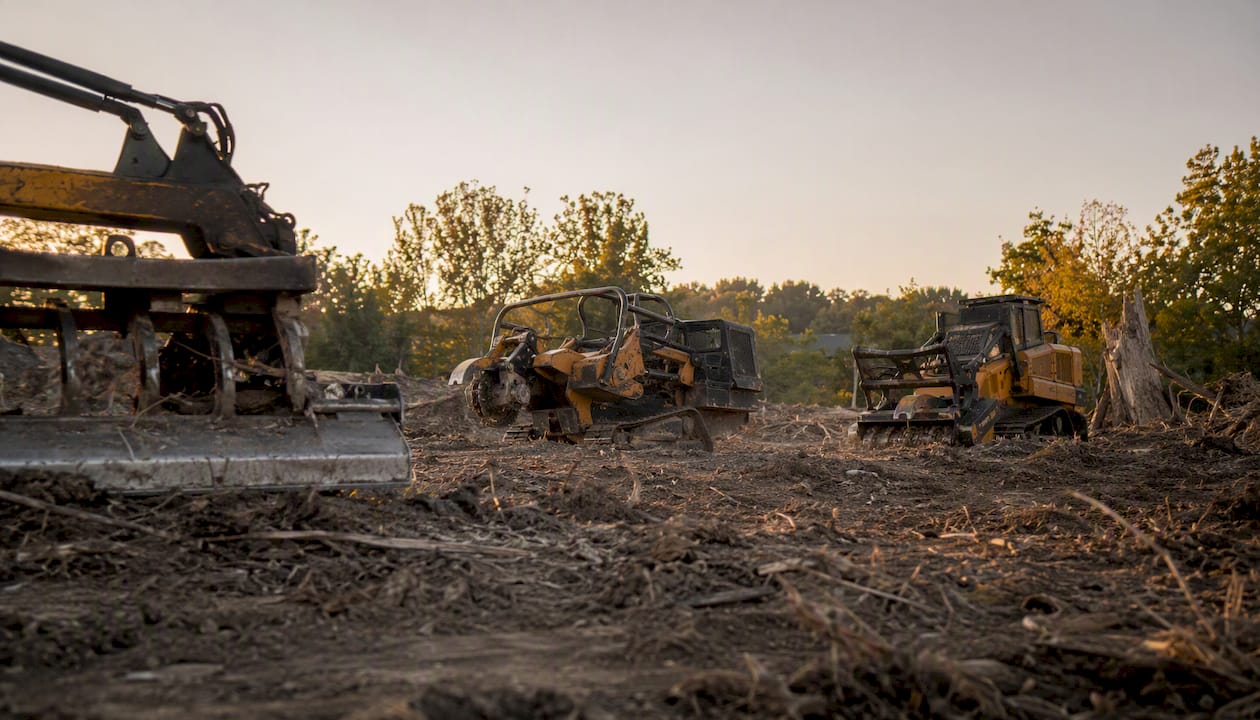
A forestry mulcher mounted on a tracked carrier handles trees up to roughly 12–18 inches in diameter in a single pass. An excavator with a root rake pulls stumps and root balls cleanly. A dozer pushes debris into piles for loading. A stump grinder follows cut-and-grind crews to remove stumps below grade. A skid steer handles debris loading and fine grading in tight spaces.
Access constraints are one of the most underestimated cost drivers in clearing bids. Before the crew arrives, confirm:
- Gate and driveway width. Most tracked equipment needs at least 10–12 feet of clear width. Narrow gates require smaller machines, which take longer and cost more.
- Overhead utilities. Power lines along the access route limit boom height and may require a utility company to temporarily de-energize lines.
- Distance from the road to the clearing area. Long haul distances for debris increase trucking costs.
- Staging area. The crew needs a place to park equipment, load debris, and store materials. A 30x50-foot area is a practical minimum.
- Temporary gravel entrance. If no hard-surface driveway exists, a gravel construction entrance is typically required by permit before any equipment rolls onto the lot.
When access is limited, contractors may use smaller equipment, require hand work in tight areas, or charge additional mobilization fees. Get these details in writing before signing a contract. If heavy equipment will cross a neighbor's private road or easement, notify the neighbor in advance and confirm the contractor carries liability insurance that covers that exposure. For more on protecting your property and retained trees during this process, see how to prepare your yard for tree removal.
Realistic costs and timelines for residential lot clearing
Cost ranges vary by method, lot size, tree density, and regional labor rates. The figures below reflect typical residential clearing in the South and Southeast; costs in higher-labor markets will run higher.
Regional contractor guides confirm that mulching with targeted stump grinding typically costs less per acre than full grub-and-haul, while mass grading for basements or subdivisions can add several thousand dollars per acre to the total.
Primary cost drivers:
- Lot size. Most contractors price per acre; partial acres are usually rounded up.
- Tree density and diameter. More trees and larger-diameter trees mean more machine time and more debris to haul.
- Distance to disposal. Longer haul distances increase trucking costs. On-site chipping or mulching eliminates haul-off but may not be suitable for all foundation types.
- Regrading needs. Significant elevation changes require more dozer or grader time and may require engineered fill.
- Soil type. Rocky or clay-heavy soils slow equipment and may require specialized attachments.
- Permit and inspection fees. Land-disturbance permits, erosion-control plan review, and inspection fees vary by jurisdiction and add to the total project cost.
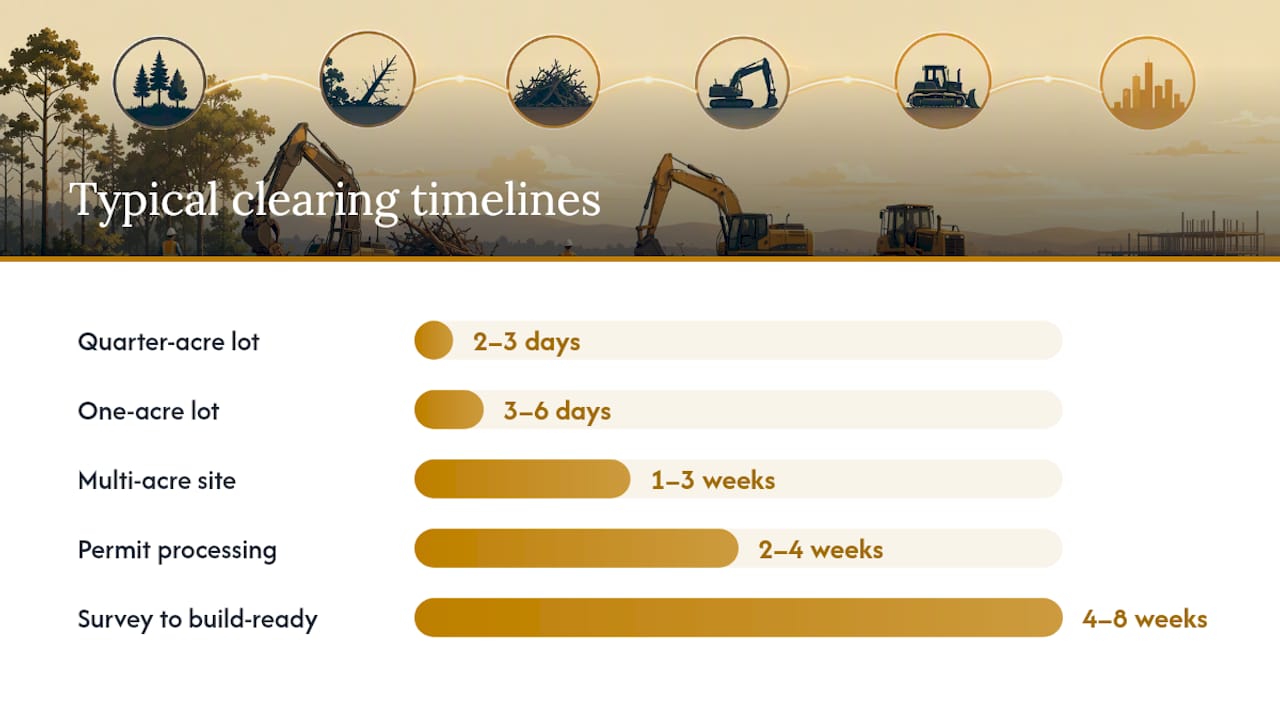
Typical timelines by lot size:
- Quarter-acre lot, lightly wooded: 1–2 days of clearing plus 1 day for grading and erosion-control installation
- One-acre lot, moderately wooded: 2–4 days of clearing, 1–2 days for grading and controls
- Multi-acre site, heavily wooded: 1–3 weeks depending on method and debris volume
Add 2–4 weeks for permit processing before mobilization, and budget a 1-week buffer for weather delays. The full sequence from survey to build-ready typically runs 4–8 weeks when permits are included.
What to look for in a line-item estimate:
- Mobilization and demobilization listed separately
- Stump grinding depth specified (not just "stumps removed")
- Hauling and disposal fees itemized, not bundled
- Erosion-control installation listed as a line item
- Permit coordination responsibility clearly assigned
Hidden costs to watch for: utility relocation (not included in clearing), topsoil replacement after grading, and re-inspection fees if erosion controls fail a first inspection.
Understanding how your clearing costs fit into the overall build budget is easier when you know how home construction bids work and how site-prep line items are typically treated in a construction loan draw schedule.
Grading, erosion controls, and protecting trees that will stay
A cleared pad is not a construction-ready pad until grading, compaction, and erosion controls are in place. Builders expect the pad to be within a few inches of finished grade, compacted to a specification their engineer will confirm, and draining away from the building footprint. Any standing water on the pad after a rain is a sign that grading is incomplete.
Erosion and sediment controls are required on virtually every residential construction site that disturbs more than a threshold area (often one acre under federal rules, but many counties set lower thresholds). Standard controls include:
- Silt fence on the downhill perimeter of disturbed areas
- Sediment traps or basins at drainage outlets
- Straw wattles or erosion matting on slopes steeper than 3:1
- A gravel construction entrance to prevent tracking mud onto public roads
- Dust control (water application or tackifier) on dry, windy sites
The ARCAT site-clearing specification lists tree protection, erosion control, and siltation control as required elements of a clearing plan, including temporary tree guards and restrictions on equipment traffic within the dripline of retained trees. That spec is a practical reference for what to include in your contract language.
The ARCAT site-clearing spec reframes "quality" of clearing to include protecting retained trees and keeping the work area controlled for erosion and dust, not just removing vegetation. A clearing contractor who does not address both is delivering an incomplete scope.
Tree protection measures for retained trees must be in place before clearing begins, not after. Standard practice:
- Install temporary fencing (orange construction fence or wooden stakes with wire) at the dripline of every retained tree
- Post "Tree Save" signs on the fencing
- Prohibit equipment, material storage, and soil disturbance within the fenced area
- Avoid cutting roots larger than two inches in diameter within the dripline
For more detail on protecting trees during active site work, see how to protect your garden during tree removal. If a retained tree is close to the proposed structure, review tree too close to your house before finalizing the tree-save plan.
How to vet and hire a lot-clearing contractor
A clearing contractor who delivers an incomplete scope or skips erosion controls can cost you a stop-work order, a failed inspection, and weeks of schedule delay. Vet every bidder before you sign.
Contractor vetting checklist:
- Current general liability insurance (minimum $1 million per occurrence; ask for a certificate naming you as additionally insured)
- Workers' compensation coverage for all crew members
- Valid business license in your state or county
- Local references from construction-clearing jobs (not just residential tree removal)
- Evidence of equipment ownership or reliable subcontractor relationships
- Written cleanup and debris-disposal policy
Scope items to require in every quote:
- Mobilization and demobilization fees
- Clearing method specified (mulching, grub-and-haul, cut-and-grind)
- Stump grinding depth (specify minimum 6 inches below finished grade for slab, 12 inches for crawlspace or basement)
- Hauling and disposal fees, including landfill or recycling facility name
- Erosion-control installation (silt fence linear footage, gravel entrance dimensions)
- Tree-save fencing installation and removal
- Rough grading to within specified tolerance of finished grade
- Restoration seeding or mulching of disturbed areas not covered by construction
- Permit coordination responsibility (who pulls the land-disturbance permit)
Questions to ask on the site walk:
- How do you handle stumps for a slab foundation versus a full basement?
- What is your process if you encounter an unmarked utility line?
- Who installs the silt fence, and when?
- What does your final walk-through include before you demobilize?
- Can you provide disposal tickets for all hauled material?
Red flags that indicate an incomplete scope or unsafe operation:
- No mention of erosion controls in the quote
- Stump removal listed without a specified depth
- Hauling listed as "included" with no tonnage or trip estimate
- No certificate of insurance provided on request
- Verbal-only scope with no written estimate
When comparing bids, ask every contractor to provide a line-item breakdown. A lump-sum bid makes it impossible to know what is and is not included. If a bid is significantly lower than others, ask which line items were excluded before assuming it is the better deal.
When DIY clearing makes sense and when it doesn't
DIY clearing is practical in a narrow set of circumstances. For most construction lots, it is not the right call.
DIY may be reasonable when:
- The lot is under a quarter acre with light brush and small-diameter trees (under 6 inches)
- No trees are within falling distance of structures, utilities, or neighbors
- No permits are required for the disturbance area
- The foundation type does not require deep stump removal or engineered compaction
- You have experience operating a chainsaw and small equipment safely
Hire a professional when:
- Any tree is over 8 inches in diameter or taller than 30 feet
- Underground utilities are present anywhere on the lot
- A land-disturbance or erosion-control permit is required
- The foundation requires compaction to a specified tolerance
- The lot is larger than a quarter acre with moderate to heavy vegetation
Safety is the primary reason to hire. Chainsaw injuries are among the most severe in residential construction work, and operating a rented skid steer or mini-excavator without training creates real liability. A licensed, insured contractor carries the risk; a DIYer does not. For a detailed look at worksite safety standards, see tree service worksite safety.
On the cost side, the math rarely favors DIY on a construction lot. Equipment rental for a chainsaw, stump grinder, and debris chipper for a week can run $1,500–$3,000 before fuel and disposal fees. A professional crew with the right equipment often completes the same work faster, with better compaction results and no personal liability exposure.
Soil compaction is a specific risk with inexperienced equipment operators. Running heavy equipment over wet soil, or making repeated passes in the same area, creates compaction problems that can affect foundation performance. Experienced operators know how to minimize this; first-time renters typically do not.
What to expect the day(s) of clearing and at final handoff
Knowing what happens on clearing day helps you verify the work is complete and hand off a clean site to your builder.
- Mobilization morning. The crew arrives with equipment and materials. Confirm the gravel construction entrance is installed before any equipment rolls onto the lot. Verify that tree-save fencing is in place before clearing begins.
- Clearing phase. The crew works from the building pad outward. Retained trees and their fencing are avoided. Utility flags are respected and not disturbed.
- Stump grinding. Follows clearing, either the same day or the next. Confirm grinding depth with the operator before they begin. For stump grinding's role in protecting the building pad, see how stump grinding protects commercial lots.
- Debris hauling. Loads are hauled to a permitted facility. Request disposal tickets for each load.
- Rough grading. The pad is graded to within tolerance of finished grade. Drainage is established away from the building footprint.
- Erosion-control installation. Silt fence is installed on the downhill perimeter. Sediment traps are placed at drainage outlets. The gravel entrance is confirmed in place.
- Final walk-through. Walk the site with the contractor before they demobilize. Confirm stakes are visible, the pad is clear, retained trees are undamaged, and all controls are installed.
Neighborhood notification: Notify adjacent neighbors at least 48 hours before clearing begins. Let them know the expected start time, duration, and the type of equipment being used. For commercial or neighbor-sensitive sites, review plan tree removal to minimize business disruption for scheduling and communication best practices.
Final documentation the contractor should provide:
- Before-and-after site photos
- Disposal tickets for all hauled material
- Signed work scope acceptance
- Certificate of insurance (if not already on file)
What to verify with your builder the morning after clearing:
- Survey stakes are visible and undisturbed
- Building pad is compacted and free of organic material
- No retained trees show equipment damage within the dripline
- Erosion controls are intact and properly installed
How lot clearing affects soil quality and what to do about it
Clearing a lot for construction changes the soil in ways that matter for long-term foundation performance. Removing ground cover exposes topsoil to erosion. Heavy equipment compacts the upper soil layers, reducing permeability and increasing runoff. Stump removal leaves voids that can settle over time if not properly backfilled and compacted.
The most significant risk is topsoil loss. Topsoil contains the organic matter and microbial activity that support plant growth, but it also tends to be the loosest, least stable layer for foundation support. On construction sites, topsoil is typically stripped from the building pad area and stockpiled for later use in landscaping. Stripping it from the pad is correct practice for foundation stability; losing it to erosion off the site wastes a resource and creates a permit violation.
Practical soil preservation steps:
- Stockpile stripped topsoil on-site in a designated area, away from drainage paths, and cover it with erosion matting or silt fence
- Limit equipment traffic to designated routes to reduce compaction outside the building pad
- Seed or mulch any disturbed areas not covered by construction within 14 days of clearing to prevent erosion
- Specify in the contract that topsoil stripped from the pad will be stockpiled and returned to non-pad areas after construction
For areas outside the building pad, soil restoration after clearing involves breaking up compacted layers with a subsoiler or aerator, incorporating organic matter, and seeding with an appropriate grass or cover crop mix. This is especially relevant for lots where the cleared area extends well beyond the building footprint into future lawn or landscaping areas.
Grading that directs drainage away from the foundation also protects soil stability long-term. Positive drainage (sloping away from the building at a minimum of 6 inches over the first 10 feet) prevents water from pooling against the foundation and saturating the soil beneath the slab or footings.
What most homeowners get wrong about clearing timing
The most common cause of build-date slips is not permit delays or contractor availability. It is clearing that was scoped too late, too loosely, or without coordination with the builder's foundation schedule. A clearing crew that arrives without a confirmed erosion-control permit, or a scope that omits stump depth specifications, can push a foundation start by weeks.
Local availability in Northwest Louisiana and the surrounding region tends to tighten in spring, when demand from new residential construction peaks. Booking a clearing crew in January or February for a March or April start gives you the best chance of hitting your foundation date. Waiting until the week before the builder needs the pad is a reliable way to end up in a queue.
The other mistake is treating clearing and grading as separate events. On most residential lots, the clearing crew and the grading crew should be coordinated so rough grading follows clearing by no more than a day or two. Leaving a freshly cleared, bare-soil pad exposed over a weekend before grading is an erosion risk and, in some jurisdictions, a permit violation.
Coordinate permits, survey, and contractor scheduling before mobilization. That sequence is not bureaucratic overhead. It is the difference between a pad that is ready when your builder shows up and one that needs rework.
Brileytreeservice handles lot clearing from first cut to construction-ready pad
Brileytreeservice offers land clearing, forestry mulching, stump grinding to grade, and erosion-control installation for residential and commercial properties throughout Shreveport, Bossier City, Ruston, and surrounding North Louisiana areas. The team is licensed and insured, with direct experience coordinating clearing scopes with builders and permit offices in Northwest Louisiana.

A free estimate from Brileytreeservice includes a site walk, a line-item scope covering clearing method, stump depth, hauling, and erosion-control installation, a timeline, and a mobilization plan. The crew shows up on time, cleans up after every job, and provides disposal tickets and site photos at handoff. For homeowners and developers who need a construction-ready pad on a firm schedule, that level of coordination matters. Schedule a free estimate and get your lot clearing scoped before the spring construction season fills the calendar.
Authoritative resources and where to go next
The sources below are the most useful references for permits, specifications, and further reading on site clearing for construction.
- ARCAT site-clearing specification: The standard construction spec for tree protection, erosion control, and siltation control. Use it as a template for contract language and to understand what inspectors expect.
- EPA sustainable management of C&D materials: Guidance on recycling green waste, wood chips, and concrete from clearing and demolition. Relevant when your permit requires a waste-management plan.
- USDA Forest Service: Broader land-management and forestry mulching context for wooded parcel conversions and ecological impact considerations.
- SafetyCulture: site clearing overview: Practical summary of site-clearing tasks, equipment, and safety considerations.
- NKY lot-clearing checklist: A nine-step contractor checklist covering survey through final inspection, with timeline guidance.
- Cut Brush: land clearing for new construction: Regional guide with cost bands, sequencing advice, and scheduling recommendations for new-home lot clearing.
When to consult a civil engineer or erosion-control specialist: If your lot has slopes steeper than 3:1, is within a regulated watershed or floodplain, disturbs more than one acre, or requires a formal stormwater pollution prevention plan (SWPPP), bring in a licensed civil engineer before clearing begins. A clearing contractor can install silt fence; only a licensed engineer can stamp an erosion-control plan that satisfies state environmental agency review. For homeowners budgeting site-prep costs within a broader construction loan, reviewing construction financing options before committing to a clearing scope helps ensure the full site-prep budget is accounted for in the draw schedule.
Sources
Anchoring your clearing scope to recognized standards reduces inspection risk and gives your contractor clear performance targets.
The ARCAT site-clearing specification is a widely referenced construction specification that covers tree protection, erosion control, and siltation control as required elements of a clearing plan. It specifies measures such as encircling retained trees with temporary guards and restricting equipment traffic within driplines. Including language from this spec in your clearing contract gives the inspector a clear benchmark and gives you a basis for requiring corrective work if controls are missing.
The ARCAT spec defines site clearing quality not just as vegetation removal, but as a controlled process that protects retained trees and manages erosion and dust throughout the work. Contractors who treat clearing as "cut everything and go" are not meeting construction-grade standards.
The EPA's guidance on sustainable management of construction and demolition materials highlights opportunities to recycle green waste, wood chips, and concrete rather than sending everything to a landfill. On-site chipping for mulch, wood chip reuse, and concrete recycling are all options worth discussing with your contractor. Beyond cost savings, recycling C&D materials can satisfy local permit conditions that require a waste-management plan.
USDA Forest Service resources provide broader context on forestry mulching's ecological impact and land-management practices relevant to converting wooded parcels to construction sites. These resources are particularly useful when a project involves significant tree canopy removal and local permits require an environmental assessment or mitigation plan.
How these standards affect your project: local land-disturbance permits increasingly reference EPA and state-level erosion-control standards. A clearing contractor who is familiar with these references will produce a scope that satisfies inspectors on the first review, reducing the risk of stop-work orders or required rework.
- Land Clearing for New Construction in NC: 2026 Guide | Cut Brush
- Lot Clearing Before Building | NKY Checklist
- What is Site Clearing and How is it Done? | SafetyCulture
- Sustainable management of construction and demolition materials | EPA
- Fs