
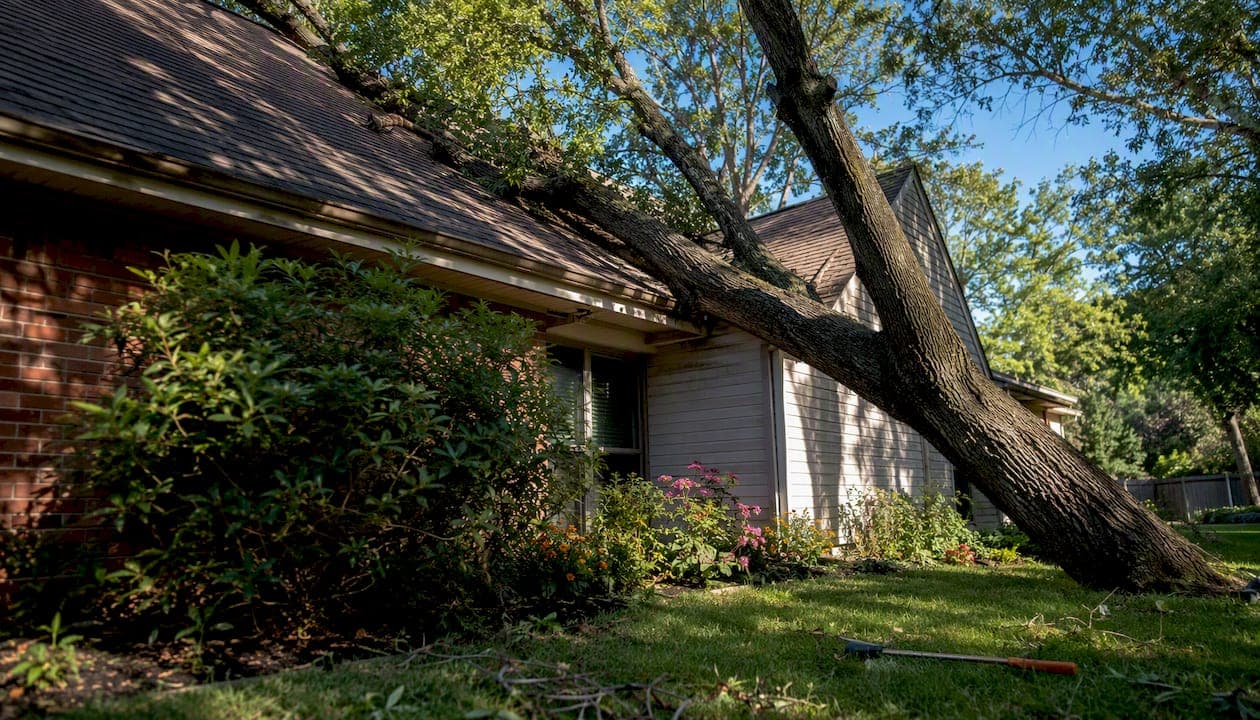
If a tree's trunk or canopy sits within 15–20 feet of your house, treat it as a potential risk until a professional says otherwise. That's the short answer. The longer one depends on the tree's species, size, visible condition, and how close it actually is to your foundation, roof, and utility lines.
Take these steps right now, before calling anyone:
- Measure the distance from the trunk to your foundation and note whether any branches extend over the roofline.
- Walk the perimeter and photograph any cracks in the foundation, lifted pavement, or soil heave near the base of the tree.
- Check the trunk for visible lean toward the house, fungal growth, or large dead limbs.
Pro Tip: Take photos in good daylight from multiple angles — wide shots showing the full tree relative to the house, plus close-ups of any cracks, root heave, or decay. These images are exactly what an arborist and your insurance adjuster will ask for first.
If any branches are actively touching the roof or siding, or if the tree shows a sudden new lean, keep people and vehicles away from that side of the house and call a certified arborist the same day.
Key Takeaways
A tree too close to your house is a structural and safety risk that gets more expensive the longer it goes unaddressed.
| Point | Details |
|---|---|
| Distance rules by size | Small trees need 8–15 ft clearance; medium trees 15–25 ft; large trees 20–30+ ft from the house wall. |
| Root reach exceeds canopy | Roots spread 2–3 times the canopy width; if the canopy overhangs the roof, roots likely reach the foundation. |
| Key red flags | Foundation cracks, lifted pavement, gutter clogging, trunk lean, and fungal growth all call for immediate arborist review. |
| Call 811 before digging | Always call 811 at least two business days before installing root barriers or planting replacement trees. |
| Brileytreeservice | Licensed and insured crews serving Shreveport, Bossier City, Ruston, and North Louisiana — free estimates available. |
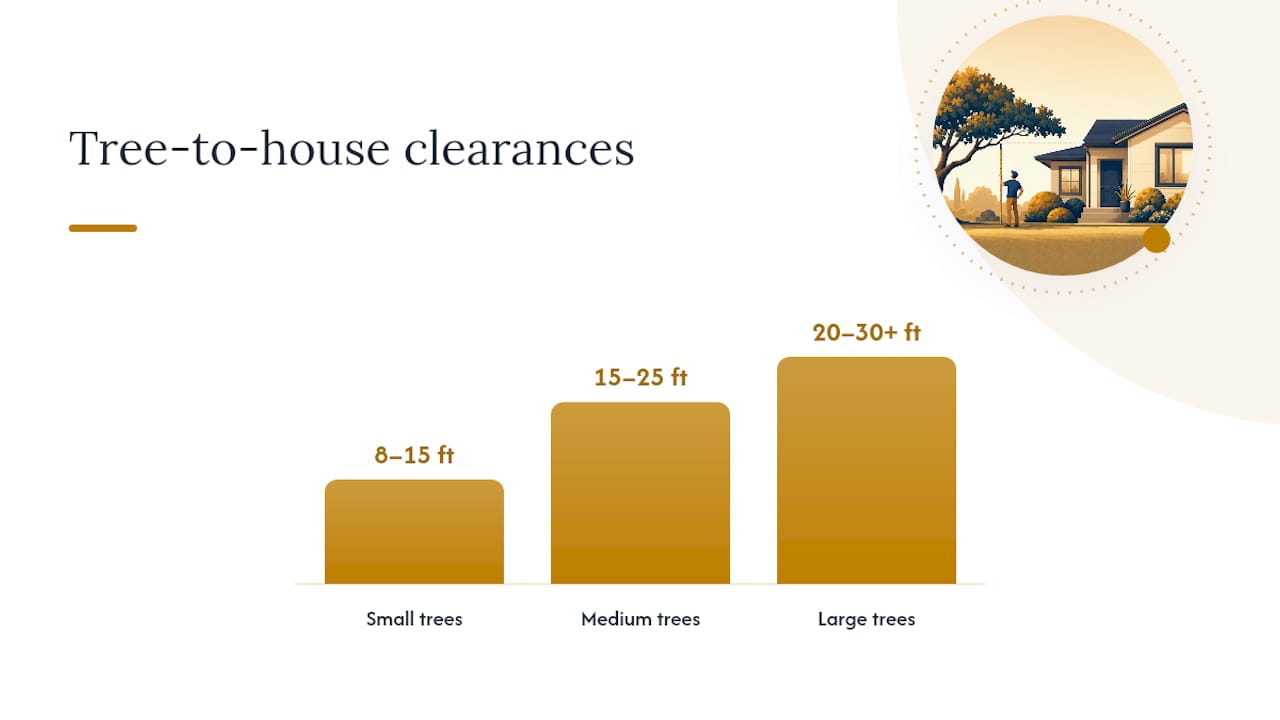
Table of Contents
- How a tree too close to your house can damage it
- How far should trees be from your house?
- Signs a nearby tree is already causing problems
- What are your options: pruning, root barriers, and removal
- When should you call a certified arborist?
- What you can safely do yourself and what to avoid
- Power lines, property lines, permits, and insurance
- Keeping trees healthy and safe after remedial work
- What most homeowners get wrong about trees near the house
- Brileytreeservice serves homeowners across North Louisiana
- Sources
How a tree too close to your house can damage it
The damage a nearby tree causes rarely happens overnight. It builds through several physical pathways, and knowing which ones apply to your situation tells you where to look first.
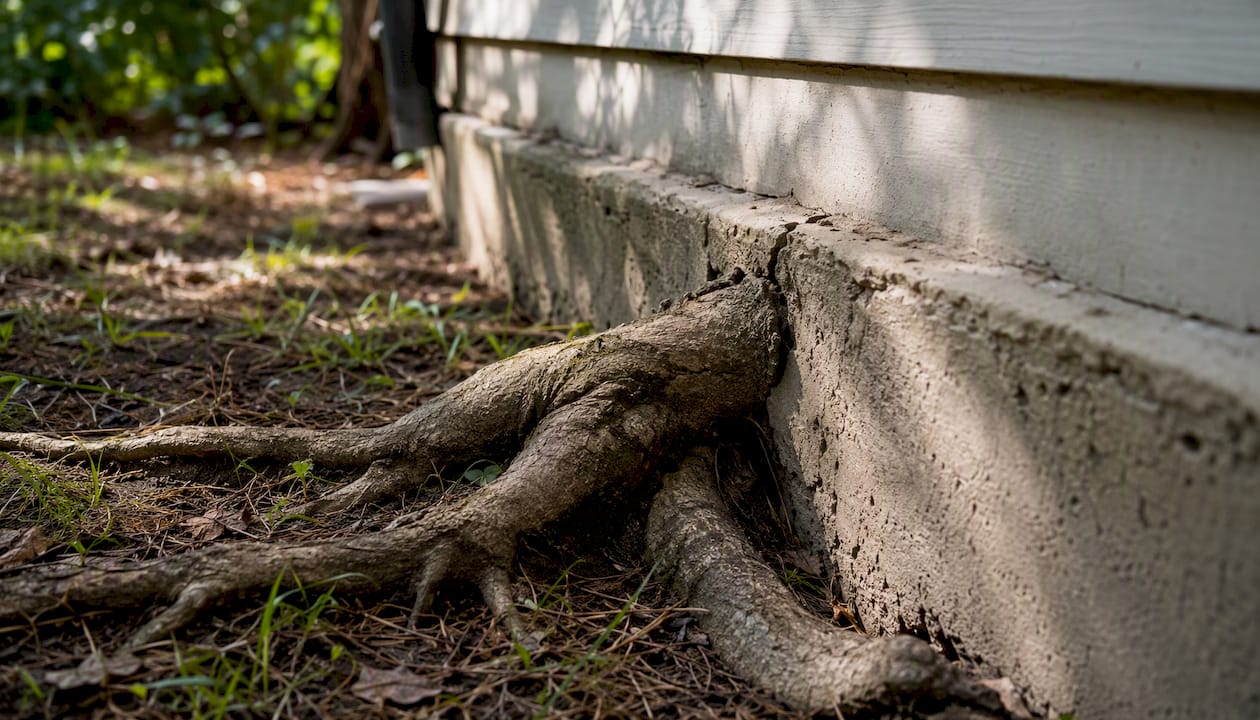
Root-related risks are the most serious and the least visible. Tree roots can spread two to three times as wide as the canopy, and most structural roots sit in the top three feet of soil, with absorbing roots concentrated in the top 12 inches. On clay soils, roots draw moisture from the ground unevenly, causing soil to shrink and shift under a slab or footing. On sandy soils, roots can physically displace material as they thicken. Either way, the foundation pays the price. Roots also follow water, which means cracked or older clay sewer pipes are a common target for root intrusion.
Aboveground risks are easier to spot. Branches that rub against shingles wear away the protective granule layer over time. Overhanging limbs drop debris into gutters, which blocks drainage and can cause ice dams in winter. Branches that touch siding create a direct moisture pathway, and where moisture stays, rot and mold follow.
If a tree's canopy already overhangs your roofline, roots are very likely extending under the foundation. Canopy spread and root spread track each other closely — what you see above ground reflects what is happening below it.
There is also a pest and wildlife dimension. Branches that reach the roofline give squirrels, raccoons, and carpenter ants a direct route into the attic. Dense shade from a nearby tree keeps siding and soil damp, which accelerates wood decay and encourages termite activity.
Species and soil type both affect how much risk a given tree actually poses. A deep-rooted oak on sandy soil behaves very differently from a shallow-rooted silver maple on clay. House construction matters too: a pier-and-beam foundation is more vulnerable to moisture shifts than a well-reinforced concrete slab.
How far should trees be from your house?
Distance rules are based on mature tree size, not current size. A sapling planted six feet from a wall may look harmless today and cause serious problems in 15 years.
The Arbor Day Foundation recommends planting small trees roughly 10–15 feet from a house wall, medium trees 15–25 feet, and larger trees 20–30 feet or more depending on mature spread. Missouri Extension guidance aligns closely: small trees at least 8–10 feet from walls, medium trees around 15 feet, and large trees 20 feet or more.
A practical urban-forestry rule: plant a tree at least as many feet from a structure as the tree's expected mature height. A tree that will reach 40 feet tall belongs at least 40 feet from the house.
Species exceptions matter as much as size. Silver maple, willow, and Bradford pear are commonly discouraged near homes because of invasive root systems, weak branch attachments, and higher structural failure risk. These species need larger setbacks than the table above suggests, and in many cases removal is the safer long-term choice.
Pro Tip: To estimate a tree's mature spread, look up the species' typical mature canopy width, then add that number to the trunk-to-house distance you measure today. If the projected canopy would overlap the foundation, you already have a problem in progress.
- Measure from the trunk base, not the outermost root flare.
- Account for the direction of lean — a tree leaning toward the house at 10 degrees covers ground faster than a vertical one.
- Check local extension service resources for species-specific mature size data in your region.
Signs a nearby tree is already causing problems
Some damage is obvious. Some requires a closer look. Work through this checklist before your arborist visit.
Foundation and structural signs:
- Stair-step or horizontal cracks in brick or block near the side of the house closest to the tree
- Bowed basement walls or a slab that feels uneven underfoot
- Doors or windows that have started sticking without an obvious weather-related cause
- Lifted or cracked sidewalks, driveways, or patio slabs near the root zone
Above-grade signs:
- Branches in contact with the roof, siding, or gutters
- Gutters that clog repeatedly in the same spot, even after cleaning
- Dark staining or soft spots on siding or fascia boards near overhanging limbs
- Fungi, mushrooms, or conks growing at the trunk base or on major roots — these signal internal decay
Tree condition signs:
- A lean toward the house that has increased noticeably in the past year
- Large dead branches (called "widow makers") in the upper canopy
- Exposed or lifting roots on the house side of the trunk
- Pest activity — carpenter ants, borers, or termite tubes on the bark
According to Dynasty Tree Experts, foundation cracks, lifted sidewalks, repeated gutter clogging, and canopy contact with the roof are the four clearest structural indicators that a tree has already crossed from a cosmetic concern into an active risk.
If the canopy extends over the roofline, Davey's arborist guidance notes that roots are very likely already extending under the foundation, which raises the urgency of a professional assessment.
Pro Tip: Photograph every sign you find with a tape measure or coin in the frame for scale. Number the photos and note where each was taken. An arborist can use this documentation to track whether damage is progressing between visits, and your insurer will want the same record.
What are your options: pruning, root barriers, and removal
The right fix depends on the tree's species, age, proximity, and the type of damage already present.
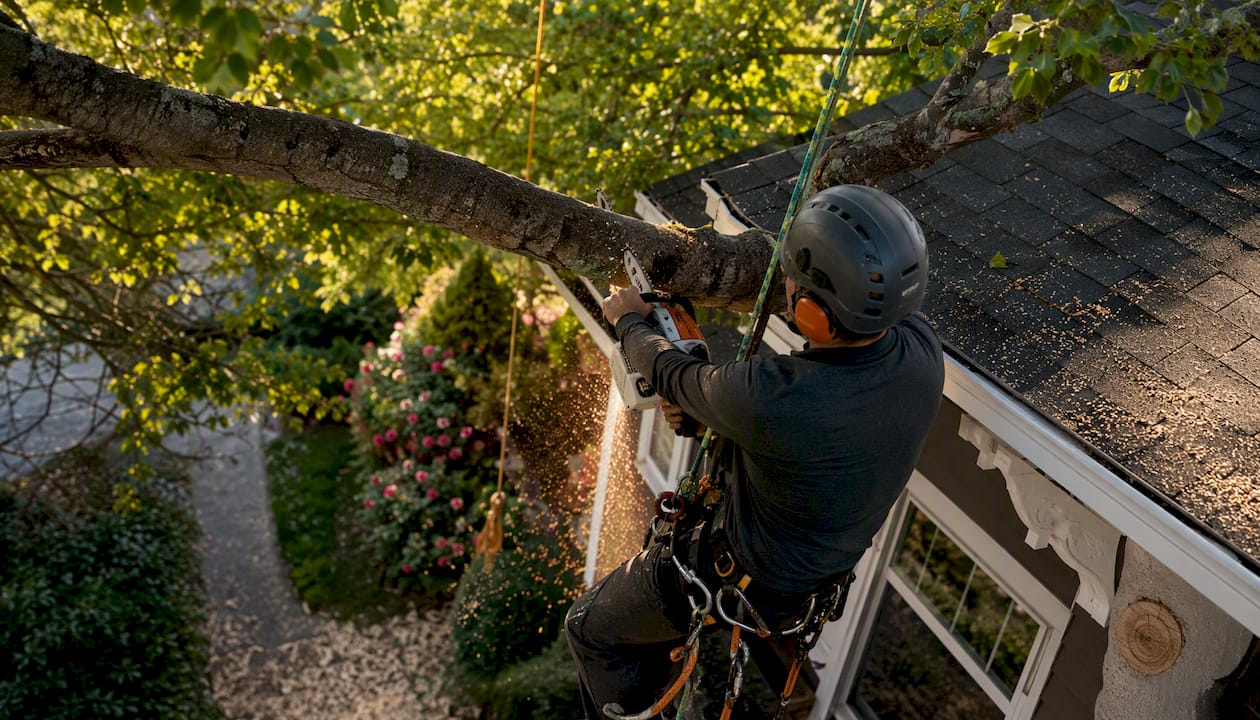
Pruning addresses aboveground hazards. Crown raising lifts the lower canopy away from the roof and siding. Crown reduction shortens the overall spread. Directional pruning steers new growth away from the structure. None of these options stop root growth, so pruning alone is not a solution when root damage is already present.
Root barriers work by redirecting roots downward and away from structures. They need to be installed to at least 24 inches of depth and are most effective when placed before significant root intrusion has occurred. For aggressive species like silver maple or willow, Dynasty Tree Experts note that barriers are less reliable and removal is often the more cost-effective long-term choice.
Transplanting is only realistic for young trees with a trunk diameter under roughly two inches. Mature trees rarely survive the process.
Full removal and stump grinding is the safest and most definitive option when the tree is large, in poor health, or an aggressive-rooted species within damaging distance. Removal eliminates both the aboveground and root risk over time. For guidance on preparing your yard for tree removal, clearing access and protecting nearby plantings ahead of the crew's arrival makes the job faster and cleaner.
Landscape impact is real but manageable. Removing a large tree opens the canopy, which can increase summer cooling costs slightly but also reduces moisture-related damage to siding and gutters. Replanting with a species suited to small yards and appropriate setback distances restores curb appeal without repeating the problem.
When should you call a certified arborist?
Call a professional arborist when any of the following are true:
- The tree leans toward the house and the lean has changed recently
- You see large dead branches, a hollow trunk, or fungal growth at the base
- Roots are visibly lifting pavement or the foundation shows new cracks
- Branches are within reach of power lines
- The tree is over 20 feet tall and within 15 feet of the structure
What credentials to look for. An ISA-certified arborist has passed a standardized exam covering tree biology, risk assessment, and pruning standards. Always confirm the crew is licensed and insured in your state. A professional tree risk assessment is not just pruning advice — it documents safety risk, provides a remediation plan, and supports insurance or permit processes.
What a proper assessment covers:
- Species identification and growth habit
- Soil type and drainage conditions around the root zone
- Root mapping and any visible root-to-structure conflict
- Decay detection (probing, mallet testing, or resistograph for large trees)
- Canopy condition and structural branch attachments
- Written remediation options with cost estimates and a recommended timeline
Questions to bring to the assessment:
- What is the species, and does it have an aggressive root system?
- How far have the roots likely spread based on canopy size?
- Is the damage I'm seeing active or stabilized?
- What are my options, and what happens if I do nothing for 12 months?
- Can you provide a written report I can share with my insurer?
Pro Tip: Red flags in a quote: no written scope of work, pressure to decide the same day, no proof of insurance, or a recommendation to "top" the tree. Topping is a harmful practice that creates decay entry points and structurally weak regrowth.
What you can safely do yourself and what to avoid
There is a clear line between routine homeowner maintenance and work that belongs to a professional.
Safe DIY tasks:
- Clearing debris and leaves from gutters
- Removing dead branches under one inch in diameter that are within easy arm's reach from the ground
- Visual inspections from the ground using binoculars for the upper canopy
- Watering and mulching to reduce root stress during drought
Never do these yourself:
- Work within 10 feet of any power line — this is utility company territory, and contact can be fatal
- Cut roots within the drip line of the tree; severing structural roots can destabilize a large tree within days
- Use a chainsaw on a ladder or on any branch larger than your wrist
- Top a tree under any circumstances
Incorrect pruning cuts, particularly flush cuts that remove the branch collar, create large wound surfaces that invite decay fungi. Once decay enters a structural limb or the trunk, the failure risk increases significantly and the damage is not reversible. Improper root cutting near the house side of a large tree can also trigger sudden lean or failure, which is far more dangerous than the original root problem.
Pro Tip: For safe techniques on trimming smaller branches yourself, this pruning guide covers the correct cut angles and tools for homeowner-scale work.
Power lines, property lines, permits, and insurance
Call 811 before you dig. Any time you plan to install a root barrier, dig a trench, or plant a replacement tree, call 811 at least two business days in advance. This free service marks underground utilities — gas, electric, water, and telecom lines — so you do not cut them. Hitting a buried line during root barrier installation is a real risk, and the liability falls on the homeowner.
Utility line rules. If branches are growing into power lines, do not attempt to trim them yourself. In most U.S. jurisdictions, the utility company controls trimming within the right-of-way around distribution lines. Contact your utility provider directly; they will either send a crew or authorize a licensed contractor. Working near energized lines without proper training and equipment is a leading cause of electrocution fatalities.
Property line basics. A tree whose trunk sits on your property is your responsibility. A tree straddling the property line is typically considered shared property under most state laws, and both owners share responsibility for maintenance and liability. You generally have the right to trim branches or roots that cross onto your property, up to the property line, as long as you do not kill the tree. State laws vary significantly, so check your local ordinances or consult an attorney before removing a shared or neighbor's tree. Document any communication with neighbors in writing.
Insurance basics. Most standard homeowner policies cover sudden, accidental damage from a fallen tree — a storm-downed tree that crushes a fence or roof is typically covered. Gradual damage from roots or slow decay is usually excluded as a maintenance issue. Insurers commonly request photos of the damage, a written arborist report, and documentation that the tree was not a known hazard before the loss. Proactive trimming creates a paper trail that supports your position if a claim is disputed.
Action checklist:
- Call 811 before any digging or root barrier installation.
- Contact your utility provider for any branch-to-power-line conflicts.
- Check your municipality's tree ordinance for permit requirements before removal.
- Notify your homeowner's insurer if a tree has caused damage; document everything in writing.
- Get a written arborist report before filing a claim — it strengthens your case.
Keeping trees healthy and safe after remedial work
Remedial work — pruning, root barriers, or removal — is not a one-time fix. Trees are living systems, and conditions change.
After pruning, inspect the cut sites at six months and again at 12 months. Healthy callus tissue should be forming around the wound edges. If decay is spreading from a cut site, that signals a deeper structural problem and warrants a follow-up arborist visit.
After root barrier installation, check the barrier annually for heaving or gaps, particularly after freeze-thaw cycles or heavy rain. Roots will find any gap, and a barrier that has shifted is no longer doing its job.
After removal, the remaining stump and root system will decay over several years. During that period, watch for soil subsidence near the stump, which can affect nearby pavement or structures as the root mass breaks down. Replanting in the same spot is generally not recommended for at least two years.
A practical maintenance schedule for any tree within 30 feet of a structure: visual inspection every spring and fall, professional arborist assessment every three to five years, and an immediate call to a pro after any major storm. Storm damage — broken limbs, root disturbance from saturated soil, or sudden lean — changes a tree's risk profile overnight. Routine maintenance best practices apply to residential properties just as much as commercial ones.
What most homeowners get wrong about trees near the house
Most homeowners focus on the branches they can see and miss the roots they cannot. A tree that looks healthy from the street can have roots actively undermining a foundation or sewer line. The canopy is the indicator, not the whole story.
The other common mistake is waiting. A tree that is borderline today — 18 feet from the foundation, moderate lean, no visible decay — becomes a much harder and more expensive problem at 12 feet with active root intrusion. The cost of a professional assessment is small compared to foundation repair, which can run well into five figures depending on the extent of damage.
There is also a tendency to over-rely on pruning as a universal solution. Pruning is the right answer for aboveground hazards. It does nothing for roots that are already under a slab. Homeowners who prune repeatedly without addressing the root issue are managing symptoms, not the problem.
Brileytreeservice serves homeowners across North Louisiana
When a tree near your home needs professional attention, Brileytreeservice handles the full scope: tree removal, trimming and pruning, stump grinding, land clearing, and 24/7 emergency storm cleanup for residential properties throughout Shreveport, Bossier City, Ruston, and surrounding North Louisiana areas. Every job is performed by a licensed and insured crew, and the team provides permit and insurance claim support when you need it.
A service visit includes a safety walkthrough, a written estimate, and full cleanup after the work is done. No debris left behind, no guesswork on scope. If you have a tree that is showing any of the warning signs covered in this article, request a free estimate from Brileytreeservice and get a clear, honest assessment of what needs to happen next.
Sources
Bring these resources to your arborist appointment or use them to check local rules before any work begins.
- Planting the Right Tree in the Right Place | Arbor Day Foundation
- How Do I Know If a Tree Is Too Close to My House? (Arborist's Guide) - Dynasty Tree Experts
- Trees You Should NOT Plant Near Your Home | The Spruce
- Missouri Extension planting and placement guide (g06900.pdf)