
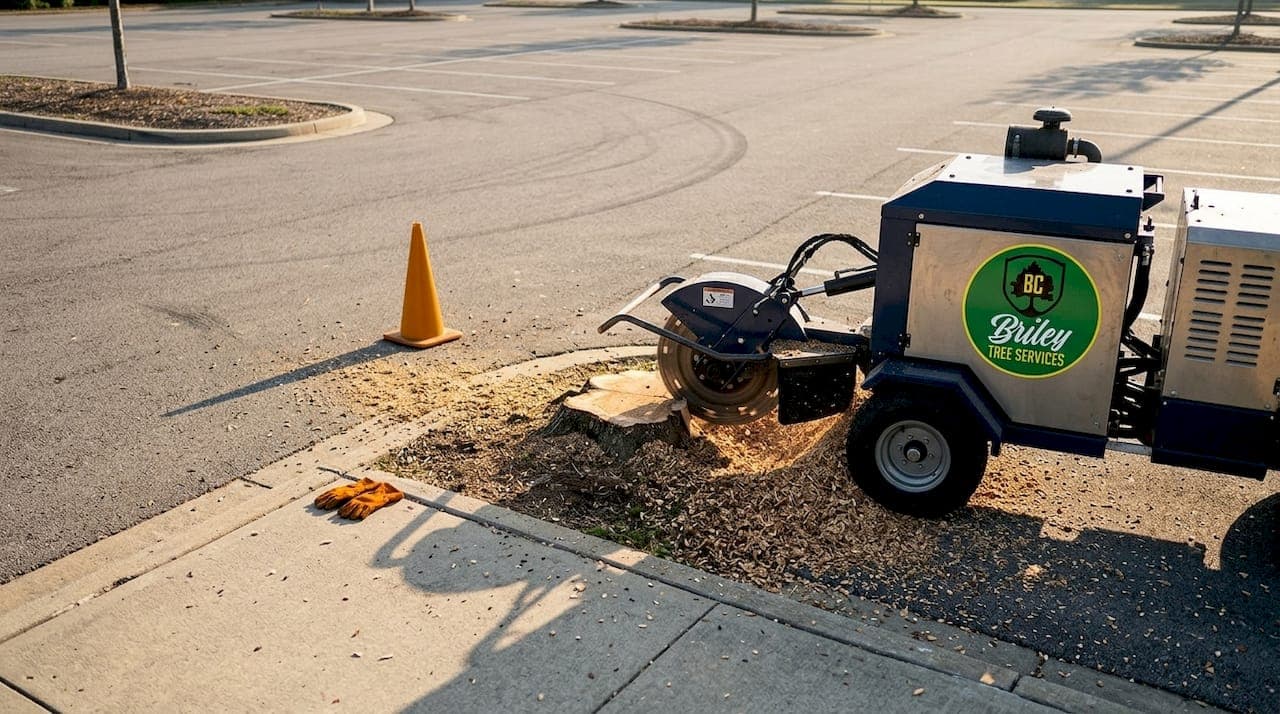
Stump grinding is the mechanical process of reducing tree stumps below ground level to protect commercial lots from safety hazards, pest infestations, and wasted space. Property managers who skip this step after tree removal leave their lots exposed to liability, accessibility violations, and structural damage from wood-boring insects. Understanding how stump grinding protects commercial lots is the first step toward making a sound maintenance decision. This article covers the physical, biological, and regulatory reasons why professional stump grinding belongs in every commercial lot maintenance plan.
How stump grinding protects commercial lots from physical hazards
Stumps left on commercial lots are trip hazards. They obstruct mowing equipment, create uneven ground near walkways, and generate liability exposure that no property manager wants to explain to an attorney. The risk is not theoretical. ADA accessibility standards require eliminating vertical changes exceeding 1/4 inch on pedestrian routes. A stump protruding even slightly above grade can put your property out of compliance and expose you to personal injury claims.
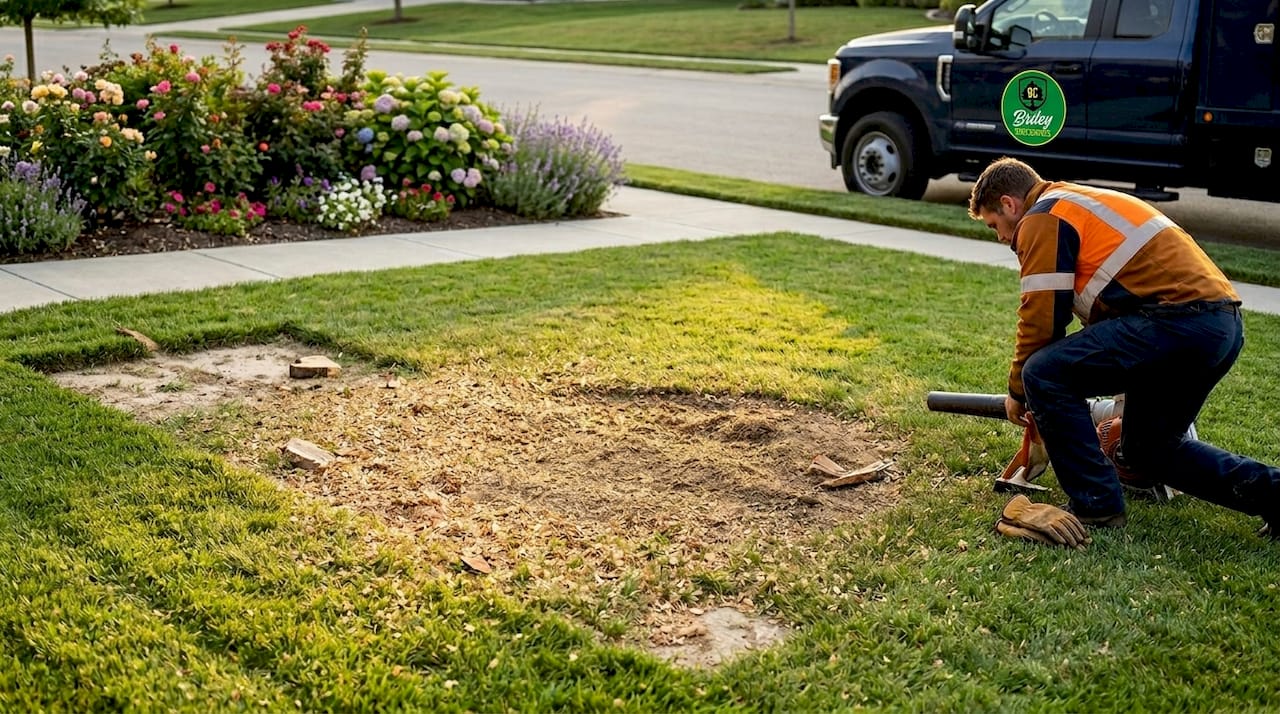
Grinding the stump below grade creates a level surface that meets accessibility requirements and removes the obstruction entirely. This matters most in high-traffic zones: parking lot islands, walkways near building entrances, and loading areas where foot traffic is constant. The wood chips produced during grinding can be raked back into the cavity, filling the void and leaving a smooth, stable surface.
Commercial property managers also face equipment damage risks when stumps are left in place. Mowing crews who hit a buried or partially buried stump can damage blades, delay maintenance schedules, and pass repair costs back to the property owner. Removing that risk entirely is a straightforward maintenance decision.
Key hazard categories that stump grinding eliminates:
- Trip and fall injuries on pedestrian routes
- ADA vertical change violations exceeding 1/4 inch
- Mowing equipment damage from hidden stump edges
- Obstructions in fire lanes and emergency access paths
- Uneven ground near parking lot curbs and islands
Pro Tip: Before grinding, walk the entire lot perimeter and flag every stump, including partially buried ones from previous removals. Crews cannot grind what they cannot see.
Does stump grinding improve commercial lot aesthetics and usability?
Yes. Decaying stumps are visually damaging to commercial properties. A rotting stump near a building entrance signals neglect to customers, tenants, and inspectors. Removing it through grinding reclaims that space for productive use and immediately improves the appearance of the lot.
Reclaiming space through stump removal gives commercial properties more flexibility for landscaping, additional parking, or expanded pedestrian areas. A single large stump in a parking lot island can block two to three parking spaces when you account for the safety buffer around it. Grinding that stump flat opens the space for replanting, paving, or simply cleaning up the lot layout.
The comparison between stump grinding and full stump removal matters here. Stump grinding leaves roots in place and produces wood chips rather than requiring excavation. Full stump removal extracts the entire root ball, which means significant ground disturbance, potential damage to nearby paving, and a larger restoration project. For most commercial lots, grinding is the right call because it delivers the visual and functional result without tearing up the surrounding surface.
Here is how the two methods compare for commercial applications:
| Factor | Stump grinding | Full stump removal |
|---|---|---|
| Ground disruption | Minimal | Significant excavation |
| Cost | Lower | Higher |
| Time to complete | Hours | Full day or more |
| Root system | Left to decay naturally | Fully extracted |
| Surface restoration | Wood chips fill cavity | Requires soil and seeding |
| Best for | Most commercial lots | New construction sites |
Space optimization steps after grinding:
- Remove or redistribute wood chips from the ground cavity.
- Fill the void with topsoil to create a level, stable surface.
- Seed with grass, install sod, or lay pavers depending on the intended use.
- Schedule a follow-up inspection at 90 days to check for settling.
How do stumps attract pests that damage commercial properties?
Old stumps are pest incubators. Decaying wood draws termites, carpenter ants, wood-boring beetles, and fungal growth. Decaying stumps attract termites and ants that establish colonies in the stump and then spread to adjacent structures, including building foundations, fencing, and wooden site furniture. For commercial properties, that migration path is a serious structural risk.
Fungal growth on stumps spreads through root systems to nearby healthy trees and shrubs. A single infected stump can compromise an entire row of mature trees along a property boundary. Losing those trees means losing privacy screening, shade, and the visual value they provide to the property.
The grinding process removes the above-ground decay that serves as the entry point for these infestations. Without the stump, there is no food source to attract wood-boring insects in the first place. This is a preventive measure, not a reactive one. Waiting until you see termite activity near a stump means the infestation has already started.
Grinding a stump eliminates the habitat, not just the visible problem. Pest colonies need decaying wood to establish. Remove the wood, and you remove the reason for them to be there.
Long-term maintenance advantages of pest prevention through grinding include:
- Reduced pesticide costs on the lot
- Lower risk of structural damage to buildings and fencing
- Protection of adjacent healthy trees and shrubs
- Fewer fungal infections spreading through shared root zones
- Cleaner inspection reports from pest control contractors
What should you look for when hiring a stump grinding contractor?
Hiring the wrong contractor creates new risks. Stump grinders are hazardous equipment that require trained operators, proper PPE, and site preparation. The RHS recommends hiring qualified contractors for stump grinding, and that recommendation applies directly to commercial property managers who carry liability for work performed on their lots.
The most overlooked pre-grinding requirement is utility locating. Underground utility strikes are a major risk during stump grinding. Contractors must call 811 before any grinding work begins to have underground lines marked. Failing to do so exposes both the contractor and the property owner to severe penalties and repair costs. Verify that any contractor you hire follows this protocol without exception.
Checking for contractor insurance and qualifications is non-negotiable for commercial work. Request proof of general liability insurance and workers' compensation coverage before signing any agreement. A contractor without coverage transfers financial risk directly to your property in the event of an accident or utility strike.
Reviewing a contractor's commercial tree maintenance experience specifically matters. Residential stump grinding and commercial lot work are different in scale, site complexity, and regulatory exposure. Ask for references from commercial clients and confirm the contractor has handled lots similar to yours in size and traffic volume.
Pro Tip: Use a tree service hiring checklist to evaluate every contractor before work begins. Verify insurance, 811 compliance, equipment condition, and cleanup procedures in writing.
Key takeaways
Stump grinding protects commercial lots by eliminating trip hazards, blocking pest entry points, reclaiming usable space, and keeping the property compliant with ADA accessibility standards.
| Point | Details |
|---|---|
| Hazard elimination | Grinding below grade removes trip hazards and ADA violations on pedestrian routes. |
| Pest prevention | Removing decaying stumps cuts off the habitat that attracts termites, ants, and fungi. |
| Space reclamation | Grinding recovers parking, landscaping, and pedestrian areas without major excavation. |
| Contractor vetting | Verify insurance, 811 compliance, and commercial experience before hiring any contractor. |
| Grinding vs. removal | Stump grinding causes less ground disruption and costs less than full root extraction for most commercial lots. |
Why I schedule stump grinding before anything else on a commercial lot
Most property managers treat stump grinding as the last item on a cleanup list. In my experience, that order is backwards. A stump left in place while other maintenance work proceeds creates compounding problems. Mowing crews work around it, landscapers plant around it, and by the time someone schedules grinding, the stump has already attracted pests or created a trip incident.
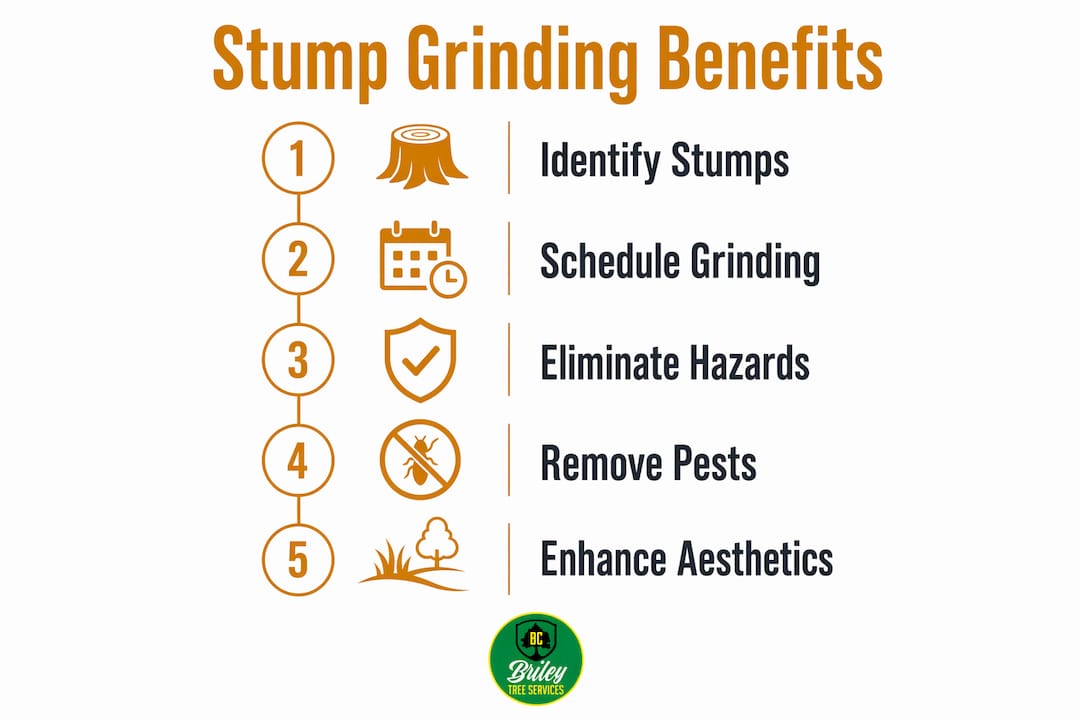
The smarter approach is to schedule grinding immediately after any tree removal, before the next maintenance cycle begins. This keeps the lot clean, prevents pest colonization from starting, and gives you a blank surface to work with when planning landscaping or paving updates. Pairing stump grinding with seasonal maintenance, specifically in early spring before peak pest activity, gives you the best protection window.
The cost-benefit calculation for commercial property managers is straightforward. One slip-and-fall claim on a stump-related trip hazard costs far more than professional grinding. One termite infestation that spreads from a stump to a building foundation costs far more than grinding. The service pays for itself in avoided liability alone, before you account for the aesthetic and space benefits.
Choosing a provider with documented commercial experience and proper insurance is the decision that determines whether grinding actually protects your property or creates new exposure. The grinding method matters less than the qualifications of the person operating the equipment.
— Tatum
Get professional stump grinding for your commercial lot
Brileytreeservice provides professional stump grinding for commercial properties throughout Shreveport, Bossier City, and Northwest Louisiana. The team follows strict safety protocols, including 811 utility locating before every job, and carries full liability insurance for commercial work.
Whether you manage a single commercial lot or multiple properties across the region, Brileytreeservice shows up on time, grinds to the correct depth, and cleans up completely after every job. Property managers in Vivian, Springhill, and Benton can request a free commercial estimate and get a clear scope of work before any grinding begins. Contact Brileytreeservice today to protect your lot and keep it compliant.
FAQ
What is stump grinding and how does it work?
Stump grinding is the mechanical process of using a rotating cutting wheel to grind a tree stump below ground level. The machine reduces the stump to wood chips, which can be used as mulch or removed from the site.
How does stump grinding reduce liability on commercial lots?
Grinding stumps below grade eliminates trip hazards that violate ADA standards requiring no vertical change greater than 1/4 inch on pedestrian routes. Removing that hazard directly reduces the risk of personal injury claims against the property.
Is stump grinding better than full stump removal for commercial properties?
For most commercial lots, stump grinding is the better option because it causes minimal ground disruption and costs less than full root extraction. Full removal is more appropriate for new construction sites where the root system must be completely cleared.
How soon after tree removal should stumps be ground?
Stumps should be ground immediately after tree removal, before the next maintenance cycle begins. Waiting allows pest colonization to start and creates ongoing trip hazards and mowing obstructions.
What should a commercial property manager verify before hiring a stump grinding contractor?
Verify that the contractor carries general liability insurance, follows 811 utility locating requirements before grinding, and has documented experience on commercial properties. Reviewing the scope of work in writing before the job starts protects the property manager from unexpected costs or liability.