
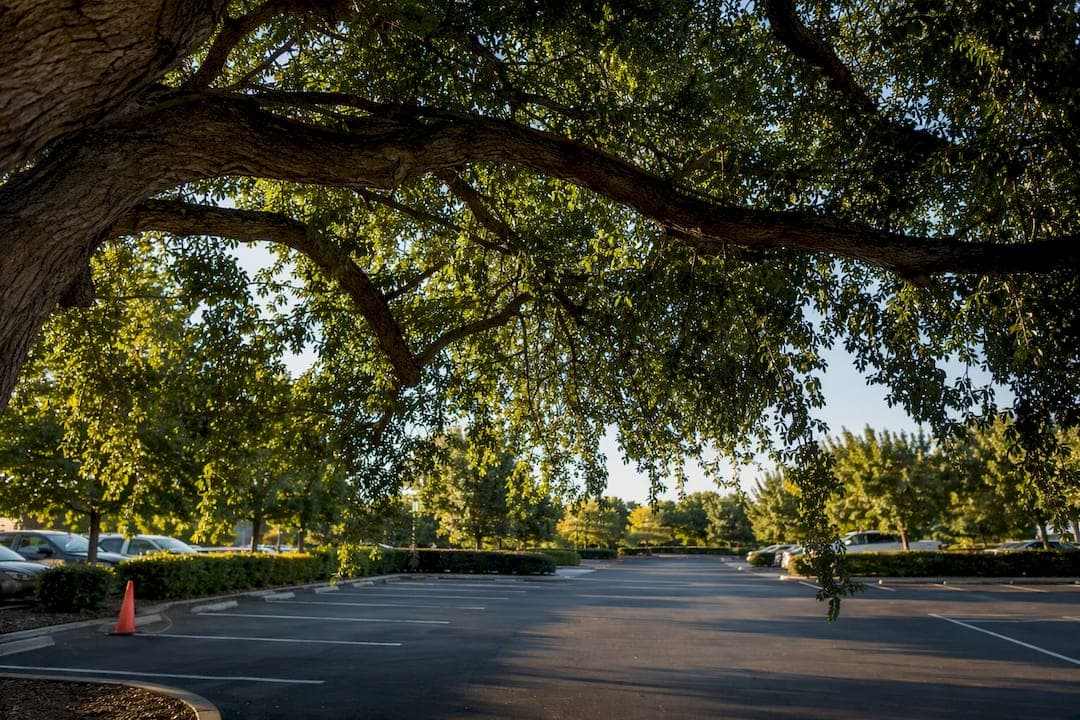
For U.S. parking lots, plan for roughly 8 feet of clearance over sidewalks and 14 feet over parking travel lanes and drive aisles. Trees also need setbacks from driveways, curbs, and intersections. The adjacent property owner is usually responsible for maintaining that clearance, and municipal permits often apply to right-of-way trees. Hire a licensed arborist to inspect your lot, confirm local code, and document compliance before it becomes a fine.
TL;DR:
- Parking lot clearance heights generally range from 7 to 8 feet over sidewalks and 14 feet over drive aisles, with specific standards like Portland's 7.5 feet over sidewalks and San Diego's 14 feet over travel lanes.
- Property owners are primarily responsible for maintaining tree clearances both within their lot and on adjacent right-of-way, with local ordinances allowing municipalities to perform and invoice for necessary work.
- Effective shade plans require at least 50% canopy coverage within 15 years, based on mature tree size, influencing parking lot design and cost considerations during redevelopment.
- Species selection for parking lot trees must prioritize deep-rooted, drought, and salt-tolerant trees that resist surface roots and damage to pavements, avoiding shallow-rooted or brittle-wood species.
- Regular annual inspections, targeted pruning, and proper documentation are essential for compliance and liability mitigation, especially with proactive measures for sightlines and signage obstructions.
Table of Contents
- Parking Lot Tree Clearance Standards: A Quick-Reference Checklist
- Who is responsible for parking lot tree clearance?
- How Much Shade Canopy Does a Parking Lot Need?
- Which Trees Actually Hold Up in a Parking Lot?
- What Maintenance Schedule Keeps a Parking Lot Compliant?
- How Do You Check Sightlines and Signage Around Parking Lot Trees?
- How Do You Hire and Schedule Contractors for Parking Lot Clearance Work?
- The Recurring Mistakes That Cost Commercial Properties the Most
- Compliance-Focused Tree Service for Commercial Properties
- Sources
- FAQ
Parking Lot Tree Clearance Standards: A Quick-Reference Checklist
Before you call a contractor, walk your lot with a tape measure and a notepad. Most clearance violations get caught during routine inspections, insurance walkthroughs, or after a delivery truck clips a low branch, and by then you're reacting instead of planning.
Portland's municipal guidance sets the benchmark that many other cities reference: 7.5 feet over sidewalks, 11 feet over residential streets, and 14 feet over arterial streets and main travel lanes. San Diego's regional standards land in a similar range, recommending 14 feet of clearance above parking traveled ways and 16 feet of horizontal clearance at driveways, split 8 feet on either side of the driveway centerline.
Clearance heights and setbacks worth checking today:
- Sidewalks and walkways: about 7 to 8 feet of clear branch height
- Residential streets: approximately 11 feet
- Arterial streets and parking lot drive aisles: roughly 14 feet
- Driveway horizontal clearance: 16 feet total, 8 feet each side
- Fire lanes: match the 14-foot standard your local fire code requires
- Setback from fire hydrants: generally between 10 and 15 feet, depending on local fire codes
- Setback from stop signs and directional signage: enough to keep the sign face fully visible from a stopped vehicle
Pro Tip: Keep a folding measuring pole or a laser distance meter in your maintenance truck. Eyeballing an 8-foot clearance from the ground is notoriously unreliable, and a five-minute measurement check beats a liability claim.
If you spot deadwood hanging over a walkway, a branch obscuring a stop sign, or a limb low enough to catch a box truck, that's an immediate fix, not a maintenance-cycle item. Remove or trim it the same week. For anything involving a public right-of-way tree, streetlight, or traffic signal, call your city's forestry or public works department before cutting. Many municipalities treat unpermitted work on right-of-way trees as a code violation, even when the tree is dropping branches onto your own parking lot.
Who Is Responsible for Parking Lot Tree Clearance?
Property owners bear the primary duty for tree clearance on their own lots, and that duty often extends to the strip of city-owned right-of-way along the property line. Greenburgh, New York's guidance makes this explicit: owners are commonly held responsible for trees on the planting strip or adjacent right-of-way, and failing to maintain visibility can trigger municipal action with costs assessed back to the owner.
Municipal tree ordinances tend to follow a similar structure regardless of the state. Perry, Iowa's code is a good example of the pattern: it sets planting setbacks (nothing within 5 feet of a water line), spacing requirements, a list of prohibited species, and a clear duty for adjacent owners to trim branches to 13 feet above alleyways and 9 feet above sidewalks. If the owner doesn't comply, the city can perform the work itself and bill the property owner for it.
That "we'll do it and send you the invoice" clause shows up in ordinance after ordinance across the country. It's worth reading yours closely, because assessed costs are usually higher than what a private contractor would charge, and they can attach as a lien if unpaid.
What typically triggers a permit requirement:
- Removing any tree in the public right-of-way, regardless of size
- Planting a new tree in a planting strip or median
- Major pruning that removes more than 25% of a tree's canopy
- Work within a certain distance of a street tree protected by a heritage or landmark designation
- Grading or excavation near root zones for parking lot expansion or repaving
Practical steps that keep you out of trouble:
- Photograph the tree's current condition, including any signage or sightline obstruction, before you touch it
- Request permits in writing and keep the confirmation number on file
- Respond to any city notice within the stated window rather than letting it lapse into a fine
- If you receive a corrective-work bill you believe is inflated or unwarranted, most cities offer an appeal or hearing process. Use it, and bring your own documentation.
Our guide to tree trimming compliance requirements for Shreveport properties breaks down how this plays out at the local level in North Louisiana, where code enforcement patterns mirror what you'll find in most mid-sized American cities. For signage-specific permit questions, our clearance pruning for signage guide walks through the steps and typical timing.
How Much Shade Canopy Does a Parking Lot Need?
Shade requirements are becoming standard in parking lot design codes, and they're driven by urban heat island research as much as aesthetics. Paved surfaces absorb and radiate heat, which raises ambient temperatures in commercial districts and increases cooling costs for nearby buildings. Penn State Extension's research on green parking lots frames tree canopy as one of the most direct mitigation tools available to property owners, alongside structural soil and permeable pavement.
The Town of Greenburgh, New York offers one of the clearer models for how a shade requirement actually works in practice. New or reconstructed parking lots must achieve 50% shading of the paved area within 15 years, and developers submit a Shade Plan showing each tree drawn at its projected 15-year canopy size, not its size at planting. That distinction matters for your design calculations: a newly planted 2-inch caliper maple won't shade much of anything on day one, but the code credits it based on where its canopy will be in year 15.
Hartford, Connecticut takes a related approach with interior landscape islands, setting minimum canopy coverage percentages for parking lot interiors and specific requirements for island dimensions. Hartford's zoning code requires structural soil under islands narrower than 15 feet, and medians under 9 feet wide need aeration systems or permeable pavement to keep roots alive under compacted soil.
| Design element | Typical requirement | Source pattern |
|---|---|---|
| Canopy coverage goal | 50% of paved area within 15 years | Greenburgh, NY |
| Island width, standard soil | 15 feet or wider | Hartford, CT |
| Island width under 15 feet | Structural soil or engineered soil required | Hartford, CT |
| Median under 9 feet wide | Aeration system or permeable pavement | Hartford, CT |
How to calculate and present your shade plan:
- Measure your total paved area in square feet, then calculate the percentage your city's code requires as shaded
- Use each tree species' mature canopy diameter, not its planting-day size, to project coverage at the 15-year mark your city likely specifies
- Existing, healthy trees you retain during a redesign usually count toward your shade credit. Confirm this with your planning department before you assume it.
- Where island space is tight, structural soil systems let roots spread laterally under pavement without heaving the surface, which the Penn State Extension research covers in more depth
- Balance canopy targets against parking counts early. A shade plan drawn after your parking layout is finalized almost always forces a redesign.
If your lot is undergoing a major repaving or expansion, get the shade plan drafted before the parking layout is locked. Retrofitting canopy requirements into a finished design is far more expensive than building them in from the start.
Which Trees Actually Hold Up in a Parking Lot?
Species selection is where most parking lot tree problems start, and it happens years before anyone notices a cracked curb or a heaved sidewalk panel. A tree that's wrong for a paved environment doesn't fail quickly. It fails slowly, over a decade, in ways that cost far more to fix than to prevent.
Arbor Day Foundation guidance on trees and parking lots points to a few consistent traits in species that succeed in this setting: tolerance for heat, drought, road salt, and compacted soil, combined with a rooting habit that goes down instead of out. Trees that spread aggressive surface roots looking for oxygen and moisture in compacted soil are the ones that crack pavement, lift curbs, and eventually undermine footings.
Species traits to prioritize:
- Deep, non-aggressive root systems that don't compete with pavement for surface space
- Drought and heat tolerance, since paved lots run hotter and drier than open landscape beds
- Salt tolerance in any region that uses road salt or de-icing chemicals in winter
- A mature canopy shape that clears vehicles and sightlines without constant corrective pruning
- Resistance to common regional pests and diseases, which cuts down on emergency removals later
Species traits to avoid:
- Shallow, aggressive surface roots (common in silver maple and some willow species)
- Weak or brittle wood prone to storm breakage
- Heavy fruit, seed pod, or sap drop that creates a slip hazard or staining on pavement
- Fast, unpredictable growth habits that outpace a maintenance schedule
Research from the International Society of Arboriculture on parking lot tree physiology backs up something a lot of property managers underestimate: trees in paved settings need adequate spacing and root volume to reach anything close to their expected mature size. A tree that would hit 40 feet in an open yard might stall out well short of that in a cramped, compacted planter, and a stunted tree rarely delivers the shade coverage your Shade Plan assumed.
Pro Tip: Check your city's approved street tree or parking lot tree list before you order stock from a nursery. Many municipalities maintain one, and planting a species that's on the prohibited list can force a removal and replant at your expense, even if the tree is healthy.
Planting specs matter as much as species choice. Standard commercial planting calls for at minimum a 2 to 2.5 inch caliper tree at installation, amended backfill soil rather than raw excavated fill, staking for the first one to two growing seasons in high-wind areas, a 2 to 3 inch mulch ring kept clear of the trunk, and a dedicated irrigation line or bag system for at least the first two summers. Skipping irrigation in year one is the single most common reason newly planted parking lot trees fail before they ever reach clearance height.
What Maintenance Schedule Keeps a Parking Lot Compliant?
An annual inspection, backed by targeted pruning on a two-to-four-year cycle depending on species and growth rate, is enough to keep most commercial parking lots within code. Faster-growing species like hackberry or certain maples may need a look every two years; slower growers like oak or ginkgo can often stretch to three or four.
The vertical clearance targets stay consistent across your maintenance cycle: 7.5 to 8 feet over sidewalks, 11 feet over residential streets, and 14 feet over arterial streets and parking drive aisles, matching the same standards you'd use during an initial site walk. San Diego's regional guidance reinforces the 14-foot figure specifically for parking lot traveled ways and fire lanes, which is the number most commercial insurers and fire marshals expect to see maintained.
A practical maintenance cycle:
- Conduct a full-lot walk-through every spring before leaf-out is fully complete, when structural issues are easiest to spot.
- Flag any branch encroaching on the clearance heights above, along with any deadwood, split limbs, or lean that's changed since the last inspection.
- Schedule clearance pruning within 30 days of flagging a hazard near a sidewalk, drive aisle, or sign. Don't let it roll into the next budget cycle.
- Photograph each tree before and after pruning, and log the date, contractor, and permit number if one applied.
- Review your maintenance log annually against your city's tree ordinance to confirm nothing has changed. Municipal codes get updated more often than most property managers realize.
Recordkeeping isn't just paperwork. If a branch fails and damages a vehicle or injures someone, your maintenance log and photo history are what demonstrate you exercised reasonable care. A property with no documentation and an overdue pruning cycle is in a far weaker position than one with dated photos and permit numbers on file, even if both trees looked identical the day before the incident.
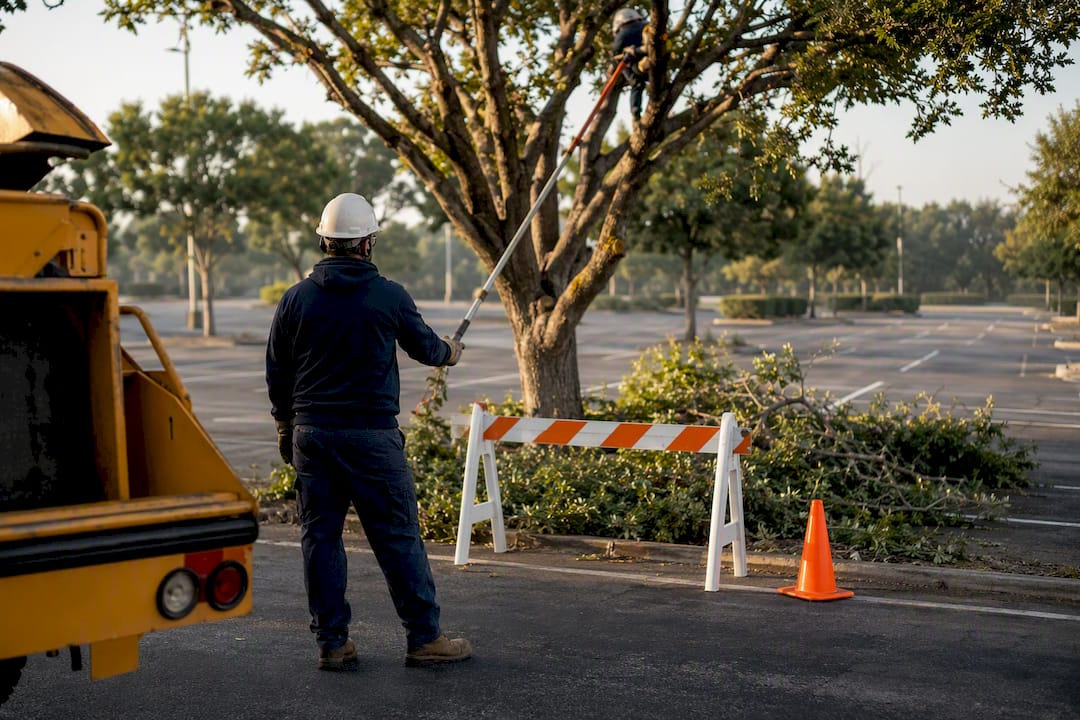
During pruning work, treat the drive aisle like a active work zone: cones or barricades around the drop zone, a spotter for reversing chippers or bucket trucks, and a debris removal plan for the same day rather than leaving branches curbside overnight. Our guide to why parking lot trees need trimming goes deeper into timing pruning around growth cycles specific to common commercial species.
How Do You Check Sightlines and Signage Around Parking Lot Trees?
A sight triangle is the unobstructed zone drivers need at an intersection, driveway, or aisle crossing to see approaching traffic and pedestrians in time to react. Municipal codes typically define this as a triangular area measured back a set distance (often 10 to 25 feet, depending on the intersection type and posted speed) from the point where two travel paths meet, within which nothing above roughly 2 to 3 feet in height should obstruct the view.
Trees intersect with sight triangles in two ways: low branches that hang into the triangle's vertical space, and shrub-height plantings or suckering growth that block the horizontal view entirely. Both are common on lots where trees were planted correctly years ago but never got pruned to keep pace with canopy growth.
Clearance zones to check around signage and lighting:
- Stop signs, yield signs, and directional signage: full visibility from a stopped vehicle at typical approach distance, with no branch overlap on the sign face
- Streetlights and parking lot light poles: canopy pruned back enough to prevent shadowing that creates dark zones at night
- Pedestrian crossing signage: clear sightline from both the driver's and pedestrian's vantage point
A 3-step visibility audit you can run in an afternoon:
- Drive the aisle. Sit in a parked car at each intersection and stop sign, then check what's actually visible from a driver's eye height, not from standing beside the vehicle.
- Walk the pedestrian paths at dusk. Lighting gaps caused by canopy overgrowth are far easier to spot once the sun is low.
- Check the sign faces from 50 feet. If foliage touches any edge of a sign face, from any driving direction, it needs pruning now, not at the next scheduled cycle.
Most sightline problems have a low-cost fix. Crown lifting, which removes lower limbs to raise the canopy's base height, solves the majority of vertical obstruction issues without harming the tree. Selective limb removal on the roadside quadrant clears horizontal sightlines. Relocating a low shrub bed is often cheaper than repeated tree pruning if the shrub keeps growing back into the same sight triangle. Where a sign has simply been placed too close to a mature tree's canopy, and code allows it, moving the sign is sometimes the more permanent solution.
How Do You Hire and Schedule Contractors for Parking Lot Clearance Work?
Getting parking lot tree work done without shutting down half your lot for a week comes down to what you put in the bid request and how you phase the work. Most disruption complaints from tenants trace back to poor scheduling, not the work itself.
What to require in every commercial bid:
- A licensed and insured arborist on the crew, with proof of general liability and workers' compensation coverage before work starts.
- A written traffic-control plan for any work near active drive aisles, including cone placement and, if needed, a flagger.
- Confirmation the contractor will pull any required municipal permits, rather than leaving that on your desk.
- A debris removal and cleanup timeline, ideally same-day, so branches and chips don't sit in customer parking overnight.
- Photo documentation before and after the job, tied to the permit number if one applies.
Pro Tip: Ask contractors for their certificate of insurance directly from the insurer, not a photocopy from the contractor. It takes one extra phone call and it's the fastest way to confirm coverage is actually active.
Phasing matters more on commercial sites than residential ones. Group work by section of the lot rather than tackling every tree at once, so at least 70 to 80% of your parking stays open throughout the project. Off-hours or early-morning scheduling, before a retail center opens or after a business closes, cuts customer friction significantly on high-traffic sites. Seasonal timing also affects cost: late fall through winter pruning, when trees are dormant, is often the cheapest window and reduces stress on the tree compared to summer pruning.
Notify tenants and customers in advance with a simple posted notice covering the work dates, which sections of the lot will be affected, and an estimated completion date. A one-page flyer at each entrance, posted 48 to 72 hours ahead, prevents most of the complaint calls a surprise crew shows up to field on-site.
The Recurring Mistakes That Cost Commercial Properties the Most
Under-sized planters are the problem I see most often on commercial sites, and it's almost always a decision made at the design stage by someone who never had to maintain the tree afterward. A planter that looked fine on a blueprint ten years ago is now cracking pavement because nobody accounted for root volume at maturity. Retrofitting structural soil under an existing island costs several times what it would have cost to specify correctly during original construction.
Deferred pruning is the second recurring failure, and it's rarely about budget. It's about scheduling. A tree that needed clearance pruning eighteen months ago gets pushed to "next quarter" until a branch finally droops low enough that a delivery truck clips it, or a tenant complains that a stop sign is invisible from the aisle. By the time it becomes urgent, it's also become expensive, because urgent work rarely gets competitive bids.
Missing permits round out the top three. Property managers assume that because a tree sits on their lot, it's entirely their call. Often the strip along the street, the median near the entrance, or a tree tied to an original site plan approval falls under municipal jurisdiction, and cutting without a permit can trigger a fine on top of the removal cost you already paid.
The fix for all three is the same: an inspection cadence a contractor can actually execute, not an ideal one that looks good on paper but never happens. One thorough spring walk-through, one mid-cycle check for fast-growing species, and a maintenance log that gets updated the same day work happens. That's a schedule that survives staff turnover, budget cycles, and the inevitable year where the lot just doesn't get enough attention.
— Tatum
Compliance-Focused Tree Service for Commercial Properties
A practical alternative to piecing together compliance work yourself, tree by tree, permit by permit is to hire one licensed and insured arborist team to handle clearance pruning, permit coordination, and documentation together, instead of chasing separate vendors and hoping the paperwork lines up.
A compliance-focused inspection covers exactly what this article walks through: measured clearance heights against local code, sightline checks around signage and lighting, soil and root conditions in your planters, and a written record you can point to if a city notice or an insurance question ever comes up. Professional tree service providers may also handle staged maintenance scheduling to minimize disruption to tenants and customers, and provide 24/7 emergency storm cleanup when a limb comes down without warning.
If your lot hasn't had a professional clearance inspection in the last year, or you're planning a repaving or expansion that will need a shade plan, request a free estimate from Brileytreeservice and get a licensed arborist on-site before a code notice forces the timeline for you.
Sources
- Portland
- San Diego Regional Urban Forests Council clearance standards
- Trees and Parking Lots — Arbor Day Foundation
- Green parking lots: Mitigating climate change and the urban heat island — Penn State Extension
FAQ
What is the 10/20/30 rule for trees?
The rule is a species-diversity guideline for urban forestry, recommending no more than 10% of one species within a planted area. It reduces the risk of losing an entire parking lot's canopy to a single pest or disease outbreak.
Why don't some parking lots have trees?
Older lots were often built before shade and canopy requirements existed in local code, and retrofitting mature planters into an existing paved layout is expensive. Newer construction and major reconstructions increasingly require a shade plan, like Greenburgh's 50% canopy coverage requirement within 15 years.
How tall is too tall for a parking garage clearance?
Parking garage clearance is a structural, code-driven number set by the building's design and local fire code, typically well below tree clearance heights and unrelated to tree pruning standards. For open-air surface lots, the relevant figure is the 14-foot clearance over travel lanes referenced in Portland's and San Diego's guidance.
How far should a tree be from a driveway?
San Diego's regional standard calls for 16 feet of total horizontal clearance at driveways, or 8 feet on either side of the driveway centerline, to keep sightlines and vehicle paths clear. Local codes vary, so confirm the exact setback with your city's planning or public works department before planting.
Who is responsible for parking lot tree clearance?
The property owner is typically responsible for maintaining clearance on trees within their lot and often on the adjacent right-of-way strip along the street. Cities can perform corrective work themselves and bill the owner if clearance violations go unaddressed after a notice.