
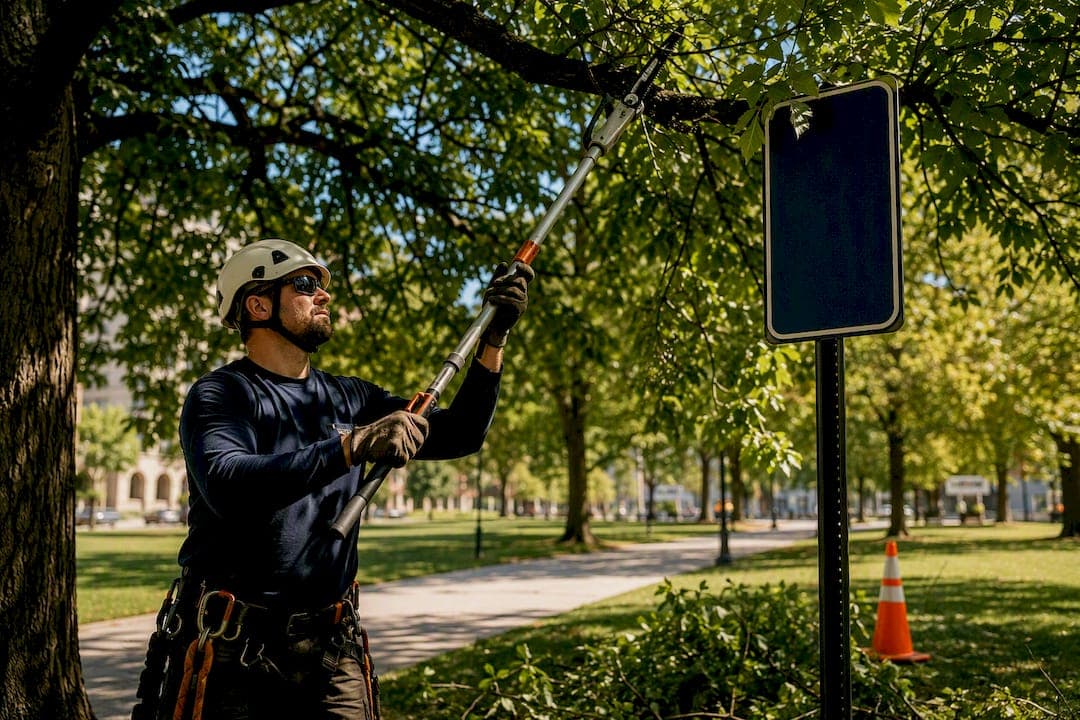
Aim for vertical clearance over sidewalks, streets, and alleyways at levels that meet common municipal guidance, and make sure any traffic sign, monument sign, or storefront sign is fully visible from every approach lane. That's the baseline most U.S. municipalities work from, and it lines up with Tacoma's street tree pruning guidance, one of the more detailed public tip sheets available. The two standards that govern how the actual cutting happens are ANSI A300 (pruning objectives) and ANSI Z133.1 (safety and PPE).
If a sign or intersection is currently blocked, your first move is simple:
- Remove dead or broken branches near the sign or sightline
- Thin the limbs that are actually blocking the view, not the whole canopy
- Check whether the tree sits in a public right-of-way before you touch it
Quick reference: Clearance over sidewalks and streets according to common standards, ensuring full sign face visibility from approach lanes. If the tree is near power lines, tall, or on public property, plan on hiring a licensed arborist.
Key Takeaways
Clearance pruning for signage succeeds when it hits the 8-foot sidewalk and 14-foot street clearance targets, follows ANSI A300 and Z133.1 standards, and gets documented before and after the work.
| Point | Details |
|---|---|
| Target clearances | Aim for 8 feet over sidewalks and 14 feet over streets and alleys, per municipal guidance. |
| Follow ANSI standards | Use A300 for pruning technique and Z133.1 for safety practices and PPE. |
| Check permit status first | Confirm right-of-way ownership and pull a municipal permit before cutting street trees. |
| Avoid topping and lion-tailing | Both trigger weak regrowth that reblocks signage within a season. |
| Hire a professional for risk factors | Bring in a licensed arborist like Briley Tree Service for work near power lines, tall canopies, or permit-required jobs. |
Table of Contents
- What Standards Set Clearance Requirements for Signage Pruning?
- How to Check Ownership and Permits Before You Prune
- Step-by-Step Pruning to Restore Sign Visibility
- PPE, Tools, and When to Call a Licensed Arborist
- How Briley Tree Service Documents Sign-Clearance Jobs
- How Tree Species Affect Pruning Strategy and Regrowth
- Post-Pruning Care That Protects Tree Health
- Common Mistakes That Undo Clearance Pruning
- What the Data Actually Tells Property Managers
- Get Sign-Clearance Pruning Done Right the First Time
- Frequently Asked Questions
- Sources
What Standards Set Clearance Requirements for Signage Pruning?
Most clearance numbers you'll find in city tip sheets aren't arbitrary. They come from decades of urban forestry practice built around pedestrian headroom, delivery truck height, and emergency vehicle access. The two figures that show up again and again: 8 feet over sidewalks and 14 feet over streets and alleys, per Tacoma's pruning guidance. Sign sightlines run on a different logic entirely: a driver has to see the full sign face, not just a corner of it, from the moment they enter the approach lane.
ANSI A300 lays out what a "correct" prune actually looks like: crown raising to lift the canopy off a sign or road, crown reduction to shrink an oversized limb, and crown cleaning to strip out dead or diseased wood. ANSI Z133.1 covers the safety side of that same job, including PPE requirements and safe work practices around equipment and elevated cuts, according to Washington's Department of Natural Resources urban forestry resources.
Municipal rules layer on top of both. Many cities, Tacoma included, require a right-of-way permit before you prune a street tree, even one growing on private property but hanging over public land. A few things worth confirming before you pick up a saw:
- Vertical clearance minimums for your specific street classification
- Whether the tree in question is legally a "street tree" under local code
- Permit requirements for any cutting within the right-of-way
How to Check Ownership and Permits Before You Prune
Before any blade touches bark, figure out who actually owns the tree. Right-of-way trees, the strip between the sidewalk and the curb, are frequently owned or regulated by the municipality even when they look like part of your yard. Pull your parcel map or call your city's public works department to confirm the boundary.
Here's a practical sequence for sorting out the paperwork:
- Check the property line. Compare your parcel survey against the tree's actual location; right-of-way trees usually trigger different rules than trees fully on private land.
- Look up the local street tree ordinance. Cities like Tacoma publish permit requirements specifically for right-of-way pruning, and most mid-size cities have something similar.
- Identify permit triggers. Work near a traffic signal, streetlight, or sign structure almost always requires notification, even on a routine trim.
- Call before you cut near utilities. If branches are anywhere near power lines, the utility company needs to be looped in, not just the city.
- Keep basic documentation ready. Most municipalities want a location description, photos, and a short scope of work before they'll issue a permit.
Skipping this step is the single most common reason property managers end up redoing work, or facing a fine, after a well-intentioned prune.
Step-by-Step Pruning to Restore Sign Visibility
Start with a survey, not a saw. Walk or drive every approach angle a customer or driver would actually use, and note exactly where the view breaks down. For street-facing signage, measure vertical headroom with a pole or laser rangefinder; for monument and directional signs, stand at the point a driver would first need to react and check whether the entire sign face is visible from there.
Once you know what's blocking the view, work through cuts in this order:
- Remove deadwood first. Dead limbs add no screening value and are a liability regardless of the visibility issue.
- Selectively thin dense growth. Open up the canopy rather than stripping it, following the crown cleaning approach in ANSI A300.
- Raise the crown where height is the problem. Crown raising lifts low limbs clear of the sign or roadway without shortening the tree.
- Use reduction cuts on oversized limbs. Shorten a branch back to a lateral rather than lopping it flat, which avoids weak regrowth.
- Never top the tree or leave stubs. Topping and lion-tailing both produce weak, fast-growing sprouts that will re-block the sign within a season or two, according to Arbor Day Foundation pruning guidance.
Clearance targets vary by sign type. Monument signs generally need clear space around lighting fixtures and full, unobstructed visibility of the sign face, based on commercial property maintenance benchmarks. Wall-mounted or fascia signs typically require some clearance off the building face for maintenance and visibility. Directional and traffic signs need a completely clear line from the driver's first sightline to the sign itself, measured in the direction of approach, not just from the sidewalk.
Pro Tip: Photograph the sign from the same three or four approach points before and after the work. Matched-angle photos make it far easier to prove compliance to a property manager or city inspector, and they take less time than a written report.
Check your work twice: once in daylight, once at night with the sign lighting on. A canopy that clears the sign face at noon can still cast a shadow that swallows an illuminated sign after dark.
PPE, Tools, and When to Call a Licensed Arborist
Clearance pruning looks simple from the ground. It stops looking simple the moment a ladder, a chainsaw, and a live traffic lane are all in the same fifteen feet of space. Basic PPE for this kind of work includes a hard hat, eye and face protection, cut-resistant gloves, chainsaw chaps, and a properly rated ladder or pole pruner for anything above head height. If the job touches a public sidewalk or street, add traffic cones or signage to protect both your crew and passing drivers.
Some situations call for a professional every time, no exceptions:
- Branches within 10 feet of an energized power line
- Any job requiring a bucket truck or aerial lift
- Visible decay, cracks, or co-dominant stems on the trunk
- Complex rigging to lower large limbs safely
- A municipal permit that requires licensed, insured work
Pruning operations that affect or pass near electrical conductors require trained line-clearance arborists and coordination with the utility, not a homeowner with a pole saw.
A licensed arborist brings more than a bigger saw. They carry the permits, run traffic control when needed, prune to ANSI A300 standards, and hand over documentation and liability coverage that a DIY job simply can't produce. If your situation touches power lines at all, that's the line where DIY should stop.
How Briley Tree Service Documents Sign-Clearance Jobs
Municipal inspectors and property managers both want the same thing: proof the work was done correctly, not just a claim that it was. Briley Tree Service builds every sign-clearance job around a repeatable checklist so that proof exists before the crew leaves the site.
The core steps: a site survey from every approach angle, matched before-and-after photos, measured clearance numbers against the 8-foot and 14-foot benchmarks, ANSI-compliant cuts, and a full site cleanup. That documentation set is exactly what most permit closeouts and property management files require.
- On-site survey identifying every blocked sightline
- Approach-angle photos taken before cutting begins
- Measured clearances recorded against local code minimums
- ANSI A300 pruning cuts performed by trained crews
- Full debris cleanup and haul-away
- Before/after photo set delivered for permit or file records
That kind of paper trail matters more than most property owners expect until a city inspector or corporate compliance team asks for it.
How Tree Species Affect Pruning Strategy and Regrowth
Not every tree responds to clearance pruning the same way, and picking the wrong technique for the species can make a visibility problem worse within a year. Fast-growing species like silver maple, hackberry, or Bradford pear regrow aggressively after a cut, so an aggressive prune now often means repeat work in 12 to 18 months. Slower-growing species like oaks or bald cypress hold a cut shape much longer, which makes them more forgiving for signage clearance work near streets and monument signs.
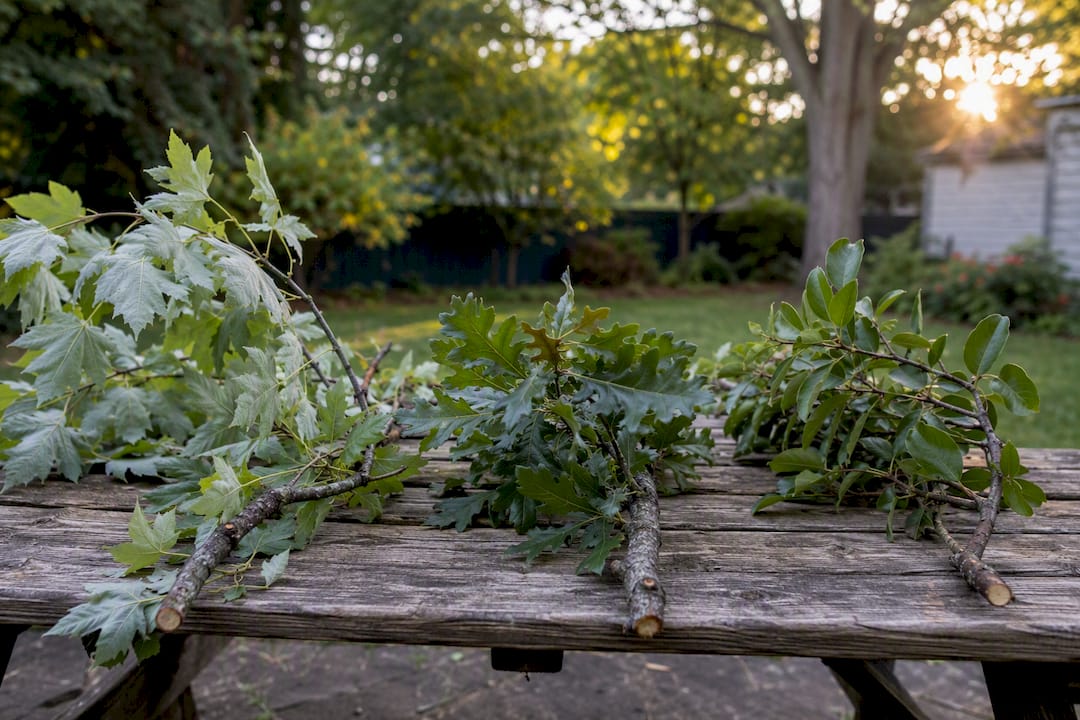
Species with a strong tendency toward weak crotch angles, ornamental pears are a common example, need extra care during crown raising, since removing the wrong limb can shift weight and stress onto a structurally weak union. Trees prone to epicormic sprouting (the fast, weak shoots that pop out after a heavy cut) will regrow directly into the cleared sightline if the pruning cut isn't made at a proper lateral branch, not a stub.
Regrowth rate also drives your maintenance schedule. A fast-growing species blocking a highway-facing sign might need a check every year, while a slower species might go three to five years between visits. Matching the pruning technique, and the follow-up schedule, to the actual species in front of you is what keeps a sign clear long term instead of just clear for one season.
Post-Pruning Care That Protects Tree Health
A clean cut is only half the job. What happens after the saw stops determines whether the tree heals well or becomes a liability. Skip a slow watering cycle after major pruning, especially in hot months, and the tree can go into stress that shows up as leaf scorch or dieback weeks later.
Avoid wound paint or sealant on fresh cuts. Trees compartmentalize damage naturally, and modern arboriculture treats sealant as unnecessary at best and disease-trapping at worst. Instead, focus on a clean final cut at the branch collar, which allows the tree to close the wound on its own timeline.
Mulching around the base, without piling it against the trunk, helps retain soil moisture and reduces competition from grass and weeds while the tree recovers. Watch for signs of stress over the following growing season: unusual leaf drop, cracking near the cut sites, or fungal growth at pruning wounds. Catching those early keeps a manageable issue from becoming a tree removal decision down the line.
Common Mistakes That Undo Clearance Pruning
The fastest way to waste a pruning job is topping the tree, cutting it back to stubs instead of proper lateral branches. It looks like a quick fix for a blocked sign, but it triggers a flush of weak, fast growth that reblocks the sightline within a season and leaves the tree structurally worse off long term.
Lion-tailing, stripping all the inner and lower branches and leaving foliage only at the branch tips, is nearly as common and just as damaging. It shifts weight to the ends of limbs, increases wind resistance failure risk, and does nothing to solve a mid-canopy sightline problem.
Other frequent errors: cutting flush against the trunk instead of at the branch collar, which slows healing and invites decay; pruning during peak growing season when the tree is under the most stress; and clearing only for daytime visibility while ignoring how canopy shadow affects an illuminated sign at night. Skipping the permit step on a right-of-way tree is a paperwork mistake that becomes a real problem the moment a city inspector notices unauthorized work.
What the Data Actually Tells Property Managers
Most guidance on clearance pruning treats the numbers, 8 feet, 14 feet, as the whole answer. They're not. The clearance figure only tells you the target; it says nothing about whether the tree will hold that shape for one season or five, and that's the part most property managers underestimate.
Species selection and regrowth rate do more to determine your long-term maintenance cost than the initial cut ever will. A fast-growing species pruned aggressively to open a sightline is a problem you'll be paying to solve again next year. That's not a reason to avoid pruning. It's a reason to think about the pruning schedule as an ongoing commitment tied to the specific tree, not a one-time fix.
The other gap in conventional advice: documentation gets treated as optional paperwork instead of a practical tool. A matched-angle before-and-after photo set isn't just for city inspectors. It's the fastest way to prove a sign is compliant without a second site visit, and it's the difference between a permit closing in a week versus a month.
Prioritize the species and the schedule first, the single cut second.
Get Sign-Clearance Pruning Done Right the First Time
Briley Tree Service is the direct alternative to guessing your way through a clearance-pruning job or hiring a general landscaper who doesn't work to ANSI standards. Property managers and municipal officials across Shreveport, Bossier City, and North Louisiana get a licensed, insured arborist team that measures clearances against real code minimums, prunes to A300 and Z133.1 standards, and hands over the documentation a city inspector or corporate office actually wants to see.
Whether it's a single monument sign blocked by an overgrown oak or a whole retail frontage that needs a maintenance plan, Briley Tree Service handles the survey, the cutting, the cleanup, and the paperwork. If the job involves work near power lines or a right-of-way permit, that's already part of the process, not an extra call you have to make yourself. Get a free estimate today and get your signage visible again without the trial and error.
Frequently Asked Questions
What's the minimum clearance for a sign next to a tree? Most municipalities want 8 feet of vertical clearance over sidewalks and 14 feet over streets and alleys, with the sign face itself fully visible from every approach lane, following guidance like Tacoma's pruning tip sheet.
Do I need a permit to prune a tree blocking a sign? Often, yes, especially if the tree sits in a public right-of-way or the work affects a traffic signal, streetlight, or sign structure. Check your city's public works department before cutting.
How often should sign-clearance pruning happen? It depends on the species. Fast-growing trees may need annual checks, while slower-growing species can go three to five years between prunes.
When should I hire a professional instead of doing it myself? Call a licensed arborist any time branches are within 10 feet of power lines, the job needs a bucket truck, you see trunk decay or co-dominant stems, or the municipality requires a permit for the work.
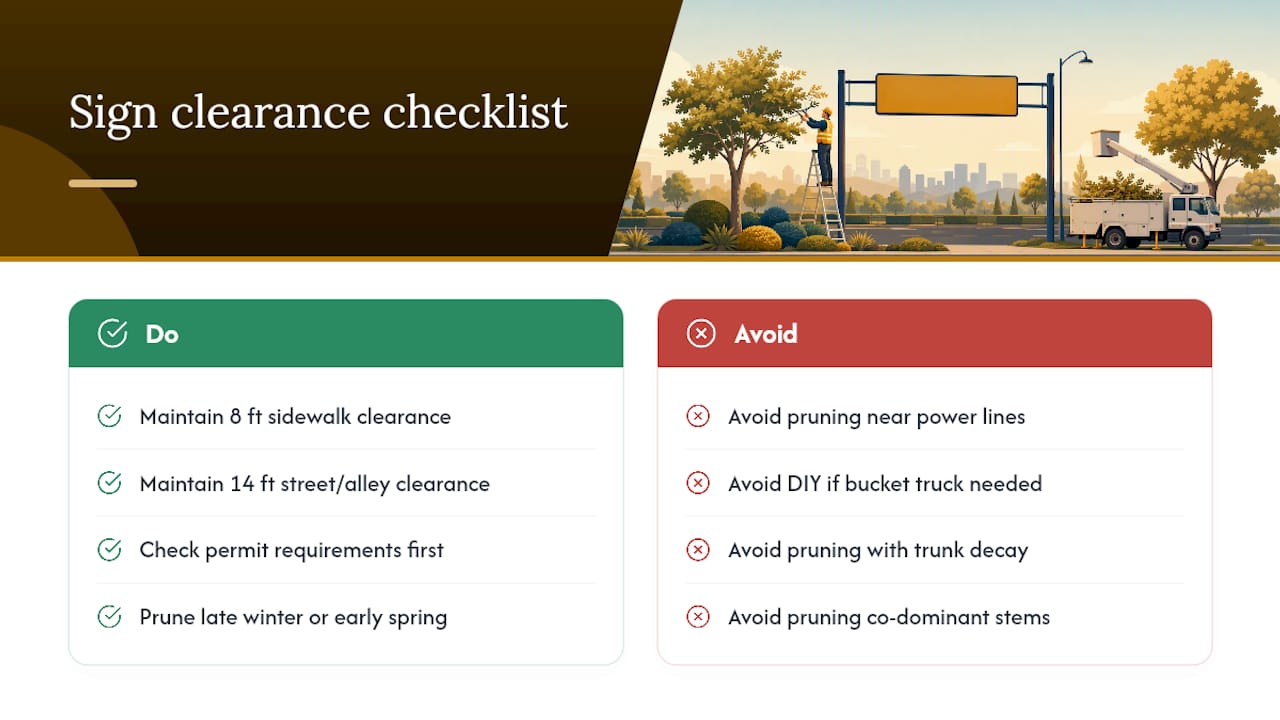
What's the best time of year to prune for sign visibility? Late winter or early spring, before new growth starts, minimizes tree stress and keeps the canopy clear through the peak summer growing season, according to Arbor Day Foundation.
Sources
- Street Tree Pruning (City of Tacoma permits)
- Urban forestry help resources (WA DNR)
- Arbor Day Foundation