
Tree service crew certification is a formal credential that proves tree care workers meet verified standards for safety, skill, and arboricultural knowledge. For property owners and managers in Shreveport and across Northwest Louisiana, understanding these credentials is the clearest way to separate professional crews from untrained ones. The International Society of Arboriculture (ISA), the Tree Care Industry Association (TCIA), and the ANSI Z133 safety standard form the backbone of what the industry recognizes as qualified tree care. Knowing what these certifications mean, and how to verify them, protects your property, your trees, and your liability.
What is tree service crew certification and why does it exist?
Tree service crew certification is the industry's answer to a real problem: tree work is dangerous, and almost anyone can legally call themselves a tree service. The ISA Certified Arborist credential is the gold standard for individual tree care professionals. It requires 3 years of field experience and passing a comprehensive 200-question exam, with continuing education required every 3 years to maintain the credential. That structure means a certified arborist has proven knowledge, not just time on the job.
Certifications exist because legal requirements alone do not fill the gap. Only 1 in 51 states requires a license for tree service specialists, meaning 96% of states require no standardized testing at all. That statistic explains why credentials from the ISA and TCIA carry so much weight. They set a professional floor where state law does not.
TCIA Accreditation works at the company level rather than the individual level. It evaluates safety programs, crew training, and equipment standards. Fewer than 10% of U.S. tree care companies hold this accreditation. When a company carries it, that signals a serious commitment to consistent standards across the entire operation, not just one certified employee.
What are the main types of tree service crew certifications?
Several distinct credentials apply to tree service crews, and each one covers a different scope of work or level of responsibility.
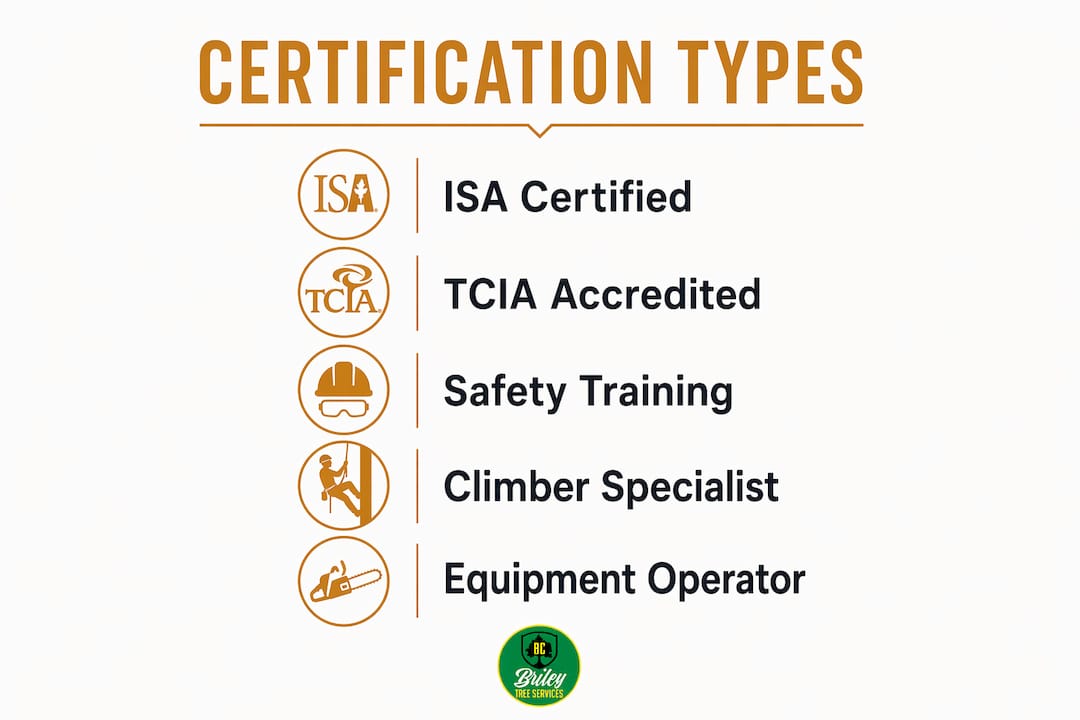
- ISA Certified Arborist: The primary individual credential in arboriculture. Requires 3 years of experience and a passing score on the ISA exam. Covers tree biology, pruning, diagnosis, and safety. Candidates typically spend 2–4 months preparing for the exam.
- Certified Treecare Safety Professional (CTSP): Administered by TCIA, this credential focuses specifically on jobsite safety management. It requires 3 years of field experience or a related degree, making it a serious professional commitment.
- Crew Leader Specialist: A TCIA credential for crew supervisors. Requires completion of continuing education units (CEUs), including at least 7.25 hours of approved coursework.
- ISA Tree Climber Specialist: A hands-on credential for aerial work. It tests practical climbing skill, not just book knowledge, making it the right credential to ask about when a job involves working at height.
- Tree Risk Assessment Qualification (TRAQ): The ISA credential required for formal hazard tree assessments. If a crew is evaluating whether a tree poses a risk to your home or structure, the person doing that assessment should hold TRAQ.
- CPR and First Aid: The ANSI Z133 standard requires at least one crew member on every jobsite to hold current CPR and First Aid certification. This is a baseline safety requirement, not optional.
Pro Tip: Ask specifically which certifications apply to the work being done on your property. A crew trimming high branches needs different credentials than one grinding stumps at ground level.
Why tree service crew certification matters for property owners
Certification matters because it directly affects your risk as a property owner. Certified crews follow established pruning and safety standards. Uncertified crews often lack knowledge of practices like ANSI Z133 and ANSI A300, which increases the chance of property damage and personal liability. A common example is tree topping, a harmful practice that certified arborists are trained to avoid but that uncertified crews perform routinely.
Insurance is another direct concern. Insurance underwriters treat ISA certification and formal safety programs as risk-mitigation tools that affect policy pricing. Certified firms typically carry lower experience modifiers, which translates to better insurance terms and more reliable coverage. That matters to you because if an uncertified crew causes damage on your property, their coverage gaps become your problem.
"Certifications signal professional commitment, but property owners must ensure insurance and contract protections separately." This distinction is critical. A certification card does not replace a current certificate of insurance.
For commercial and municipal properties, the stakes are even higher. ISA certifications become structural requirements for many commercial and government contracts. Property managers overseeing office parks, HOAs, or public facilities often cannot legally award tree care contracts to uncertified companies. Choosing a certified crew is not just a quality preference in those cases. It is a contract requirement.
The risks of skipping certification checks include:
- Improper pruning that shortens tree lifespan and creates future hazards
- Liability exposure if an uncertified worker is injured on your property
- Voided insurance claims if the contractor lacked proper credentials
- Structural tree damage that reduces property value over time
How to verify tree service crew certifications
Verification is straightforward when you know where to look. The ISA maintains a public certification registry at treesaregood.org where you can confirm any arborist's credential by name or ISA number. Use it before signing any contract.
Follow these steps when vetting a tree service crew:
- Ask for the ISA number. Every ISA Certified Arborist has a unique credential number. Verify it directly on treesaregood.org.
- Request a certificate of insurance. Ask for general liability and workers' compensation certificates. Confirm the policy is current, not expired.
- Ask about ANSI compliance. A professional crew should be able to confirm they follow ANSI Z133 for safety and ANSI A300 for pruning standards.
- Match credentials to the job. Aerial work requires an ISA Tree Climber Specialist. Hazard assessments require TRAQ. Stump grinding and ground work have different requirements than climbing.
- Check for TCIA Accreditation. If the company claims accreditation, verify it through the TCIA website. This confirms company-level standards, not just individual credentials.
| Credential | Issued by | Best for |
|---|---|---|
| ISA Certified Arborist | ISA | General tree care and diagnosis |
| CTSP | TCIA | Jobsite safety management |
| ISA Tree Climber Specialist | ISA | Aerial and climbing work |
| TRAQ | ISA | Hazard tree risk assessments |
| TCIA Accreditation | TCIA | Company-level safety programs |
Pro Tip: Because ISA certification applies to individuals, a company may have one certified arborist overseeing a crew of uncertified laborers. Ask whether the certified person will be present on your jobsite, not just on the company roster.
Industry standards versus legal requirements in tree service
The gap between what the law requires and what professional standards demand is wide. No U.S. state currently mandates ISA certification to operate a tree service. Most states require only a basic business license, and many require nothing specific at all. That means a person with no formal training can legally offer tree services in most of the country.
Professional certifications fill that gap. The ISA and TCIA programs set knowledge and safety benchmarks that state licensing does not. ANSI Z133 establishes specific safety practices for tree work, including equipment requirements, fall protection, and crew communication protocols. These standards exist because tree work consistently ranks among the most hazardous occupations in the United States.
The practical effect for property owners is this:
- Legal compliance is a minimum floor, not a quality indicator
- Certification programs represent the actual professional standard the industry uses
- Commercial contracts, municipal bids, and many insurance policies treat certifications as requirements even when state law does not
- Hiring a legally operating but uncertified crew still exposes you to quality and liability risks
The absence of a state mandate does not mean certifications are optional in practice. For any significant tree work, including removal, large-scale pruning, or hazard assessment, treating certification as a requirement protects you far better than relying on legal minimums.
Key Takeaways
Tree service crew certification is the most reliable way to confirm that a crew meets professional safety and skill standards before work begins on your property.
| Point | Details |
|---|---|
| ISA Certified Arborist is the benchmark | This credential requires 3 years of experience, a 200-question exam, and ongoing education every 3 years. |
| Legal requirements leave a major gap | Only 1 in 51 states requires a license for tree service work, making voluntary certifications the real standard. |
| Match credentials to the job | Aerial work needs an ISA Tree Climber Specialist; hazard assessments require TRAQ; all jobsites need CPR-certified crew. |
| Verify credentials independently | Use the ISA public registry at treesaregood.org and always request a current certificate of insurance. |
| Certification does not replace insurance | A certified arborist credential does not guarantee liability coverage; verify both separately before signing any contract. |
Certifications tell part of the story, not all of it
I have seen property owners make two opposite mistakes. The first is hiring any crew that shows up with a truck and a low quote, with no credential check at all. The second is treating a certification card as a complete guarantee of quality and safety.
The truth sits between those two positions. Certifications from the ISA and TCIA are meaningful. They represent real study, real experience requirements, and real accountability through continuing education. A crew with an ISA Certified Arborist on site is genuinely more likely to make sound decisions about pruning cuts, hazard identification, and equipment use.
But credentials do not tell you whether that certified arborist will actually be present during your job, or whether the rest of the crew follows safe practices when no one is watching. I always recommend asking the company directly: will the certified arborist be on site for the full job, or just for the estimate? That one question separates companies that use certifications as marketing from those that use them as operating standards.
The best crews I have seen combine progressive certifications with active continuing education and a culture of safety that shows up in how they set up a jobsite, how they communicate with each other, and how they handle unexpected situations. Look for companies where multiple crew members hold credentials, not just the person who answers the phone.
— Tatum
Certified tree care for Shreveport properties
Brileytreeservice serves residential and commercial properties across Shreveport, Bossier City, and Northwest Louisiana with crews trained to professional safety and quality standards. Whether you need tree removal or trimming, stump grinding, or emergency storm cleanup, Brileytreeservice brings the credentials and insurance coverage that protect your property from start to finish. The team follows ANSI Z133 safety standards on every job and treats your property with the same care they would give their own. Contact Brileytreeservice today for a free estimate and see why property owners across the Shreveport area trust this team for all their tree care needs.
FAQ
What does tree service crew certification mean?
Tree service crew certification means crew members have passed verified exams and met experience requirements set by bodies like the ISA or TCIA. It confirms professional knowledge of safe tree care practices.
Is ISA certification required by law?
No U.S. state currently requires ISA certification to operate a tree service. However, commercial contracts, municipal bids, and many insurance policies treat it as a practical requirement.
How do I verify a tree service crew's certification?
Check the ISA public registry at treesaregood.org using the arborist's name or credential number. Also request a current certificate of insurance before any work begins.
What is the difference between ISA and TCIA credentials?
ISA credentials certify individual arborists and climbers based on knowledge and skill exams. TCIA Accreditation certifies companies based on their safety programs, training systems, and equipment standards.
Why does certification matter if the crew is insured?
ISA certification and insurance serve different purposes. Certification confirms professional knowledge and safe practices. Insurance covers financial liability. Both are necessary, and neither replaces the other.