
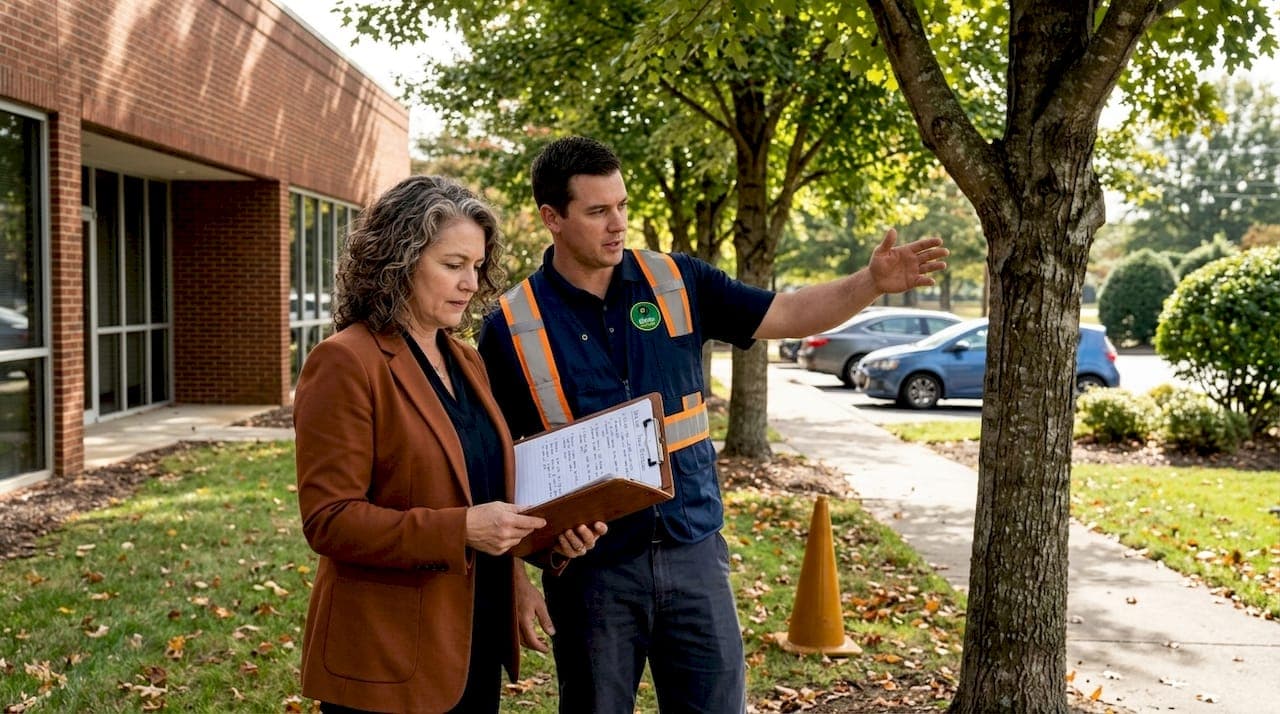
Most property managers assume commercial tree service means calling someone when a tree falls down. That assumption costs money, creates liability, and leaves landscapes looking neglected. What is commercial tree service, really? It is a structured program of inspections, risk assessments, preventive pruning, hazard removals, and emergency response that protects your property, your tenants, and your business. It is what the industry calls commercial arboriculture, and it goes far beyond sending a crew with chainsaws.
Table of Contents
- Key takeaways
- What commercial tree service actually covers
- Understanding tree risk assessments
- Why credentials matter in commercial tree care
- Benefits beyond safety
- My perspective on getting tree care right
- Trusted commercial tree care from Briley Tree Service
- FAQ
Key takeaways
| Point | Details |
|---|---|
| More than removal | Commercial tree care covers inspections, pruning, risk assessments, and emergency response. |
| Risk comes first | Formal tree risk assessments document hazard levels and guide prioritized, cost-effective decisions. |
| Credentials matter | ISA Certified Arborists bring verified knowledge in safety, tree biology, and ethics. |
| Curb appeal has value | Well-maintained trees improve customer perception and tenant satisfaction on commercial sites. |
| Contracts save money | Scheduled maintenance programs reduce emergency costs and provide documentation for insurance. |
What commercial tree service actually covers
The phrase "commercial tree service" describes professional tree care delivered at the scale, complexity, and liability level that commercial properties demand. It is not just bigger equipment or larger crews. It is a different scope of responsibility entirely.
Here are the core types of tree services commercial properties rely on:
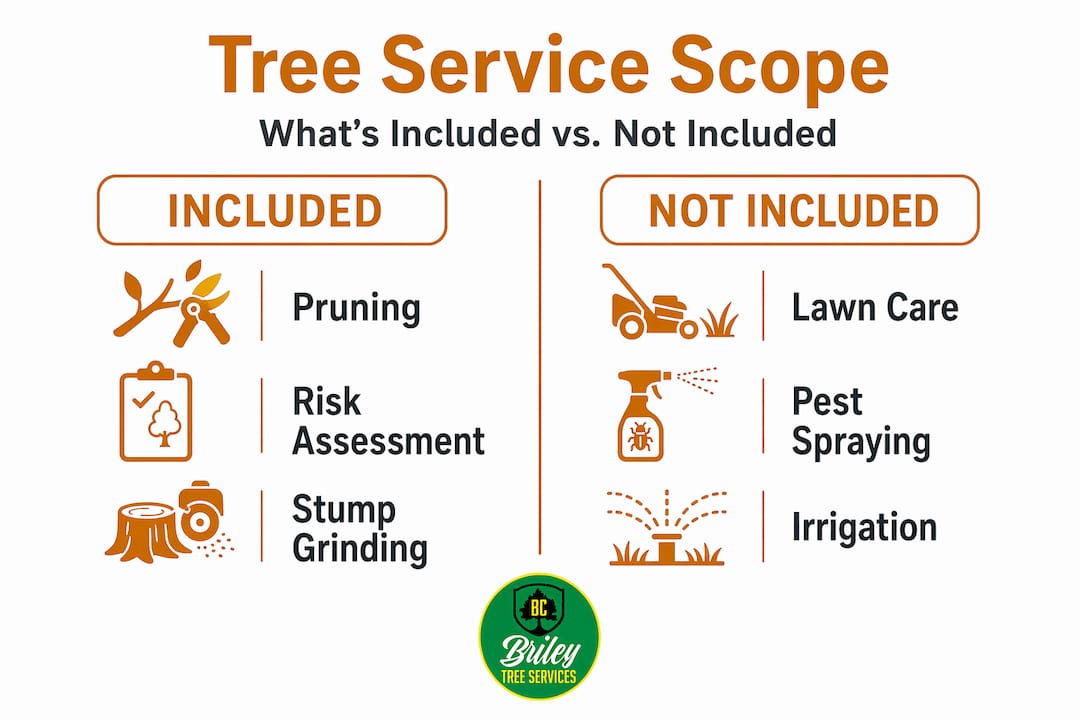
- Routine inspections and tree risk assessments. A qualified arborist walks the property, evaluates every significant tree for structural defects, disease, root problems, and proximity to buildings or foot traffic. This is the foundation of any responsible program.
- Preventive pruning. Deadwood and cracked limbs are removed before they become hazards. Crown thinning reduces wind resistance. Clearance pruning keeps branches away from rooftops, signs, and power lines.
- Tree removal and stump grinding. When a tree is beyond saving or poses unacceptable risk, full removal with stump grinding eliminates tripping hazards and clears the site cleanly.
- Emergency response. Rapid mobilization after storms is what separates professional providers from part-time operators. Downed limbs in parking lots and blocked building entrances need same-day attention.
- Land clearing and planting. Some commercial projects require site preparation or strategic replanting as part of long-term landscape plans.
Coordination is a factor most property managers underestimate. Scheduling tree work around business operations requires planning for off-hours access, traffic control, and pedestrian safety. A professional crew manages all of that. A part-time crew does not.
Pro Tip: When reviewing what does tree service include in a vendor's proposal, ask specifically whether the scope covers debris removal and site cleanup. Many low-cost bids exclude it, leaving you to manage disposal.
Understanding tree risk assessments
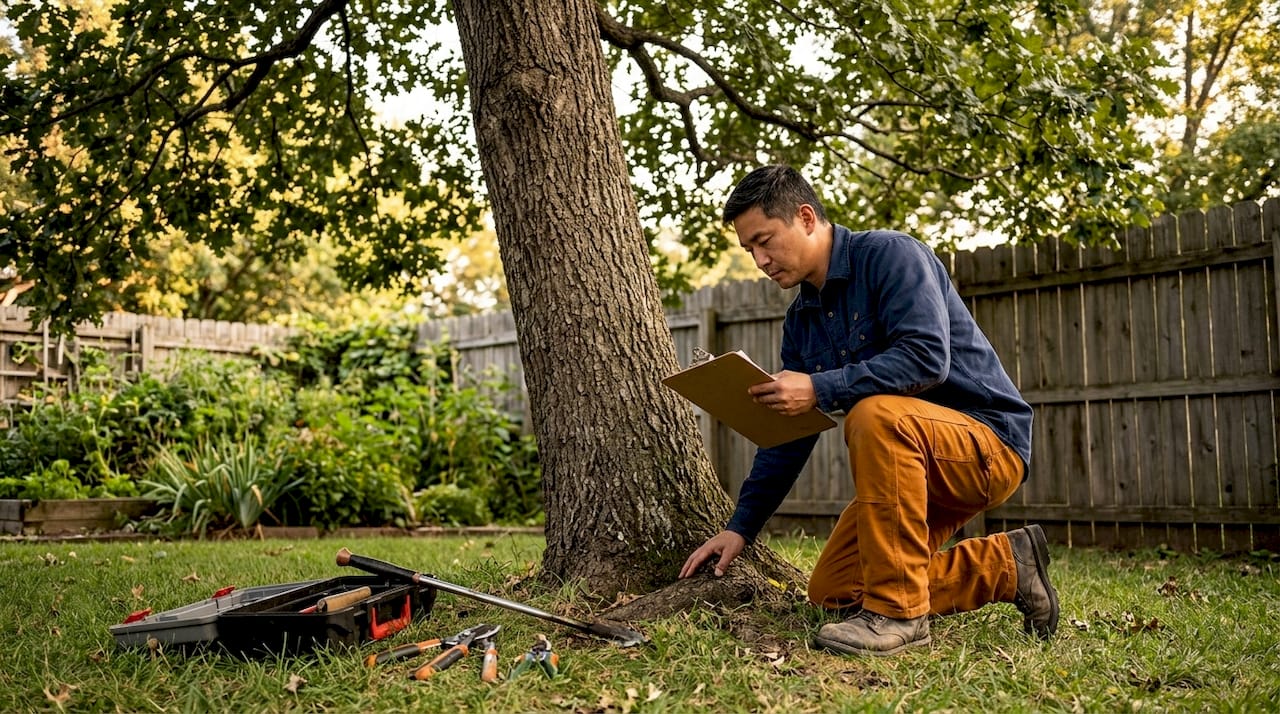
A tree risk assessment is not the same as a trimming visit. It is a formal evaluation that measures the likelihood of a tree or branch failing and the consequences if it does. The output is a written report with a risk rating and prioritized recommendations.
Here is how a professional assessment works in practice:
- Visual inspection. The arborist examines the whole tree: trunk, canopy, root zone, and surrounding targets such as buildings, walkways, and parked cars.
- Hazard rating. Using standardized ISA methodologies, the arborist assigns a rating of low, moderate, or high based on failure likelihood and consequence of failure combined.
- Recommendations. The report specifies what action to take, whether pruning, cabling, removal, or monitoring, and assigns a timeline for each.
- Documentation. The written report becomes part of your property file.
"Formal assessment reports with recommendations provide useful paper trails for risk management and insurance claims." — Tree Risk Assessment, ISA Certified Arborist Consulting
That paper trail is worth more than most property managers realize. If a branch falls and injures someone, a documented assessment showing you acted responsibly on professional recommendations is a meaningful defense. A robust risk assessment also lets you prioritize spending. Not every tree needs immediate attention. Knowing which ones do lets you allocate your maintenance budget where it matters most.
The key distinction: an arborist who only prunes is managing appearance. An arborist conducting a formal risk assessment is managing liability.
Why credentials matter in commercial tree care
Not every tree service company is qualified to work on commercial properties. The credential to look for is the ISA Certified Arborist designation, issued by the International Society of Arboriculture.
Here is a comparison of what separates credentialed providers from uncredentialed ones:
| Factor | ISA Certified Arborist | Uncredentialed contractor |
|---|---|---|
| Knowledge base | Tree biology, safety, diagnosis, ethics | Variable, no standard verified |
| Code of ethics | Required, enforced by ISA | None |
| Risk assessment capability | Formal ISA methodology | Informal or absent |
| Insurance documentation | Typically carries liability and workers' comp | May lack adequate coverage |
| Communication quality | Written reports, prioritized plans | Verbal quotes only |
For a commercial property, the stakes of hiring unqualified contractors go beyond a bad haircut on a tree. If an uncredentialed crew removes a structurally sound tree that was protecting a building from wind load, or prunes incorrectly and accelerates decay, you bear the consequences. ISA credentials confirm the person making decisions about your trees has met a verified standard of knowledge.
When hiring, check three things: the ISA certification number (verifiable on the ISA website), proof of liability insurance, and proof of workers' compensation coverage. A legitimate commercial tree care provider produces all three without hesitation.
Pro Tip: Use a tree service hiring checklist before signing any contract. The same criteria that protect homeowners apply even more forcefully to commercial properties with higher liability exposure.
The best commercial tree service contracts also specify which credentialed arborist will oversee the work, not just show up for the sales call.
Benefits beyond safety
Safety and liability are the most cited reasons to invest in commercial tree care. They are not the only reasons.
Well-maintained trees improve curb appeal and create strong first impressions for customers and tenants. An office park with overgrown, dead-limbed trees signals neglect. The same property with clean, shaped canopies signals that management pays attention. That perception affects leasing decisions and retail foot traffic more than most property managers account for.
Here are additional benefits that compound over time with a scheduled maintenance program:
- Lower emergency costs. Preventive pruning removes the branches most likely to fail in a storm before they do. Each avoided emergency call saves hundreds or thousands of dollars.
- Extended tree lifespan. Trees that receive regular health assessments and pruning live longer and require fewer costly removals.
- Better insurance positioning. Documentation from formal assessments shows insurers you manage the property proactively. Some carriers factor this into premium calculations.
- Operational continuity. When storm cleanup is handled by a provider already familiar with your site, response is faster and disruption to tenants is shorter.
- Coordinated scheduling. A contracted provider works around your operating hours, tenant move-ins, and events rather than showing up when it is convenient for them.
For large commercial campuses, urban forestry management becomes relevant. This involves tracking tree inventory, planning for future planting, and managing tree health across a large number of specimens as an organized program rather than a series of one-off calls. Coordinating around business operations and keeping a full-service provider on contract makes that kind of systematic management practical.
For property managers who handle multiple sites, commercial tree maintenance best practices around buildings and visitor areas are worth reviewing to understand what a complete program looks like at each location.
My perspective on getting tree care right
I have watched property managers handle trees the same way they handle deferred maintenance: ignore it until something breaks. And something always breaks. Usually at the worst possible time, a Friday afternoon before a holiday weekend, during a lease renewal period, or right after a storm when every tree service in the region is booked solid.
What I have learned is that the managers who treat commercial tree care as a risk program, not a line item to cut, spend less over three to five years. They pay for inspections and pruning on a schedule. They have a provider who knows their property. When a storm hits, that provider picks up the phone and shows up. The managers who skip preventive care spend more on emergency calls, more on liability claims, and more on emergency removals of trees that could have been saved.
The other thing I want to say plainly: credentials are not a formality. I have seen uncredentialed contractors make cuts that introduced decay into otherwise healthy trees, costing property owners removal bills they would not have faced for another decade. The ISA Certified Arborist standard exists for a reason. Ask for it by name.
The practical advice is simple. Get a formal tree risk assessment done at each of your commercial sites. Use it to build a prioritized maintenance schedule. Negotiate your commercial tree service contract to include both routine work and emergency response. Then stop reacting and start managing.
— Tatum
Trusted commercial tree care from Briley Tree Service
Brileytreeservice provides professional commercial tree care across Shreveport, Bossier City, and Northwest Louisiana. The company's services cover tree removal, pruning, stump grinding, and emergency storm cleanup for commercial properties of all sizes. Brileytreeservice works with property owners and managers to handle inspections, hazard removals, and scheduled maintenance programs that protect both the property and the people on it. The team responds quickly after storms, cleans up after every job, and coordinates work to minimize disruption to business operations. Commercial property owners in the region can request a free estimate today and get a clear picture of what their trees need. Brileytreeservice also covers additional service areas throughout the region for both routine and emergency commercial tree work.
FAQ
What does commercial tree service include?
Commercial tree service includes routine inspections, tree risk assessments, preventive pruning, hazard removal, stump grinding, and emergency storm response. Full-service providers also handle debris cleanup and coordinate scheduling around business operations.
How is a tree risk assessment different from regular trimming?
A tree risk assessment is a formal evaluation that assigns a hazard rating and produces written recommendations for mitigation. Regular trimming addresses appearance and basic maintenance but does not document structural integrity or failure likelihood.
Why should I hire an ISA Certified Arborist for my commercial property?
ISA Certified Arborists have verified knowledge in tree biology, safety, diagnosis, and ethics. For commercial properties with higher liability exposure, that verified standard reduces the risk of costly mistakes and provides documentation that supports insurance claims.
How can I recognize when a tree needs removal rather than pruning?
Signs that a tree may need removal include significant trunk decay, major root damage, severe lean toward a structure, and repeated large branch failures. Reviewing warning signs of hazardous trees helps property managers identify which trees warrant a formal assessment.
Do commercial tree service contracts actually save money?
Yes. Scheduled maintenance programs reduce the frequency and cost of emergency calls, extend tree lifespans, and provide documentation that supports insurance positioning. Proactive inspections catch problems while they are still manageable, before they become expensive removals or liability claims.