
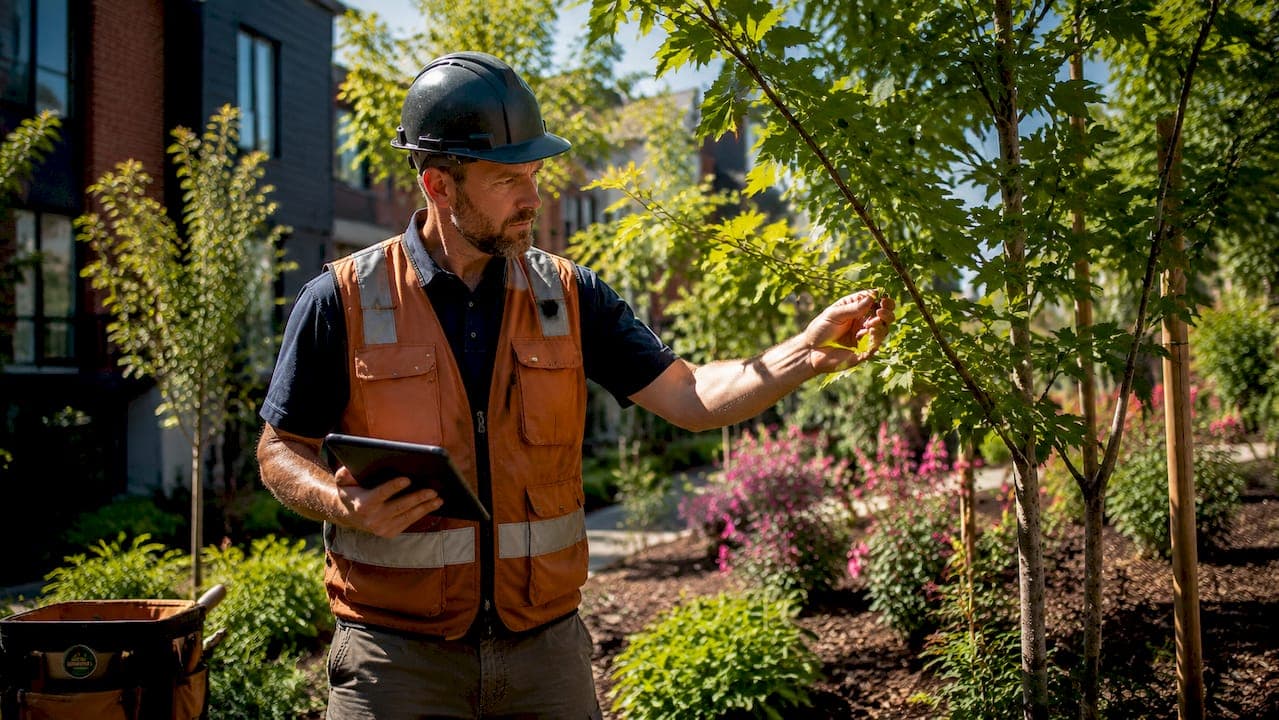
Commercial properties need arborists because trees on business sites are simultaneously financial assets and legal liabilities that require certified professional oversight to manage safely. An arborist is a trained specialist in tree health, structural stability, and risk assessment. Unlike a general landscaping crew, a certified arborist applies science-based methods to evaluate, treat, and document tree conditions across complex commercial environments. Property managers who treat trees as scenery rather than infrastructure routinely face preventable costs, from storm damage claims to declining property values.
Why commercial properties need arborists: the core case
Trees are not passive features on a commercial site. They affect property value, occupant safety, insurance exposure, and regulatory compliance all at once. The importance of arborists for businesses comes down to one fact: no other professional combines tree health expertise with formal risk documentation in a single service relationship.
Certified arborists hold credentials from the International Society of Arboriculture (ISA), the recognized standard for professional tree care. That credential matters on commercial sites because it signals training in hazard identification, disease diagnosis, and structural evaluation. A general landscaper can mow and mulch. An arborist can tell you whether a mature oak near your parking structure poses a fall risk before it becomes a claim.

The mindset shift from trees as scenery to trees as infrastructure is the first step every commercial property manager needs to make. Once you see trees as assets with maintenance schedules, inspection records, and risk ratings, the business case for arborist services becomes straightforward.
How do arborists enhance tree health and stability on commercial properties?
Proactive tree health management on commercial sites follows a structured protocol, not a reactive call when something looks wrong. Annual or biannual inspections by licensed arborists are the industry standard for optimizing risk mitigation and cost efficiency. These walkthroughs produce a tree inventory: a documented record of every tree on site, its condition, its risk rating, and its recommended treatment schedule.
The practical difference between commercial and residential tree care is significant. Commercial sites carry higher foot traffic, more infrastructure proximity, and greater public occupancy. A dead limb over a residential backyard is a nuisance. The same limb over a retail entrance is a liability event waiting to happen.
Arborists use several specific treatments to maintain structural integrity across a commercial portfolio:
- Crown pruning removes dead, crossing, or structurally weak branches before they fail.
- Disease and pest management addresses fungal infections, boring insects, and root rot through targeted treatments.
- Structural support systems install cables or braces in trees with co-dominant stems or split trunks.
- Root zone management protects root systems from compaction caused by paving, construction, or heavy equipment.
- Soil health programs correct nutrient deficiencies that weaken trees over time.
Documented maintenance records from these treatments serve a dual purpose. They guide future care decisions, and they provide written evidence of reasonable care if a tree-related incident ever leads to a legal claim.
Pro Tip: Request a formal tree inventory from your arborist after the first inspection. That document becomes the foundation of your entire maintenance program and your first line of defense in any liability dispute.
What financial and aesthetic benefits do arborists bring to commercial properties?
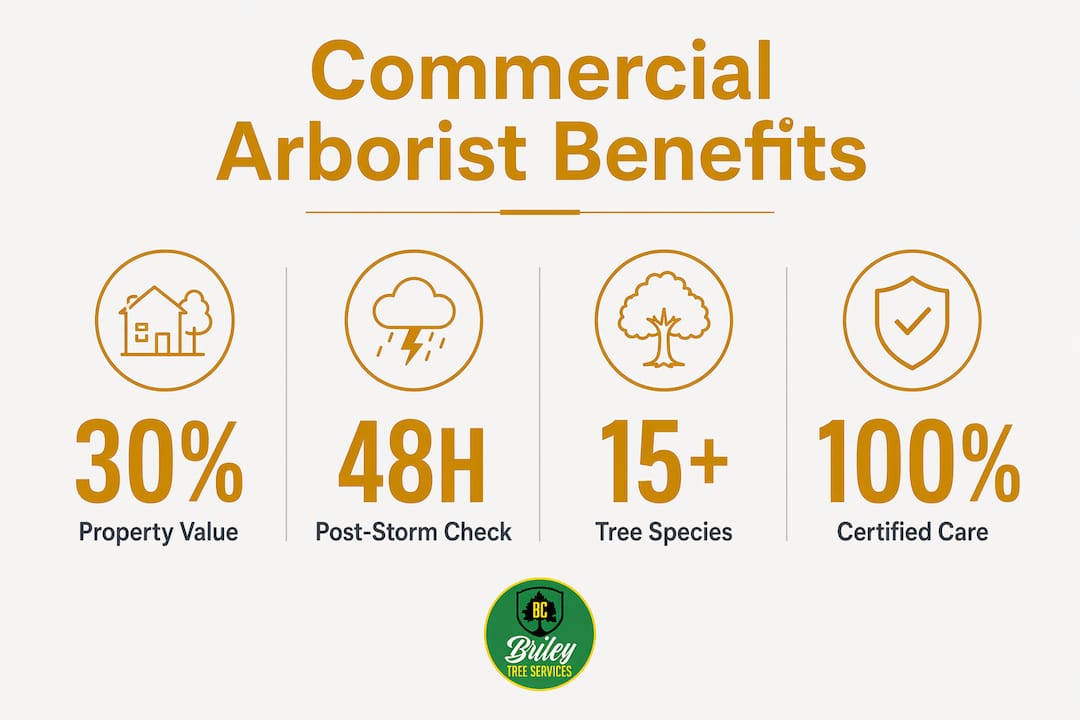
Professional tree care directly affects property value in measurable ways. Mature, well-maintained trees can boost property resale value by 5% to 15% when landscaping is intentional and professionally managed. That range is not incidental. It reflects the difference between trees that enhance a site and trees that simply exist on it.
Placement matters as much as condition. Research shows that trees within 10 meters of a building can decrease commercial property value by approximately 2.96%, while trees positioned 10–20 meters away increase value by about 1.16%. The financial gap between a poorly placed tree and a well-placed one can exceed $100,000 on a single property. Arborists identify these placement risks and recommend corrective action before they compound.
The aesthetic benefits of professional tree care extend beyond raw property values. Well-maintained mature trees signal to tenants, clients, and visitors that a property is actively managed. That perception affects lease rates, occupancy, and brand reputation. A retail center with healthy, shaped trees at its entrance draws more foot traffic than one with overgrown or visibly declining specimens.
Key financial and aesthetic benefits of arborist services for commercial real estate include:
- Higher resale and appraisal values from documented, professionally maintained tree assets
- Improved tenant retention because tenants prefer well-maintained environments
- Stronger curb appeal that supports marketing and leasing efforts
- Reduced emergency costs from proactive treatment versus reactive removal
- Compliance with municipal tree ordinances that protect existing canopy and avoid fines
Commercial landscaping experts who specialize in arboriculture also help property managers plan new plantings strategically. The right species in the right location grows into a long-term asset rather than a future liability.
How do arborists help manage risks and liabilities on commercial properties?
Risk management is where arborist services for commercial real estate deliver the clearest financial return. Trees pose multiple hazard categories on commercial sites: falling limbs, root damage to pavement and utilities, sightline obstruction near driveways, and fire fuel load near structures. Each category carries its own liability exposure.
The central document in commercial tree risk management is the Arborist Report. An Arborist Report is a defensible, science-based document used for risk assessment, insurance claims, and legal defense. It includes a tree inventory, individual risk ratings, and specific maintenance recommendations. Insurers and attorneys rely on this document, not informal crew opinions, when evaluating tree-related claims.
Consistent arborist care proves reasonable care in a legal context. Maintaining clear maintenance records can provide a strong defense against negligence claims when a tree incident occurs. Without those records, a property manager has no documented evidence that the hazard was identified and addressed.
| Factor | Residential tree crew | Certified commercial arborist |
|---|---|---|
| Insurance coverage | General liability only | Commercial-grade COI required |
| Documentation | Informal notes or none | Formal Arborist Report |
| Risk assessment | Visual inspection | Science-based hazard rating |
| Regulatory knowledge | Limited | Municipal code compliance |
| Legal defensibility | Weak | Strong |
Using residential-focused tree crews on commercial sites often lacks adequate insurance and increases both liability and compliance risk. Property managers should verify a certificate of insurance (COI) before any crew begins work on a commercial site.
Pro Tip: After every major storm, schedule a post-storm inspection with your arborist within 48 hours. Hidden structural damage from wind loading often does not show visible symptoms until weeks later, when failure risk is highest.
What distinguishes commercial arborist services from residential tree care?
Commercial arborist consultations differ from residential tree work by focusing on expert analysis, regulatory support, and formal reporting rather than operational tasks alone. A residential arborist visit typically addresses one or two trees. A commercial engagement covers an entire site, its infrastructure, its occupants, and its regulatory obligations.
The distinctions that matter most for property managers include:
- Site-wide risk management that evaluates every tree in relation to buildings, utilities, and pedestrian areas
- Formal written reports that satisfy insurance, legal, and municipal requirements
- Specialized insurance coverage that protects the property manager from underinsured work
- Compliance with urban forestry regulations including permit requirements for removal or pruning of protected species
- Capital planning support that helps managers budget for tree care as a recurring line item, not a surprise expense
Commercial sites tie trees to operations, infrastructure, and regulation, which requires science-based consultation rather than residential advice. A property manager overseeing a mixed-use development in Shreveport faces different tree care requirements than a homeowner with a backyard oak. The scale, the legal exposure, and the documentation standards are all different.
Establishing a preferred vendor relationship with a certified arborist accelerates emergency response and keeps the property in ongoing compliance with urban forestry regulations. That relationship also means your arborist already knows your site when a storm hits, which reduces assessment time and speeds up response. Proactive maintenance is more cost-effective than emergency tree work and keeps regulatory compliance current without scrambling for permits after the fact.
You can review commercial tree maintenance best practices to understand how scheduled arborist programs compare to reactive care in terms of cost and risk outcomes.
Key Takeaways
Commercial properties need arborists because trees require certified, documented professional care to protect property value, reduce legal liability, and maintain safety across complex commercial sites.
| Point | Details |
|---|---|
| Trees are financial assets | Professionally maintained mature trees can increase property resale value by 5% to 15%. |
| Placement affects value | Trees within 10 meters of a building can decrease property value; optimal placement increases it. |
| Arborist Reports are legal tools | A formal Arborist Report provides defensible documentation for insurance and negligence claims. |
| Commercial care differs from residential | Commercial arborists provide site-wide risk assessments, formal reports, and regulatory compliance support. |
| Proactive care saves money | Scheduled maintenance costs less than emergency removal and keeps compliance current without delays. |
Trees as infrastructure: what experience actually teaches
I have seen property managers treat tree care as a line item to cut when budgets tighten. That decision almost always costs more than the savings. The pattern is consistent: deferred maintenance leads to a storm event, a storm event reveals structural failures that were already present, and the property owner ends up paying for emergency removal, pavement repair, and sometimes a legal defense. All of that was preventable with a scheduled inspection program.
The most undervalued part of working with a certified arborist is the documentation. Property managers focus on the physical work, the pruning and the removals. But the Arborist Report is what actually protects you when something goes wrong. Insurers and attorneys do not accept "we had someone look at it." They want dated records, risk ratings, and signed reports from credentialed professionals.
The other thing experience teaches is that the best arborist relationships are ongoing, not transactional. An arborist who has walked your site twice a year for three years knows which trees are declining, which ones responded well to treatment, and which ones need to come down before the next storm season. That institutional knowledge is worth more than any single service call. Property managers who build that relationship early spend less, respond faster, and sleep better after a storm.
— Tatum
Brileytreeservice commercial tree care for Shreveport properties
Brileytreeservice serves commercial property managers across Shreveport, Bossier City, and Northwest Louisiana with licensed tree care built for business sites. The team handles tree trimming, removal, stump grinding, and emergency storm cleanup, all backed by the documentation and insurance coverage that commercial properties require.
Property managers working with Brileytreeservice get scheduled maintenance programs, post-storm inspections, and formal assessments that support both insurance requirements and liability defense. Every job includes cleanup and a clear record of work completed. For property managers who need reliable commercial tree services in the Shreveport area, Brileytreeservice offers free estimates and straightforward scheduling. Contact Brileytreeservice today to protect your trees, your tenants, and your property value.
FAQ
Why do commercial properties need arborists instead of landscapers?
Arborists are certified in tree health, structural risk assessment, and formal documentation, which landscapers are not trained to provide. Commercial properties require Arborist Reports for insurance and legal defense, which only a credentialed arborist can produce.
Do commercial properties require arborists by law?
Many municipalities require permits for tree removal or pruning of protected species, and those permits often require documentation from a certified arborist. Regulatory requirements vary by city, so property managers should verify local urban forestry ordinances.
How often should a commercial property have an arborist inspection?
Annual or biannual inspections are the industry standard for commercial properties. High-traffic sites or properties with aging tree canopy may benefit from more frequent walkthroughs, particularly after major storms.
What is an Arborist Report and why does it matter?
An Arborist Report is a science-based document that includes a tree inventory, individual risk ratings, and maintenance recommendations. Insurers and attorneys rely on this report when evaluating tree-related claims, making it the primary legal defense tool for property managers.
How do arborist services affect commercial property value?
Professionally maintained mature trees can increase property resale value by 5% to 15%. Poor tree placement, specifically trees too close to structures, can decrease value significantly, which is why arborist guidance on placement and health is a direct financial investment.