

Call 811 (or visit call811.com) before you dig. Every project, every time. Free national locate service, no exceptions for "small" jobs. The Department of Transportation cites research showing calling 811 gives you a 99% chance of avoiding an incident while excavating. Skip the call, and you're gambling with gas lines, buried power, and repair bills that dwarf whatever you saved by not picking up the phone.
TL;DR:
- Calling 811 provides a 99% chance of avoiding underground utility damage, but ignoring it risks hitting gas, electric, or water lines.
- Wait the full notification period, which is at least two business days, and confirm that utility marks are visible and accurate before digging.
- Have clear information ready before calling, including your address, work details, and planned start date, and pre-mark your digging area to speed up locating.
- Private lines like sewer laterals and buried irrigation or low-voltage wiring are not covered by 811, so homeowners must locate these themselves.
- Hand-dig within the marked zones, re-call if marks fade, and always verify current marks to prevent accidents and costly repairs.
Table of Contents
- What Happens After You Call 811
- When to Call and How Long You'll Wait
- What to Have Ready Before You Call
- Confirming Locates Before You Break Ground
- Situations 811 Doesn't Fully Cover
- Digging Safety Practices That Actually Prevent Strikes
- How We Coordinate Locates on Every Job
- When the Job Is Bigger Than a Weekend Project
- Where to Verify the Rules Yourself
- The Locate Ticket Isn't Paperwork. It's Insurance
- Sources
What Happens After You Call 811
Calling 811 sets off a chain reaction. You call or submit a request online, and within moments you get a locate ticket number tied to your address and project. That number matters. It's your proof of notice and your reference point if anything looks off later.
Every affected utility company gets notified through that ticket. Then each one sends a crew, or a contracted locator, to your property to mark where their lines run.
Here's what typically happens at that stage:
- Crews mark underground lines with spray paint, flags, or both, using industry-standard colors (red for electric, yellow for gas, blue for water, and so on).
- Some utilities leave written notice or a door tag if no lines are found on your property.
- You must wait the full required timeframe and visually confirm marks from every utility on the ticket before touching a shovel.
A ticket number alone doesn't clear you to dig. It only confirms the request went out.
When to Call and How Long You'll Wait
Standard guidance across most states: call at least two business days before you plan to dig. Weekends and holidays don't count toward that window, so a Friday call often means work doesn't start until the following Wednesday.
State rules vary, and that's worth checking directly. Texas811 requires excavators to give at least two business days' notice, excluding weekends and holidays, and it posts alerts when a utility declares "extraordinary circumstances" that push the locate timeline back further.
A few things stretch that window:
- Large-scale projects covering multiple lots or long trench runs.
- Sites with a high density of utilities (older neighborhoods often have more buried infrastructure than new subdivisions).
- Declared extraordinary circumstances, like storm damage that has utility crews stretched thin.
Call early. A two-day minimum is the floor, not a guarantee.
What to Have Ready Before You Call
A locate request moves faster and comes back more accurate when you walk in prepared. Have these details on hand:
- Your exact address, including any cross streets or landmarks if your property sits on a large lot or rural road.
- A callback phone number where a locator can actually reach you with questions.
- Your planned start date for digging, since the clock on your two business days starts from that date.
- A clear description of the work area, including how deep you plan to dig and the boundaries of the site.
Before the crews show up, pre-mark your dig area with white paint or flags. It sounds like a small step, but it tells locators exactly where to focus, which speeds up accuracy on their end.
This applies to more projects than people assume: setting fence posts, planting a tree, installing a mailbox, building a pool border, and yes, stump grinding all count as digging in the eyes of your state 811 center.
Confirming Locates Before You Break Ground
Your locate ticket number is your paper trail. Hang onto it. If a dispute ever comes up about whether you gave proper notice, that number and its timestamp are your proof.
Once the waiting period passes, walk the site yourself:
- Look for paint or flags from every utility listed on your original ticket, not just the ones you expected to see.
- If a utility marked "no conflict" or left no marks at all, that's still a response. Silence with no visit is not.
- Hand-dig within roughly 18 to 24 inches of any marking (the tolerance zone) rather than running a powered auger or trencher through it.
If marks are missing, faded, or contradict each other, contact 811 again before digging and take photos of the site for your records.
Pro Tip: A ticket number is not a green light to dig. Wait for the actual marks, then confirm each one with your own eyes before the first shovel goes in the ground.
Situations 811 Doesn't Fully Cover
811 handles public utility lines, but it stops at your property's main connection point. Private lines, like the sewer lateral running from your house to the street main, usually fall on the homeowner to locate and repair if something goes wrong, including damage from root intrusion.
A few other gaps worth knowing:
- Some utility lines sit shockingly close to the surface, sometimes just a few inches down, so never assume a "safe" digging depth based on a marking's general location.
- Irrigation lines, invisible fencing, and low-voltage landscape wiring often aren't part of the standard 811 process and require separate arrangements with the installer.
- Rules differ by state, so check your local center, like Texas811, for extraordinary-circumstance notices and any local timeline exceptions.
Digging Safety Practices That Actually Prevent Strikes
Calling 811 gets your locates marked. What you do next determines whether that information actually protects you.
- Hand-dig inside the tolerance zone. Stick to shovels and hand tools within roughly two feet of any marking rather than mechanical equipment.
- Re-call if marks fade. Paint washes out in rain faster than most people expect. If you're returning to a site days later and marks look worn, call 811 again before resuming.
- Check contractor tickets. If you're hiring help, ask to see the active locate ticket and confirm the crew is working from current, visible marks before equipment starts moving.
None of this replaces common sense. Treat every exposed line as live until a utility owner tells you otherwise.
How We Coordinate Locates on Every Job
Even seasoned crews don't skip the call. At Brileytreeservice, verifying locate marks is a standard part of site prep before a stump grinder or excavation equipment touches the ground, no matter how confident anyone is that a yard is clear.
Root systems can shift soil and mask what's underneath, and old sewer laterals often have existing damage that roots exploit rather than cause. We call 811 on every job, even when a homeowner is certain nothing's buried nearby. It's a small step that avoids a very expensive mistake. If you're planning removal work yourself, our guide to preparing your yard for tree removal covers the site-prep steps worth handling before any equipment arrives.
When the Job Is Bigger Than a Weekend Project
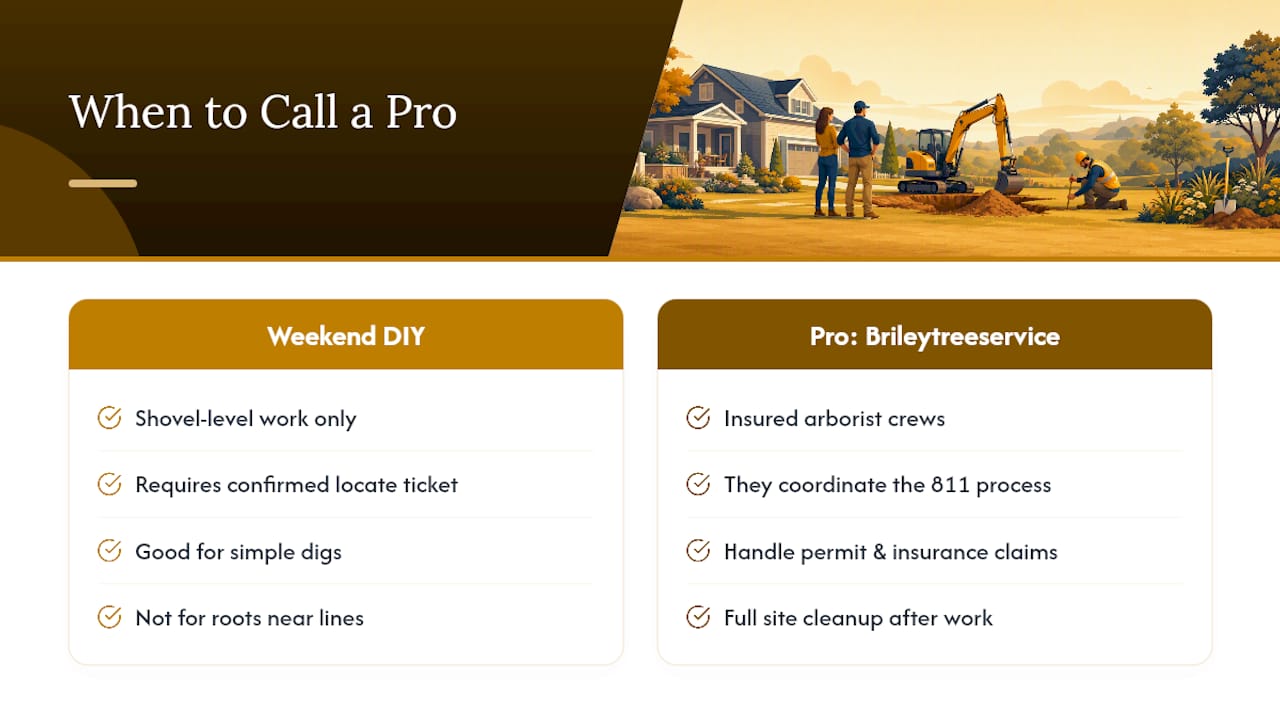
Some digging jobs are simple enough for a homeowner with a shovel and a confirmed locate ticket, but larger projects often require professional help like Cornelius Wrecking | Nationwide Demolition & Excavating Contractor. Others aren't, especially stump grinding near a driveway, tree removal close to a foundation, or any project where roots may have already compromised a sewer lateral.
That's where Brileytreeservice comes in. We're the local alternative to guessing your way through a complicated removal or grinding job. Our insured arborist crews coordinate the 811 process as part of every site visit, handle permit and insurance claim support when storm damage is involved, and clean up fully once the work is done.
If you're staring down a hazardous tree, a stump sitting too close to underground lines, or storm damage that needs fast attention across Shreveport, Bossier City, or Ruston, get a free estimate from Brileytreeservice before you pick up a shovel or a chainsaw.
Where to Verify the Rules Yourself
For official guidance, start with call811.com to find your state 811 center, and check the DOT's call-811 safety page for national statistics. Texas residents can confirm local timelines directly through Texas811.
The Locate Ticket Isn't Paperwork. It's Insurance
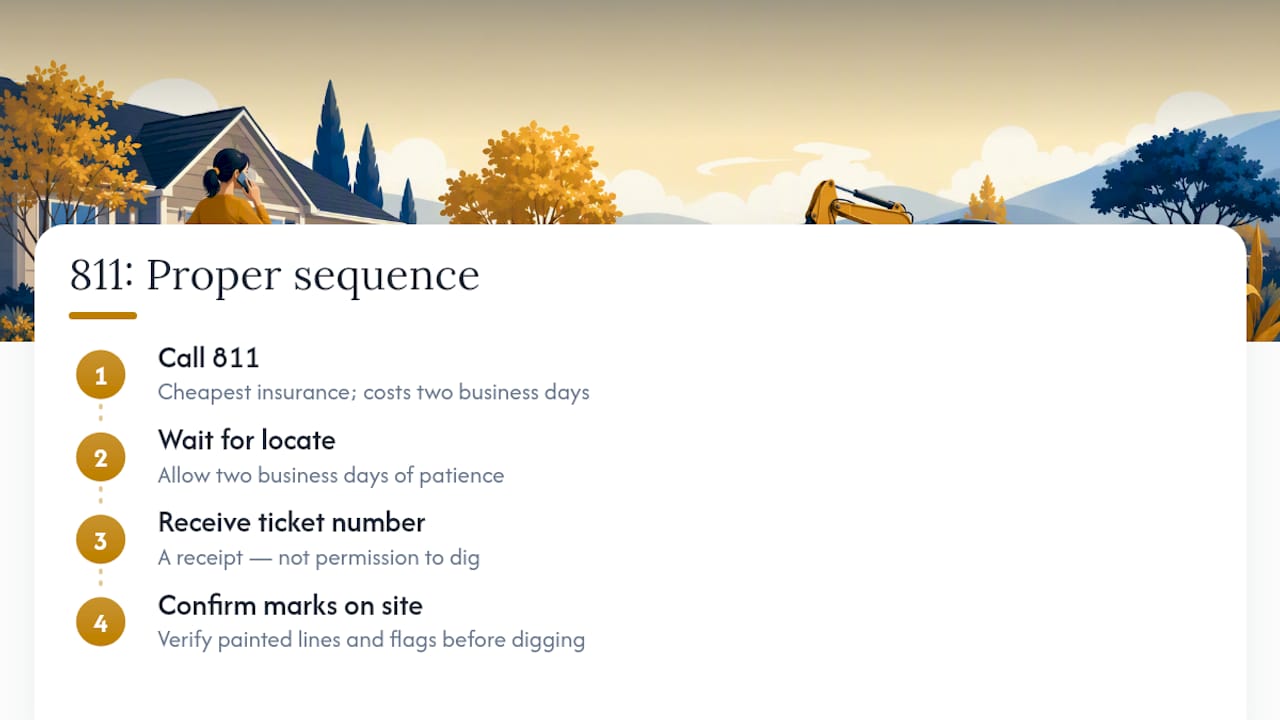
Most homeowners treat calling 811 like a formality, something you check off before the real work starts. That's backwards. The locate process is the cheapest insurance policy available to anyone with a shovel, and it costs nothing but two business days of patience.
What gets underestimated is how often "I'll just dig carefully" fails as a strategy. Careful digging doesn't help when a gas line sits four inches under a spot nobody expected one to be. The tolerance zone and hand-digging rules exist precisely because human judgment about depth is unreliable, even for people who've dug in their yard for years.
The other overlooked piece: a ticket number isn't permission. It's a receipt. Too many DIYers see that number land in their inbox and assume they're cleared to start. The real clearance comes from standing in your yard, staring at painted lines and flags, and confirming every utility on that list actually showed up. Skip that step, and the call to 811 was just theater.
— Tatum
Sources
- Call 811 Before You Dig | U.S. Department of Transportation
- 811 Before You Dig
- Texas811 | Facility Notification Center in Texas
- Tree roots and sewer lines | N.C. Cooperative Extension