
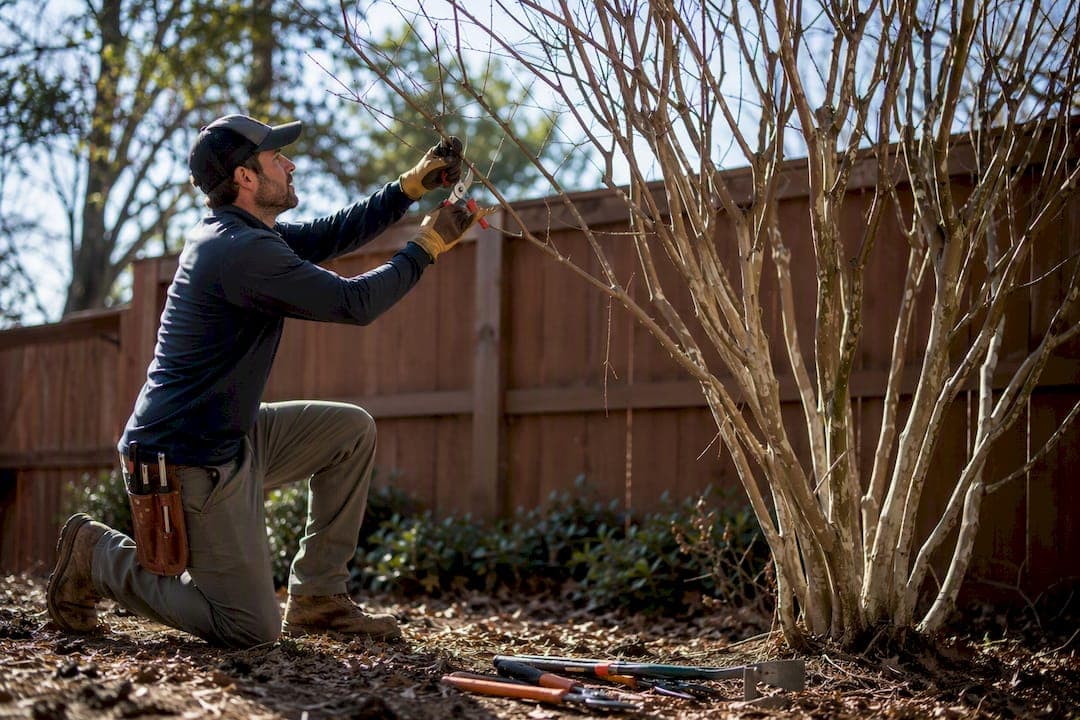
Prune crepe myrtles in late winter, from late February through early March, while the tree is still dormant. Focus on removing dead, crossing, and diseased wood, thinning for an open canopy, and clearing suckers instead of cutting back the whole crown. Skip the topping. Crepe myrtles bloom on new wood no matter how you prune, so heavy cuts every year do more harm than good.
TL;DR:
- Pruning crepe myrtles is best done in late winter before spring growth begins to allow for clear structural cuts and faster healing.
- Most flowers develop on new wood, so heavy annual pruning is unnecessary; trimming is mainly for health, safety, or aesthetic purposes.
- Avoid topping trees, as it causes weak growth and long-term disfigurement, and instead focus on removing dead, diseased, or crossing branches.
- Use appropriate tools like bypass pruners and loppers for precision cuts, and call a licensed arborist for large or risky limb removal.
- Corrective pruning can take several seasons to restore a misformed or overgrown tree properly, or consider replacing severely damaged specimens.
Table of Contents
- When Is the Best Time to Prune Crepe Myrtles?
- Do You Even Need to Prune Your Crepe Myrtle?
- How Do You Actually Prune a Crepe Myrtle?
- What Pruning Mistakes Actually Hurt Crepe Myrtles?
- What Tools and Safety Steps Do You Need?
- Can You Fix a Crepe Myrtle That Was Topped or Overgrown?
- Less Cutting, Better Trees: An Editorial Take
- Get Professional Pruning Help From Briley Tree Service
- Sources
When Is the Best Time to Prune Crepe Myrtles?
Late winter is the window that works best, specifically late winter, right before spring growth kicks in. The tree is still dormant, so cuts heal faster and you can see the branch structure clearly without leaves in the way.
Timing matters more than most homeowners realize. Prune too early in the winter and a hard freeze can damage the fresh cuts. Wait too long, past the point new buds start swelling, and you interrupt the tree's spring growth cycle right when it needs that energy most.
A few seasonal notes worth keeping in mind:
- Stick to the dormant window for structural cuts, but dead or diseased branches can come off anytime as basic safety maintenance, according to extension guidance from N.C. Cooperative Extension.
- Some cultivars respond well to light tip pruning of spent blooms in early summer, which can encourage a smaller second flush of flowers.
- Avoid pruning in fall. It pushes tender new growth right before winter, and that growth rarely survives a hard freeze.
Do You Even Need to Prune Your Crepe Myrtle?
Crepe myrtles flower on new wood each season regardless of pruning severity the previous winter. That single fact undercuts the whole reason most people reach for the loppers in the first place. UF/IFAS research confirms that pruning has nothing to do with whether your tree blooms.
So why prune at all? A few legitimate reasons:
- Health, removing dead, damaged, or diseased wood before it spreads.
- Structure, correcting weak crossing branches while the tree is young.
- Clearance, keeping limbs off the roofline, walkway, or power lines.
- Safety, eliminating hazardous limbs that could fail in a storm.
- Appearance, light shaping for a cleaner natural form.
If your crepe myrtle keeps outgrowing its spot every single year, that's not a pruning problem. Clemson HGIC notes that recurring size battles usually trace back to picking the wrong cultivar for the space. A dwarf or semi-dwarf variety planted in the right spot needs almost no maintenance at all.
How Do You Actually Prune a Crepe Myrtle?
Start with a walk-around, not the pruners. Look for dead wood, disease, branches rubbing against each other, and any suckers sprouting from the base or trunk. That inspection tells you exactly where to cut before you make a single move.
- Remove suckers first. Pull them off by hand while they're still soft and green. It's easier on the tree than cutting woody suckers later, and it saves you a corrective cut down the road.
- For young trees, pick your trunks. Choose a few well-spaced main stems and remove competing ones at the base. This is where you set the tree's shape for the next decade.
- For mature trees, thin before you reduce. Make thinning cuts at the branch collar to open up the canopy for light and airflow, following the naturalistic approach Virginia Tech Extension recommends over blunt size reduction.
- Use reduction cuts, not headers, when a limb needs to come back. Cut to a lateral branch that's at least one-third the diameter of the branch you're removing. That keeps the joint strong instead of leaving a stub that sprouts weak growth.
- Clean up seedheads and debris. Old seed clusters can come off for appearance, and raking up trimmings helps prevent fungal issues from lingering near the base.
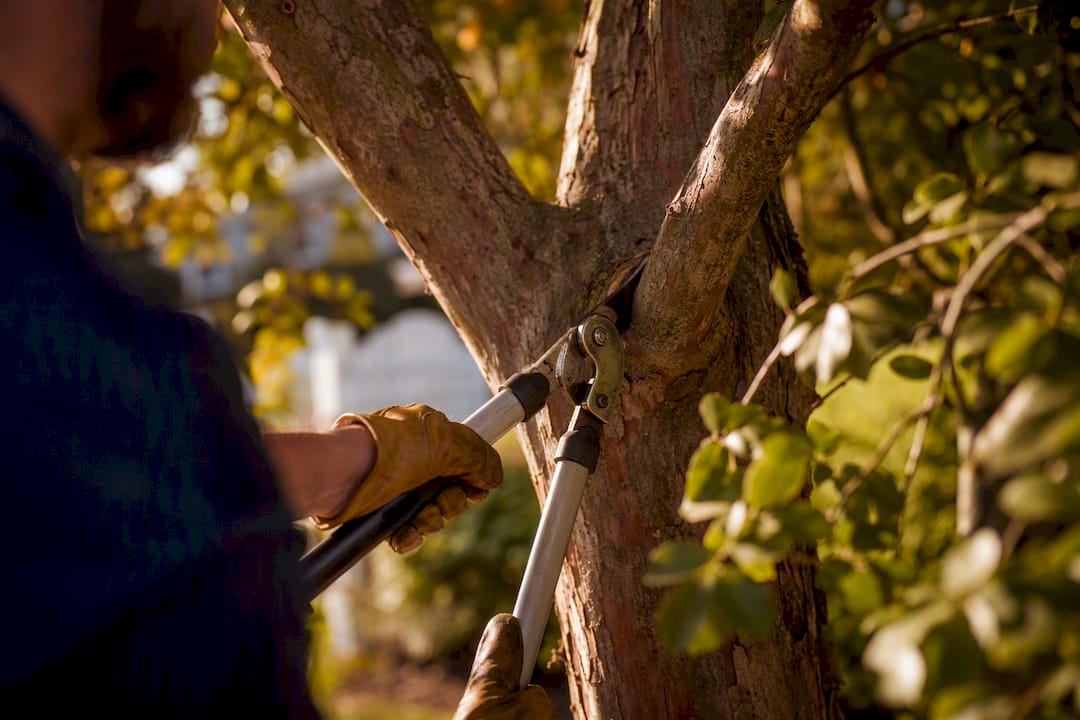
For anything thicker than your wrist, use the three-cut method: an undercut a foot or so out from the trunk, a top cut just past it to drop the weight, then a final clean cut just outside the branch collar. This prevents bark tearing and gives the tree the best shot at a clean callus.
Pro Tip: Always cut just outside the branch collar, the slightly swollen ring where a limb meets the trunk. Cutting flush into the trunk removes tissue the tree needs to seal the wound properly.
What Pruning Mistakes Actually Hurt Crepe Myrtles?
Topping, chopping main branches down to stubs, is the most common and most damaging mistake homeowners make. Gardeners have nicknamed it "crape murder" for good reason: UF/IFAS research shows it disfigures the tree and weakens its long-term structure.
- Topping results in weak, thin shoots from cuts that are prone to snapping in wind or rain.
- Those dense knuckles create shaded, crowded growth that's more prone to fungal disease and pest problems.
- Removing too much of the crown at once starves the tree of the leaf area it needs to store energy for next season, adding stress right when it should be recovering.
- Repeated severe pruning almost always signals the wrong cultivar for the spot, not a tree that genuinely needs it.
If your crepe myrtle has already been topped in past seasons, you're not stuck. Recovery is possible with the right approach, covered further down.
What Tools and Safety Steps Do You Need?
Sharp bypass hand pruners, bypass loppers, and a folding pruning saw are suitable tools for most crepe myrtle pruning cuts. Virginia Tech Extension points out that precise hand tools preserve natural form far better than a chainsaw, which is built for speed and volume, not the careful cuts good pruning requires.
- Keep blades clean and sharp; dull tools crush bark instead of slicing it, and that invites disease.
- Wear eye protection and gloves, and never work from a ladder leaned against a limb you're about to cut.
- Don't reach beyond what you can control with both feet planted. If a cut requires stretching or climbing higher than a sturdy step stool, it's not worth the risk.
- Call a licensed arborist for anything involving large-diameter cuts, structural corrective pruning, or limbs near power lines or a roofline.
Can You Fix a Crepe Myrtle That Was Topped or Overgrown?
Yes, but plan on a few seasons, not a single weekend, to rebuild the structure properly.
- Select strong sprouts. From each cut stub, pick two or three of the strongest, best-positioned shoots and remove the rest. UF/IFAS extension guidance recommends repeating this thinning over multiple seasons as the retained shoots mature into real branches.
- Or start over at ground level. Cutting the whole tree down to the base and reselecting new trunks from the regrowth gives you a full renewal, though it takes longer to reach mature height again.
- Consider replacement. If the tree has been topped repeatedly for years and the trunk structure is badly compromised, a fresh start with a properly sized cultivar can be the more sustainable move.
Less Cutting, Better Trees: An Editorial Take
The instinct to prune hard every winter is almost always the wrong one. Most homeowners reach for the loppers because they assume more flowers depend on it, and that assumption is simply false. The trees that end up looking best over a decade are the ones left mostly alone, with an owner who steps in for a few precise cuts rather than an annual crown reduction.
Briley Tree Service's approach reflects that same restraint:, backed by, and feedback like. For large limbs, structural corrections, or anything near a power line or roofline, bring in a licensed arborist rather than guessing with a ladder and a chainsaw.
— Tatum
Get Professional Pruning Help From Briley Tree Service
Briley Tree Service handles the corrective pruning most homeowners aren't equipped to do safely on their own, without asking you to sign a long-term maintenance contract just to get one tree fixed.

If your crepe myrtle has been topped for years, has hazardous limbs near a roofline, or just needs a trained eye before you make the first cut, that's exactly the kind of job a licensed and insured crew handles differently than a homeowner with a ladder and a pair of loppers. Briley Tree Service offers pruning, corrective structural work, hazard limb removal, and full cleanup for properties across Shreveport, Bossier City, Ruston, and the surrounding North Louisiana area. Insurance coverage matters here too: a bad cut on a large limb can damage property or cause injury, and a licensed arborist carries the coverage to protect you if something goes wrong. Request a free estimate and get a plan for your trees before the next dormant season closes.
Sources
- ENH1138/EP399: Crapemyrtle Pruning (UF/IFAS)
- Pruning Crapemyrtles (Virginia Tech Extension)
- Crape myrtle pruning (Clemson HGIC)
- Crape myrtle pruning (UF/IFAS county pages)