
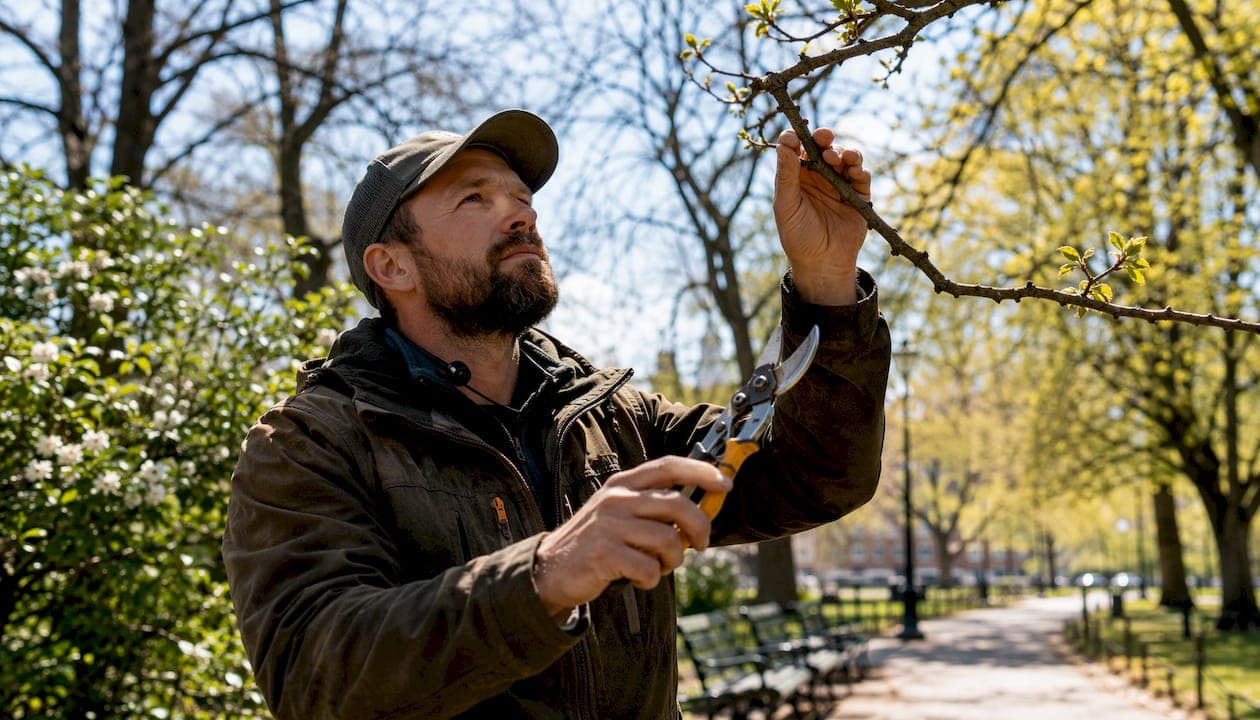
For most deciduous trees in the United States, late winter to very early spring is the best time to prune. That window, just before bud break, lets wounds seal quickly once the growing season starts and keeps pest pressure low. Three situations override that general rule immediately:
- Hazard or storm damage: Broken, hanging, or structurally compromised limbs need to come down right away, regardless of season.
- Oak wilt and Dutch elm disease areas: Oaks and elms in affected states should be pruned only during the dormant season. Check your state forestry office or local extension service for quarantine windows before scheduling any cuts.
- Spring-flowering trees: Species like dogwood, redbud, and lilac set flower buds the previous fall. Prune them immediately after they finish blooming, not before.
Three quick actions for homeowners: inspect your trees now for dead or damaged limbs, confirm whether your county has oak-wilt or elm pruning restrictions, and book a licensed arborist for structural work before the late-winter rush.
Table of Contents
- Why does pruning season affect your tree's health?
- What should you prune in each season?
- Which trees need special timing rules?
- Maintenance, structural, and emergency pruning: what goes when?
- How does your region change the pruning window?
- How do you plan and schedule pruning work?
- What pruning mistakes do homeowners make most often?
- How does Brileytreeservice handle seasonal pruning?
- Does pruning season affect the environment?
- What post-pruning care does your tree need?
- What tools work best for each season?
- Key Takeaways
- The timing decision most homeowners get wrong
- Brileytreeservice serves Shreveport and Northwest Louisiana year-round
- Useful sources for homeowners
Why does pruning season affect your tree's health?
Timing a pruning cut is not just a scheduling preference. It directly affects how fast a tree seals its wounds, how vigorously it grows afterward, and whether insects or pathogens get a foothold in fresh cuts.
During dormancy, a tree's metabolic activity slows. Pruning then means the wound sits exposed for only a short time before spring growth triggers callus tissue formation, the tree's natural wound-sealing process. Late dormant pruning stimulates that callus tissue early in the growing season, reducing decay risk. Cut the same branch in midsummer and the wound stays open longer under heat stress, with active insects around to exploit it.
Pest and pathogen activity follows the calendar closely. Oak wilt, caused by the fungus Bretziella fagacearum, spreads most aggressively through sap-feeding beetles that are most active from April through July in many Midwestern and Southern states. Pruning oaks during that window and leaving fresh wounds is one of the primary ways the disease spreads from tree to tree. The same logic applies to Dutch elm disease: dormant-season pruning reduces the insect activity that carries the pathogen to fresh cuts.
The practical upside of dormant pruning is visibility. Without leaves, branch structure is clear, making it easier to spot crossing limbs, co-dominant stems, and structural defects that need correction.
What should you prune in each season?
Each season has a distinct role in a sound tree care timing guide. Understanding the pros and cons of each window helps you plan work that fits both the tree's biology and your schedule.
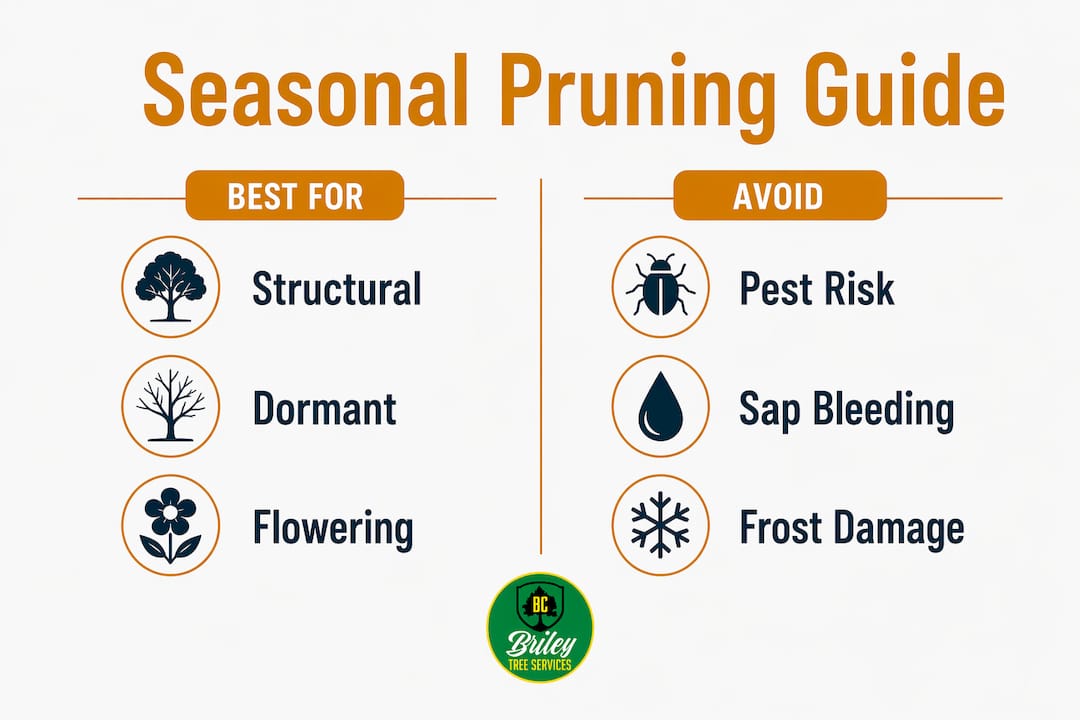
| Season | Best for | Avoid | Key risk |
|---|---|---|---|
| Late winter | Structural pruning, most deciduous trees | Heavy cuts on oaks in wilt zones | Low — dormancy limits pest/pathogen activity |
| Spring | Light corrective cuts, post-bloom flowering trees | Stimulating excessive new growth | Moderate — watch for weak shoots after heavy cuts |
| Summer | Slowing vigorous shoots, minor deadwood | Heavy crown removal | High — heat/drought stress on open wounds |
| Fall | Light cleanup in warm regions | Heavy structural cuts in cold climates | Moderate — new growth triggered by cuts may not harden before frost |
Winter (late dormancy): This is the gold standard for structural pruning of most deciduous trees. Leaves are gone, structure is visible, insects are inactive, and wounds seal fast once spring arrives. Book this work early; licensed arborists fill their late-winter schedules quickly.
Spring: Light corrective cuts work well just after bud break if the goal is to stimulate growth. For spring-flowering trees, wait until blooms drop before touching them. Avoid heavy structural cuts that force the tree to redirect energy from new leaf development.
Summer: Summer pruning increases stress risk from heat and drought. Keep cuts light and targeted. One legitimate use: slowing a particularly vigorous shoot by removing it in July reduces its dominance without a major structural cut. If you prune in summer, water the tree consistently afterward.
- Remove only what is necessary.
- Water deeply within 24 hours of any summer cut.
- Avoid pruning during heat advisories or drought conditions.
Fall: Late summer and fall pruning can trigger new growth that does not harden before the first frost, making it vulnerable to cold damage. In warmer USDA zones (8–10, which includes much of the Gulf South), light fall cleanup is generally fine. In colder zones, hold structural work until late winter.
Which trees need special timing rules?
Species differences matter as much as season when you plan pruning work. A few common trees require timing adjustments that catch homeowners off guard.
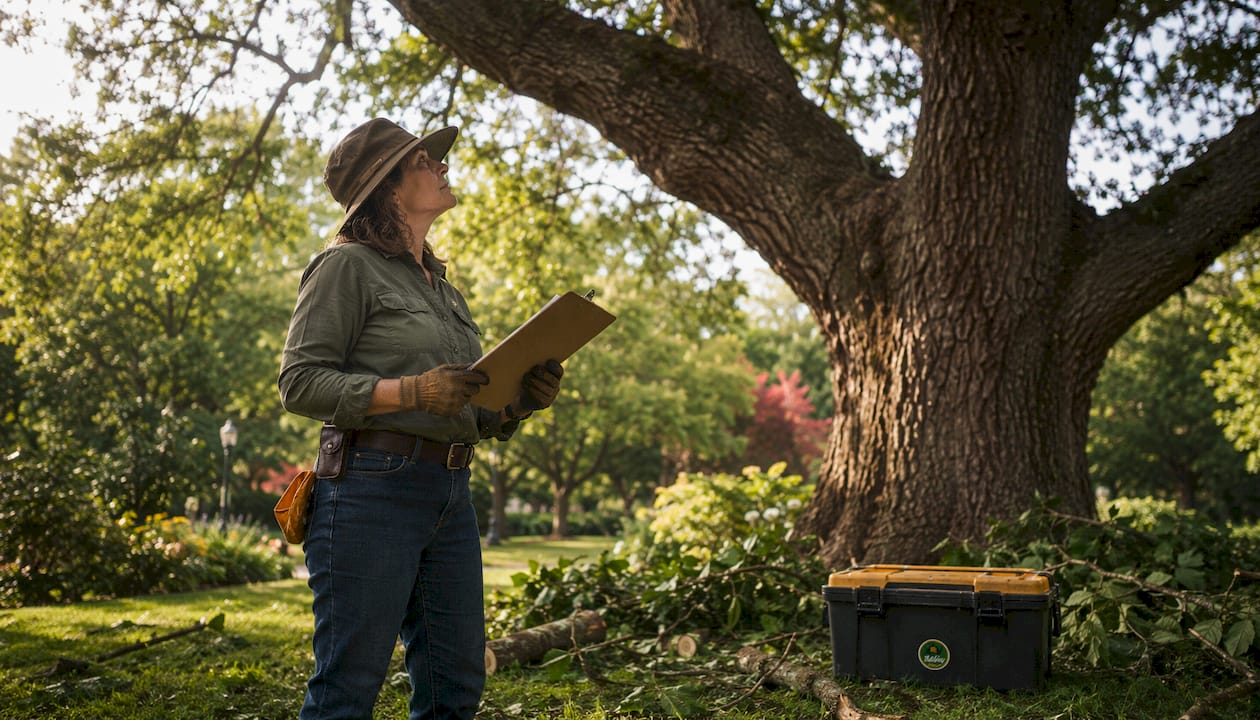
Oaks and elms are the most time-sensitive. In states with active oak wilt pressure, including Texas, Minnesota, Wisconsin, and much of the South, oaks should be pruned only during full dormancy (December through February in most of those states). If a cut is unavoidable outside that window, seal the wound immediately with a pruning sealant to block beetle access. Elms face similar restrictions in areas with Dutch elm disease; check your local extension service for city-specific elm pruning bans, which some municipalities enforce from April through August.
Maples, birches, and walnuts will bleed sap heavily if pruned in late winter. According to Colorado State University's forestry service, that bleeding is almost always cosmetic and not harmful to the tree. If the appearance bothers you, delay cuts on these species until after leaves are fully expanded in late spring.
Flowering ornamentals follow a simple rule from Clemson Extension: plants that bloom before June 1 should be pruned right after they bloom; plants that bloom after June 1 can be pruned just before spring growth begins. Crape myrtles, which bloom in summer on new wood, can be pruned in winter without affecting flowers.
Fruit trees benefit from late-winter shaping (February through early March in most U.S. regions) to direct energy into fruit production. Light summer pruning can manage size and improve light penetration into the canopy, but avoid heavy structural cuts after July.
Evergreens generally need less pruning than deciduous trees. Spruces and firs can be pruned almost any time because they have lateral buds that activate when tip buds are removed. Pines are best pruned in late winter before new candles emerge. Palms, common in Florida and the Gulf Coast, should be pruned only to remove dead fronds; avoid cutting into green fronds, and timing is less season-dependent than for deciduous species.
Pro Tip: Never prune oaks between April and July in oak-wilt states without immediately sealing the cut. A can of pruning sealant costs a few dollars. Losing a mature oak to wilt costs far more.
Maintenance, structural, and emergency pruning: what goes when?
Not all pruning jobs are equal, and matching the job type to the right timing is what separates good tree care from guesswork.
- Maintenance pruning covers small corrective cuts, deadwood removal, and light shaping. Dead, diseased, and damaged branches can and should be removed at any time of year. Do not wait for the "right" season to remove a dead limb. Delaying increases the risk of spread and structural failure.
- Structural pruning trains young trees and corrects co-dominant stems, crossing branches, and poor architecture. This work is best done during dormancy when structure is visible and wounds heal fast. ISA-certified arborists prioritize dormant-season scheduling for structural jobs precisely because the outcomes are more predictable.
- Emergency pruning applies to broken, hanging, or storm-damaged limbs that pose immediate risk to people or property. Season is irrelevant. Call a licensed arborist immediately. Do not attempt to remove large broken limbs yourself; a partially attached limb under tension can swing unpredictably when cut.
When to stop DIY and call a professional: any branch larger than 4 inches in diameter, any work requiring a ladder near power lines, and any situation involving a leaning or structurally compromised trunk. The benefits of preventive trimming are real, but so are the risks of an untrained cut on a large limb.
How does your region change the pruning window?
The general late-winter recommendation assumes a temperate U.S. climate, but USDA hardiness zones and local pest pressures shift that window meaningfully.
- Warmer zones (8–10): Homeowners in the Gulf South, Florida, and Southern California often see bud break earlier, sometimes by late January. Adjust your pruning window accordingly; "late winter" may mean January rather than March.
- Colder zones (3–5): In Minnesota, Wisconsin, and the northern Plains, late winter can extend into March or even early April. Watch for bud swell as your signal, not the calendar date.
- Oak-wilt states: Texas, Minnesota, Wisconsin, Iowa, and several neighboring states have active oak-wilt pressure. The USDA APHIS and state forestry agencies publish updated quarantine windows. Check before scheduling any oak work.
- Emerald ash borer zones: Most of the eastern U.S. now falls within EAB territory. Ash trees are already under stress in many areas; consult your state forestry office before pruning stressed ash trees.
- Municipal elm bans: Cities including Minneapolis and others in the Upper Midwest enforce seasonal elm pruning bans to limit Dutch elm disease spread. Violating these bans can result in fines.
The most reliable local signal is phenology: watch for leaf drop in fall and bud swell in late winter. Those biological cues are more accurate than any fixed date for your specific microclimate. State cooperative extension offices and local forestry departments publish region-specific pruning calendars; use them.
How do you plan and schedule pruning work?
A short checklist keeps the planning process straightforward.
- Identify the objective. Is this maintenance (deadwood, light shaping), structural (training a young tree, removing a co-dominant stem), or emergency (hazard removal)?
- Identify the species. Oak, elm, maple, flowering ornamental, fruit tree, or evergreen? Species determines timing constraints.
- Check local advisories. Search your state forestry or cooperative extension website for oak-wilt or elm pruning restrictions in your county.
- Confirm the season window. Match your objective and species to the seasonal guide above.
- Book early. Late-winter slots with licensed arborists fill fast, often by December for the following February. For recurring tree trimming service, ask about annual scheduling agreements.
Questions to ask an arborist before hiring:
- Are you ISA-certified? (Verify at the ISA's online directory.)
- Do you carry liability insurance and workers' compensation?
- Will you provide a written estimate and scope of work?
- How do you handle debris and cleanup?
- Do you follow ANSI A300 pruning standards?
Typical cost ranges depend on tree size, access, complexity, and debris disposal. A small ornamental tree under 25 feet generally runs less than a large shade tree over 50 feet. Hazard removals and emergency calls carry premium rates. Always get at least two written estimates for structural or removal work.
What pruning mistakes do homeowners make most often?
Several common errors cause long-term damage that shows up years after the cut.
Topping is the most destructive. Cutting a tree's main leader or removing large portions of the upper crown triggers weak, fast-growing sprouts called water shoots. These shoots are structurally inferior and create a cycle of repeated topping. No credible arborist recommends topping as a pruning method.
Flush cuts remove the branch collar, the slightly raised ring of tissue where a branch meets the trunk. That collar contains the cells the tree uses to seal the wound. Cutting flush into the trunk destroys those cells and leaves a wound that may never fully close.
Removing too much live crown at once stresses the tree. The general guideline from arborists is to remove no more than one-quarter to one-third of the live crown in a single season. Removing more forces the tree to use stored energy reserves it needs for root development and defense.
Pruning stressed trees in drought compounds existing stress. If your tree is already showing signs of drought stress (wilting, early leaf drop, scorched leaf edges), delay non-emergency pruning until conditions improve and the tree has been watered.
The three-cut method for large branches: make a partial undercut about 12 inches from the trunk, then cut from the top a few inches farther out to remove the bulk of the branch, then make the final cut just outside the branch collar. This sequence prevents bark tearing, which creates a much larger wound than a clean cut.
Pro Tip: Sharpen or disinfect your pruning tools between trees, especially when working near diseased wood. A 10% bleach solution or 70% isopropyl alcohol on blades takes 30 seconds and prevents spreading pathogens from one tree to the next.
How does Brileytreeservice handle seasonal pruning?
A homeowner in Shreveport contacted Brileytreeservice in late January about a large water oak with several crossing limbs and one branch hanging over the roofline after a December windstorm. The timing was close to ideal for structural work: the tree was fully dormant, the branch structure was visible, and pest activity was minimal.
The Brileytreeservice team follows a standard workflow: an initial site assessment to identify hazards, a written scope of work, crew arrival with appropriate safety gear, and full debris removal and site cleanup before departure. For structural pruning jobs, the crew documents the cuts made so the homeowner has a record for future scheduling. Brileytreeservice serves Shreveport, Bossier City, and the surrounding Northwest Louisiana area for residential and commercial tree care.
Does pruning season affect the environment?
Timing pruning cuts thoughtfully reduces harm to wildlife and the broader ecosystem on your property.
Spring pruning during nesting season (roughly March through July in most U.S. regions) can disturb active bird nests. Before making cuts in spring or early summer, visually inspect branches for nests. Disturbing an active nest with eggs or young birds may violate the Migratory Bird Treaty Act. Late-winter pruning, before nesting begins, avoids this issue entirely.
Dormant-season pruning also reduces the volume of fresh sap and plant tissue available to opportunistic insects. Fewer insects at the wound site means less risk of secondary infection. Chipping or composting pruned wood on-site rather than hauling it offsite reduces fuel use and returns organic matter to the soil.
One caution: do not move pruned oak wood out of an oak-wilt quarantine zone. The fungus can survive in cut wood and spread to new areas. Check your state forestry office for rules on transporting oak material.
What post-pruning care does your tree need?
The care a tree needs after pruning depends on when the work was done and how extensive the cuts were.
After late-winter pruning, the tree generally needs little intervention. Spring growth will begin the wound-sealing process on its own. Water the tree during any dry spells in early spring, particularly for young trees or recently transplanted specimens. Avoid applying high-nitrogen fertilizer immediately after pruning; it pushes rapid new growth that can be structurally weak.
After summer pruning, water is the priority. The tree has lost leaf area during a period of high evaporative demand. Deep watering within 24 hours of the cuts, and consistently for the following two to three weeks, reduces the stress load. Monitor for signs of pest activity at the wound sites.
Wound sealants are generally not recommended by arborists for routine cuts because they can trap moisture and interfere with the tree's natural callus formation. The exception is oaks pruned outside the dormant window in wilt-prone areas, where sealant blocks beetle access to fresh wounds.
Mulching the root zone after any pruning session helps retain soil moisture and moderate soil temperature, both of which support recovery. Apply 2–4 inches of wood chip mulch in a ring around the tree, keeping it away from direct contact with the trunk.
What tools work best for each season?
The right tool depends on branch diameter and the season's specific demands.
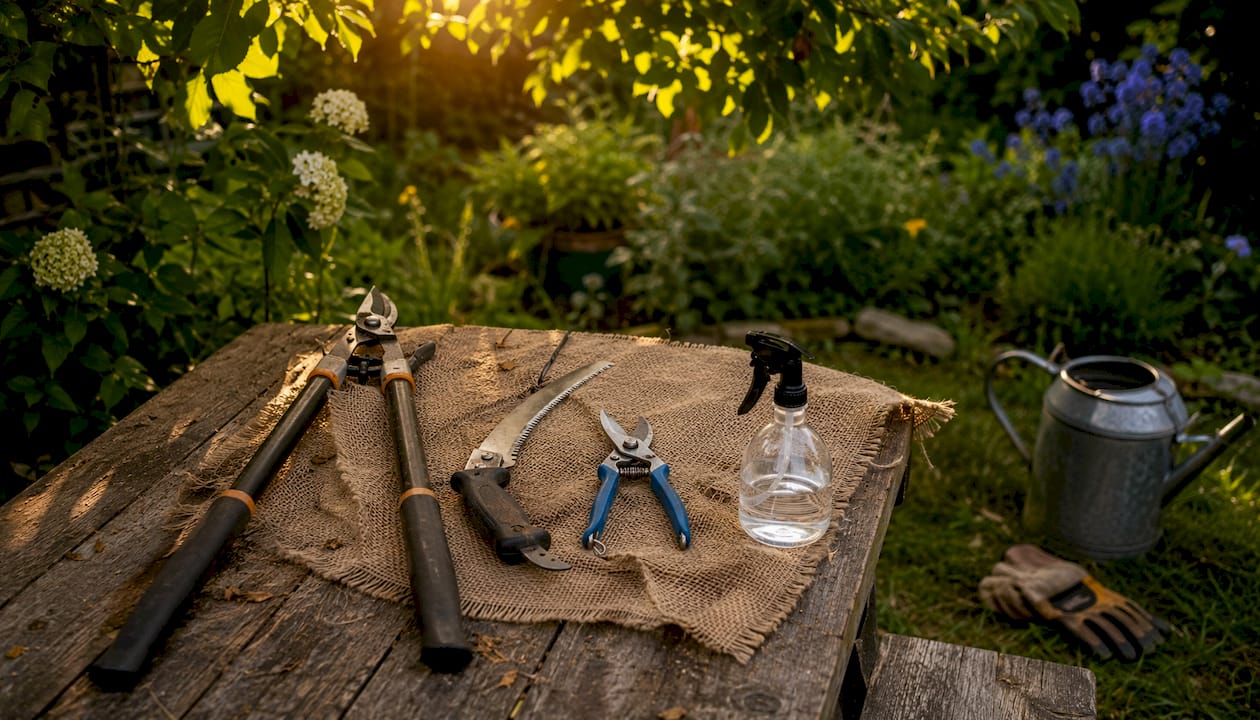
Hand pruners (bypass style) handle stems up to about 3/4 inch in diameter. They work year-round for small corrective cuts and deadwood removal. Keep blades sharp and clean; a dull blade crushes rather than cuts, leaving a ragged wound that heals slowly.
Loppers extend your reach and handle branches up to about 2 inches in diameter. Useful for late-winter structural work on young trees where a chainsaw would be excessive.
Pruning saws are the right tool for branches 2–4 inches in diameter. A folding pruning saw handles most homeowner jobs in this range. In winter, the absence of leaves makes it easier to position the saw correctly at the branch collar.
Chainsaws are for larger branches and should be operated only by trained users with appropriate protective equipment. For any chainsaw work above ground level, hire a licensed arborist.
Seasonal tool note: In summer, carry a spray bottle of 70% isopropyl alcohol to disinfect blades between cuts, especially when removing diseased wood. In winter, metal tools can become brittle in extreme cold; store them indoors and allow them to warm before use in sub-freezing temperatures.
Pole pruners extend reach for overhead branches without a ladder. Use them for branches under 2 inches in diameter. For anything larger overhead, the three-cut method and a stable platform are required, and at that point a professional is the safer choice.
Key Takeaways
Late-winter pruning is the single most reliable default for most U.S. deciduous trees, but species, region, and job type all determine whether that rule applies to your situation.
| Point | Details |
|---|---|
| Best default window | Late winter to very early spring is the gold standard for structural pruning of most deciduous trees. |
| Emergency cuts have no season | Dead, diseased, and damaged limbs should be removed immediately, regardless of time of year. |
| Species change the rules | Oaks and elms need dormant-season cuts in disease-prone states; flowering trees should be pruned right after bloom. |
| Check local restrictions | Oak-wilt states and cities with elm bans have enforceable pruning windows; confirm with your state forestry office before scheduling. |
| Brileytreeservice | Serves Shreveport, Bossier City, and Northwest Louisiana for seasonal structural pruning, hazard removal, and emergency storm cleanup. |
The timing decision most homeowners get wrong
The most common mistake is treating pruning as a once-a-year chore scheduled by habit rather than by the tree's actual condition and biology. Homeowners prune in fall because the yard looks messy, or in spring because the weather is nice, without considering whether those cuts will trigger frost-vulnerable new growth or remove flower buds that were set months earlier.
The biology is straightforward once you know it: dormancy protects wounds, pest activity follows warmth, and flowering depends on when buds were set. None of that maps neatly onto a fixed calendar date, which is why arborists consistently recommend watching the tree rather than the calendar. Bud swell in late winter is a more reliable signal than February 15.
The other underappreciated point is that emergency pruning has no season. A broken limb over a roof does not become less dangerous because it is July. Waiting for the "right" season to address a structural hazard is a liability decision, not a tree-care decision. Remove the hazard, then plan the structural work for dormancy.
Brileytreeservice serves Shreveport and Northwest Louisiana year-round
When seasonal pruning needs a professional, Brileytreeservice provides tree trimming, structural pruning, hazard removal, and emergency storm cleanup for residential and commercial properties throughout Shreveport, Bossier City, and Northwest Louisiana. The team shows up on time, works safely, and cleans up completely before leaving.

Scheduling late-winter structural pruning before the spring rush means shorter wait times and better availability. Contact Brileytreeservice today for a free estimate and find out what seasonal pruning work your trees actually need this year.
Useful sources for homeowners
These sources provide reliable, regionally relevant guidance on pruning timing, technique, and disease management.
- The Morton Arboretum: Covers when and how to prune trees with species-specific guidance; one of the most cited authorities on dormant-season pruning rationale.
- Arbor Day Foundation: Explains the "3 D's" rule (dead, diseased, damaged), the three-cut method, and timing exceptions for oaks and elms.
- Portland.gov Tree Care Resources: Practical homeowner pruning guide covering municipal restrictions and year-round emergency removal rules.
- Colorado State University Forest Service: Addresses the late-winter vs. early-spring debate and explains why sap bleeding in maples and birches is cosmetic, not harmful.
- UMN Extension: Pruning Trees and Shrubs: Detailed species-by-species timing chart covering apple trees, flowering shrubs, and evergreens; strong regional relevance for northern states.
- USDA APHIS: Emerald Ash Borer: Current quarantine maps and movement restrictions for ash wood; essential for homeowners in EAB-affected states.
- Your state cooperative extension office: Search "[your state] tree pruning extension" for county-level oak-wilt advisories, elm ban dates, and local phenology calendars specific to your USDA zone.