
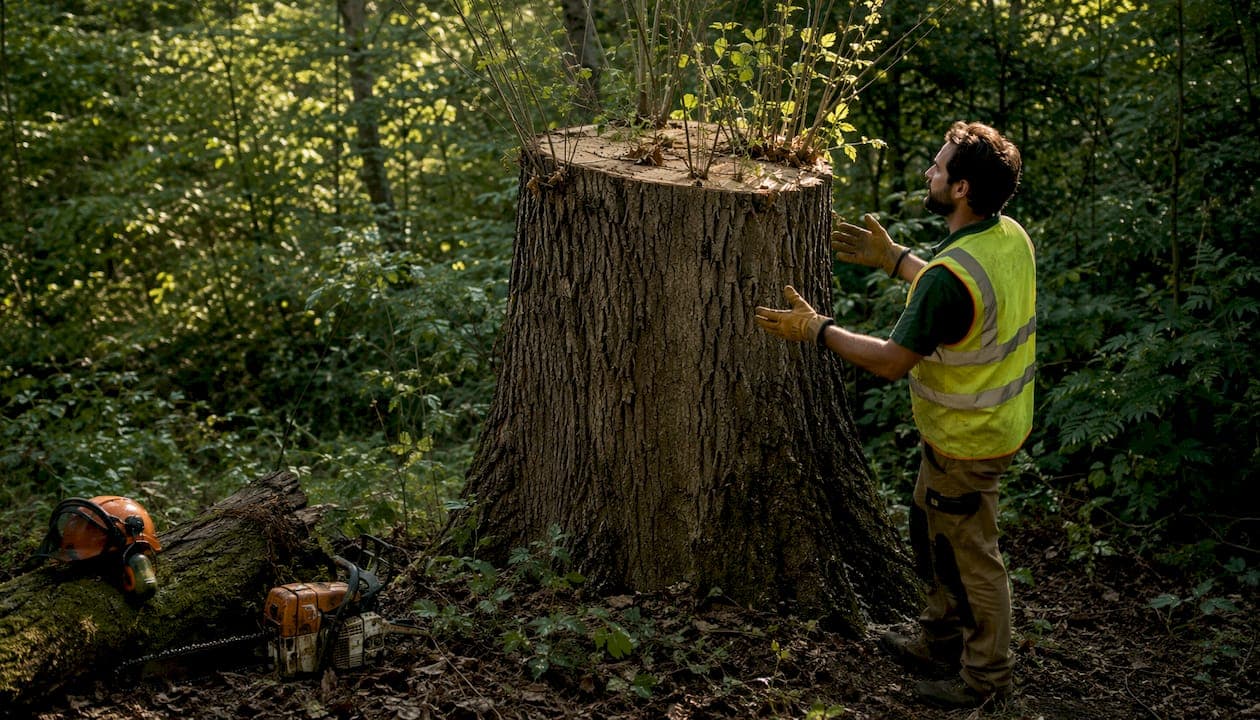
Tree topping is the indiscriminate cutting back of a tree's main branches and central leader to large, blunt stubs, leaving wounds that the tree cannot properly seal. The International Society of Arboriculture (ISA) classifies topping as an unacceptable practice, and every major extension service in the United States agrees. If a contractor has quoted you a "topping" job or is already on-site, stop the work and call a certified arborist for an assessment before any cuts are made.
- Tree topping goes by several names: hat-racking, heading, stubbing, rounding over, and lopping. All refer to the same harmful practice.
- Stubs larger than 2 inches in diameter are biologically unable to seal properly, opening the tree to decay for years.
- Topping typically costs more over time than proper pruning because of the repeated maintenance and eventual removal it often requires.
- Brileytreeservice offers certified arborist assessments in Shreveport, Bossier City, and surrounding North Louisiana areas. Call for a free estimate before any canopy work begins.
Table of Contents
- What is tree topping, and how do you recognize it?
- Why do homeowners and contractors still top trees?
- How does topping harm a tree?
- What are the safer alternatives to topping?
- How do you manage a tree that has already been topped?
- How do you choose a qualified arborist?
- Are there laws or local rules against tree topping?
- How does tree topping affect local wildlife?
- What does tree topping cost compared to proper pruning?
- Key Takeaways
- The case against topping is stronger than most homeowners realize
- Brileytreeservice serves Shreveport homeowners who want the job done right
- Useful sources and further reading
What is tree topping, and how do you recognize it?
Tree topping, also called hat-racking, stubbing, heading, heading-back, rounding over, or dehorning, all describe the same malpractice: cutting a mature tree's main leader and large scaffold limbs back to uniform stubs, with no regard for branch collars or natural growth points.
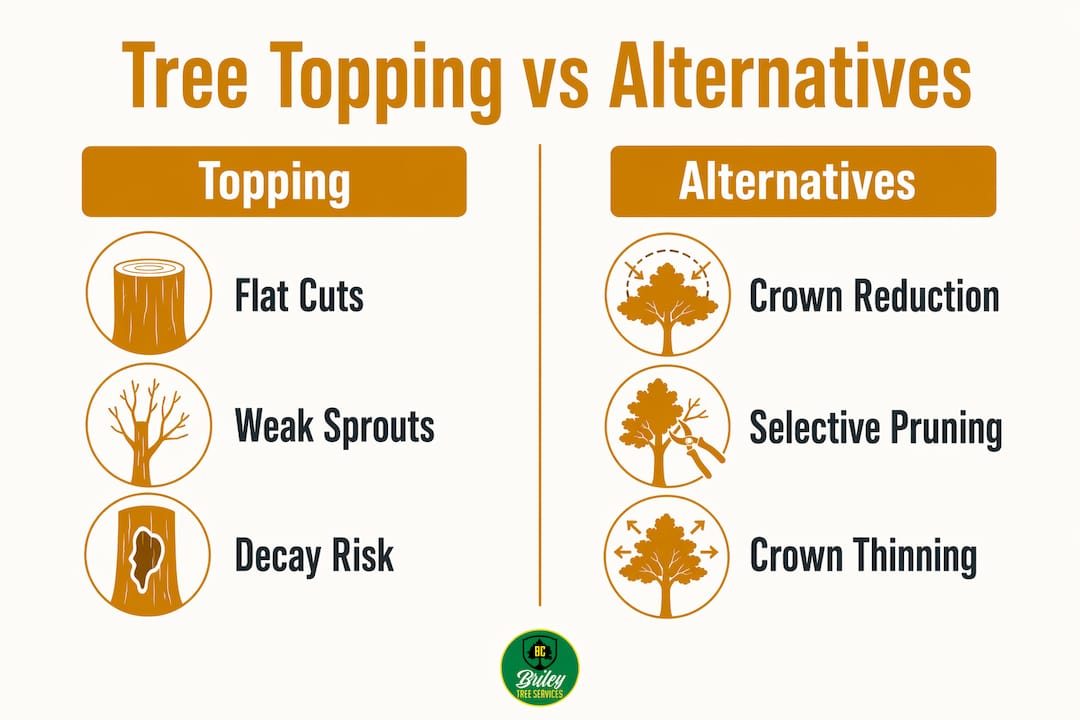
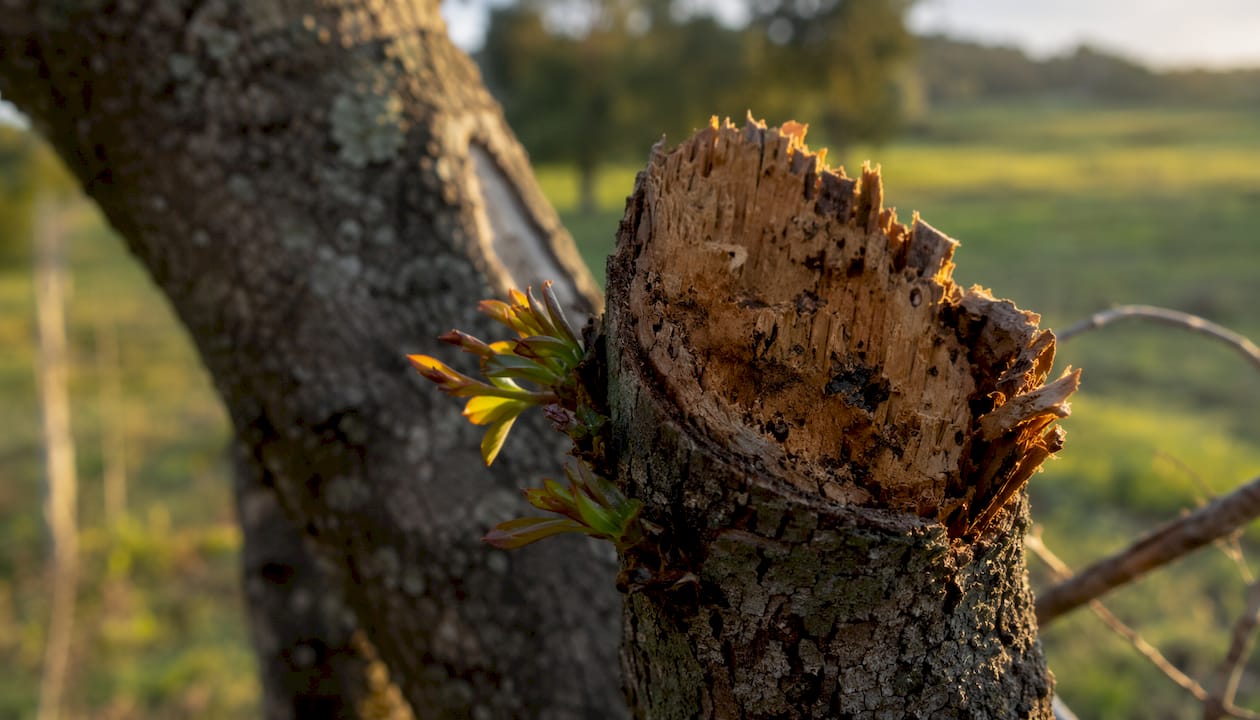
In practice, a contractor performing a topping job removes the upper canopy to a predetermined height, leaving large, flat-cut stubs rather than making proper cuts at the branch collar. The result is a flat-topped silhouette with multiple large wound faces exposed to weather and pathogens. Within a growing season, dense clusters of fast-growing shoots called epicormic sprouts or watersprouts emerge from just below each cut.
Visible signs of a topped tree:
- Multiple large stubs of uniform height across the canopy
- Absence of branch collars at cut points (cuts made mid-branch rather than at the natural union)
- An abrupt, flat-topped or rounded-off canopy silhouette
- Dense, upright sprout clusters growing from stub ends
- Large, discolored wound faces, often with soft or darkened wood at the center
Pro Tip: When reviewing contractor photos or visiting a site, look for the flat-topped silhouette and clusters of thin, vertical sprouts. Those sprouts are the tree's emergency response to sudden leaf loss, not a sign of healthy recovery.
Why do homeowners and contractors still top trees?
Topping persists largely because of public misconception and a handful of situations where it seems like the obvious quick fix. Understanding those motivations makes it easier to push back on a contractor who recommends it.
Common reasons people choose topping:
- Size and height control. A tree has outgrown its space, and cutting it shorter seems like the straightforward solution.
- Perceived safety. Homeowners assume a smaller tree is a safer tree, especially after storm damage.
- Cost. Topping a tree is faster than proper structural pruning, so the upfront price is lower.
- Power-line clearance. Utility proximity leads some contractors to cut everything above a certain height rather than selectively removing conflicting branches.
- Poor species selection. Trees planted too close to a structure or under power lines eventually grow into a conflict that topping appears to solve.
The core misconception in nearly every case is that a shorter tree is a safer tree. The opposite is often true after topping.
Topping does not reduce hazard. It creates new hazards. Topped trees produce weakly attached sprouts that break under wind and ice, and internal decay from large stubs can cause sudden structural failure years after the initial cut. A properly maintained large tree is safer and more valuable than a topped one.
How does topping harm a tree?
The damage from topping is both immediate and long-term. Each mechanism compounds the others, and the full picture often does not become visible until years after the cuts were made.
-
Loss of food-making capacity. Removing the upper canopy strips away the majority of a tree's leaf area. Leaves produce the carbohydrates that feed roots and fuel growth. A severe crown removal leaves insufficient leaf area to sustain the root system, triggering dieback and decline.
-
Weak epicormic regrowth. The tree responds by pushing out dense watersprouts from latent buds near each stub. These sprouts grow fast but attach weakly to the wood beneath them. Under wind or ice load, they break far more easily than branches that developed naturally over years.
-
Decay from large stubs. Cuts that exceed roughly 2 inches in diameter bypass the branch collar's natural defense zone. Topped wounds often fail to compartmentalize decay, allowing rot organisms to spread inward along the wood for years before any external sign appears.
-
Insect and pathogen entry. Large, exposed wound faces attract wood-boring insects and fungal pathogens. The combination of mechanical damage and biological invasion accelerates internal deterioration.
-
Structural failure risk. As decay advances and epicormic sprouts grow heavier, the risk of sudden branch drop increases. This is the opposite of the safety outcome most homeowners expected when they approved the work.
-
Shortened lifespan. The cumulative stress of repeated topping cycles, decay, and resource depletion shortens a tree's functional life significantly compared to a properly maintained specimen.
-
Reduced property value. A disfigured, declining tree is a liability, not an asset. Proper pruning maintains or increases property value; topping typically reduces it.
The ISA and extension professionals classify topping as an unacceptable practice. In liability terms, an arborist or contractor who tops a tree instead of using industry-standard pruning methods may be considered negligent. Document all tree work in writing and verify credentials before any cuts are made.
Watch for these signs in a previously topped tree: brown or soft wood under a stub when probed, excessive new sprout growth within weeks of cutting, and visible cavities or dark staining at old wound faces.
What are the safer alternatives to topping?
Every goal that leads a homeowner to consider topping can be met with a method that does not destroy the tree's structure. The key is knowing which technique fits which situation.
| Goal | Recommended Method | Notes |
|---|---|---|
| Reduce overall height | Crown reduction | Cuts back to lateral branches at least one-third the diameter of the removed limb; preserves structure |
| Reduce canopy weight | Crown thinning | Selectively removes interior branches; improves wind resistance without changing height |
| Improve clearance | Selective pruning | Removes specific conflicting branches at the branch collar; minimal impact on overall form |
| Correct structure | Structural pruning | Establishes a dominant leader and balanced scaffold; best started when the tree is young |
| Manage near power lines | Directional pruning | Removes branches growing toward lines; utility arborists use this instead of topping |
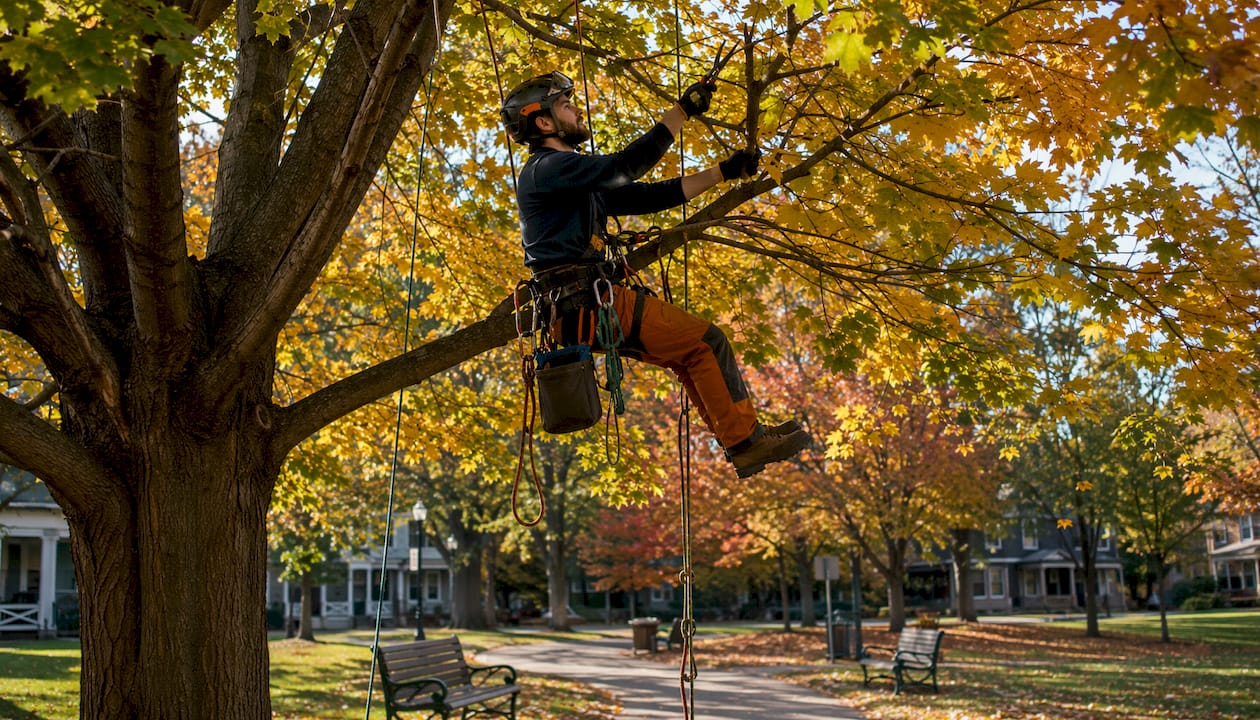
Crown reduction cuts the canopy back to lateral branches that are large enough to assume the terminal role. The tree retains its natural form and the cuts are made at proper branch unions, not mid-stem. This is the correct answer when a tree has genuinely outgrown its space.
Crown thinning removes selected interior branches to reduce density and wind resistance. It does not change the tree's height but reduces the sail effect that makes large trees feel threatening in storm-prone areas like North Louisiana.
Selective pruning at the branch collar removes individual branches that conflict with structures, power lines, or sight lines. The cut is made flush with the branch collar, the slightly raised ring of tissue at the branch base, which allows the tree to seal the wound efficiently.
Pollarding is a specialized technique where the same cut points are used repeatedly over many years, starting when the tree is young. It is not appropriate for mature trees that have never been pollarded and should not be confused with topping.
When none of these methods can resolve the problem, removal is the right answer. Clear indicators include extensive internal decay visible at the base, repeated topping wounds that have never sealed, and severe structural failure. A certified arborist assessment will tell you which category your tree falls into.
Pro Tip: When writing a work order or contract, specify: "Structural crown reduction by a certified arborist; all cuts at branch collars; no topping, heading, or stub cuts." That language protects you if the contractor deviates from the agreed scope.
How do you manage a tree that has already been topped?
A topped tree is not automatically a dead tree, but it does need a structured plan. The sooner you act, the more options you have.
-
Immediate safety check. Walk the perimeter and look for hanging or partially attached limbs. Keep people and pets away from the area beneath the canopy until a professional has assessed the tree.
-
Schedule a certified arborist assessment. An arborist can probe stubs for decay, evaluate the structural integrity of the remaining scaffold, and recommend a corrective pruning plan or removal if warranted.
-
Avoid repeat topping. Cutting the sprouts back to stubs again restarts the decay cycle and compounds the structural damage. Each round of topping shortens the tree's remaining life.
-
Establish a maintenance timeline. The first 6–12 months after topping are critical: watch for epicormic growth patterns, signs of infection at wound faces, and any soft or discolored wood. Between years 1 and 5, the tree will likely need repeated corrective pruning to select the strongest sprouts and remove the weakest. Long-term, if decay advances into the main scaffold, removal becomes the only safe outcome.
A seasonal pruning schedule helps keep corrective work on track and reduces the cost of each visit by preventing problems from compounding.
Pro Tip: Start a photo log the day you notice the topping. Date-stamped photos of wound faces, sprout growth, and any visible decay give an arborist a baseline and can support an insurance or warranty claim if the work was done without your authorization.
How do you choose a qualified arborist?
Hiring the right professional is the single most effective way to protect your trees from topping and its consequences. Here is what to verify before signing anything.
Questions to ask every contractor:
- Are you ISA-certified? Can you show your certification number? (Verify at isa-arbor.com)
- Do you carry liability insurance and workers' compensation? Can you provide certificates?
- Can you provide local references for crown reduction or structural pruning work?
- Will the written scope specify "no topping or heading cuts" and identify the method to be used?
- Where exactly will cuts be made? (The correct answer: at the branch collar.)
- Who handles cleanup, and is it included in the quote?
Red flags to watch for:
- The contractor uses the word "topping" or "hat-racking" without any indication that it is a problem.
- The quote is unusually low and promises to "shorten" or "cut back" the tree without specifying the method.
- No written scope is offered, or the contractor refuses to put the method in writing.
- No proof of insurance or credentials is available.
- The contractor offers to leave wood chips in exchange for a discount on a job that requires no such tradeoff.
Understanding ISA certification and what it means in practice helps you ask sharper questions and spot evasive answers quickly.
Are there laws or local rules against tree topping?
Tree topping is not uniformly banned by federal law in the United States, but local regulations vary significantly and can carry real consequences. Many municipalities, homeowners associations, and utility districts have ordinances that govern how trees on private or public property may be pruned or removed.
In some cities, topping a street tree or a tree in a protected zone without a permit is a fineable offense. Certain states require licensed contractors for any work that removes more than a specified percentage of a tree's canopy. HOA rules frequently prohibit practices that damage tree health or alter the visual character of a neighborhood, and topping almost always falls into that category.
Before any significant canopy work, check with your city's urban forestry department or HOA board. In Shreveport and Bossier City, the city's code enforcement office can clarify whether a permit is required for large-scale pruning or removal. When in doubt, a certified arborist familiar with local regulations can pull permits on your behalf and keep the work compliant.
How does tree topping affect local wildlife?
Trees provide nesting sites, food sources, and shelter for birds, squirrels, insects, and other wildlife. Topping disrupts all three functions at once.
Removing the upper canopy eliminates the high-canopy nesting zones that many bird species depend on, including cavity-nesting birds that use older, larger limbs. The dense watersprout regrowth that follows topping does not replicate that habitat. Sprouts are thin, weakly attached, and lack the structural complexity of mature branch unions.
Large wound faces also attract wood-boring beetles and other insects that, while part of the natural ecosystem, accelerate decay in ways that destabilize the tree rather than support it. A declining topped tree eventually becomes a hazard tree rather than a habitat tree, and removal eliminates whatever wildlife value remained.
Healthy, properly pruned trees maintain canopy structure, support pollinators through continued flowering, and provide durable nesting and foraging habitat for decades longer than a topped specimen typically survives.
What does tree topping cost compared to proper pruning?
The upfront cost of topping is usually lower than proper structural pruning because it requires less skill and takes less time. That cost advantage disappears quickly.
A topped tree typically needs corrective pruning every few years to manage the dense, weakly attached sprout growth. Each round of maintenance adds to the cumulative cost. When decay advances to the point of structural failure, removal becomes necessary, and tree removal costs for a large, compromised specimen are substantial. The total spend over the tree's shortened life routinely exceeds what proper pruning would have cost from the start.
Proper crown reduction or structural pruning costs more per visit but extends the tree's functional life, maintains property value, and reduces the likelihood of emergency removal. The long-term benefits of correct pruning are well documented by extension services across the country.
For commercial property managers, the liability exposure from a structurally compromised topped tree adds a financial dimension that goes beyond maintenance costs. A falling limb or failed scaffold branch creates claims that far exceed any savings from a low-bid topping job.
Key Takeaways
Tree topping is the most harmful pruning practice in common use, and every major arboricultural authority in the United States classifies it as unacceptable.
| Point | Details |
|---|---|
| Topping definition | Indiscriminate cutting of main branches to stubs; also called hat-racking, heading, or rounding over. |
| Primary harms | Large stubs fail to seal, inviting decay, weak sprout growth, structural failure, and shortened tree life. |
| Safer alternatives | Crown reduction, crown thinning, and selective pruning at the branch collar meet the same goals without destroying tree structure. |
| Immediate action | Stop any topping work in progress; schedule a certified arborist assessment before cuts are made. |
| Brileytreeservice | Brileytreeservice provides certified arborist assessments and structural pruning in Shreveport, Bossier City, and North Louisiana. |
The case against topping is stronger than most homeowners realize
Tree topping is one of those practices that looks like a solution until you understand what it actually does to a tree. The flat-topped silhouette and the burst of new growth afterward can look like progress. It is not.
What concerns me most is the gap between when the damage is done and when it becomes visible. A topped tree can look reasonably healthy for two or three growing seasons while decay spreads through the stub wood and the new sprouts grow heavier and more unstable. By the time a homeowner notices something is wrong, the structural integrity of the tree may already be compromised beyond repair.
The other issue is the contractor problem. Topping is still offered because it is fast, it is cheap to perform, and many homeowners do not know to refuse it. A low quote to "shorten" a tree should be a warning, not a selling point. The ISA's position is unambiguous: topping is not a pruning technique. It is a form of damage.
The right approach for a tree that has outgrown its space is crown reduction performed by a certified arborist who makes every cut at a proper branch union. For a tree that is genuinely too large, too damaged, or too close to a structure to be safely maintained, removal is the honest answer. Neither option involves leaving a row of large stubs and walking away.
Brileytreeservice serves Shreveport homeowners who want the job done right
When a tree needs attention, the difference between proper pruning and topping comes down to who is holding the saw and what they know. Brileytreeservice provides certified arborist assessments, structural crown reduction, crown thinning, selective pruning, safe tree removal, stump grinding, and 24/7 emergency storm cleanup for residential and commercial properties throughout Shreveport, Bossier City, Ruston, and surrounding North Louisiana areas.
Every assessment includes a written scope that specifies the method, the cut locations, and what will not be done. No topping. No heading cuts. No stubs left behind. The team is licensed and insured, and permit support is available when local regulations require it. If your tree has already been topped, an on-site evaluation can determine whether corrective pruning or removal is the right path forward.
Schedule a free estimate with Brileytreeservice and get a clear, written plan before any work begins.
Useful sources and further reading
| Source | Why it's reliable |
|---|---|
| International Society of Arboriculture (ISA) | The leading professional body for arboriculture in the U.S.; sets certification and practice standards. |
| Illinois DNR — Tree Topping | State forestry agency bulletin explaining topping harms and proper alternatives. |
| Arbor Day Foundation — Don't Top Trees | Nonprofit authority on tree planting and care; public education resource on topping misconceptions. |
| Penn State Extension — Tree Topping Costs | University extension analysis of long-term financial and structural costs of topping. |
| Clemson HGIC — Topping Trees | University extension factsheet on proper pruning alternatives and ISA guidance. |
| Illinois Extension — Tree Topping | Current extension blog post on why topping is never a good option, with liability notes. |
| Brileytreeservice | Local certified arborist team serving Shreveport and North Louisiana; free estimates available. |