
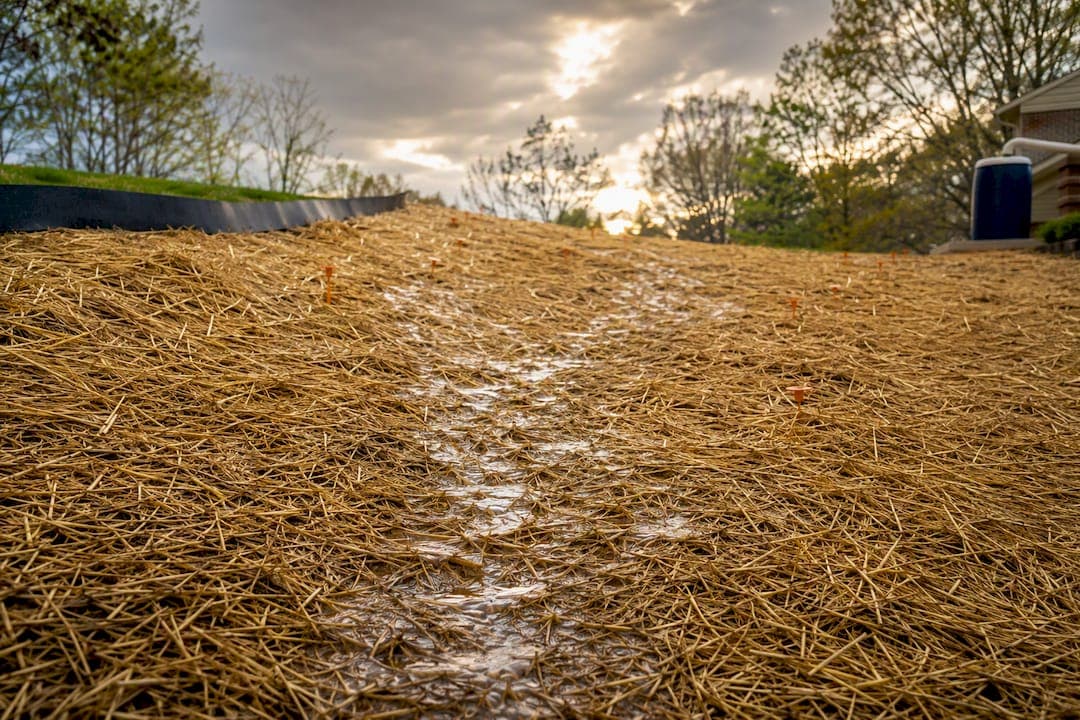
Erosion control mulching is a temporary ground-cover practice that protects exposed soil by absorbing raindrop energy, slowing runoff, and helping seed take root. It works best after clearing or grading, on bare slopes without concentrated water flow, and alongside new seeding. The EPA's BMP mulching guidance and the NRCS Conservation Practice Standard 484 both treat it as a first line of defense, not a permanent fix, and Briley Tree Service sees why on nearly every site we clear.
TL;DR:
- Mulching reduces soil erosion by over 70 percent when coverage exceeds 60 percent, but performance drops with steep slopes, high rainfall, or patchy application.
- The effectiveness of mulch depends on site conditions, with rock and engineered blankets best for concentrated flows and steep or windy slopes.
- Proper installation and frequent inspection after heavy rain or wind are essential to maintain mulch performance and fix bare spots or displacement early.
- Mechanical mulching with wood chips works well immediately after clearing but may require additional fertilization and anchoring on complex slopes.
- Professional services are recommended for steep, inaccessible, or large sites to ensure correct application, especially when heavy equipment or specialized mulching methods are needed.
Table of Contents
- Which Mulch Type Works Best For Erosion Control?
- How Much Does Mulching Actually Reduce Erosion?
- What Site Factors Determine The Right Mulch Choice?
- How Do You Apply And Anchor Mulch On A Slope?
- How Often Should You Inspect Mulch For Failure?
- What Do You Learn Watching Erosion Control Fail On Real Job Sites?
- Need Professional Mulching Or Site Stabilization In North Louisiana?
- Where To Verify These Erosion Control Standards
- Sources
Which Mulch Type Works Best For Erosion Control?
The right material depends on your slope, your soil, and how much rain the site sees before grass takes hold. Loose organic mulches, engineered blankets, sprayed hydromulch, and rock each solve a different version of the same problem.
- Straw mulch is cheap and fast to spread by hand, but it blows off exposed or windy sites unless it's crimped or tacked down.
- Wood chips last longer than straw and resist wind well, making them a strong choice for wooded lots and slopes near tree lines, though they break down slowly and can tie up nitrogen in the topsoil.
- Compost blankets feed the soil while covering it, a good fit for residential beds and low-slope areas where long-term soil health matters as much as erosion control.
- Erosion control blankets (ECBs), made from coir, excelsior, jute, or woven synthetic fiber, hold to steep grades where loose mulch simply slides. Coir lasts years; straw based blankets break down in a season or two.
- Hydromulch and bonded fiber matrices get sprayed on as a slurry, letting crews cover steep or hard to reach ground without walking on freshly graded soil.
- Rock and gravel handle concentrated flow, such as swales and channel bottoms, where organic material would just wash away.
Wind exposure points you toward chips or anchored blankets. Steep grades favor ECBs or hydromulch. Anywhere water concentrates into a channel calls for rock, not mulch of any kind.
How Much Does Mulching Actually Reduce Erosion?
Mulch works by breaking the fall of raindrops before they hit bare soil, slowing the sheet flow that carries particles downhill, and giving water more time to soak in instead of running off. A 2023 global meta-analysis in Geoderma put the average numbers at a 47.4% reduction in runoff and a 76.2% reduction in soil loss across the studies reviewed.
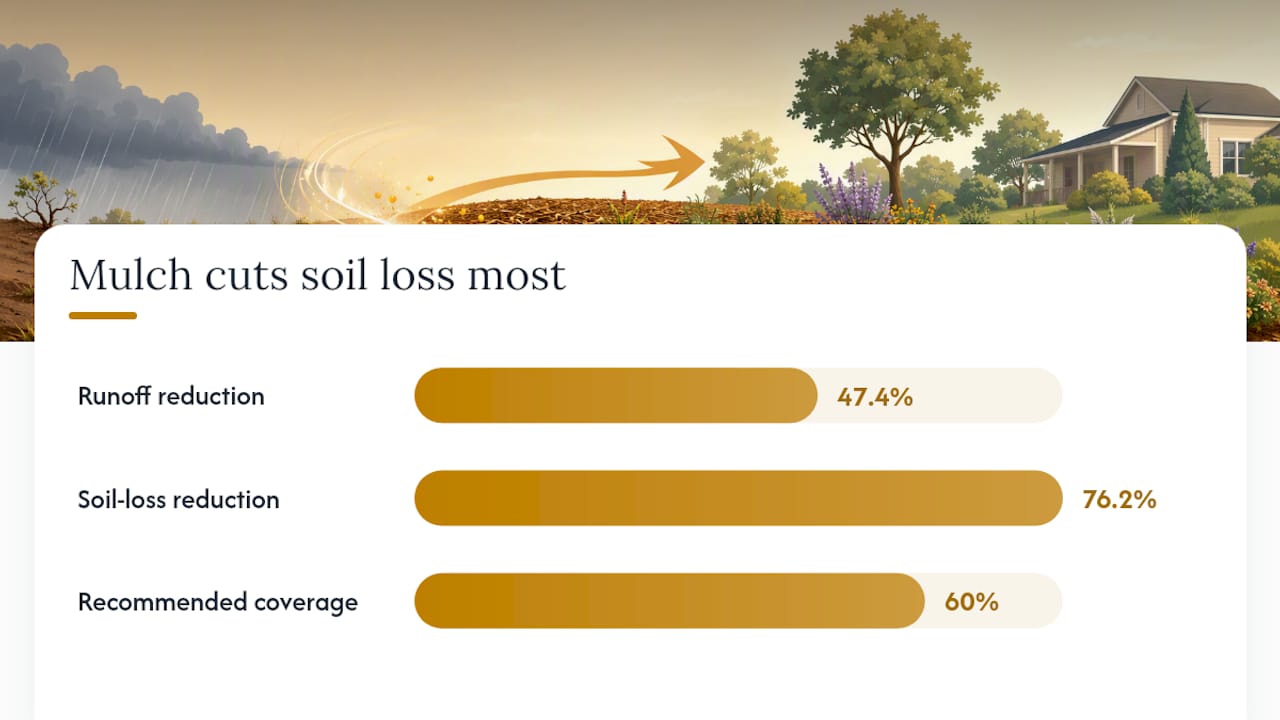
Those averages hide a lot of variation. Performance drops fast with lower coverage, on steeper slopes, and during high-intensity storms, which is why the same analysis recommended at least 60% mulch coverage as a practical minimum.
Pro Tip: Coverage matters more than material in the first few weeks. A thin, patchy layer of premium coir blanket will underperform a thick, continuous layer of straw.
| Material | Typical rate | Reported soil-loss reduction | Notes |
|---|---|---|---|
| Straw | Recommended application rate for erosion control | Moderate, needs anchoring | Fast to install, short-lived |
| Wood chips | ~6 tons/acre | Around 94% in EPA-cited state tests | Durable, resists wind |
| Wood cellulose/hydromulch | Varies by sprayer output | High on gentle to moderate slopes | Needs dry time before rain |
| Rock/gravel | Site-specific | High in channels | For concentrated flow only |
Coverage, rainfall intensity, and slope steepness all shift these numbers, so treat the table as a starting point for planning, not a guarantee.
What Site Factors Determine The Right Mulch Choice?
Before buying a single bale, walk the site and record what you're actually working with. The decision gets much easier once you know these numbers:
- Slope gradient and length. Gentle, short slopes tolerate loose mulch; long or steep grades need ECBs, hydromulch, or rock.
- Soil texture. Sandy soils drain fast but erode easily; clay-heavy soils shed water and need more infiltration help.
- Exposure to wind and sun. Open, unshaded slopes dry out and blow mulch away faster than shaded ones.
- Presence of concentrated flow. Any spot where water funnels into a rivulet or channel needs rock or a structural fix, not loose organic material.
- Accessibility for equipment. Steep or fenced-in areas may only be reachable by hand crews or hydromulch spray trucks.
- Proximity to storm drains or waterways. Sites near water need biodegradable netting, never synthetic plastic mesh that can trap wildlife.
NC State Extension recommends covering at least 85% of bare soil for effective seed protection, while NRCS Standard 484 sets a general floor of 70% minimum ground cover for many conservation uses. Aim for the higher number when you can; it buys real margin during the first heavy rain.
Always buy weed-free certified mulch, especially straw, and check your state or local erosion control manual before choosing netting material near a creek or drainage easement.
How Do You Apply And Anchor Mulch On A Slope?
Getting the material down is only half the job. Anchoring it correctly is what keeps it from becoming the next thing that washes downhill.
- Grade and fill. Smooth the surface and fill any rills or small gullies before laying anything down.
- Lime, fertilize, and seed. Most guidance calls for seeding before mulching so seed makes contact with soil, though hydromulch mixes often blend seed directly into the slurry.
- Spread at the right rate. A single straw bale, roughly 80 pounds, covers about 1,000 square feet at a typical depth, a useful conversion for translating professional per-acre rates into homeowner-sized jobs.
- Anchor immediately. Crimp straw into the soil with a straw crimper, spray on a tackifier, or staple netting over the top; on ECBs, trench in the top and bottom edges so water can't get underneath.
For small residential jobs, visually check coverage the way you would check paint coverage on a wall: no bare spots showing through when you look straight down. For hydromulch tank mixing, follow the manufacturer's water ratio closely; too thin a slurry won't bond, too thick won't spray evenly.
How Often Should You Inspect Mulch For Failure?
Check new mulch right after installation, then weekly, and always after any heavy rain or wind event. Early problems are cheap to fix; ignored ones turn into gullies.
- Look for: bare patches below 70 to 85% cover, small rills or gullies cutting through the mulch, mulch that's drifted downslope, torn or lifted netting, and whether grass seedlings are actually coming up.
- Common fix: reseed and remulch bare spots before they widen, add netting or an ECB to a section that's sliding, or cut a small diversion channel above a spot where water keeps concentrating.
- End of life: once vegetation is established and covering the ground on its own, remove synthetic netting so it doesn't choke growing stems, and either compost organic material in place or haul off excess.
What Do You Learn Watching Erosion Control Fail On Real Job Sites?
Forestry mulching and full clearing look similar from the road, but they behave very differently once rain hits. Mechanical mulching grinds standing brush and small trees into a chip layer that stays on the ground, which buys a short window of protection compared with bulldozed, fully bare dirt. It still needs inspection, and on real slopes it often needs supplemental anchoring or seeding to hold past that first season.
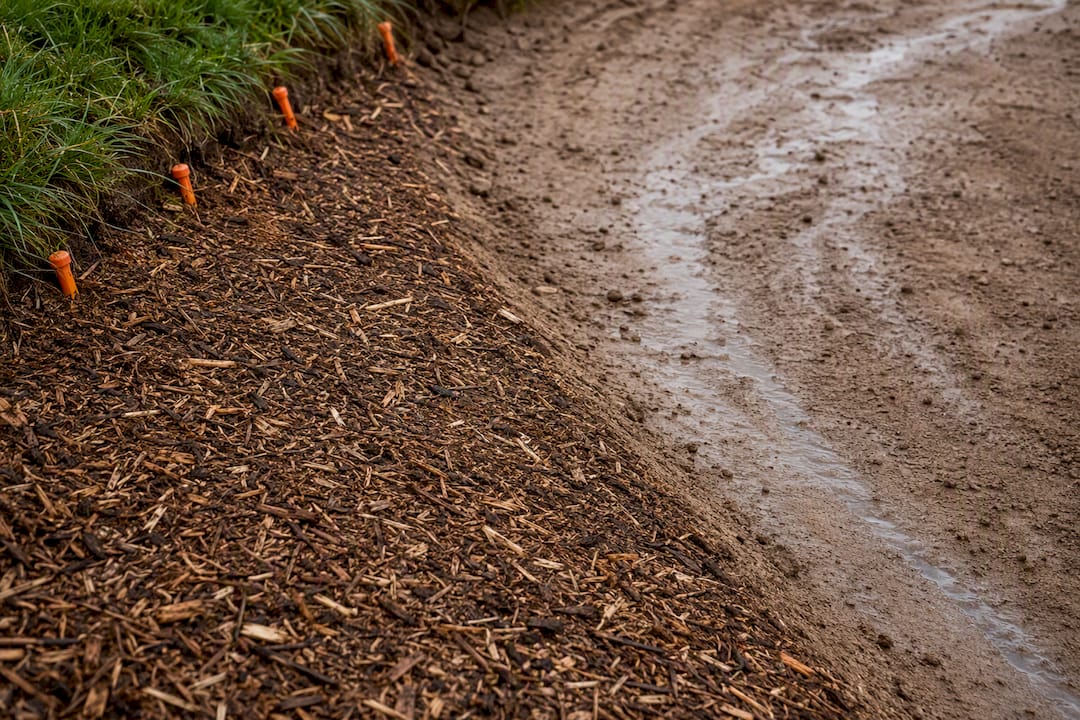
Wood chips left over from tree removal make solid erosion control mulch on flatter ground, but a heavy chip layer over turf or planting beds can tie up soil nitrogen as it breaks down, so a light fertilizer topdress afterward is smart. Watch chip piles near driveways and mowed areas too. Loose material kicked into traffic lanes or mower paths is a routine slip-and-debris hazard on job sites.
The best scheduling window is right after clearing, before the next heavy rain, and ahead of your region's seeding season. Coordinating mulching with the crew already running equipment for lot clearing or stump grinding avoids a second mobilization and gets protection down while the soil is still freshly exposed.
— Tatum
Need Professional Mulching Or Site Stabilization In North Louisiana?
Briley Tree Service is the direct alternative to renting equipment and guessing at application rates yourself. When a slope is too steep to walk safely, access is tight, or a site needs hydromulch equipment homeowners simply don't own, our licensed crews handle forestry mulching, lot clearing, stump grinding, and emergency stabilization in one visit instead of three separate rentals.

We show up insured, licensed, and ready to clean up after ourselves, whether the job is a residential slope that washed out after a storm or a commercial lot that needs grading and mulch before a build. Permit and insurance claim complexity doesn't slow us down either; we've supported homeowners and property managers across Shreveport, Bossier City, and North Louisiana through exactly that process. If your site needs erosion protection now, request a free estimate from Briley Tree Service and get a crew scheduled before the next rain.
Where To Verify These Erosion Control Standards
For deeper design specs, consult the EPA's mulching BMP for rates and anchoring options, NRCS Standard 484 for conservation criteria, and NC State Extension for residential-scale installation notes. The Geoderma meta-analysis backs the effectiveness figures cited throughout.
Sources
- The effectiveness of mulching practices on water erosion control: A global meta-analysis (Geoderma, 2023)
- Mulch options for erosion control on construction sites (NC State Extension)
- Conservation Practice Standard Mulching (Code 484) (NRCS, 2023)