
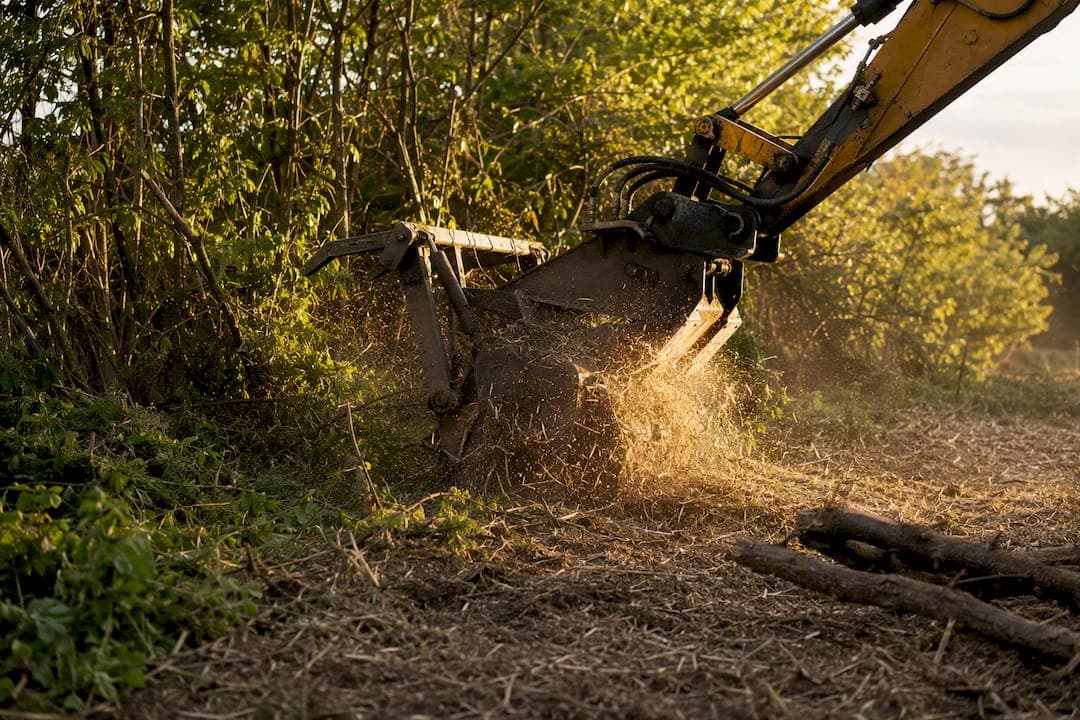
Forestry mulching typically runs $500 to $8,000 per acre, with most residential projects landing between $1,000 and $4,000. Light brush sits at the low end, medium vegetation lands near $2,000 to $2,500 per acre, and heavy timber or dense hardwood stands push toward $4,000 and above. The single most useful step you can take before budgeting anything: schedule an on-site estimate so a licensed contractor can price your actual acreage instead of a national average.
TL;DR:
- Vegetation density and stem size are the primary factors influencing forestry mulching costs, ranging from $500 to over $8,000 per acre depending on overgrowth severity.
- Small residential lots typically have minimum charges of $500 to $1,000 regardless of size, while larger properties benefit from volume discounts that lower per-acre rates below $2,000.
- Site conditions such as steep terrain, rocky ground, and difficult access can significantly increase the final price due to slower work and additional equipment wear.
- Using on-site estimates and detailed scopes helps avoid surprise costs, especially for projects involving large trees, permits, or complex terrain.
- Multiplying hourly rates or adding separate charges for stump grinding and debris hauling provides more accurate budgeting for unpredictable or mixed-density properties.
Table of Contents
- Forestry Mulching Cost Per Acre: Quick Price Reference
- What Drives the Price of Forestry Mulching Up or Down
- Per-Acre, Hourly, or Day-Rate: How Contractors Actually Price the Job
- Real Numbers: What 0.5, 1, 5, and 10 Acres Actually Cost
- Getting an Accurate Forestry Mulching Quote
- The Hidden Costs Beyond the Machine Itself
- How Long a Forestry Mulching Project Actually Takes
- Why Mulching Often Beats Traditional Land Clearing on Total Cost
- Regional and Seasonal Price Swings to Expect
- What Mulching Leaves Behind, and When It's the Wrong Tool
- Briley Tree Service's Perspective on Fair Pricing
- Request a Free Forestry Mulching Estimate
- Sources
Forestry Mulching Cost Per Acre: Quick Price Reference
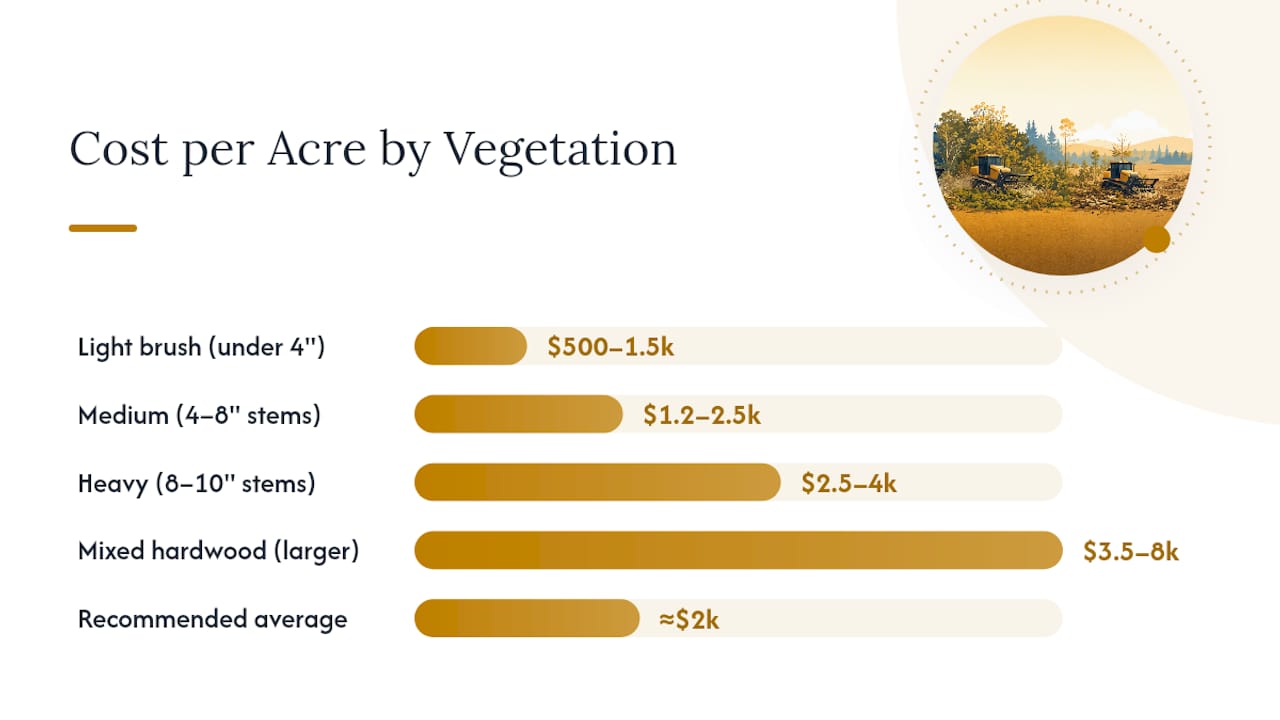
Before you call a contractor, it helps to know roughly where your property falls on the price spectrum. Vegetation density drives most of the swing between a $1,000 job and an $8,000 one, and the table below maps common scenarios to realistic budget ranges.
| Vegetation Type | Typical Cost Per Acre | Example Project | Estimated Total |
|---|---|---|---|
| Light brush and saplings (under 4 inches) | $500 to $1,500 | 1 acre of overgrown pasture edge | $800 to $1,500 |
| Medium vegetation (mixed brush, 4 to 8 inch stems) | $1,200 to $2,500 | 2 acres of fence-line overgrowth | $2,000 to $2,500 |
| Heavy vegetation (dense brush, 8 to 10 inch stems) | $2,500 to $4,000 | 5 acres of neglected timber lot | $7,500 |
| Mixed hardwood with larger stems | $3,500 to $8,000 | 3 acres of hardwood thicket | $35,000 |
| Recommended budget average | Around $2,000 per acre | Typical residential clearing job | Varies by acreage |
Small residential lots rarely see the full per-acre discount. A quarter-acre backyard clearing often carries a minimum charge of $500 to $1,000 regardless of the math, because contractors quote $150 to $400 per hour or $1,200 to $2,500 per acre and a mulcher still has to be trailered, unloaded, and set up no matter how small the job is.
Larger acreage tends to bend the curve the other way. Once you get past 5 or 10 acres, the fixed costs of mobilizing equipment spread across more billable hours, and many contractors will shave $200 to $500 off the per-acre rate for volume. Expect real variance around every number in that table. A property with heavy vine tangles or standing water can cost more than a "heavy" rating suggests, while a flat, dry lot with moderate brush can beat the "medium" average even with a higher stem count.
What Drives the Price of Forestry Mulching Up or Down
Vegetation density and stem diameter matter more than almost anything else. Light vegetation, generally under 4 inches in diameter, mulches fast and cheap. Medium vegetation in the 4 to 8 inch range slows the machine down and increases wear on the mulching head. Heavy vegetation, dense stands with 8 to 10 inch stems packed close together, can double or triple the machine-hours needed for the same acre.
A handful of site conditions swing price just as hard as vegetation type:
- Slope and terrain: steep grades slow the machine and raise the safety risk, which often means slower progress and a higher hourly rate.
- Ground access: locked gates, narrow easements, or soft ground after rain can add setup time before the mulcher even starts working.
- Rock and stumps: rocky substrate accelerates wear on cutting teeth and can force a contractor to slow down to protect the equipment.
- Tree diameter: trees above a certain diameter typically exceed what a standard mulching head can handle efficiently, pushing the job into a hybrid approach that combines felling and limbing with mulching.
- Mobilization distance: remote properties or jobs far from a contractor's base add trucking and setup costs that get baked into the quote.
- Permits and season: some counties require permits for large-scale clearing, and wet winters or drought-restricted seasons can shift scheduling and cost.
Standard mulching heads and carriers have real diameter limits, and pushing past them accelerates wear on the equipment. That is precisely why a property with a scattering of large oaks or pines usually costs more than a similar-sized lot covered in privet and saplings, even though both might look equally "overgrown" from the road.
Per-Acre, Hourly, or Day-Rate: How Contractors Actually Price the Job
Contractors price forestry mulching three main ways, and knowing which model you are looking at changes how you should read a quote.
- Per-acre pricing gives you predictability, which is why most homeowners prefer it. The catch: ask exactly how the contractor defines "an acre" in the quote, since a wooded acre with dense stems takes far longer to clear than an open acre of light brush, even at the same quoted rate.
- Hourly and day-rate pricing shows up more often on complex or unpredictable sites where density varies across the property. Rates commonly run $150 to $400 per hour, and productivity ranges from roughly 1 to 4 acres a day for light brush down to a quarter or half an acre a day for dense vegetation. Multiply the hourly rate by the estimated hours, and you can sanity-check any per-acre quote you receive.
- Minimum charges apply to almost every contractor's pricing sheet. A minimum fee exists because trailering a mulching machine to a half-acre lot costs the contractor nearly as much in fuel and labor as a five-acre job, so expect a floor somewhere between $500 and $1,500 regardless of how small your project is.
If your property has wildly uneven vegetation density, an hourly or day-rate quote is often the fairer deal for you. A flat per-acre price on a mixed site tends to get padded upward to cover the contractor's risk on the densest sections. Ask about switching to hourly if a per-acre bid feels high for what you're actually clearing.
Real Numbers: What 0.5, 1, 5, and 10 Acres Actually Cost
Ranges only become useful once you attach them to a real property. Here's how the math typically works out.
0.5 to 1 acre, light brush. A quarter-acre to one-acre lot with saplings and light brush, mulched at roughly $200 per hour over 3 to 5 hours, lands between $800 and $1,500 total, including the minimum charge most contractors apply to small jobs.
1 to 5 acres, medium vegetation. A 3 acre lot of mixed brush at $1,800 per acre runs close to $5,400, but a 5 acre lot of the same density might drop to $1,500 per acre once volume discounts kick in, bringing the total to $7,500 instead of $9,000. The discount comes from spreading one mobilization trip across more billable acreage.
5 to 10+ acres, dense hardwood. A 10 acre stand of mixed hardwood with larger stems, priced around $3,500 per acre, totals roughly $35,000. At this scale, if more than a handful of trees exceed 10 to 12 inches in diameter, a hybrid approach that fells and limbs the largest trees before mulching the rest is often the more economical path, since it protects the mulching head from unnecessary wear.
Common add-ons stack on top of the base clearing price. Stump grinding typically adds an extra cost per stump, hauling debris off-site (rather than leaving mulch in place) can add $500 to $2,000 depending on volume, and grading or seeding afterward often adds additional cost.
Pro Tip: Ask your contractor to quote stump grinding and debris hauling as separate line items rather than a bundled number. It's the fastest way to spot which parts of the bid you can trim if your budget is tight.
Getting an Accurate Forestry Mulching Quote
A phone estimate is a guess. A site visit is a quote. Before a contractor ever shows up, send clear photos of the property, note where the gates and access points are, and flag any property line markers or underground utilities you know about. That prep work alone speeds up the on-site assessment and reduces the odds of a change order later.
During the visit, expect the contractor to walk the property, check equipment access points, flag hazards like standing water or unstable ground, and confirm the exact scope, meaning what stays, what gets cleared, and where the property boundary actually falls.
Watch for a few red flags before you sign anything:
- A quote with no defined scope, just a total price and no explanation of what's included.
- No proof of insurance or license offered when you ask for it.
- A bid noticeably lower than every other quote you've received with no clear reason why.
- No written warranty or callback policy if regrowth or missed areas show up within a set window.
Before work begins, request a certificate of insurance, a copy of the license, a written scope of work, and a payment schedule. A tree service hiring checklist can help you compare bids apples to apples instead of guessing which contractor is actually cheaper once the fine print is accounted for.
The Hidden Costs Beyond the Machine Itself
The mulching head running across your property is only part of the bill. Permitting is the first cost many landowners overlook. Some counties and municipalities require a land-disturbance or vegetation-clearing permit for larger projects, particularly near wetlands, floodplains, or protected buffer zones, and permit fees can run anywhere from $50 to a few hundred dollars depending on the jurisdiction.
Debris handling is the next variable. Forestry mulching grinds vegetation into mulch that's typically left on-site, which is cheaper than hauling. But if local code requires debris removal, or if you simply want a cleaner finished look, hauling can add significant costs depending on volume, as noted in the worked examples above.
Environmental considerations can add cost too. Properties near streams, wetlands, or steep slopes sometimes require erosion-control measures like silt fencing or buffer strips left un-mulched to satisfy state or local runoff regulations. Skipping these isn't a shortcut. It can trigger fines that dwarf the cost of doing it right the first time.
Finally, factor in incidental costs: a survey to confirm property lines if boundaries are unclear, tree removal permits if any protected species are on-site, and disposal fees if local ordinances restrict what can be left as mulch versus what must be trucked to a facility.
How Long a Forestry Mulching Project Actually Takes
Most homeowners are surprised by how fast the mulching itself goes and how much of the timeline is everything around it. A half-acre to one-acre light brush job can be mulched in a single day, sometimes in just a few hours. A dense, multi-acre hardwood project can take several days to a week or more of active machine time.
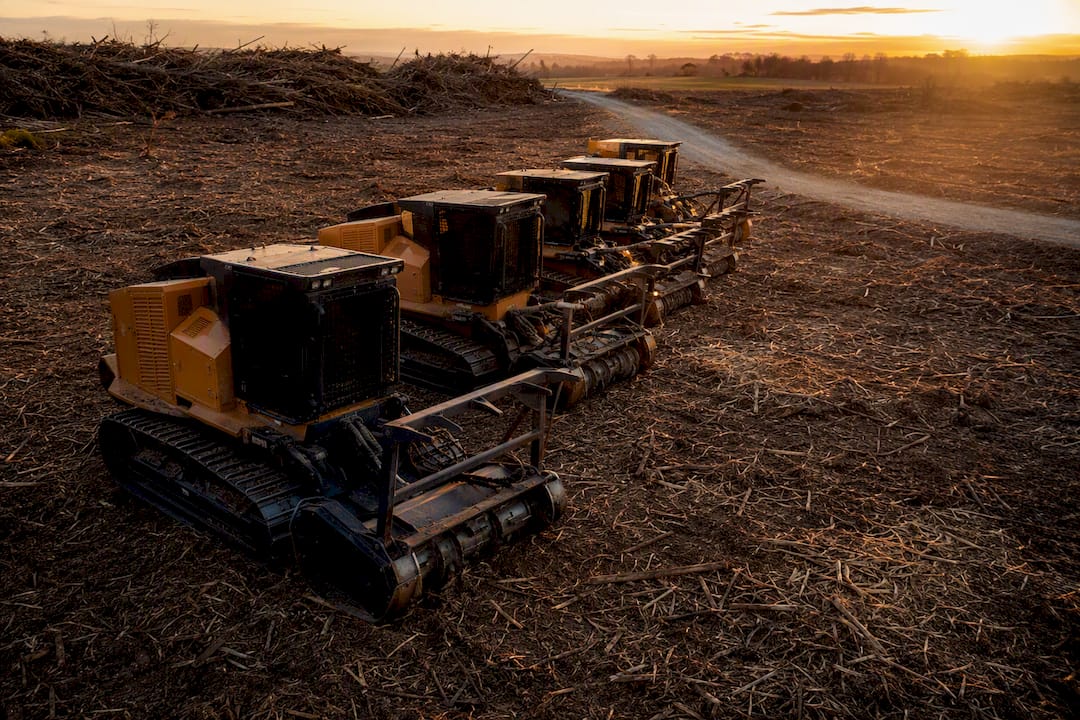
Add in the steps most estimates don't mention. Scheduling and permitting, when required, can take anywhere from a few days to several weeks before equipment ever arrives. On the day of the job, expect setup time for equipment access, walk-through confirmation of the scope, and safety checks before the mulcher starts moving.
After the machine work wraps, cleanup is its own phase. If debris is being hauled rather than left in place, that's typically a separate day or half-day of loading and trucking. If the property needs grading, seeding, or erosion control afterward, tack on another day or two depending on acreage. For a typical residential project, budget one to three days from equipment arrival to final walk-through; for larger commercial-scale clearing, plan on a week or more.
Why Mulching Often Beats Traditional Land Clearing on Total Cost
Forestry mulching's real financial advantage shows up after the job, not during it. Traditional land clearing, meaning bulldozing and hauling everything away, often runs comparable or higher upfront costs once you add debris disposal and burn permits, and it leaves bare soil behind. Mulching grinds vegetation into a layer of organic material that stays on-site.
That organic layer isn't just leftover debris. USDA forest management guidance supports using ground vegetation as a soil amendment that helps with moisture retention and erosion control, which means you're not paying separately for mulch or ground cover after the fact. Bulldozing, by contrast, frequently requires follow-up seeding or erosion control to stabilize bare dirt, an added cost mulching sidesteps.
Mulching also tends to suppress regrowth more effectively than cutting alone, since grinding stumps and root systems down close to grade slows resprouting compared to a simple mow-and-cut approach. That can mean fewer maintenance visits over the following two to three years. State extension guidance on vegetation control backs up longer maintenance intervals when clearing methods address root systems rather than just above-ground growth.
Where mulching doesn't win outright: properties with significant merchantable timber. If your land has valuable sawtimber, selective logging or a hybrid removal that sells the timber before mulching the rest can offset costs that pure mulching can't recover.
Regional and Seasonal Price Swings to Expect
Forestry mulching prices are not flat across the country, and knowing the general pattern helps you judge whether a local quote is reasonable. Industry pricing roundups show the West and Northeast trending toward higher per-acre costs, largely due to steeper terrain and fewer operators competing for jobs in those regions. The Southeast, with its flatter ground and denser concentration of land-clearing contractors, tends to run less expensive on a per-acre basis.
Season matters almost as much as region. Late fall through winter is typically the slower season for most contractors, and that can translate into better scheduling flexibility and occasionally softer pricing. Spring and early summer, when overgrown vegetation is most visible and landowners are eager to clear before summer heat, tends to be the busiest and priciest window.
Weather itself changes the math too. Wet ground after heavy rain slows equipment and can push a job into a higher hourly bracket simply because the machine works less efficiently in mud. Drought conditions in some regions can also trigger burn bans or debris-disposal restrictions that shift a project toward hauling instead of leaving mulch on-site, adding cost. If your budget has any flexibility, scheduling during a contractor's slower season is one of the easiest ways to trim the final number without cutting scope.
What Mulching Leaves Behind, and When It's the Wrong Tool
Forestry mulching leaves a layer of ground-up organic material spread across the cleared area rather than bare dirt. That layer helps with erosion control and moisture retention, but it also means stumps typically remain in the ground rather than being pulled, and root systems stay intact underground unless stump grinding is added as a separate service.
Mulching isn't the right method for every property. Large merchantable timber, generally trees well beyond the 10 to 12 inch diameter threshold, exceeds what a mulching head can process efficiently, and forcing the issue accelerates equipment wear without actually clearing the tree. In those cases, felling and hauling the timber, sometimes with salvage value offsetting cost, makes more sense than trying to mulch through it.
Rocky ground presents a similar problem from a different angle. Exposed bedrock or heavy rock content tears up cutting teeth fast, and a contractor may recommend a different clearing method or charge a significant premium to compensate for accelerated equipment wear. Very wet or swampy ground can also rule out mulching entirely if the machine can't get safe footing, in which case clearing may need to wait for a drier season or shift to hand-clearing methods.
If your property has a mix of conditions, some open brush, a few large legacy trees, and a rocky corner, a hybrid approach that mulches the easy sections and handles the difficult ones separately is often the most cost-effective path.
Briley Tree Service's Perspective on Fair Pricing
We build every forestry mulching estimate from a site visit, not a phone call. Vegetation density, stem diameter, and ground access vary too much across North Louisiana properties to price blind, and a firm written scope protects you from surprise charges once the machine is on-site.
In practice, we see the widest cost swings on properties with legacy hardwoods mixed into brush, exactly the scenario where a hybrid approach saves money over forcing everything through a mulching head. If you're also dealing with a fence-line clearing project or need stumps removed afterward, we scope those separately so you know exactly what you're paying for and why.
— Tatum
Request a Free Forestry Mulching Estimate
Getting a number you can actually budget around starts with a site visit, not a generic per-acre average. Brileytreeservice sends a licensed and insured arborist team to walk your property, confirm access points, flag any large-diameter trees that might need a hybrid approach, and hand you a written scope before any equipment moves.
To make that visit fast and productive, send a few photos of the area beforehand and note where gates, fence lines, and property markers are located. We'll confirm insurance coverage on the spot and walk through exactly what's included, mulching, debris handling, and any stump grinding or hauling you want added, so there are no surprise line items on the final invoice. If you're weighing forestry mulching against other clearing methods, our team will tell you honestly which one fits your land and your budget. Request a free estimate from Brileytreeservice and get a firm number for your property this week.
Sources
- Angi — Forestry mulching cost
- Skid Steers Direct — What is forestry mulching and how much does it cost?
- eForestProducts — forestry mulching cost