
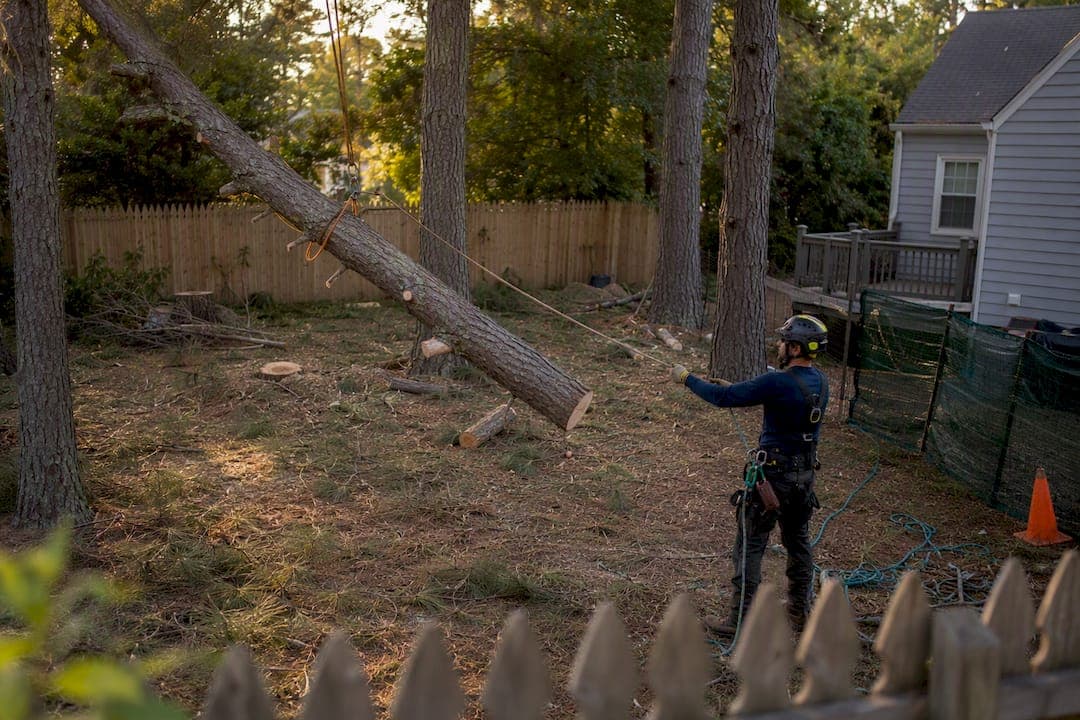
Removing a pine tree typically costs between $200 and $2,000, with most homeowners paying around $750 for a standard job. Small pines under 30 feet often run $200 to $500, while mature pines over 80 feet can climb past $1,500 to $5,000 or more, especially when the tree sits near a house or power line.
The fastest way to get a real number for your situation is simple: schedule an on-site estimate. Photos and phone descriptions never capture trunk diameter, lean, or how tight your yard access really is, and those details swing the price more than anything else.
- National average: about $750 for a standard residential removal
- Typical permit fee, when required: $60 to $150
- A local example: Briley Tree Service prices Shreveport and Bossier City jobs after a free on-site walk-through, not a phone guess
Get at least one written, itemized quote before you sign anything. If a contractor won't put the price in writing after seeing the tree in person, that's your first red flag.
Key Takeaways
Pine tree removal cost depends primarily on height, with national prices ranging from $200 for small trees to $5,000 or more for tall pines near structures.
| Point | Details |
|---|---|
| Height sets the baseline | A 30-ft pine runs $200–$500 while trees over 80 ft often exceed $1,500–$5,000. |
| Access and hazards raise price | Proximity to power lines or structures can add 25% to 50% to a standard quote. |
| Extras add up fast | Stump grinding, hauling, and permits typically add $150–$400 combined to the base removal. |
| Get three written estimates | Comparable, itemized quotes protect you from lowball offers and missing insurance coverage. |
| Local example available | Briley Tree Service prices Shreveport-area pine removals around $750 after an on-site visit. |
Table of Contents
- Pine Tree Removal Cost by Size: What to Expect
- What Factors Actually Move Your Pine Tree Removal Price
- Add-On Costs and Permit Fees You'll See on Your Invoice
- How Location Changes Your Pine Tree Removal Estimate
- Getting Comparable Quotes: Questions and Red Flags
- Should You Remove a Pine Tree Yourself?
- A Real-World Pine Removal Example From Briley Tree Service
- Frequently Asked Questions
- Sources
Pine Tree Removal Cost by Size: What to Expect
Height drives price more than any other single factor. A pine's weight, the rigging needed to bring it down safely, and the labor hours all scale with how tall the tree is, so the size bucket your tree falls into tells you most of what you need to know before a contractor ever shows up.
Here's how pricing generally breaks down across common pine sizes, based on pine-specific industry cost data:
| Tree Height | Typical Cost Range | What's Usually Included |
|---|---|---|
| Up to 30 ft | $200–$500 | Felling, basic cleanup of small debris |
| 30–60 ft | $500–$1,500 | Felling or sectional removal, branch cleanup, basic hauling |
| 60–80 ft | $1,500 to $5,000 or more | Sectional cutting, rigging, full debris haul-away |
| 80+ ft | $1,500–$5,000+ | Crane or bucket truck likely, specialized rigging, full cleanup |
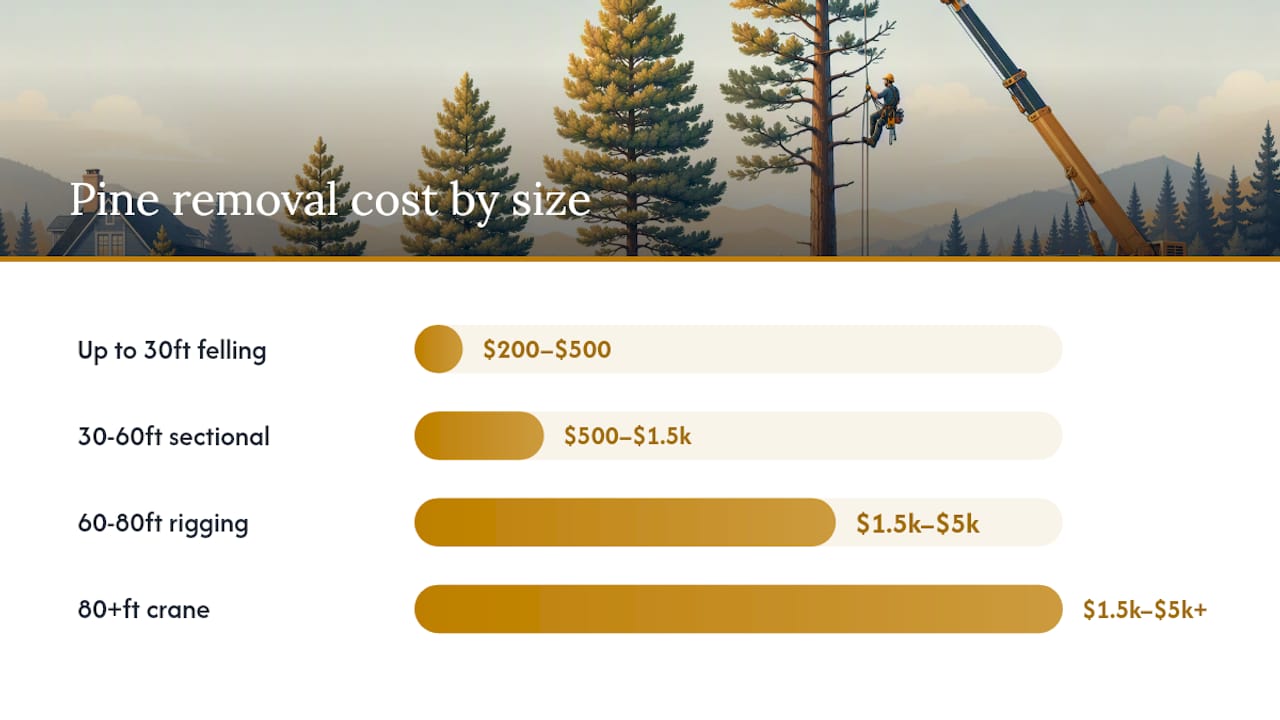
These ranges cover the tree coming down and basic cleanup. They usually do not include stump grinding, which is priced separately in most contracts.
A quick example: say you have a 50-foot pine in a mid-size backyard with no obstacles nearby. The base removal might land around $800. Add stump grinding at $150, and hauling the wood off-site at another $100, and your total estimate lands closer to $1,050. That's a realistic number for a straightforward job.
One national estimate puts the overall average tree removal cost at $750, but pine-specific quotes tend to track slightly below that for smaller trees and well above it once you're dealing with anything over 80 feet near a structure.
Pro tip on reading a quote's pricing method: most contractors price per job, not strictly per foot, but you can back into a rough per-foot rate to compare bids. Divide the quoted price by tree height. If one bid comes in at $15 per foot and another at $9 per foot for a similar tree in similar conditions, ask the higher bidder what's driving the difference. It's usually access, insurance coverage, or crew size, and a good contractor will explain it without hesitation.
What Factors Actually Move Your Pine Tree Removal Price
A quote isn't just about height. Several variables stack on top of the base size price, and knowing which ones apply to your tree helps you understand why two bids for the "same" job can differ by hundreds of dollars.
- Trunk diameter: wider trunks take longer to cut and require heavier equipment, even at the same height.
- Tree health and rot: dead or structurally weak pines are more dangerous to climb and rig, which raises labor cost and insurance risk.
- Proximity to structures or power lines: working near a house, fence, or utility line can add 25% to 50% to the bill because crews have to section the tree down piece by piece instead of felling it whole.
- Yard accessibility: a tree behind a fence, next to a pool, or without truck access often means more manual labor and longer job time.
- Crew size and hours: larger or more hazardous jobs need more hands, and every extra hour on-site adds to the invoice.
- Crane or bucket truck need: renting a crane can add $250 to $600 per day, and it's often unavoidable for tall pines in tight spaces.
- Cleanup and disposal scope: hauling every branch and chunk of trunk away costs more than leaving split logs for the homeowner.
Homeowners commonly miss a few costs that show up later: travel fees for jobs outside a contractor's normal service radius, municipal dump or disposal charges baked into the invoice, and arborist report fees, which can average several hundred dollars when a city requires documentation before issuing a permit.
Pro Tip: Ask about seasonal timing. Some companies offer winter discounts of 10% to 15% during their slower months, while storm-driven emergency removals almost always carry a premium. If your pine isn't an immediate hazard, scheduling in the off-season can meaningfully lower your bid.
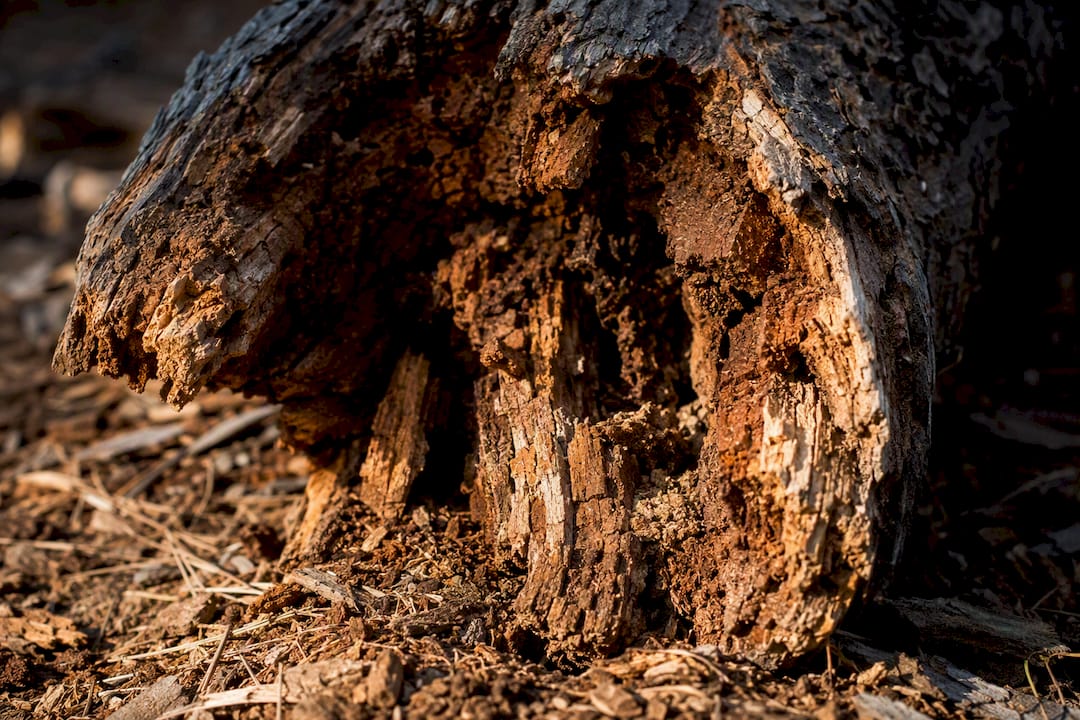
Rot and structural weakness deserve special mention here. A pine that looks fine from the ground can have internal decay that changes the entire removal plan, which is one reason large trees near a home often need a closer inspection before anyone gives you a firm number.
Add-On Costs and Permit Fees You'll See on Your Invoice
Most pine removal quotes separate the core felling job from optional extras, and those extras are often where a "cheap" quote turns expensive. Knowing what's typically itemized helps you compare bids fairly instead of comparing a bare-bones price against a full-service one.
- Stump grinding: commonly $100 to $150 depending on stump diameter
- Stump removal (full extraction): usually priced higher than grinding since it involves pulling the root ball
- Wood chipping: equipment rental or service runs $150 to $250
- Cleanup and debris haul-away: typically $70 to $95 on top of the base removal
- Log splitting or firewood service: varies by wood volume, sometimes offered as a trade for keeping the logs
- Crane or bucket truck time: $250 to $600 per day when equipment is required
- Emergency or after-hours service: carries a premium, often the highest line item on a storm-related invoice
| Add-On Service | Typical Cost Range |
|---|---|
| Stump grinding | $100–$150 |
| Wood chipping | $150–$250 |
| Debris cleanup/haul-away | $70–$95 |
| Permit fee (if required) | $60–$150 |
Permits usually enter the picture when a tree exceeds a certain diameter, sits on a protected species list, or grows within city limits with tree preservation ordinances. When a permit is needed, the contractor typically pulls it as part of the job, though some cities require the property owner to file directly. Either way, confirm who's responsible before work starts.
Disposal choices affect price too. Leaving split logs for firewood costs less than a full haul-away, and mulching the smaller branches on-site can shave a chipping fee off your total.
How Location Changes Your Pine Tree Removal Estimate
National averages are a starting point, not a promise. Local labor rates, disposal fees, and permitting rules push prices up or down depending on where you live, sometimes by hundreds of dollars for a comparable tree.
| Region | Sample Cost Range |
|---|---|
| California | $200 to $500 |
| Florida | $750–$1,500 |
| Texas | $200 to $500 |
| New York | $750 |
These regional samples reflect real differences in the cost of doing business. Florida's higher range often ties back to hurricane-driven demand and strict local permitting in coastal counties. California's labor and insurance costs run higher across most trades, tree service included. Texas markets often land lower thanks to a larger pool of competing crews and fewer permit hurdles in many areas.
Rural properties bring their own math. A tree service traveling 40 minutes outside its normal service area may add a trip fee, even if the removal itself is straightforward. Urban and suburban jobs, meanwhile, tend to cost more when access is tight, since a townhouse lot with no side-yard clearance takes longer to work than an open rural acre.
If you want to estimate your local number from the national average, start with the $750 baseline, then adjust up for tight urban access or down for open rural land with easy equipment access. It's a rough starting point, not a substitute for an actual quote.
Getting Comparable Quotes: Questions and Red Flags
A quote is only useful if you can compare it to another quote apples to apples. That means asking the same questions of every contractor and insisting on a written estimate rather than a verbal number.
Ask each contractor:
- Are you licensed and insured for tree removal in this state?
- Can you provide proof of general liability and workers' compensation coverage?
- Is this estimate itemized, including stump work, hauling, and cleanup?
- Who is responsible for pulling any required permit?
- What's the expected timeline, and how many crew members will be on-site?
- Will you need a crane or bucket truck, and is that cost already included?
- Has an arborist inspected the tree, or is that recommended before work begins?
A written estimate should list the base removal price, stump grinding or removal if requested, hauling and disposal, permit fees if applicable, and any crane or bucket truck time as separate lines. If a quote is a single lump number with no breakdown, ask for the itemization before you agree to anything.
Watch for these red flags:
- No proof of insurance offered, or a vague answer when you ask
- Only a verbal quote with nothing in writing
- A price dramatically lower than every other bid you've received
- A demand for a large cash-only deposit before work starts
Most reputable contractors ask for a modest deposit, if any, with the balance due on completion. Getting at least three local estimates is standard advice for a reason. It gives you a real sense of the local market instead of guessing off a national number.
Should You Remove a Pine Tree Yourself?
For a small pine under 20 feet with no obstacles nearby, a homeowner with proper PPE, a sharp chainsaw, and basic felling knowledge might reasonably handle it. Anything larger changes the calculation fast.
- Power lines nearby: always call a professional; contact with a line can be fatal
- Proximity to your roof, driveway, or a neighbor's property
- Trees over 30 feet, where a miscalculated fell direction becomes dangerous
- Visible rot, cavities, or dead limbs that make the tree unpredictable to climb or cut
When safety risk is present, expect added costs for insulated equipment, utility company coordination, or crane rental. Those aren't upsells. They're what it actually takes to do the job without anyone getting hurt.
If in doubt, hire a licensed, insured pro. A DIY mistake with a pine this size isn't just expensive to fix. It can be permanently damaging to a home or fatal to the person holding the saw.
A Real-World Pine Removal Example From Briley Tree Service
Here's how a typical 50-foot residential pine removal breaks down when Briley Tree Service prices a Shreveport-area job:
| Line Item | Estimated Cost |
|---|---|
| Base removal (fell, section, basic cleanup) | $60 to $150 |
| Stump grinding (optional) | $100–$150 |
| Hauling and debris disposal | $70 to $95 |
| Permit (if required by local ordinance) | $60–$150 |
| Total estimated range | $750 |
Briley Tree Service sets pricing after an on-site assessment that looks at trunk diameter, lean direction, yard access, and proximity to structures. When a tree shows signs of rot or sits close to a power line, that assessment includes a note on any added safety equipment needed before the crew ever schedules the job.
This example is illustrative. Your actual price depends on your tree's condition and your property's specific layout, which is exactly why an on-site estimate matters more than any online calculator.
Why professional removal is usually the smarter investment
A hazardous pine that fails can cost far more than removal ever would. A damaged roof or foundation after a fall dwarfs even a $2,000 removal bid, which is why permits and pro assessments matter.
Request Your Free Estimate From Briley Tree Service
Briley Tree Service is the alternative to guessing at a price over the phone. Every estimate starts with a real, licensed, and insured crew looking at your actual tree, whether it's a routine backyard pine or an emergency after a storm. Serving Shreveport, Bossier City, Ruston, and the surrounding North Louisiana area, the team handles removal, stump grinding, land clearing, and 24/7 storm cleanup for both homeowners and commercial properties, including permit and insurance claim support when a job requires it.
If you're staring at a leaning pine and wondering what it's actually going to cost, skip the guesswork. Schedule a free on-site estimate with Briley Tree Service and get a written, itemized quote you can trust before any crew touches your tree.
Frequently Asked Questions
What is the average pine tree removal cost? Most pine removals cost between $200 and $2,000, with a national average around $750. Height and proximity to structures push individual quotes higher or lower.
How much does it cost to remove a tree close to a house? Removal near a house typically costs 25% to 50% more than an open-yard removal, since crews must section the tree down in pieces instead of felling it whole.
Do I need a permit to remove a pine tree? It depends on your city. Many municipalities require a permit for trees above a certain diameter or in protected zones, with fees typically running $60 to $150.
What's the cost to remove pine trees that are very tall, over 80 feet? Expect $1,500 to $5,000 or more, since trees this size often require a crane or bucket truck and specialized rigging.
How do I get an accurate pine tree removal estimate? Schedule an on-site visit with at least three licensed, insured contractors, and request a written, itemized quote that separates removal, stump work, hauling, and permit fees.
Sources
- Tree Removal Cost 2026 Data | Angi
- How Much Does It Cost to Remove a Tree? 2025 Data | HomeAdvisor
- Average Pine Tree Removal Cost: Factors & Tips | Zacarias Tree & Landscaping
Your city planning office remains the final word on local permit rules.