
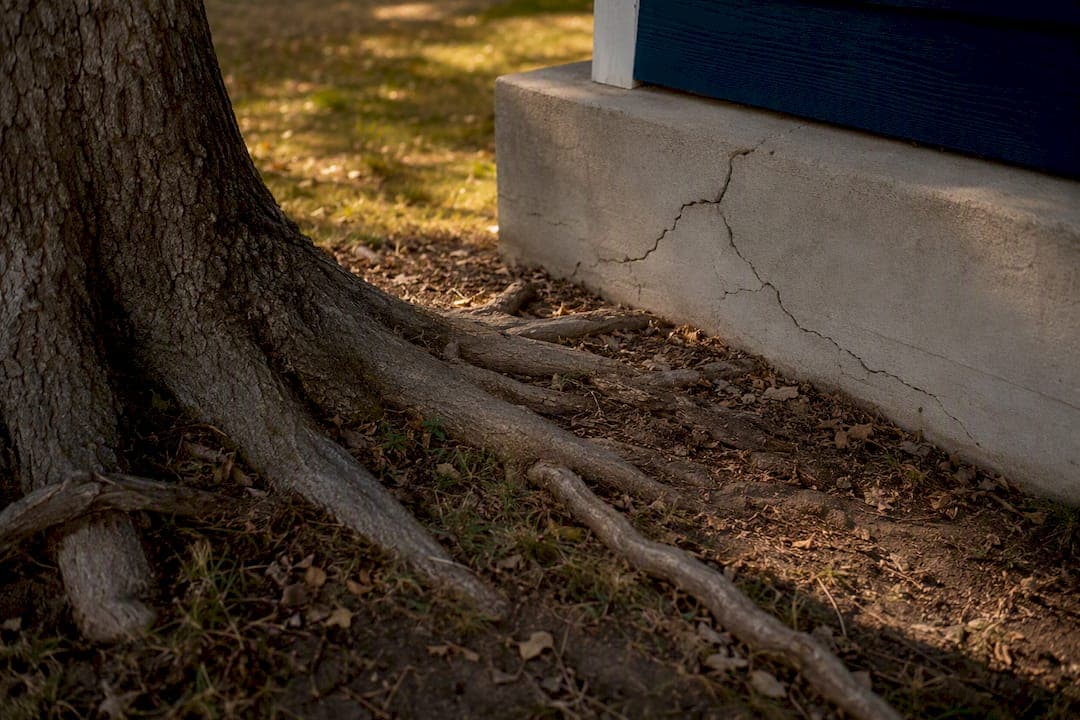
Short answer: tree roots rarely break sound concrete. Most foundation problems linked to trees come from soil moisture change and opportunistic root growth, not roots physically cracking a footing. When a root does contribute to damage, it's almost always an indirect process: the root dries out the soil, the soil shrinks, and the foundation settles unevenly on top of it.
That distinction changes how you should respond. Instead of panicking about a maple 15 feet from your porch, look for the signs that actually correlate with root-driven movement:
- Cracks that widen in dry months and partially close after rain
- Soil separation of 1 to 3 inches between the ground and the foundation during drought
- Damage concentrated on the side of the house closest to the tree
If cracks exceed a quarter inch or run horizontally, call a structural engineer first. For root mapping and safe pruning, a certified arborist is the right call, and a local provider like Briley Tree Service can send someone out to look at both the tree and the soil around it.
Key Takeaways
Most foundation damage blamed on trees comes from soil moisture change, not roots physically breaking concrete, and the fix depends on diagnosing the real cause before touching the tree.
| Point | Details |
|---|---|
| Roots rarely break concrete | Soil desiccation and differential settlement cause most damage attributed to trees. |
| Watch for one-sided damage | Cracking and soil separation concentrated near the tree side signal a root-related cause. |
| High-risk species exist | Oaks showed a 5.5 to 1 damage ratio relative to their population in MSU research. |
| Stabilize before removing | Cutting down a tree before fixing the foundation can trigger heave in expansive clay soil. |
| Get a local assessment | Briley Tree Service offers certified arborist evaluation and root management across North Louisiana. |
Table of Contents
- What Causes Tree Roots Foundation Damage in the First Place?
- What Signs Point to Root-Related Foundation Movement?
- Which Trees Actually Threaten a Foundation?
- How Do You Prevent Foundation Damage From Nearby Trees?
- What Are Your Options if the Foundation Has Already Moved?
- What Should You Do First if You Suspect Root Damage?
- How Briley Tree Service Diagnoses Root-Related Risk
- Why Most Homeowners Worry About the Wrong Thing
- Get a Root and Foundation Risk Assessment From Briley Tree Service
- Sources
What Causes Tree Roots Foundation Damage in the First Place?
Roots don't push foundations over like a lever. They change the moisture content of the soil beneath and around a footing, and that moisture swing is what moves concrete. In expansive clay soils, common across much of the country, this mechanism does most of the work.
Here's the sequence. A mature tree pulls hundreds of gallons of water from the soil on a hot day. If its roots run under or near a footing, that water uptake dries the clay out faster than rainfall can replace it. Dry clay shrinks. As it shrinks unevenly, one section of the foundation loses support while another stays put. That's differential settlement, and it's the actual culprit behind most cracking blamed on trees.
Roots also behave opportunistically. They don't seek out foundations, but they will exploit an existing crack or a leaking pipe joint because that's where moisture and oxygen are easiest to find. A root growing into a hairline crack doesn't create the crack. It just moves in after the fact and can widen it slowly as it thickens.
Depth matters more than people assume. Most of a tree's root mass sits in the top 18 to 24 inches of soil, and root systems commonly extend well past the edge of the canopy, sometimes three to five times the distance from trunk to dripline depending on species and soil compaction. That's why a tree that looks safely distant can still influence soil moisture at your footing.
Watch for these seasonal patterns:
- Crack width that fluctuates with rainfall rather than staying fixed
- Doors and windows that stick worse in July and August, then ease up after fall rain
- Visible gaps between soil and slab that appear only in dry stretches
What Signs Point to Root-Related Foundation Movement?
Not every crack means roots are involved. Settling foundations, poor original construction, and plumbing leaks cause similar symptoms, so the pattern of damage matters more than any single crack.
Look for these indicators, roughly in order of reliability:
- Damage concentrated on one side. If cracking, sticking doors, and sloping floors all show up on the side of the house nearest the tree, that's a strong correlation.
- Diagonal or stair-step cracks, especially radiating from window and door corners, rather than straight vertical hairlines.
- Soil separation of an inch or more between the foundation and the surrounding ground during dry months, closing up somewhat after rain.
- Seasonal sticking of doors and windows that eases after wet weather, which points to moisture-driven movement rather than a one-time structural failure.
Professionals confirm the cause with tools most homeowners never get to see. Date-stamped photos of the same crack taken monthly through a full wet-and-dry cycle reveal whether a gap is actively moving or was always static. Level monitoring, using a laser level or manometer across several visits, tracks whether the slab itself is rising and falling with the seasons. For root inspection specifically, arborists use an Air Knife, a tool that blasts compressed air to expose roots without cutting or damaging them, so nobody has to guess what's under the soil.
Pro Tip: Before you blame a tree, have a plumber check for slow leaks near the foundation. A leaking supply line or sewer joint mimics root-driven soil movement almost perfectly, and fixing a pipe is a lot cheaper than fixing a tree.
Call a structural engineer if cracks exceed a quarter inch, run horizontally, or show any bowing. Call a certified arborist when you need root mapping, species identification, or a pruning plan that won't destabilize the tree itself.
Which Trees Actually Threaten a Foundation?
Species matters more than most homeowners realize. Research from Michigan State University Extension found that oaks accounted for more than 11% of observed foundation damage despite making up only 2.1% of the surveyed tree population, a 5.5 to 1 ratio. Poplars and ashes also showed elevated damage ratios relative to how common they are.
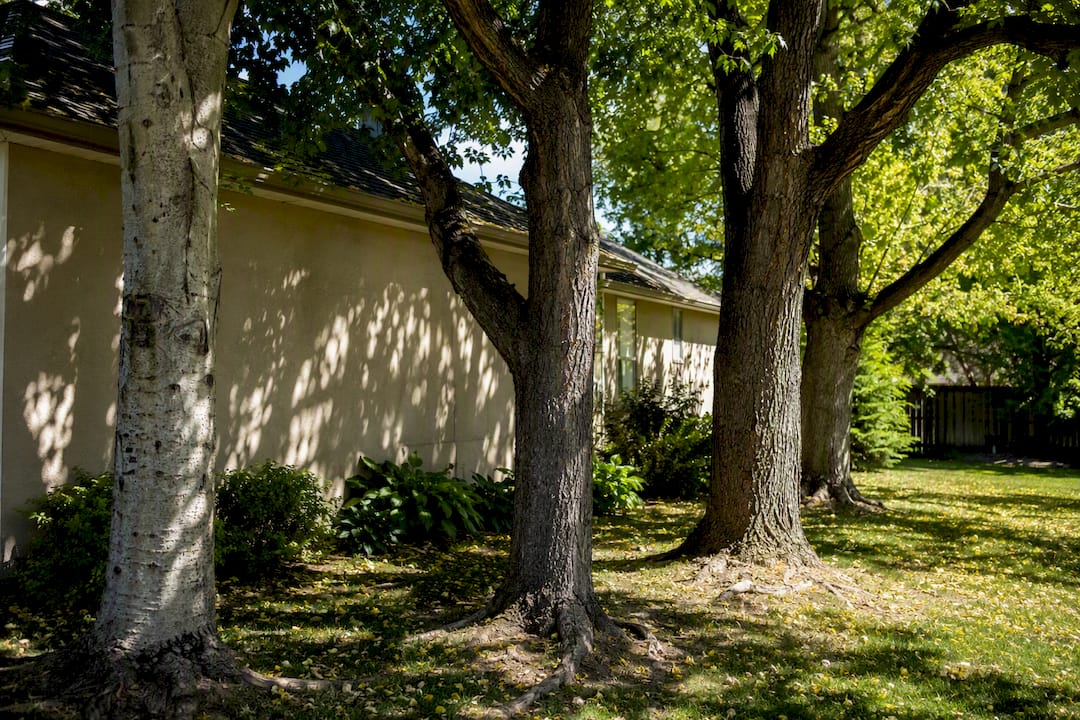
The species that cause the most trouble tend to share traits: fast growth, aggressive water demand, and shallow, wide-spreading root systems. Willows, silver maples, poplars, cottonwoods, and American elm all fall into this category. Add certain oak varieties to the list, not because their roots are unusually invasive, but because their sheer size and water consumption make them efficient at drying out clay soil near a footing.
Site conditions matter just as much as species:
- Expansive clay soil, which shrinks and swells dramatically with moisture change
- Shallow or older foundations poured without modern moisture barriers
- Compacted subsoil that forces roots to grow laterally instead of down
- Nearby leaking pipes that draw roots toward the foundation
| Tree Type | Typical Risk Level | Reason |
|---|---|---|
| Willow, poplar, cottonwood | High | Fast growth, high water demand, shallow spreading roots |
| Silver maple, American elm | High | Aggressive lateral root systems, large canopy water draw |
| Oak (various species) | Elevated | Large size and water consumption despite deeper taproots |
| Smaller ornamental species (dogwood, crape myrtle) | Low | Limited size and moderate water needs |
As a general planting guideline, keep large species at least 20 feet from a foundation, and push that to 30 feet or more on known expansive clay. Smaller ornamentals can safely sit closer.
How Do You Prevent Foundation Damage From Nearby Trees?
Prevention costs far less than repair, and most of it comes down to managing soil moisture rather than fighting the tree itself.
- Fix drainage and grading first. Water should slope away from the foundation, not pool against it. Extend downspouts at least 5 to 10 feet from the house.
- Stabilize soil moisture in dry spells. A soaker hose run occasionally along the foundation during drought keeps expansive clay from shrinking too fast, especially on the side nearest a large tree.
- Install a root barrier if a valuable tree sits close to the house. Barriers typically run 18 to 24 inches deep and redirect roots downward or sideways instead of toward the footing.
- Repair leaking pipes and sewer lines near the foundation. Roots follow moisture, and a fixed leak removes the incentive for roots to grow that direction at all.
- Have a certified arborist prune roots, if needed, rather than doing it yourself. Cutting too close to the trunk or removing too much root mass in one session can destabilize the tree and create a new hazard.
Pro Tip: Never rent a trencher and start cutting roots on your own. An arborist follows pruning guidelines that limit how much root mass can be safely removed at once. Cut too much and you risk killing the tree or making it more likely to fall in the next storm.
If you'd rather have someone assess the tree itself before you touch anything near your foundation, a professional consultation is worth the visit.
What Are Your Options if the Foundation Has Already Moved?
If cracks and sloping floors confirm real movement, the repair path depends on severity, but the sequence matters as much as the method.
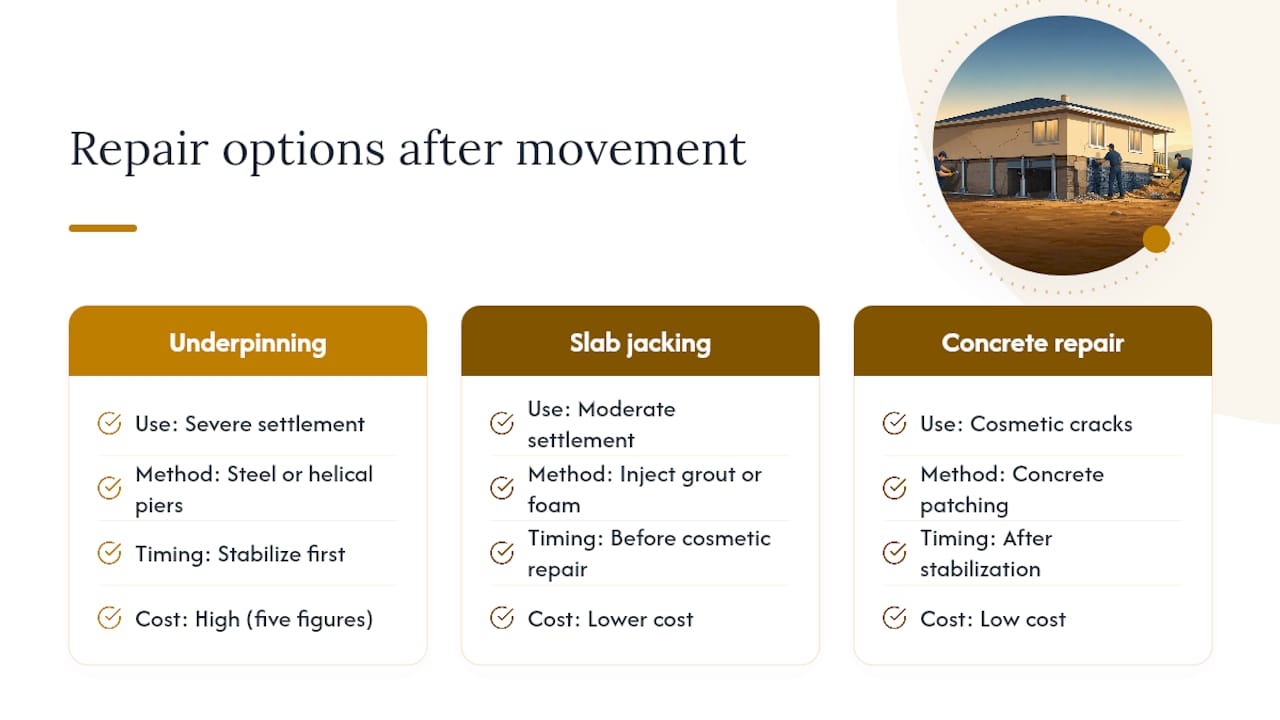
Underpinning with steel or helical piers is the standard fix for significant settlement. Piers transfer the foundation's load down to stable soil below the affected layer, and this is usually the go-to for cracks wider than a quarter inch or any horizontal displacement.
Slab jacking or foam injection works for more moderate settling, lifting a sunken slab by injecting material beneath it. It's faster and cheaper than full underpinning but doesn't address severe structural movement.
Localized concrete repair handles cosmetic cracking once the underlying soil movement has been stabilized. Doing this before fixing the moisture problem is a waste of money, since the same crack will likely return.
Here's the part homeowners get backward most often: removing the tree isn't step one. On expansive clay, cutting down a large tree that's been drying out the soil for years can trigger heave as the clay re-absorbs moisture and swells, sometimes causing more damage than the original settlement. The recommended order is to stabilize the foundation first, manage root growth with a barrier or targeted pruning, and only then consider removal if the tree remains a genuine risk.
Cost ranges vary widely by region and severity, but underpinning with piers commonly runs into five figures for a full perimeter, while slab jacking and localized repairs cost considerably less. Get an independent structural engineer's specification and at least two contractor bids before committing to any repair.
What Should You Do First if You Suspect Root Damage?
Work through this in order rather than jumping straight to the most dramatic (and expensive) option.
- Photograph every crack monthly, with a date stamp, through at least one full wet and dry season. This is the single most useful piece of evidence you can hand a professional.
- Rule out plumbing first. Have leaks near the foundation checked and repaired before assuming roots are responsible.
- Call a certified arborist for root mapping if a tree sits within 20 to 30 feet of the affected side of the house.
- Call a structural engineer if any crack exceeds a quarter inch or shows horizontal movement.
- Apply temporary protection while you wait on appointments: improve grading, extend downspouts, and run a soaker hose during dry spells to limit further clay shrinkage.
This order protects you from paying for underpinning when the real problem was a $200 plumbing fix.
How Briley Tree Service Diagnoses Root-Related Risk
An experienced arborist doesn't start with a chainsaw. The process typically begins with a visual survey of the tree's canopy, trunk lean, and the soil surface near the foundation, looking for the separation and cracking patterns described earlier.
From there, noninvasive tools do the real diagnostic work:
- Air Knife exposure to map root location and size without cutting into roots or soil
- Coordination with a structural engineer when crack severity suggests the foundation itself needs a formal report
- Soil and drainage observation to identify moisture sources feeding the problem
Briley Tree Service brings a licensed and insured arborist team to residential and commercial properties across Shreveport, Bossier City, Ruston, and surrounding North Louisiana areas. A free estimate covers the initial assessment, and the team can help with permit questions and insurance claim documentation if the damage needs to go through a claims process.
Why Most Homeowners Worry About the Wrong Thing
The conventional advice on this topic gets the priorities backward. Most guides lead with root barriers and planting distances, as if the tree itself is the primary threat. It rarely is. Soil moisture management is the lever that actually matters, and it's the one homeowners skip because fixing a downspout feels less satisfying than blaming a 40-foot oak.
I'd also push back on the instinct to remove a tree the moment cracks show up. That instinct is understandable and usually wrong. Cutting down a mature tree on expansive clay before stabilizing the foundation can make things worse, not better, because the soil rehydrates and swells. The research on heave risk backs this up clearly, yet it's the step most homeowners want to take first.
If you're dealing with cracks right now, the highest-value move isn't a barrier or a removal quote. It's a month of dated photos through a dry spell, followed by a plumbing check. That combination will tell you more than a hundred articles about which species are "dangerous."
— Tatum
Get a Root and Foundation Risk Assessment From Briley Tree Service
If a tree near your house is drying out the soil, a phone consultation can't tell you how bad it is. You need someone standing on your property looking at the crack pattern, the soil, and the root zone together.
Briley Tree Service handles the full range of what this situation calls for: certified arborist assessment, root pruning, root barrier installation, stump grinding if a tree needs to come out, full removal when necessary, and 24/7 emergency response if storm damage has made a tree unstable near your home. Every job is done by a licensed and insured team, and the company supports homeowners through permit questions and insurance claim documentation when foundation damage needs to be filed.
If you're seeing seasonal cracking, soil separation, or sticking doors on the side of the house near a large tree, request a free estimate and get a certified arborist out to map the roots before you spend money on repairs that might not solve the actual problem.
Sources
- Tree roots landscaping foundation damage — DFX Repair
- Purdue Extension Q&A on tree roots and foundations — Purdue University
- Trees in the home landscape — UNL NebGuide (G1747)