
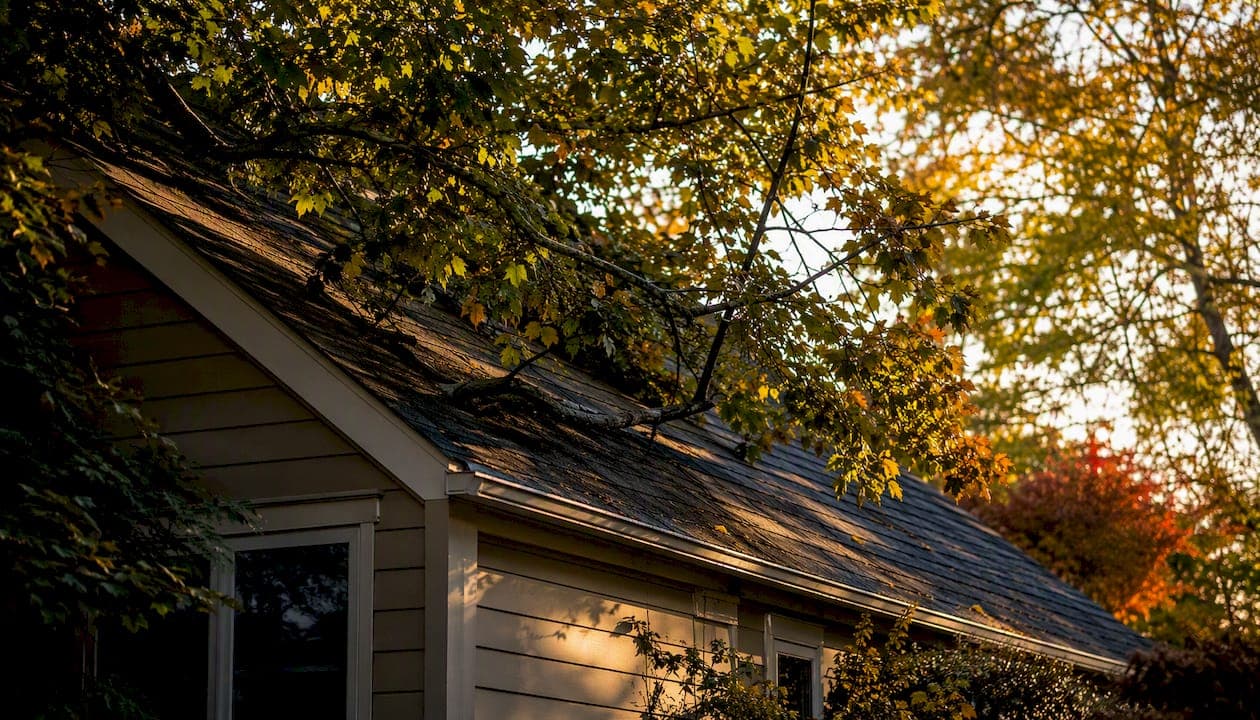
Tree branches over your roof are a risk you should address now, not later. If any branch touches or hangs within a safe distance from your shingles, the damage process has likely already started. The good news: a few clear steps protect your home, your insurance claim, and your safety.
Immediate actions if branches are touching or overhanging your roof:
- Stay clear of any area where a branch looks unstable or partially broken.
- Move vehicles out from under overhanging limbs.
- If a branch has fallen and downed a power line, call your utility company and emergency services immediately.
- Photograph the current condition of the branches and roof from the ground.
- If water is entering the home, place a tarp over the affected area only if it is safe to do so from the ground or a stable ladder.
- Contact a certified, insured arborist to assess hazardous limbs before the next storm.
Pro Tip: Don't wait for a storm to reveal the problem. FEMA and the U.S. Fire Administration recommend keeping all plants, trees, and branches at least 10 feet from your home as a baseline protection measure.
Key Takeaways
Tree branches touching or overhanging your roof cause active damage through abrasion, moisture retention, and debris accumulation, and require prompt action to protect both the structure and your insurance coverage.
| Point | Details |
|---|---|
| Minimum safe clearance | Keep branch tips at least 6 feet from the roof; 10 feet is the FEMA/USFA standard for full protection. |
| Widowmakers need pros | Broken or hanging branches are classified as extremely hazardous and must be removed by a certified arborist promptly. |
| Insurance depends on cause | Coverage applies to sudden storm damage; neglect or decay exclusions can deny your claim if maintenance was deferred. |
| Annual inspection schedule | Walk the perimeter every January or February, clean gutters twice a year, and prune every 2–5 years by species. |
| Brileytreeservice | Certified, insured crews in Shreveport, Bossier City, and North Louisiana handle hazardous removal, pruning, and emergency cleanup. |
Table of Contents
- Why branches over your roof cause real damage
- How far should tree branches be from your roof?
- When you can trim yourself and when to call a certified arborist
- What to expect when a professional arborist works over your roof
- What to do immediately if a branch falls on your roof
- Insurance and legal basics: who pays and who is responsible
- Typical costs and what drives the price
- Prevention and seasonal maintenance to protect your roof long-term
- Why hire a certified, insured arborist — Briley Tree Service's approach
- Signs of early branch damage or decay to watch for
- How tree species affect long-term roof risk
- The real trade-off homeowners face with branches over the roof
- Briley Tree Service handles hazardous branches safely in North Louisiana
- Sources
Why branches over your roof cause real damage
Tree branches touching your roof do more than look untidy. They set off a chain of failure modes that compound over time.
Abrasion and shingle wear. A branch that rests on your roof moves constantly in the wind. That friction strips the protective granule layer from asphalt shingles. GAF's guidance on tree damage is direct: wind-driven contact combined with moisture retention wears down shingle surfaces and slows roof drying, which accelerates moss and mold growth. A branch that looks harmless on a calm afternoon can still be grinding away granules every time the wind picks up.
Debris, gutters, and moisture. Leaves, twigs, and seed pods shed from overhanging limbs pile up in gutters and roof valleys. Clogged gutters cause water to back up under flashing and fascia. Wet debris sitting on shingles keeps the surface damp long after rain stops, creating the conditions that CDC mold guidance identifies as a health and structural risk.
Falling limbs. A large branch dropping from a height can carry enough force to puncture decking, crack rafters, or collapse a section of roof. Metal roofs are not immune: IKO's roof-damage guidance notes that metal roofing can dent or scratch from impact while shingles can be punctured or abraded outright.
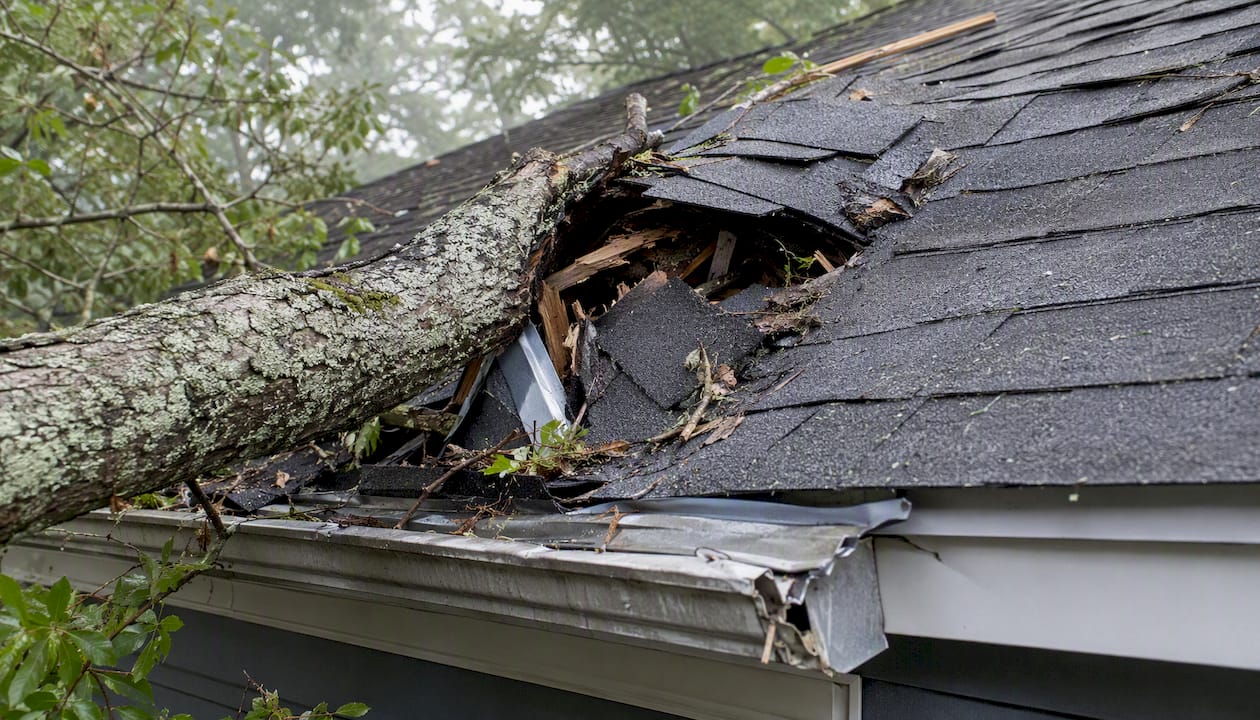
Animal access and flashing damage. Branches that touch or nearly touch the roofline give squirrels, raccoons, and rats a direct path onto the roof. Once there, they pry at flashing, chew through fascia boards, and find gaps near chimneys or vents.
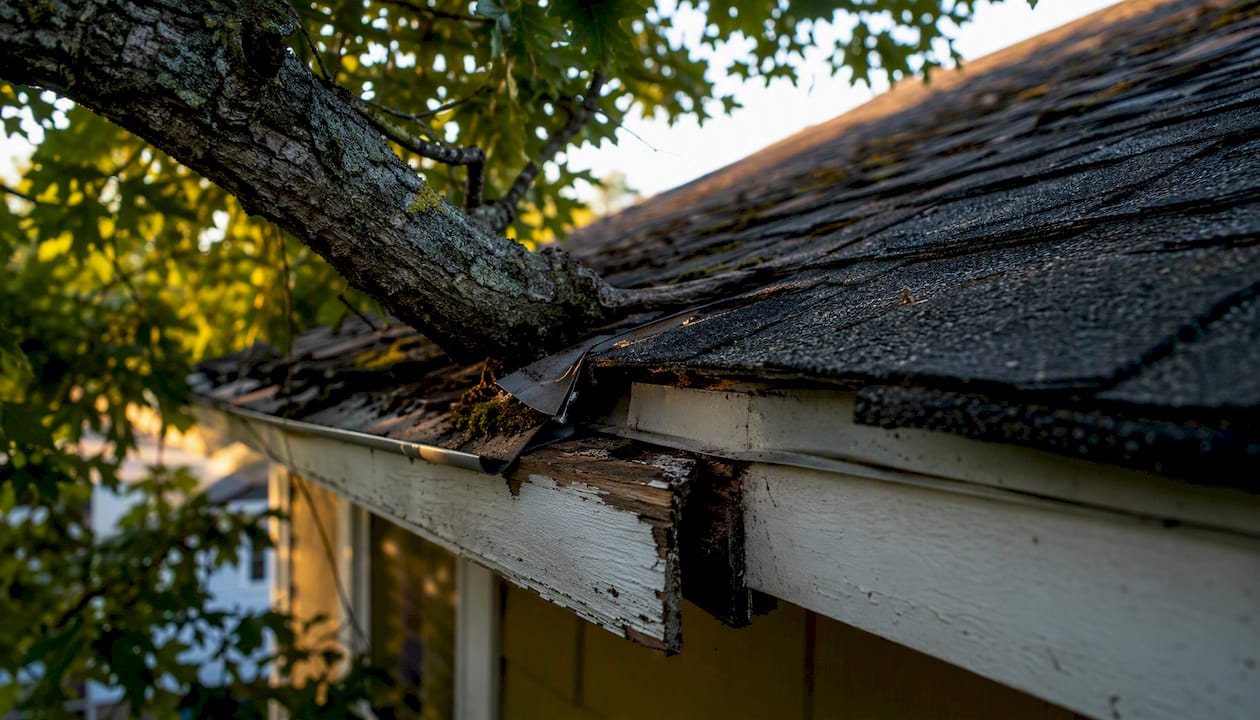
Pro Tip: A branch that clears your roof by two feet on a still day may actually touch it in a 20-mph wind. Always assess clearance with movement in mind, not just static position.
How far should tree branches be from your roof?
Two clearance figures appear consistently in authoritative guidance, and they serve different purposes.
Six feet is the practical minimum that roofing manufacturers recommend between branch tips and the roof surface. IKO's guidance frames this as the threshold below which contact, debris accumulation, and moisture retention become likely problems.
Ten feet is the standard the U.S. Fire Administration recommends for vegetation clearance from structures, with wildfire risk as the primary driver. In fire-prone regions or during dry seasons, the wider buffer is the safer choice.
The gap between the two figures matters. Six feet protects against abrasion and debris under normal conditions. Ten feet adds a margin for wind movement, fire risk, and the natural growth that will close that gap within a season or two if you don't prune on schedule.
How to measure from the ground:
- Stand at the corner of the house and sight along the roofline toward the tree.
- Hold a tape measure or use a long pole as a visual reference.
- Take a photo with a known-height object (a 6-foot person, a ladder) in frame for scale.
- Check clearance from multiple angles, including from the side of the house.
- Note which branches swing toward the roof when you push them or when wind blows.
Pro Tip: Pay extra attention to clearance near roof valleys, gutters, and chimneys. These areas trap debris and stay wet longest, so even a branch that barely clears the main roof surface can cause disproportionate damage if it sheds leaves directly into a valley.
- Branches too close to the roof: schedule pruning soon.
- Branches touching the roof: treat as an active problem requiring prompt attention.
- Branches with visible cracks, dead wood, or hanging sections: call a certified arborist immediately.
When you can trim yourself and when to call a certified arborist
Some pruning is within reach of a careful homeowner. Most overhanging-branch work is not.
Safe DIY scenarios:
- Small lateral branches (under 2 inches in diameter) that you can reach from a stable ladder without leaning.
- Branches well away from power lines and at least 10 feet from the roofline.
- Work where both feet stay on the ladder and no rigging is needed to control the cut piece.
Call a certified, insured arborist when:
- Any branch shows cracks, decay, or is already partially broken (a "hanger" or "widowmaker"). PNW ISA guidance classifies these as extremely hazardous and states they should be removed promptly.
- The branch is large enough that a fall could damage the roof, a vehicle, or a person.
- The work requires removing more than 25% of the tree's live crown.
- The tree or branch is near a power line. See how to handle trees near power lines safely before attempting anything yourself.
- The roof pitch is steep, access is limited, or rigging is needed to lower cut sections safely.
Decision checklist before you pick up a saw:
- Can you reach the branch from a stable, level surface without overreaching?
- Is the branch under 2 inches in diameter?
- Is it completely free of power lines and utility wires?
- Is the branch healthy, with no visible cracks or decay?
- Will the cut piece fall clear of the roof, gutters, and anyone below?
If you answer "no" to any of these, stop and call a professional. DIY work that damages the roof or injures someone can void your homeowners insurance coverage for that incident and expose you to liability.
What to expect when a professional arborist works over your roof
A qualified arborist does not simply climb up and start cutting. The job follows a structured sequence designed to protect the tree, the roof, and the crew.
Typical steps a professional takes:
- Site assessment: walk the property, identify hazards (hangers, proximity to utilities, root condition), and plan the cut sequence before any climbing begins.
- Hazard removal first: broken or partially attached branches come down before any cosmetic pruning, consistent with ISA's prioritization of widowmakers.
- Rigging and sectional dismantling: large limbs are rigged with ropes so each section is lowered in a controlled path, not dropped onto the roof or gutters.
- Protective measures: plywood or padding may be placed on the roof surface below the work zone; gutters are checked before and after.
- Proper cut technique: professionals use the three-cut method to prevent bark tearing and cut to the branch collar, not flush with the trunk. This reduces decay entry points and supports long-term tree health.
- Clean-up and disposal: all debris is removed from the roof, gutters, and ground.
Questions to ask before hiring:
- Are you ISA-certified? Can I see proof?
- Do you carry general liability and workers' compensation insurance? Can I see the certificates?
- Will you provide a written, itemized estimate before starting?
- Do you need a permit for this work in my municipality?
- How will you protect my roof and gutters during the job?
Pro Tip: Watch for over-pruning. A reputable arborist will tell you this upfront.
What to do immediately if a branch falls on your roof
Speed and sequence matter here. Follow these steps in order.
- Get everyone out of the affected area. Do not enter rooms directly under the impact zone until you know the structure is stable.
- Check for downed power lines. If any wire is on the ground or on the roof, call your utility company and 911 immediately. Do not approach.
- Shut off utilities if safe. If you smell gas or see sparking near the impact, turn off the main gas valve and leave the house.
- Photograph and video everything from a safe distance. Capture the branch, the roof, the surrounding area, and any visible interior damage. Timestamp matters for insurance.
- Place a tarp if water is entering. Only do this if the roof is accessible from a stable ladder and there is no structural risk. Stopping water intrusion now limits secondary damage.
- Call your utility company for any wire contact, then your insurer to open a claim, then a certified arborist for branch removal, and a licensed roofer for a full inspection.
Pro Tip: Document your pre-existing maintenance history before you call the insurer. Photos of healthy, well-trimmed trees from prior seasons help show the damage was sudden and not the result of neglect, which directly affects whether your claim is covered.
For a full breakdown of emergency scenarios, see types of emergency tree situations.
- Keep receipts for all emergency expenses: tarps, temporary repairs, hotel stays if you evacuate.
- Do not remove the branch or disturb the damage scene until the insurer has documented it or given you the go-ahead.
- Ask the adjuster specifically about debris-removal sublimits and whether a wind/named-storm deductible applies.
Insurance and legal basics: who pays and who is responsible
How homeowners insurance typically handles tree damage:
Standard homeowners policies generally cover roof damage caused by a sudden, covered peril such as wind, hail, or a falling object. Treelaws is clear that damage resulting from decay, disease, or neglect is typically excluded. If your insurer can show the tree was visibly dead or diseased before it fell, your claim may be denied or reduced.
Debris removal is usually covered up to a sublimit, often $500–$1,000 per occurrence, which rarely covers the full cost of removing a large tree from a roof. Wind and named-storm deductibles in states like Louisiana can be a separate, higher deductible than your standard policy deductible.
Neighbor tree rules:
- You generally have the right to trim branches from a neighbor's tree that cross your property line, up to the property line.
- You cannot damage the tree in the process, and some municipalities require notice or permits.
- If a neighbor's tree is visibly dead or diseased and falls on your home, liability may shift to the neighbor if you can show they were notified and failed to act. Document any written communication.
- Check your local ordinances before trimming a neighbor's tree, even on your side of the line.
Pro Tip: Send a written notice (email is fine) to a neighbor whose tree poses a risk to your property. Keep a copy. This documentation protects you legally and strengthens your insurance position if the tree later causes damage.
Typical costs and what drives the price
Trimming or removing branches over a roof is not a flat-rate job. Price varies based on several factors, and getting two or three written estimates is the only reliable way to know what your specific job will cost.
Key cost drivers:
- Branch size and height: A 4-inch limb 15 feet up costs far less to remove than a 12-inch limb at 40 feet.
- Access: Tight yards, fences, or a steep roof pitch that limits where equipment can be positioned will raise the price.
- Equipment needed: A bucket truck or crane costs more to mobilize than a climbing-only job.
- Disposal: Hauling and chipping debris adds to the total; some companies charge separately for it.
- Emergency timing: Storm-response work, especially after a major weather event when demand spikes, typically carries a premium.
- Bundled services: Combining branch trimming with gutter cleaning or a roof inspection often costs less than booking each separately.
Ask for an itemized written estimate so you can see exactly what each line covers. A reputable arborist will break out labor, equipment, disposal, and any permit fees separately.
Pro Tip: Ask whether the estimate includes debris removal from the roof and gutters, not just the ground. Some quotes cover only what falls to the ground, leaving you to clear the rest.
Prevention and seasonal maintenance to protect your roof long-term
Consistent maintenance is cheaper than emergency removal. A simple schedule keeps branches at a safe distance and catches problems before they become costly.
Seasonal timing for pruning:
- Late winter to early spring (February through March for most of the South) is the preferred window for most species. Trees are dormant or just breaking dormancy, wounds close faster, and pest and disease pressure is lower.
- Avoid heavy pruning in late summer and fall for oaks in areas where oak wilt is a concern; fresh cuts attract the beetles that spread the disease.
- For spring pruning scheduling, plan appointments before new growth flushes so the tree recovers quickly.
Annual homeowner maintenance checklist:
- Walk the perimeter of your home in January or February and photograph all branches within 15 feet of the roofline.
- Clean gutters in November after leaf drop and again in spring.
- Look for deadwood, hanging branches, or cracks in limbs visible from the ground.
- Measure or estimate clearance from branch tips to the nearest roof surface.
- Schedule a professional pruning every 2–5 years depending on species growth rate and proximity to the roof.
- After any storm, do a ground-level inspection for new hangers or shifted branches before the next rain.
- Remove deadwood from the crown annually; it does not need to wait for a full pruning cycle.
Maintaining 6–10 feet of clearance, cleaning gutters twice a year, and scheduling regular tree trimming and pruning are the three habits that prevent most overhanging-branch problems from developing.
Why hire a certified, insured arborist — Briley Tree Service's approach
Hiring the wrong person for hazardous branch work creates new risks. Here is what to verify before any crew starts on your property.
Credentials to confirm:
- ISA (International Society of Arboriculture) certification for the lead arborist.
- Current general liability insurance certificate naming your property.
- Workers' compensation coverage for every crew member on site.
- Any municipal permit required for removal or work near utilities.
Briley Tree Service operates with licensed and insured crews across Shreveport, Bossier City, Ruston, and surrounding North Louisiana communities. Services include hazardous branch removal, selective pruning, stump grinding, land clearing, forestry mulching, and 24/7 emergency storm cleanup. The team also provides permit coordination and insurance-claim documentation support, which matters when you need a paper trail for your adjuster.
What a professional visit from Briley Tree Service looks like:
- Written estimate before any work begins.
- Safety plan reviewed with the homeowner.
- Roof and gutter protection measures in place during the job.
- Full clean-up of all debris from the roof, gutters, and ground.
- Documentation available for insurance purposes.
Pro Tip: Ask your arborist to photograph the completed work from the same angles you used to document the problem. Before-and-after photos are useful both for your records and for any insurance correspondence.
Signs of early branch damage or decay to watch for
Catching a failing branch before it falls is far less expensive than dealing with the aftermath. These are the warning signs to look for during your annual ground inspection.
- Dead branches: No leaves in growing season, brittle bark, or a hollow sound when tapped.
- Cracks or splits: Visible lengthwise cracks in a branch, especially near the union with the trunk.
- Hanging or partially attached limbs: A branch that is broken but still held by bark alone. These are widowmakers and require immediate professional attention.
- Fungal growth: Mushrooms or conks at the base of a branch or on the trunk indicate internal decay.
- Bark abnormalities: Sunken, discolored, or missing bark (cankers) signal disease or structural weakness.
- Excessive lean: A branch that has shifted its angle noticeably since your last inspection.
- V-shaped crotches: Narrow branch unions with included bark are structurally weaker than wide, U-shaped unions and more likely to split under load.
Any of these signs on a branch that overhangs the roof moves that branch from "monitor" to "remove promptly."
How tree species affect long-term roof risk
Not all trees pose the same threat to a roof. Species selection and placement at the time of planting determine how much maintenance a homeowner will face for decades.
High-risk species near structures:
- Silver maple and cottonwood grow fast and produce large, brittle limbs that break readily in wind and ice storms.
- Bradford pear has a notoriously weak branch structure; the narrow, upright form splits apart under moderate wind or ice load.
- Sweetgum drops spiky seed balls that clog gutters and damage shingles when they accumulate.
- Large pines shed long needles that mat on the roof surface and hold moisture, accelerating shingle deterioration.
Lower-risk choices for planting near homes:
- Crape myrtle, dogwood, and native hollies stay small enough that their canopies rarely threaten a roofline even without frequent pruning.
- If you want a large shade tree, plant it at least 20 feet from the foundation so the canopy clears the roof even at full maturity.
The practical rule: match the mature canopy spread of the species to the available distance from the structure. A tree that will spread 40 feet at maturity needs to be planted at least 25–30 feet from the house to keep branches clear of the roof without constant heavy pruning.
The real trade-off homeowners face with branches over the roof
Most homeowners do not ignore overhanging branches because they don't care. They delay because the cost feels uncertain, the tree has sentimental value, or the problem looks manageable from the ground.
Here is the honest picture. A branch that touches your roof today is costing you money in shingle wear and potential moisture damage even if nothing dramatic happens. Delaying a $400 pruning job can turn into a $4,000 roof repair if a storm accelerates the timeline. And if your insurer finds evidence of neglect, the repair bill lands entirely on you.
The smarter sequence is: address immediate hazards first, even if that means a temporary tarp and a quick call to an arborist for the most dangerous limbs. Then schedule a full pruning assessment when your budget allows. Removing a tree entirely is rarely necessary if the problem is caught early and managed with selective pruning on a regular schedule.
Tree value is real. A mature shade tree can add measurable value to a property. But that value disappears fast if the tree damages the roof it is supposed to shade. The goal is not to remove every tree near the house. The goal is to keep them pruned, healthy, and at a safe clearance so they remain an asset rather than a liability.
Briley Tree Service handles hazardous branches safely in North Louisiana
When branches over your roof need professional attention, Brileytreeservice provides certified, insured crews across Shreveport, Bossier City, Ruston, and the surrounding North Louisiana region. The team handles hazardous branch removal, selective pruning, emergency storm cleanup, and roof-protection tarping, along with permit coordination and insurance-claim documentation support.
Every job starts with a written estimate and a safety plan. Crews protect your roof and gutters during the work and clean up all debris before leaving. If you have a branch that is touching the roof, showing signs of decay, or came down in a recent storm, request a free estimate from Brileytreeservice today. Have a few ground-level photos of the branches and a brief description of the hazard ready when you call, and the team can give you an accurate assessment quickly.
Sources
- Pictograph: Trim Branches That Overhang Your Home
- Pruning - Pacific Northwest ISA
- Signs of Tree Damage to Your Roof and Prevention Strategies — GAF
- Does homeowners insurance cover tree damage? — TreeLaws
- How to Avoid Roof Damage from Trees & Deal with a Fallen Tree — IKO