

Multi-property tree service is defined as a centralized, single-vendor program that manages tree care across an entire portfolio of properties under one contract, one contact, and one billing account. The industry term for this model is a master vendor program. Property managers overseeing residential communities, commercial sites, or mixed portfolios use it to replace fragmented vendor relationships with a single, standardized system. Brileytreeservice delivers this model across Shreveport, Bossier City, and Northwest Louisiana, covering everything from routine trimming to emergency storm cleanup under one coordinated plan.
What is multi-property tree service and how does it work?
A multi-property tree service is a centralized model where one provider manages all properties under a single contact, consolidated billing, and standardized protocols. That structure removes the guesswork of coordinating separate vendors for each site. Instead of tracking five invoices from five companies, you receive one account, one report, and one point of contact for every property in your portfolio.
The operational model follows a clear sequence. Providers schedule on-site assessments within 48 hours to develop standardized, portfolio-wide care plans that balance budget and safety requirements. Each property receives a tailored service plan based on its tree species, layout, and risk profile. From there, the provider coordinates all scheduling, tracks tree health status across sites, and delivers detailed documentation after each visit.

Technology plays a growing role in how these programs run. Digital tracking systems log maintenance history, flag trees with structural concerns, and generate reports that property managers can share with boards, insurers, or municipal inspectors. That paper trail matters when a liability question arises after a storm.
Pro Tip: Ask any provider you evaluate whether their reporting system gives you property-level breakdowns. Portfolio-wide summaries are useful, but site-specific records are what protect you in a dispute.
The numbered workflow a typical program follows looks like this:
- Initial portfolio assessment across all sites, completed within 48 hours of first contact.
- Development of a master service agreement covering scope, pricing, and priority response terms.
- Scheduling of recurring maintenance visits aligned to each property's seasonal needs.
- Post-service documentation delivered with before-and-after photos on the same day work is completed.
- Quarterly or annual reporting summarizing tree health, completed work, and flagged risks across the full portfolio.
What are the key benefits for property owners and managers?
The most direct benefit of a master vendor program is the elimination of administrative overhead. Centralizing tree services resolves fragmented invoices and unequal service quality, replacing them with repeatable, consistent care. Property managers report fewer vendor disputes, faster response times, and cleaner financial records when all tree work runs through one contract.
Safety compliance is a second major advantage. A unified program applies the same pruning standards, removal protocols, and inspection schedules to every property in the portfolio. That consistency reduces the risk of one site falling out of compliance while another is well-maintained. Master vendor contracts can also consolidate Certificates of Insurance and W-9 documentation into a single entry point, cutting the administrative burden of tracking separate insurance records for each vendor.
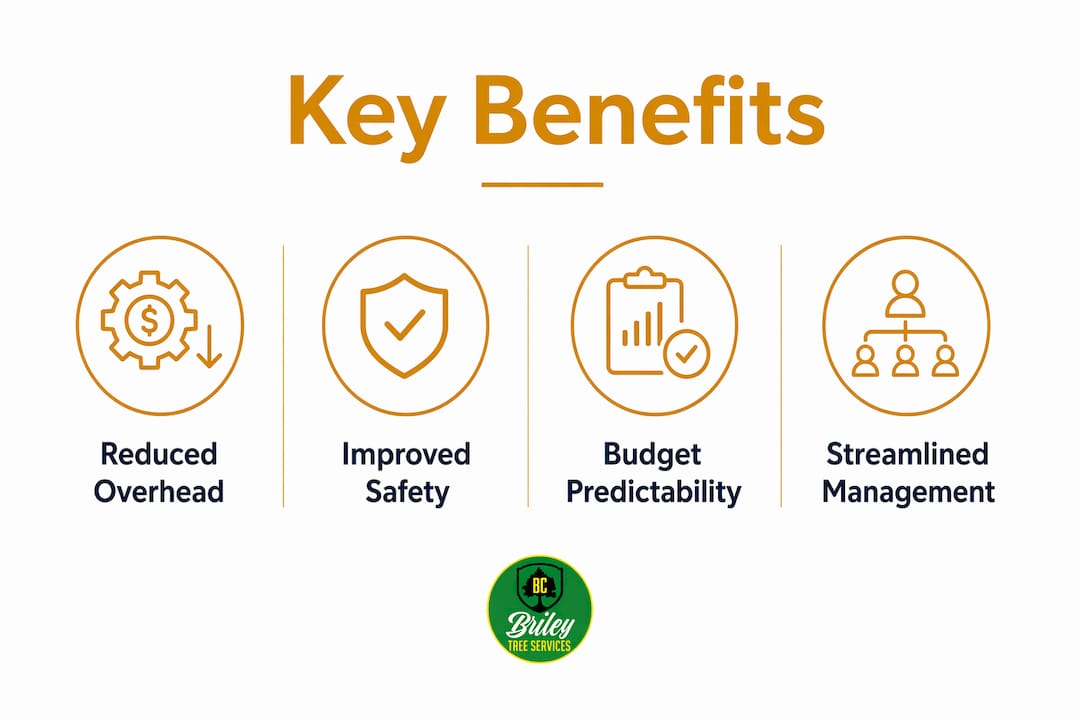
Budget predictability improves significantly under a consolidated contract. You negotiate pricing once, across all sites, rather than accepting whatever rate a local vendor quotes for a one-off job. That structure makes annual tree care costs easier to forecast and easier to defend in a budget meeting.
The financial case for proactive care is strong. Proactive tree management protects property value and reduces emergency expenses. Emergency removals and storm-damage repairs cost significantly more than scheduled maintenance. A master vendor program shifts spending from reactive to planned, which lowers total annual cost over time.
Key advantages at a glance:
- Single vendor relationship reduces time spent sourcing, vetting, and managing multiple contractors.
- Uniform service standards mean every property receives the same quality of pruning, removal, and inspection work.
- Consolidated billing simplifies accounting and reduces invoice processing time.
- Proactive risk management identifies hazardous trees before they cause damage or liability.
- Centralized compliance documentation keeps insurance records, COIs, and inspection logs in one place.
What challenges does a multi-property tree program solve?
Property portfolios face a predictable set of tree-related problems. HOA and multi-property overgrowth violations commonly arise from sidewalk encroachment, fence line overgrowth, and signage obstruction. Each of those issues carries a fine risk and a liability exposure. A structured maintenance program addresses them on a scheduled basis before a violation notice arrives.
Emergency response is another area where fragmented vendor relationships fail. Without a master contract, storm response defaults to a first-come, first-served queue. Storm response in multi-property contracts is prioritized by pre-established lists rather than call order, so your highest-traffic or highest-risk properties get addressed first. That prioritization can be the difference between a cleared parking lot and a blocked emergency exit the morning after a major storm.
A recommended inspection schedule reduces emergency interventions significantly. Three annual visits covering pre-season preparation, post-storm assessment, and an annual structural audit keep the portfolio in a known, documented condition year-round. That cadence catches structural failures before they become emergency removals.
Pro Tip: Build your storm priority list into the master service agreement before you need it. Trying to negotiate response order after a storm has already hit puts you at a disadvantage.
The table below shows how a unified program compares to a fragmented vendor approach across common management challenges:
| Challenge | Fragmented vendor approach | Unified program approach |
|---|---|---|
| Overgrowth violations | Addressed reactively after notice | Prevented through scheduled maintenance |
| Storm response | First-come, first-served queue | Pre-established priority list by site risk |
| Insurance documentation | Separate COIs per vendor | Single consolidated entry point |
| Service quality consistency | Varies by vendor and site | Standardized protocols across all properties |
| Budget forecasting | Unpredictable, quote-by-quote | Fixed contract pricing, planned annually |
How do you select and implement a multi-property tree care service?
Selecting the right provider starts with verifying credentials. Look for companies with documented experience managing commercial portfolios, not just residential one-off jobs. Ask for references from property managers who oversee a similar number of sites. Confirm that the provider carries adequate liability insurance and can supply a consolidated COI for your records.
The master service agreement is the most important document in the relationship. A well-written agreement defines the full scope of services, pricing per property type, response time guarantees, and the storm priority list. Vague scope language is the most common source of billing disputes. Get specific terms in writing before work begins.
Practical steps for a successful rollout:
- Conduct a portfolio-wide tree audit before signing any contract. Know what you have before you agree to a service plan.
- Define communication protocols in writing. Specify who receives service reports, how quickly you expect responses, and what triggers an emergency call.
- Set reporting expectations upfront. Require property-level documentation, not just portfolio summaries.
- Schedule the initial assessment within the first week. Providers who offer same-day project photos and 48-hour quote turnarounds set a standard you should expect from the start.
- Review performance quarterly. Track completed work against the agreed schedule and flag any gaps before they compound.
Learning what tree service includes across standard industry protocols helps you evaluate whether a provider's scope of work is complete or missing key services. A provider who excludes stump grinding or emergency response from their base contract may cost more in the long run than one who bundles those services upfront.
For a deeper look at how commercial tree maintenance works across different property types, reviewing best practices for property managers gives you a clear benchmark for evaluating any provider's proposal.
Key Takeaways
A multi-property tree service master vendor program reduces cost, risk, and administrative burden by replacing fragmented vendor relationships with one contract, one contact, and standardized care across every property in your portfolio.
| Point | Details |
|---|---|
| Centralized management model | One provider, one contract, and one billing account covers all properties in the portfolio. |
| Proactive care reduces cost | Scheduled inspections and maintenance lower emergency repair expenses over time. |
| Storm response requires a priority list | Pre-established site priority lists in the contract determine response order after a storm. |
| Consolidated documentation | Master vendor contracts consolidate COIs and tax forms into a single administrative entry point. |
| Provider selection starts with credentials | Verify commercial portfolio experience, insurance coverage, and references before signing any agreement. |
Why reactive tree management costs more than you think
Property managers often treat tree work as a line item to minimize rather than a risk to manage. I've seen that mindset play out the same way repeatedly. A portfolio runs fine for two or three years with no major incidents, so the budget for tree care gets cut. Then one storm drops a limb on a parked car, and the emergency removal plus liability claim costs more than three years of scheduled maintenance would have.
The shift from reactive to proactive care is not just about saving money. It changes how you relate to your properties. When you know the condition of every significant tree across your portfolio, you make better decisions about capital planning, insurance coverage, and lease renewals. That knowledge comes from consistent documentation, which only a master vendor program reliably delivers.
The misconception I hear most often is that multi-property programs are only worth it for large portfolios. That is not accurate. Even a manager overseeing four or five properties benefits from consolidated billing and a single point of contact. The administrative savings alone justify the structure. The risk reduction is the bonus.
Technology is changing what these programs can deliver. Digital tree health tracking, photo documentation, and cloud-based reporting are now standard offerings from established providers. Property managers who use those tools make faster, better-informed decisions. Those who still rely on paper work orders and verbal updates are operating with a significant blind spot.
— Tatum
Brileytreeservice for your multi-property portfolio
Brileytreeservice serves property owners and managers across Shreveport, Bossier City, and Northwest Louisiana with a straightforward, single-vendor approach to tree care.
Whether your portfolio includes residential communities, commercial sites, or a mix of both, Brileytreeservice handles tree removal, trimming, stump grinding, and emergency storm cleanup under one coordinated plan. Every job includes on-time arrival, full cleanup, and clear documentation. One call covers every property you manage. Contact Brileytreeservice for a free estimate and get a tree care plan built around your specific portfolio. Property managers across Northwest Louisiana trust Brileytreeservice to keep their sites safe, compliant, and well-maintained year-round.
FAQ
What does a multi-property tree service include?
A multi-property tree service typically includes tree trimming, removal, stump grinding, emergency storm response, and scheduled inspections across all properties in a portfolio. Services are delivered under one contract with standardized protocols and consolidated billing.
How quickly can a provider start after first contact?
Most established providers schedule on-site assessments within 48 hours of initial contact and deliver project documentation the same day work is completed.
Is a master vendor program worth it for a small portfolio?
A master vendor program delivers administrative and cost benefits even for portfolios with four or five properties. Consolidated billing, a single insurance certificate, and consistent service standards reduce overhead regardless of portfolio size.
How does storm response work under a multi-property contract?
Storm response is managed through a pre-established priority list built into the master service agreement. Critical or high-traffic properties are addressed first rather than on a first-come, first-served basis.
What should a master service agreement include?
A strong master service agreement defines the full scope of services, per-property pricing, response time guarantees, the storm priority list, and documentation requirements. Vague scope language is the most common source of billing disputes, so specific terms matter.