
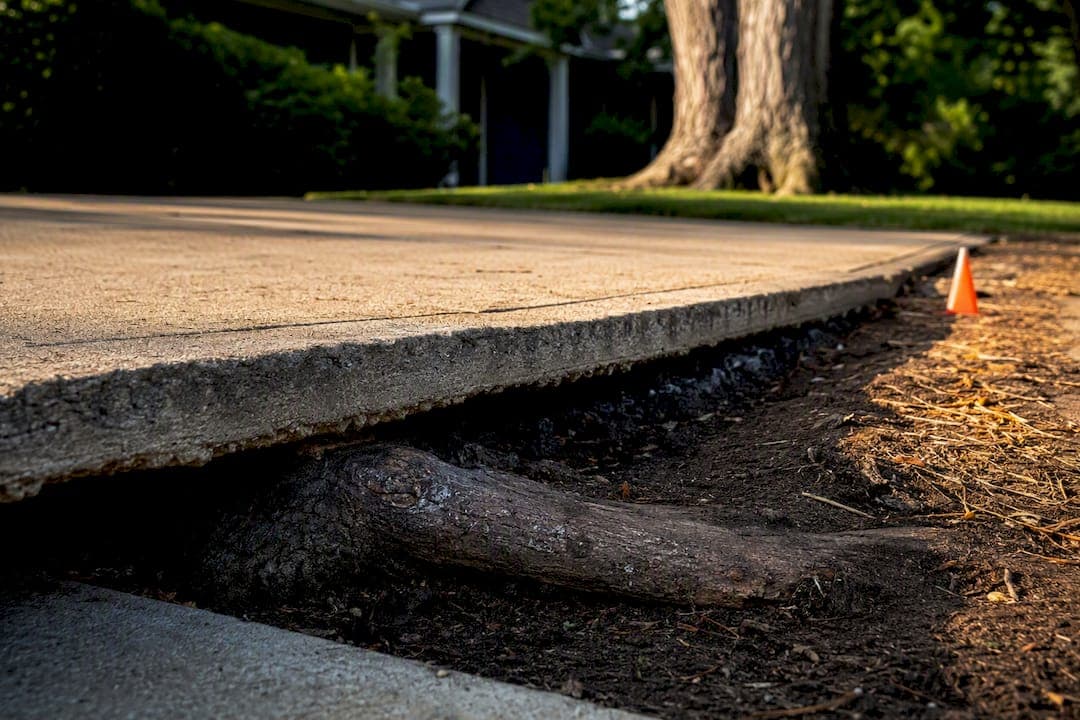
Roots are the likely cause if cracks curve, follow a line back to a tree, and keep widening season after season. The immediate move is to measure the lift and photograph the damage before doing anything more than a temporary patch. The lasting fix means addressing the offending root and rebuilding the base beneath the slab, not just resurfacing the crack on top.
TL;DR:
- Driveway cracks caused by roots usually result from vertical heave over 1.5 inches, often pointing toward a nearby tree with age and proximity as key factors.
- Temporary fixes like grinding or patching are short-lived and do not address the underlying root or base issues, typically failing within one to three years.
- Permanent repair involves excavating, pruning conservatively, installing deep vertical barriers, and rebuilding the base with proper compaction for several years of durability.
- Full slab replacement becomes more economical if over a third of the surface is affected or if previous patches have repeatedly failed.
- Preventative site design, including installing barriers and choosing appropriate trees, is the most effective way to avoid root-related cracking altogether.
Table of Contents
- How Roots Cracking a Driveway Actually Happens Underground
- Is It Roots or Something Else? How to Tell
- Fixing a Cracked Driveway: From Quick Patch to Full Rebuild
- Building a Driveway That Roots Can't Beat
- When to Call In a Professional
- Where This Guidance Comes From
- Why the "Just Cut the Root" Advice Falls Short
- Sources
How Roots Cracking a Driveway Actually Happens Underground
A driveway doesn't crack because a root punches through concrete like a fist through drywall. It cracks because a root thickens year after year, pressing upward against the underside of the slab until the concrete bends past its breaking point. That's a bending failure, not a puncture, and the distinction matters for how you diagnose and fix it. A slab that's been pushed up from below cracks in a curve or a straight heave line, not the random spider-web pattern you get from settling soil or freeze-thaw cycles.
Roots don't grow upward on purpose. They grow toward moisture, oxygen, and loose soil, and a driveway with a thin sub-base or poor drainage practically invites them in. Compacted gravel under a slab holds less water and less air than the soil beside it, but a shallow or poorly built base leaves gaps and moisture pockets that draw roots exactly where you don't want them. In a lot of cases, a driveway that "has a root problem" actually has a base problem that made the root problem possible.
Some conditions raise your odds of trouble more than others:
- Tree age: Trees that have reached maturity have had time to grow structural roots wide enough to lift pavement.
- Proximity: Trees planted within about 2 to 3 meters of the driveway edge are far more likely to cause conflict than trees set farther back, according to Forest Service research on tree and infrastructure conflicts.
- Species: Surface-rooting species like silver maple, willow, and sweetgum spread lateral roots close to the surface instead of digging deep.
- Drainage: Low spots or poor grading near the slab edge create the exact moist, oxygen-rich zone roots are drawn to.
- Base thickness: A driveway poured over a few inches of loose fill has less resistance to root pressure than one built on a properly compacted aggregate base.
Quick fact: Age and distance aren't guesswork. Research on tree and pavement conflicts found problems cluster around trees older than 15 to 20 years planted within roughly 2 to 3 meters of pavement, especially where the base or drainage is already weak.
If your driveway checks two or three of those boxes, roots are the most probable explanation for what you're looking at. If it checks none of them, you're more likely dealing with settling, poor original compaction, or a drainage problem that has nothing to do with the tree in your yard.
Is It Roots or Something Else? How to Tell
Before you call anyone, spend fifteen minutes actually looking at the crack. Root damage has a signature, and once you know what to look for, it's hard to miss.
Signs that point to a root, not settling or age:
- The crack curves or arcs rather than running in a straight, jagged line.
- One side of the crack sits higher than the other, a condition called heave.
- Tracing the crack or heave line back tends to point roughly toward the base of a nearby tree.
- The gap has visibly widened compared to last year or the year before.
- A patch or filler you applied previously has already failed or re-cracked in the same spot.
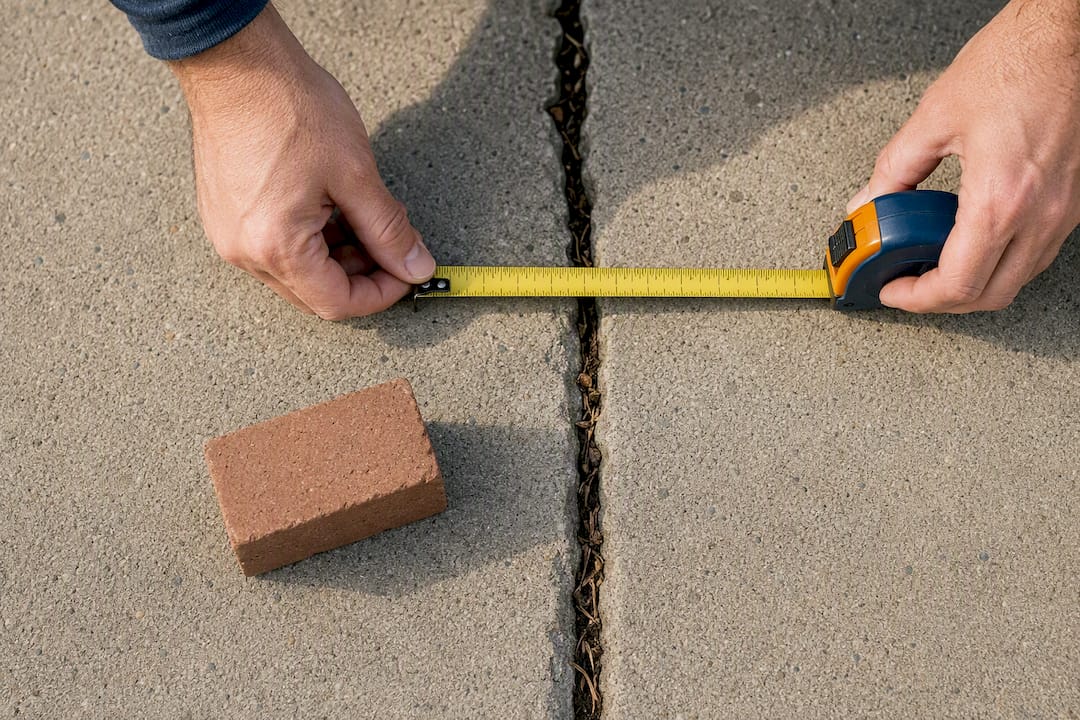
Once you've confirmed the pattern, take real measurements instead of relying on a glance. A vertical lift of more than 1 to 1.5 inches usually signals a root thick enough that surface patching alone won't hold. Tap around the edges of the crack with a screwdriver or thin rod. Hollow sounds or a probe that sinks in easily suggest a void underneath, which means the slab has already separated from its base. If you patched the same area before and it failed again within a season or two, that's your clearest signal that the root, not the concrete, is the actual problem.
Pro Tip: Take photos in the same spot every few months, standing at the same angle with something for scale, like a tape measure or a brick. Root-driven heave is slow but steady, and a photo series turns "it feels worse" into hard evidence you can hand to a contractor or arborist.
Once you have your measurements and photos, you're ready to decide who to call. A large lift near the foundation, a crack that's widened noticeably in one season, or any concern about the tree's own stability all point toward bringing in a certified arborist first, since removing the wrong root can hurt tree health or safety before it ever helps your driveway. If the tree itself looks healthy and stable, a concrete contractor familiar with root damage can usually handle the repair. Reserve a structural engineer for cases where the lift is affecting an attached structure, like a garage slab or a walkway tied into the house foundation. For a deeper look at how root pressure interacts with structural elements, see this guide on whether tree roots cause foundation damage.
Before contacting anyone, gather your dated photos, your lift measurements, notes on when the cracking started, and any record of prior repairs. That packet saves a site visit's worth of guesswork and gets you a more accurate quote.
Fixing a Cracked Driveway: From Quick Patch to Full Rebuild
Not every cracked driveway needs the same level of intervention. The right fix depends on how much lift you're dealing with, how big the offending root is, and whether you've already tried a patch that failed.
Temporary measures buy time, not permanence
Grinding down a lip where one slab edge sits higher than the other, driving in leveling wedges, or filling hairline cracks with a flexible concrete filler can smooth things out for a season or two. These fixes are worth doing when the lift is minor, under half an inch, and mostly cosmetic. They're not a substitute for treating the root, though. Roots don't stop growing because you ground down the concrete above them, and most temporary fixes fail again within one to three years if the root underneath keeps thickening.
Permanent localized repair follows a specific sequence
The repair that actually holds combines root management with a rebuilt base, and contractors who specialize in this kind of work follow roughly the same order every time, a method sometimes called the barrier-first approach to fixing driveways lifted by roots:
- Excavate the damaged section of driveway down to and around the offending root.
- Expose the root fully so its diameter and direction are clear before anyone touches it.
- Prune or shave conservatively. Iowa State University Extension recommends avoiding cuts on roots larger than a moderate diameter, and shaving the top of a large root is usually safer for tree health than severing it outright.
- Install a vertical root barrier made of high-density polyethylene (HDPE) along the excavated edge, of a depth consistent with common arborist recommendations, to redirect future root growth downward and away from the slab.
- Recompact the aggregate sub-base in lifts of about 2 inches at a time, rather than dumping and tamping the whole depth at once, which is how you get a base that actually holds long term.
- Repour the patch once the base has been properly compacted and cured.
Skipping the barrier or the base rebuild is the single most common reason a "fixed" driveway cracks again in the same spot within a year or two.
Full replacement makes sense past a certain point
If more than a third of the driveway surface is affected, or if you're on your second or third failed patch in the same area, a full slab replacement is usually the more economical long-term choice. It also gives you the chance to build stronger edge zones near trees from the start, with a deeper base and a barrier already in place, rather than reacting to the same root again in five years.
| Repair type | Best for | Typical lifespan | Root barrier included? |
|---|---|---|---|
| Surface patch or filler | Hairline cracks, lift under 1 inch | 1 to 3 years | No |
| Grinding or leveling wedge | Minor trip hazards, cosmetic lips | 1 to 2 years | No |
| Localized excavate and rebuild | Lift over 1 to 1.5 in, one identifiable root | several years with proper barrier | Yes |
| Full slab replacement | Multiple failed patches, large affected area | 20+ years | Yes, along all tree-adjacent edges |
Pro Tip: Ask any contractor bidding on the job to specify the barrier depth in writing. Trials comparing root-management methods found that barriers installed too shallow, or buried below the surrounding grade, let roots grow right over the top within a few years. A barrier only works if it's deep enough and its top edge sits at or above grade.
Cutting roots carelessly creates its own risk, separate from the driveway problem. Removing too much of a tree's root system at once can destabilize it or trigger dieback, so a general guideline among arborists is to avoid removing more than about 25% of a tree's total root zone in a single project. Any root thicker than 2 inches deserves a call to a certified arborist before a shovel touches it, both to protect the tree and to avoid a repair that solves this year's crack while creating next year's falling-tree problem.
Building a Driveway That Roots Can't Beat
The cheapest way to deal with root damage is to never have the conversation in the first place, and that starts at the design stage, whether you're pouring a new driveway or replacing an old one.
Design choices that head off root conflicts before they start:
- Build the sub-base with a root-excluding layer, either washed gravel or a foam board barrier, at least a few inches thick, per Iowa State University Extension's sidewalk and driveway guidance.
- Install a vertical HDPE root barrier along the driveway's tree-facing edge, set to a depth commonly recommended by arborists, with the top edge at or slightly above grade.
- Choose smaller-maturing tree species, or keep large-maturing trees planted at a distance roughly equal to their expected mature canopy width away from the pavement.
- Avoid known aggressive surface rooters, silver maple, willow, and sweetgum among them, anywhere near a driveway, walkway, or foundation.
- Where a large tree is already established and non-negotiable, consider structural soil as a base material, which is engineered to support pavement loads while leaving room for roots, though installations typically run as deep as 24 inches.
- Look at flexible paving, interlocking pavers, or rubber pavers instead of a monolithic concrete slab, since jointed surfaces flex and settle with minor root movement instead of cracking outright.
None of this is complicated engineering. It's the same base-and-barrier logic used in repairs, just applied before the crack ever happens. Field trials on sidewalk root damage back this up directly: driveways and walkways built with a barrier and a proper base from day one showed far less root contact and lifting than those without either. If you're planning any construction near mature trees, a guide on protecting root systems during construction is worth reading before the excavator shows up.
Preventing the conflict during installation costs a fraction of what a retrofit costs after roots have already lifted a slab. If you're already deciding where to plant a new tree, treating that decision as a driveway decision too will save you a repair bill a decade from now.
When to Call In a Professional
Some driveway root problems are a weekend project. Others aren't, and knowing which is which up front saves you from a repair that fails again in eighteen months.
Bring in a professional when you're looking at any of the following:
- A lift greater than 1.5 inches, especially near a garage slab or a walkway tied into your foundation.
- A root you suspect is a major structural anchor for the tree, where removing or cutting it wrong could destabilize the tree itself.
- A second or third repair failure in the same location after a prior patch job.
- Any driveway section affecting more than roughly a third of the total surface.
A qualified crew handling this kind of job typically maps the root system first, prunes conservatively within the limits arborists recommend, installs the vertical barrier, and coordinates the base rebuild and repour with a concrete contractor, all while managing compaction to spec and cleaning the site when the work is done. A qualified crew typically handles the tree side of that equation for homeowners in the local area, including root pruning, tree removal, stump grinding, and the kind of careful assessment that tells you whether a root is safe to manage or needs a bigger conversation first.
When you're collecting estimates, ask for proof of insurance, evidence of arborist credentials, and before-and-after photos from similar jobs. A crew confident in its own work will hand those over without hesitation. If a tree removal or major root work turns out to be part of your fix, preparing your yard for the job ahead of time keeps the project moving instead of stalling on access or cleanup logistics.
Where This Guidance Comes From
The recommendations here draw on a mix of research and field practice. The Forest Service's tree and infrastructure conflict study established the age and proximity thresholds that flag high-risk trees. Iowa State University Extension's sidewalk repair guidance sets the pruning limits and base thickness recommendations used throughout this piece. The Arboriculture & Urban Forestry trial comparing root-damage mitigation methods backs the barrier depth and installation-quality guidance. Contractor field practice, summarized in RapidRepair's barrier-first repair method, informed the repair sequencing.
Why the "Just Cut the Root" Advice Falls Short
Most driveway advice stops at "cut the root and patch the crack," and that's exactly why so many of those patches fail again within a year. Cutting the root treats the symptom. The recurring lift is the tree telling you the base underneath was never built to resist it in the first place.
The research backs a less satisfying but more honest answer: find the specific root causing the problem, manage it conservatively, install a barrier deep enough to actually redirect future growth, and rebuild the sub-base with real compaction. Skip any one of those four steps and you're buying time, not solving the problem.
What I'd tell any homeowner standing over a cracked driveway is this: don't let a contractor talk you into a same-day patch as if it's a permanent fix, and don't let a tree crew remove a root without checking its diameter and role in the tree's stability first. Ask both parties to work from the same plan. That coordination, more than any specific product or material, is what separates a driveway that holds for a decade from one that's cracked again by next spring.
— Tatum
Sources
- Research: Treesearch study on tree–infrastructure conflicts
- Sidewalk repair near trees — Iowa State extension
- Comparison of methods to reduce sidewalk damage from tree roots — Arboriculture & Urban Forestry (ISA)
- Rapidrepair