
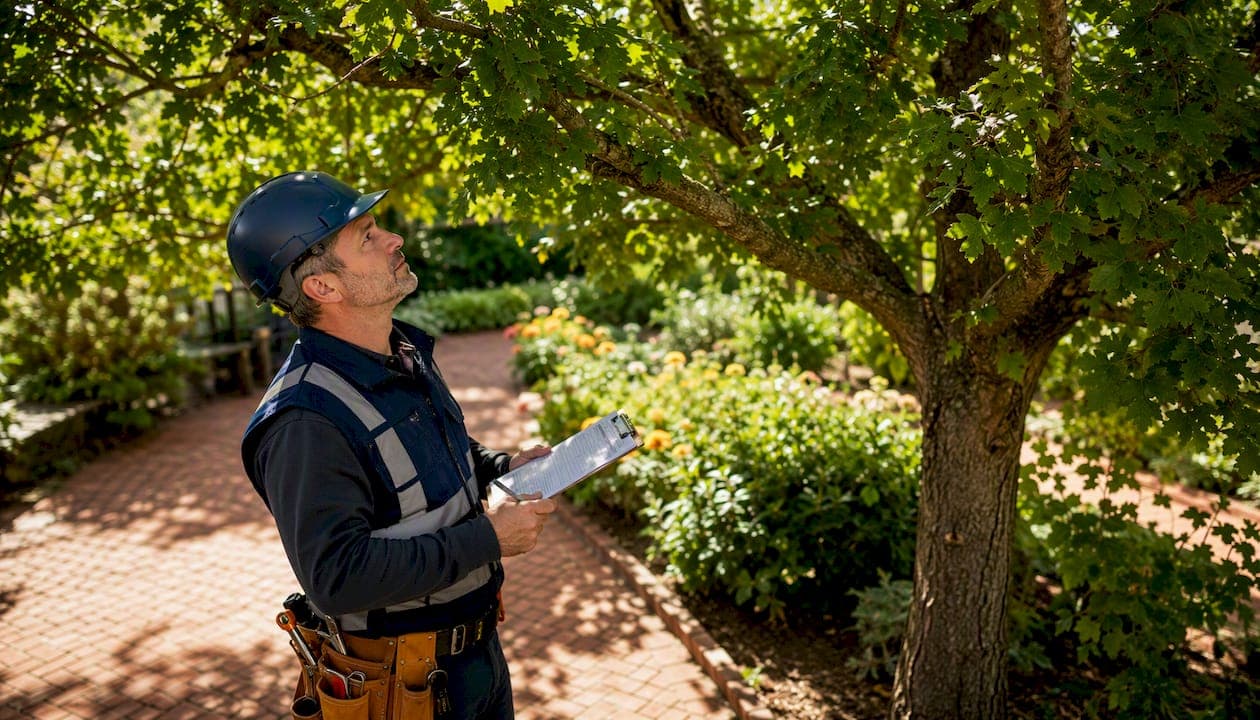
Scheduled tree maintenance is the proactive, recurring program of professional inspections and care interventions that preserves tree health, reduces safety risk, and protects property value. It is not a one-time trim or a reactive call after a branch falls. It is a planned cycle, governed by industry standards like ANSI A300 and ISA Best Management Practices, carried out by credentialed arborists on a defined timetable. Three things drive the need for it:
- Safety. Regular inspections catch structural defects, deadwood, and root problems before they become hazards to people and structures.
- Reliability. Utilities and municipalities depend on scheduled programs to maintain clearances and prevent service disruptions.
- Asset protection. Well-maintained trees can increase property values by up to 15%, while neglected trees raise liability exposure and repair costs.
Table of Contents
- What does scheduled tree maintenance actually include?
- Who runs scheduled programs and who is responsible?
- How often should you maintain trees?
- How do you put a scheduled maintenance program into action?
- What safety standards and regulations apply?
- How do you design a scheduled maintenance plan?
- What does the research say about the benefits of tree maintenance?
- Key Takeaways
- Why most tree programs fail before they start
- Brileytreeservice supports your tree maintenance program
- Useful sources and where to check local rules
What does scheduled tree maintenance actually include?
A complete program covers more than pruning. Each activity targets a specific risk or health need.
Inspections are the foundation. A certified arborist evaluates crown structure, root zone condition, and overall health, then documents findings in a written report. Pruning and trimming address crown thinning, reduction, and clearance from structures or utility lines. What is tree trimming in this context? It is the selective removal of branches to improve structure, light penetration, and clearance, not a wholesale shearing of the canopy.
Watering and establishment care matter most for young trees. Newly planted trees need roughly 2 gallons of water per inch of trunk diameter during dry periods, with focused attention for the first 1–3 years. Mulching protects roots and retains moisture. Apply 2–4 inches of shredded bark or wood chips, keeping mulch away from the trunk base.

Fertilization should follow a soil test, not a calendar. Applying fertilizer without testing is a common waste of money and can actually stress trees. Pest and disease monitoring begins as leaves emerge each season and requires proper diagnosis before any treatment is applied. Cabling and bracing support structurally compromised limbs or co-dominant stems. Removals are included when a tree is dead, dying, or poses an unacceptable hazard.
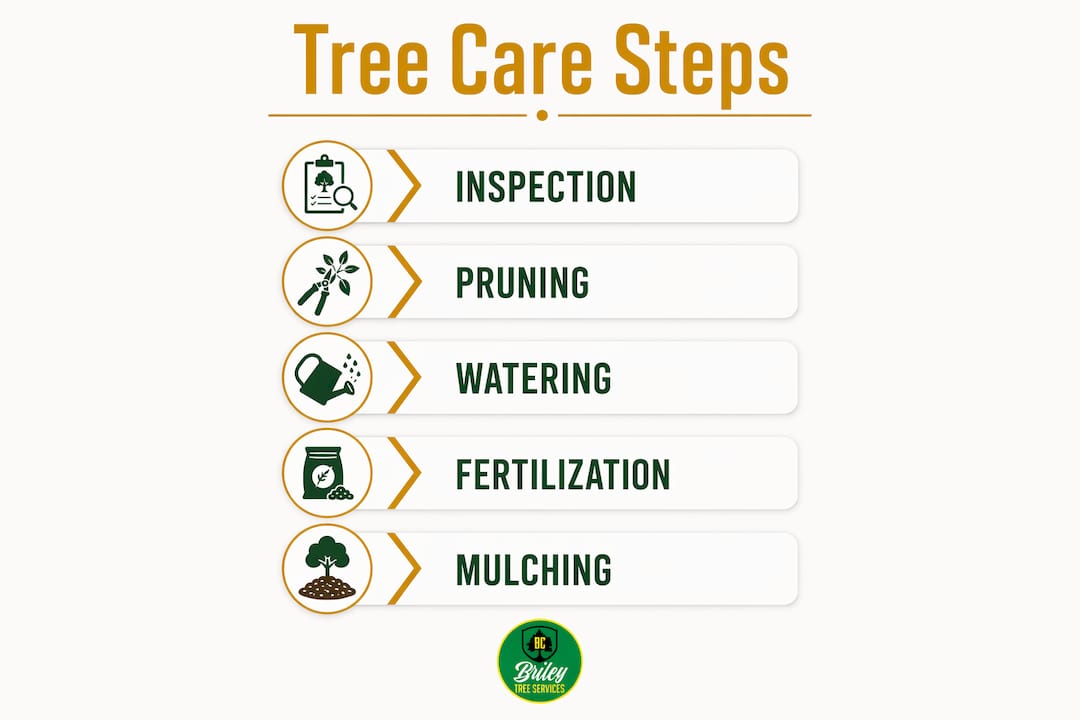
Pro Tip: Avoid "mulch volcanoes," the practice of piling mulch against the trunk. It traps moisture against the bark, invites rot and pests, and is one of the most common errors seen on maintained properties. Keep mulch 2–4 inches deep and several inches clear of the trunk flare.
Who runs scheduled programs and who is responsible?
Responsibility depends on tree location and ownership.
- Municipal public-works and urban forestry departments manage trees in parks, along streets, and in public right-of-ways. The City of South Gate, for example, contracts tree maintenance on a 4-year cycle, trimming all city trees once every four years by neighborhood rotation, with emergency work handled separately on request.
- Utility companies run their own line-clearance programs, typically on annual or biannual cycles, focused on keeping branches clear of power and communication lines.
- Private property owners are responsible for trees on their own land. When branches overhang a neighbor's property or a public right-of-way, local ordinances may assign shared or sole responsibility.
- Certified arborists and licensed contractors perform the actual work across all three contexts. Look for ISA certification as the baseline credential, along with proof of liability insurance and worker's compensation coverage.
Not sure who to call? Start with your city's public works department for street trees, your utility's customer service line for line-clearance questions, and a local ISA-certified arborist for trees on private property.
How often should you maintain trees?
Frequency is not one-size-fits-all. Tree age, species, location, and condition all affect the right interval.
- Young trees (years 1–5). Structural pruning annually or biennially during the first 5–10 years builds sound architecture and reduces costly corrective work later. Watering and mulching are necessary throughout this window.
- Maturing trees (years 5–10). Pruning cycles extend to every 2–3 years as structure stabilizes. Pest monitoring and soil checks remain important.
- Mature trees (10 years and beyond). Selective pruning every 1–5 years depending on species, health, and site conditions. Annual visual inspections are still recommended, especially for urban trees facing compaction and limited rooting space.
- Municipal programs. Cities typically operate on 3–4 year full-cycle schedules, with priority or hazard trees addressed more frequently as needed.
- Utility line clearance. Annual or biannual cycles are standard, driven by reliability requirements rather than tree health alone.
Certain events trigger an unscheduled review regardless of where a tree falls in its cycle: major storms, rapid canopy decline, nearby construction that disturbs root zones, or any visible structural failure. A seasonal tree care schedule helps property owners track these triggers year-round.
How do you put a scheduled maintenance program into action?
The process follows a consistent sequence whether you are managing one residential tree or a municipal forest.
- Site inspection. A certified arborist walks the property, evaluates each tree's health and structure, and identifies hazards.
- Risk assessment. The arborist scores trees by likelihood of failure and potential consequences, prioritizing high-risk specimens.
- Written plan and proposal. The inspection produces a customized care plan with line-item tasks, crew qualifications, and a documented scope of work.
- Permitting. Street trees, heritage specimens, and work in public right-of-ways often require an encroachment or tree-work permit from the local municipality before work begins.
- Scheduling and execution. Work is timed to seasonal needs, species requirements, and site access. Some species should only be pruned during specific windows to avoid disease transmission.
- Post-work documentation. Inspection reports and work records form the program's paper trail, supporting liability defense and future planning.
| Phase | Typical cost drivers |
|---|---|
| Inspection | Tree count, site access, report complexity |
| Pruning/trimming | Tree size, canopy height, crew size, equipment needed |
| Removal | Diameter, proximity to structures, debris hauling |
| Cabling/bracing | Hardware cost, height, number of attachment points |
| Permitting | Municipality fees, heritage-tree classification |
When reviewing bids, request line-item task breakdowns, crew credentials, proof of insurance, traffic control plans for street work, site cleanup terms, and any warranty or follow-up inspection commitment.
What safety standards and regulations apply?
Two references govern professional tree work in the United States.
- ANSI A300 is the technical standard for tree care operations, covering pruning, cabling, fertilization, and risk assessment. Portland Parks & Recreation's Urban Forestry program, for instance, explicitly requires that park tree inspections follow ANSI A300 standards and ISA Best Management Practices.
- ISA Best Management Practices translate ANSI A300 into field guidance. A key rule: avoid removing more than 20–30% of a tree's canopy in a single year. Exceeding that threshold causes physiological stress and accelerates decline.
- Utility clearance rules are set by each utility and may be reinforced by state public utility commission requirements. Right-of-way responsibilities vary by jurisdiction.
- Permits are commonly required for street tree work, removal of heritage or specimen trees, and any work within a public right-of-way. Check with your local public works department before starting.
- Emergency situations. A visibly cracked trunk, a hanging limb over a structure, or post-storm crown failure warrants an immediate call to a licensed emergency tree crew, not a wait for the next scheduled cycle. Document the condition with photos before and after work for liability purposes.
How do you design a scheduled maintenance plan?
A workable program starts with a clear inventory and a realistic budget.
- Inventory your trees. Record species, size, location, and current condition for every tree on the property or right-of-way.
- Rank by risk priority. Address high-risk trees first, then schedule lower-priority trees into the regular cycle.
- Set a budget estimate. Factor in inspection fees, pruning cycles, and a contingency for unscheduled removals or storm response.
- Build a service frequency matrix. Assign each tree or zone a maintenance interval based on age, species, and risk level.
- Establish record-keeping. Maintain inspection reports, work orders, and before/after photos for every service visit.
Contract terms worth including: defined scope and frequency, payment schedule, liability and insurance requirements, a change-order process, and a reporting or inspection frequency commitment from the contractor. When interviewing arborists, ask for sample inspection reports, references from comparable properties, a list of equipment they use, and their safety protocol for work near structures or traffic.
What does the research say about the benefits of tree maintenance?
The financial and safety case for scheduled programs is well-documented. Well-maintained trees can increase property values by up to 15%, while deferred maintenance raises both liability exposure and emergency repair costs. Proactive care is consistently less expensive than reactive work: waiting until a visible failure appears reduces treatment options and drives up costs significantly.
An annual professional inspection with a documented plan converts unpredictable emergency spending into a budgetable line item. For utilities, scheduled clearance programs reduce outage frequency and duration. For municipalities, regular cycles prevent the accumulation of hazard trees that require expensive emergency removals. The benefits of preventive trimming compound over time: trees that receive structural training early need far less corrective work at maturity.
Key Takeaways
Scheduled tree maintenance is a proactive, standards-driven program that reduces safety risk, protects property value, and costs less over time than reactive emergency work.
| Point | Details |
|---|---|
| Core definition | Scheduled maintenance is a recurring cycle of inspections and care, not a one-time service. |
| Frequency by age | Young trees need annual or biennial pruning; mature trees typically need attention every 1–5 years. |
| Standards to reference | ANSI A300 and ISA Best Management Practices are the governing technical standards in the U.S. |
| Program ownership | Property owners manage private trees; municipalities and utilities handle public and right-of-way trees. |
| Brileytreeservice | Brileytreeservice provides inspections, pruning, removals, and documented proposals for property owners and commercial clients in Northwest Louisiana. |
Why most tree programs fail before they start
Most property owners and municipal planners understand the value of scheduled tree care in theory. The gap is almost always in execution, specifically in the first step. Programs that skip a formal inventory and risk-priority ranking tend to spend money on low-risk trees while genuinely hazardous specimens go unaddressed for years. The result is not just wasted budget. It is a liability waiting to happen.
The other common failure is treating the first inspection as optional. A written inspection report from a certified arborist is not a formality. It is the document that justifies every subsequent work order, supports insurance claims after storm damage, and protects property owners from liability if a tree fails. Contractors who cannot or will not produce a documented proposal are a red flag, regardless of price.
For property owners and managers in the Shreveport and Northwest Louisiana area, the local climate adds urgency. Gulf-influenced storms, high humidity, and species like water oaks and sweetgums that are prone to internal decay mean that annual inspections are not conservative practice. They are the minimum. Any reputable contractor in this region should provide a written scope of work, proof of insurance, and documentation after every service visit.
Brileytreeservice supports your tree maintenance program
Brileytreeservice delivers the full range of tree maintenance services that a scheduled program requires: professional inspections, pruning and trimming, tree removal, stump grinding, land clearing, and 24/7 emergency storm response. The company serves residential and commercial properties throughout Shreveport, Bossier City, Ruston, and surrounding North Louisiana communities.
Every job comes with a documented proposal, licensed and insured crews, and permit support when local regulations require it. For property managers and commercial clients, Brileytreeservice provides the kind of written records and consistent service that a defensible maintenance program depends on. Contact Brileytreeservice for a free estimate and get a scheduled inspection on the calendar before the next storm season.
Useful sources and where to check local rules
- ANSI A300 Tree Care Standards (via ISA): The technical standard governing pruning, cabling, fertilization, and risk assessment for professional tree work in the U.S.
- International Society of Arboriculture (ISA): The primary credentialing body for certified arborists; use the ISA's online directory to verify a contractor's certification status.
- University of Illinois Extension — Tree Maintenance Schedule: Practical lifetime maintenance timetable covering watering, mulching, pruning, and pest monitoring by tree age.
- Arbor Day Foundation: Guidance on tree selection, planting, and long-term care; useful for property owners establishing new trees.
- NYSDEC — Urban Tree Care: Covers inspection frequency, pruning standards, and the unique stresses facing urban trees.
- Your local public works department: The first call for questions about street tree trimming cycles, right-of-way responsibilities, and permit requirements in your municipality.
- Your utility provider's vegetation management line: For questions about line-clearance schedules and who is responsible for trees near power or communication infrastructure.