
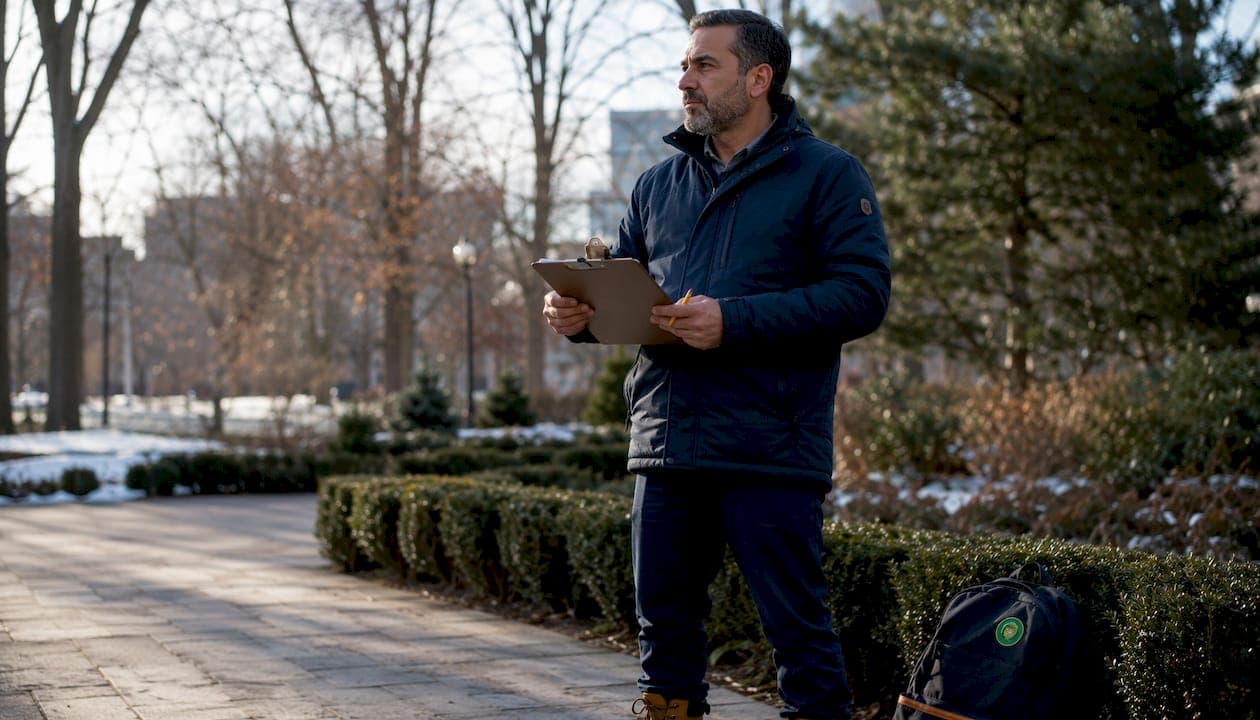
A sound seasonal tree maintenance schedule for commercial properties runs on four windows: winter for structural pruning and risk assessment, spring for post-dormancy inspection and light corrective work, summer for irrigation and stress monitoring, and fall for hazard reduction and winter preparation. The single highest-priority task in any year is a documented risk assessment by an ISA-certified arborist, completed before winter pruning begins.
Quick-action priorities for property managers:
- Schedule your annual documented risk assessment in late fall or early winter, before major structural work begins.
- Prune structurally during dormancy (December through February for most U.S. regions); avoid heavy cuts at bud break.
- Inspect irrigation systems and new plantings every spring; deep-water new trees two to three times per week in their first growing season.
- Monitor for drought stress and pest activity throughout summer; defer non-urgent pruning until cooler months.
- Complete deadwood removal and final irrigation soaks before the first hard freeze each fall.
- Budget a significant emergency contingency on top of your routine maintenance line item.
One-line seasonal calendar:
| Season | Top Priority |
|---|---|
| Winter | Structural pruning and documented risk assessment |
| Spring | Post-dormancy inspection and light corrective shaping |
| Summer | Irrigation management and pest/stress monitoring |
| Fall | Deadwood removal and winter preparation |
Table of Contents
- Why does seasonal planning reduce costs and liability for commercial sites?
- What should you do in winter for commercial tree maintenance?
- What spring inspections should commercial properties prioritize?
- How do you manage trees on commercial properties during summer?
- What fall tasks protect commercial trees through winter?
- How do you prioritize tree work across a large commercial portfolio?
- How do you build a seasonal tree maintenance budget and calendar?
- How do you align seasonal services with written contracts and vendor agreements?
- What should a qualified commercial tree service provider actually deliver?
- How does Brileytreeservice structure year-round commercial tree care?
- Key Takeaways
- The tradeoffs commercial property managers rarely talk about
- Brileytreeservice commercial tree care: request an estimate
- Authoritative sources for commercial tree care planning
Why does seasonal planning reduce costs and liability for commercial sites?
Reactive tree work is expensive and unpredictable. Property managers who shift to a planned maintenance program convert emergency spikes into stable, forecastable recurring budget lines. That shift also reduces liability exposure: trees on commercial properties are high-liability assets, and documented, scheduled care creates the paper trail that protects owners in litigation.
Routine maintenance averages roughly $300 to $750 per tree per year, while emergency call-outs cost substantially more and require an added contingency. For a retail campus with multiple trees, routine annual spend can be estimated by multiplying an average per-tree cost, plus a significant emergency contingency of 20–30%. Planned removals, budgeted every 7–10 years at $2,000–$5,000 each, avoid the sticker shock of emergency crane work.
Seasonal biology drives the timing logic. Trees are most tolerant of structural cuts during dormancy, when sap flow is low and fungal spores are less active. Pest pressure peaks in summer. Root systems are most receptive to establishment watering in spring. Working against those biological windows costs more and produces worse outcomes.
Why a proactive program outperforms reactive spending:
- Predictable annual costs replace unpredictable emergency invoices.
- Documented inspections reduce litigation risk when a limb failure occurs.
- Scheduled vendor relationships secure preferred pricing and priority emergency response.
- Early detection of pest or disease problems prevents costly removals.
- Phased multi-year removal planning avoids large single-year budget spikes.
What should you do in winter for commercial tree maintenance?
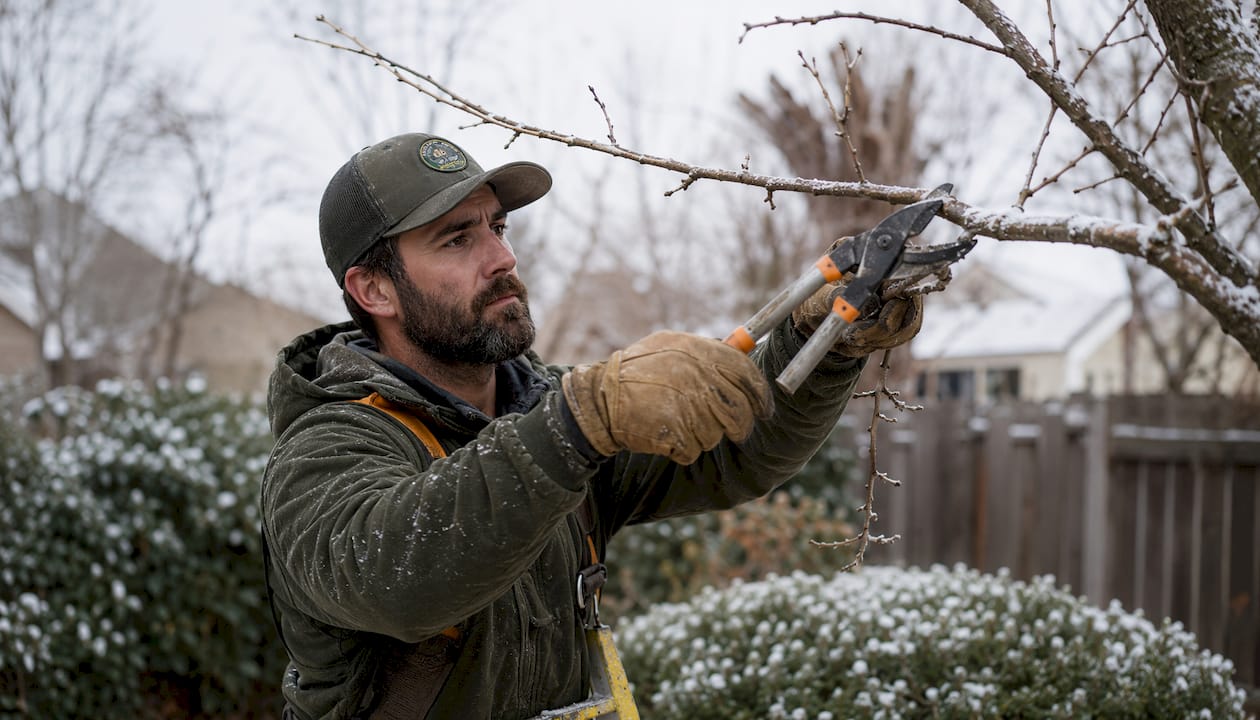
Winter is the primary window for major structural work on most species. Dormancy means lower sap flow, reduced disease pressure, and fully visible branch architecture, making it easier for an arborist to identify structural defects, co-dominant stems, and crossing limbs that need correction. Structural pruning and large removals completed during dormancy heal more cleanly and carry lower infection risk than cuts made during active growth.
Winter commercial tree care checklist:
- Complete the annual documented risk assessment; categorize every tree by risk level and recommended action.
- Perform structural pruning on deciduous trees: remove co-dominant leaders, crossing branches, and deadwood.
- Schedule large removals and stump grinding for trees flagged as high-risk or end-of-life.
- Clear canopy from building clearances, signage, and utility lines per local utility coordination requirements.
- Confirm storm-prep pruning is complete before peak winter storm season in your region.
- Document all work with geo-tagged photos and written inspection reports.
Risk-priority matrix: how to triage flagged trees
| Risk Level | Likelihood of Failure | Consequence | Recommended Action |
|---|---|---|---|
| High | Likely or imminent | High-traffic area or structure | Remove or cable/brace within 30 days |
| Moderate-High | Possible | Moderate exposure | Schedule pruning or removal promptly |
| Moderate | Unlikely without trigger | Low-traffic area | Monitor; schedule next inspection cycle |
| Low | Unlikely | Minimal exposure | Routine pruning on standard cycle |
Regional disease windows matter. Oak pruning should be avoided between April and July in many U.S. regions due to oak wilt transmission risk. Winter is therefore the safest window for oak structural work in most of the country. Similar constraints apply to elms and certain fruit-bearing species. When emergency cuts are unavoidable outside safe windows, wound sealant application and immediate debris disposal are required.
Pro Tip: Before scheduling winter removals near utility lines or public rights-of-way, confirm permit requirements and utility notification timelines with your local municipality. Lead times of two to four weeks are common, and missing them can push work into spring disease windows.
What spring inspections should commercial properties prioritize?
Spring is an inspection-first season. Avoid heavy structural cuts on most species at bud break; the tree is directing energy into new growth, and large wounds at that stage slow recovery. The right work in spring is light corrective shaping, documentation, and establishment care for new plantings.
Spring inspection checklist:
- Record bud development and timing anomalies (delayed or uneven flush can signal root or vascular problems).
- Check bark for winter injury: frost cracks, rodent damage, and mechanical damage from snow removal equipment.
- Examine root collars for soil piling, mulch volcanoes, or girdling roots that developed over winter.
- Look for early pest and disease indicators: leaf distortion, cankers, unusual discoloration, or aphid colonies on new growth.
- Test and inspect irrigation systems before the first deep-watering cycle.
- Confirm staking on newly planted trees is still functional and not causing bark abrasion.
For new plantings, the first two years of establishment are critical. Deep watering two to three times per week during the first growing season, tapering to weekly in the second season, gives root systems the consistent moisture they need. Deep watering means wetting the soil 12–18 inches down via slow trickle or soaker hose for 30–45 minutes under the drip line. Mulch applied 3–4 inches deep (kept clear of the root flare) retains moisture and moderates soil temperature.
Regional climate shifts the entire calendar. A property in USDA Zone 9 may begin spring inspections in February; a Zone 5 property in the upper Midwest may not see safe inspection conditions until April. Build your tree maintenance calendar around your local last-frost date and the historical timing of bud break for your dominant species, not a generic national calendar.
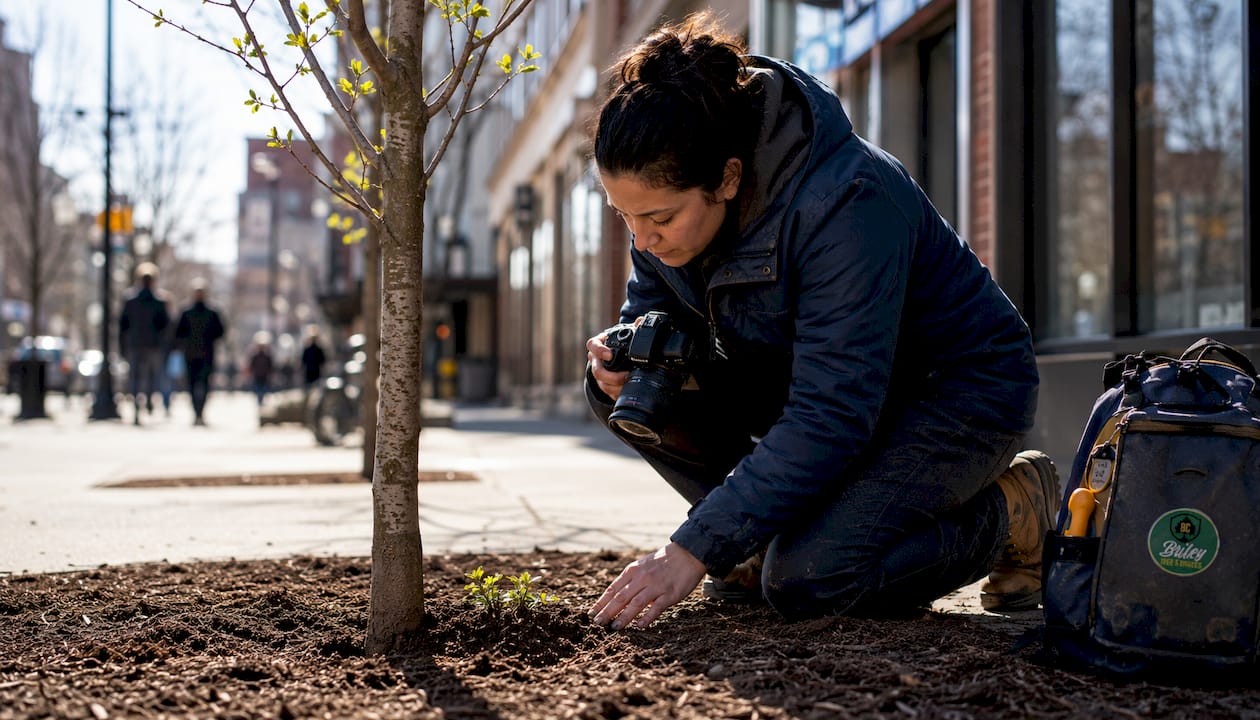
Pro Tip: Photograph the root collar of every significant tree during spring inspection. A year-over-year photo comparison is the fastest way to catch slow-developing girdling roots or soil subsidence before they become structural failures.
How do you manage trees on commercial properties during summer?
Summer is a monitoring and stress-management season. Heavy pruning during peak heat stresses trees that are already managing drought and high transpiration demand. The priority is protecting root health, maintaining soil moisture, and catching pest or disease problems before they escalate.
Summer commercial tree care checklist:
- Deep-water established trees during extended dry periods; prioritize high-value, high-visibility, or at-risk specimens.
- Refresh mulch to 3–4 inches depth to retain soil moisture and moderate root-zone temperature.
- Scout for pest activity: aphids, scale insects, borers, and spider mites are most active in summer heat.
- Defer structural pruning on most species until late summer at the earliest, or until fall dormancy approaches.
- Remove only actively hazardous deadwood or storm-damaged limbs on an as-needed basis.
- Document any stress symptoms with dated photos for the fall inspection record.
Irrigation priorities for large portfolios require triage. Newly planted trees need deep, consistent watering far more urgently than established specimens. When water budgets are constrained, direct resources to trees in their first two years of establishment and to high-value specimens in high-visibility or high-liability locations.
Stress signs that require immediate triage:
Early leaf scorch (brown margins on otherwise green leaves), premature leaf drop, and progressive canopy thinning are the three most reliable indicators of serious summer stress. When you see any of these on a specimen that was healthy in spring, the first step is a soil moisture check at 12-inch depth. Dry soil at that depth during a heat event means the tree is not receiving adequate water. Persistent symptoms after irrigation correction warrant an arborist visit to rule out root damage, vascular disease, or borer activity.
What fall tasks protect commercial trees through winter?
Fall is the last opportunity to remove hazards before winter storm loads arrive and to prepare root systems for cold-weather stress. Deadwood that survives summer becomes a liability when ice or wind loading increases in November and December.
Fall commercial tree care checklist:
- Remove all deadwood and structurally compromised limbs identified during summer monitoring.
- Complete a final deep irrigation soak before the first hard freeze to reduce winter desiccation stress.
- Apply or refresh mulch to 3–4 inches depth over root zones to insulate against freeze-thaw cycles.
- Aerate compacted root zones on high-traffic commercial sites where soil compaction has been documented.
- Implement a leaf management plan: remove heavy accumulations from root zones where anaerobic decomposition could damage surface roots, or chip and compost on-site where permitted.
- Confirm canopy clearances from buildings, signage, and parking structures before storm season.
Debris management on large commercial sites requires coordination. Hauling is the cleanest option for sites with no on-site composting capacity, but on-site chipping reduces hauling costs and produces usable mulch. Large-scale removals in fall may require municipal permits for debris disposal or street closures for chip truck access. Confirm those requirements at least two weeks before scheduling.
For high-traffic retail or office campuses, schedule fall work during off-peak hours to minimize disruption to tenants and customers. Early morning start times and clear site communication with building management reduce complaints and keep work windows productive.
How do you prioritize tree work across a large commercial portfolio?
Prioritize by documented risk: likelihood of failure multiplied by consequence of failure, weighted by public exposure and asset replacement value. That framework keeps limited budgets focused on the trees that pose the greatest liability, not the ones that are simply most visible or most recently complained about.
Asset scoring framework:
| Score | Risk Factor | Impact Factor | Value Factor | Recommended Action |
|---|---|---|---|---|
| 9–10 | High failure likelihood | High-traffic or structure | High replacement value | Immediate action required |
| 6–8 | Moderate failure likelihood | Moderate exposure | Moderate value | Schedule promptly |
| 3–5 | Low failure likelihood | Low exposure | Standard value | Routine cycle; monitor |
| 1–2 | Minimal failure signs | Minimal exposure | Low value | Inspect annually; no action |
Prioritization workflow:
- Inspect all trees and assign a risk score using the matrix above.
- Rank the full inventory by score; flag all 9–10 items for immediate scheduling.
- Group 6–8 items by location and work type to bundle mobilization costs.
- Schedule 3–5 items into the next routine maintenance window.
- Document all scores, recommended actions, and photo evidence in a centralized log.
- Re-evaluate scores after each major weather event and after completed work.
Annual documented risk assessments by an ISA-certified arborist are the foundation of this workflow. The assessment creates the legal paper trail that demonstrates due diligence, which matters when a limb failure results in a property damage or personal injury claim.
Pro Tip: Use a smartphone app with geo-tagging to photograph and log each tree during inspections. A geo-tagged photo library tied to a simple spreadsheet gives you a defensible, timestamped record that speeds vendor quoting and supports insurance claims.
How do you build a seasonal tree maintenance budget and calendar?
Set routine maintenance as a recurring annual line item, budget 20–30% above that for emergency contingency, and plan major removals across multiple years rather than absorbing them as single-year surprises. That three-part structure converts tree care from a reactive cost center into a managed operating expense.
Sample annual budget breakdown for a 30-tree commercial campus:
| Budget Category | Basis | Sample Amount |
|---|---|---|
| Routine maintenance | 30 trees × $500 average | $15,000 |
| Emergency contingency | 20–30% of routine | $3,000–$4,500 |
| Planned removals (amortized) | 1–2 removals per year at $2,000–$5,000 each | $2,000–$5,000 |
| New planting and replacement | Site-specific | Variable |
Sample quarterly maintenance calendar:
| Quarter | Primary Tasks |
|---|---|
| Q1 (January–March) | Annual risk assessment, structural pruning, large removals, stump grinding |
| Q2 (April–June) | Post-dormancy inspection, light corrective shaping, new planting establishment |
| Q3 (July–September) | Irrigation management, pest scouting, stress monitoring, deferred pruning late in quarter |
| Q4 (October–December) | Deadwood removal, final irrigation soak, mulching, canopy clearance, storm prep |
Common cost drivers that shift budget estimates:
- Tree height and trunk diameter (larger specimens require more labor and equipment).
- Site access constraints (narrow gates, underground utilities, proximity to structures).
- Crane or aerial lift requirements for large removals in confined spaces.
- Traffic control and lane closure permits for street-adjacent work.
- Species-specific constraints (oak wilt windows, protected species permits).
- Emergency versus scheduled mobilization (emergency call-outs carry premium rates).
Managed annual contracts typically deliver preferred pricing and bundled mobilization compared with individual purchase orders. For portfolios with more than 15–20 trees, a multi-year managed agreement is almost always more cost-effective than per-event purchasing.
How do you align seasonal services with written contracts and vendor agreements?
Translate your seasonal plan into a clear scope of work before you issue an RFP. Vague scopes produce vague bids, and vague bids produce disputes. Every deliverable, inspection frequency, and response time expectation belongs in writing before work begins.
Sample scope-of-work items to specify in your contract:
- Annual documented risk assessment with written report, risk ratings, and photo evidence for each tree.
- Structural pruning cycle (frequency, species-specific timing constraints, clearance standards).
- Emergency response time commitment (example: four-hour response for high-risk failures, 24-hour for moderate).
- Photo documentation requirements (geo-tagged, timestamped, filed by tree ID).
- Debris removal and site cleanup standards after each service visit.
- Notification protocol for hazard trees discovered during routine work.
Vendor RFP questions to include:
- Provide proof of commercial general liability insurance with limits appropriate for your property value.
- List all ISA-certified arborists on staff who will perform or supervise work on this account.
- Provide three references from commercial properties of similar size and tree inventory.
- Describe your equipment inventory, including aerial lift and crane capacity.
- Describe your written safety program and how it applies to work near occupied buildings.
- Provide a sample inspection report from a comparable commercial engagement.
Certifications and documentation to require before contract execution:
- ISA Certified Arborist credential for the supervising arborist (verify at the ISA's online directory).
- Commercial general liability insurance certificate naming your property as an additional insured.
- Workers' compensation coverage for all crew members.
- Written proof of experience on commercial properties with comparable tree inventories.
Commercial contracts structured as managed annual agreements rather than one-time purchase orders give you bundled pricing, priority emergency response, and a vendor who knows your site. Define response times, scheduled maintenance windows, and escalation procedures for hazard trees in the agreement itself.
What should a qualified commercial tree service provider actually deliver?
A qualified commercial provider delivers documented inspections, a prioritized work plan, scheduled service windows, and a written emergency response agreement. If a bidder cannot produce all four of those on request, they are not equipped for commercial work.
Vendor qualification checklist:
- Current ISA Certified Arborist credential for the supervising arborist.
- Commercial general liability insurance at limits appropriate for your site.
- Workers' compensation coverage with no gaps.
- Three verifiable references from comparable commercial properties.
- Sample inspection report demonstrating risk ratings, photo documentation, and recommended actions.
- Equipment list confirming aerial lift or crane capacity for large specimens.
- Written safety program covering work near occupied buildings and public areas.
What to expect on a commercial quote:
Itemized quotes for commercial tree work typically break out per-tree routine pruning, structural pruning (priced separately from routine), removal by size class, stump grinding, traffic control setup, and debris hauling. A quote that bundles all services into a single line item makes it impossible to compare bids or track costs by service type.
Red flags that disqualify a bidder:
- No commercial general liability insurance or limits too low for your property exposure.
- No written inspection reports; verbal assessments only.
- No ISA-certified arborist on staff or supervising the work.
- No references from commercial properties; residential-only experience.
- Inability to provide a sample scope of work or contract template.
- Pressure to sign without a written agreement or defined scope.
How does Brileytreeservice structure year-round commercial tree care?
A typical Brileytreeservice commercial engagement on a 30-tree retail campus in the Shreveport area runs on four phased work windows per year. The annual ISA-certified inspection in late fall or early winter produces a written risk assessment with a photo-documented inventory, a risk rating for each tree, and a prioritized work list. Structural pruning and any flagged removals follow in the winter window. A spring canopy pass addresses light corrective work and new-planting establishment checks. A fall hazard pass removes deadwood and completes pre-storm clearance work. Emergency priority response is available throughout the year for storm damage and sudden hazard failures.
Deliverables managers should require from any commercial engagement:
- Written risk assessment report with a risk rating (high/moderate/low) for each tree.
- Geo-tagged, timestamped photos filed by tree ID for every inspection and work visit.
- Prioritized work list with recommended action, estimated cost, and urgency timeline.
- Post-work documentation confirming completed tasks and any follow-up items identified during work.
- Emergency response protocol with defined contact procedures and response time commitments.
Brileytreeservice serves commercial properties throughout Shreveport, Bossier City, and Northwest Louisiana, covering commercial tree inspections, managed pruning contracts, emergency storm cleanup, removals, and stump grinding. Property managers can request an estimate directly through the Brileytreeservice website.
Pro Tip: Ask your provider to deliver the annual inspection report in a format you can share with your insurance carrier. A documented, ISA-certified risk assessment on file with your insurer strengthens your position in any liability claim involving a tree on your property.
Key Takeaways
A well-executed seasonal tree maintenance schedule for commercial properties depends on four things: a documented annual risk assessment, season-appropriate work windows, a realistic budget with contingency, and a vendor qualified for commercial-scale work.
| Point | Details |
|---|---|
| Annual risk assessment first | An ISA-certified arborist's documented assessment is the legal and operational foundation of every year's work plan. |
| Season windows drive outcomes | Structural pruning in winter dormancy, light inspection in spring, stress monitoring in summer, hazard removal in fall. |
| Budget with contingency | Routine maintenance plus a 20–30% emergency contingency prevents unplanned budget overruns after storm events. |
| Require written contracts | Scope of work, inspection deliverables, emergency response times, and insurance requirements must all be in writing before work begins. |
| Brileytreeservice for commercial sites | Brileytreeservice delivers ISA-certified inspections, photo-documented reports, and managed commercial contracts across Shreveport, Bossier City, and Northwest Louisiana. |
The tradeoffs commercial property managers rarely talk about
The hardest part of managing a commercial tree program is not the biology. It is the scheduling. A structural pruning window that is ideal for tree health often falls in January, which is also when parking lots are full for post-holiday retail traffic and when your maintenance crew is stretched across snow and ice response. The biology does not care about your lease calendar.
The practical answer is bundling. When you group structural pruning, stump grinding, and canopy clearance work into a single mobilization, you reduce the number of times a crew and equipment show up on your property. That cuts both cost and disruption. A vendor who knows your site can sequence work efficiently across a single two-day visit rather than three separate half-day calls.
Clear scope and a shared priority list make that possible. When a property manager hands a vendor a ranked work list before the season starts, the vendor can plan equipment, crew size, and traffic control in advance. That preparation is what separates a smooth commercial engagement from a reactive one. Safety and predictability are the deliverables that matter most on a commercial site, and both come from planning done months before the crew arrives.
Brileytreeservice commercial tree care: request an estimate
Brileytreeservice handles the full scope of commercial tree care for property managers across Shreveport, Bossier City, and Northwest Louisiana. Services include annual ISA-certified risk assessments, managed pruning contracts, structural pruning, tree removal, stump grinding, and emergency storm cleanup. Every commercial engagement includes a photo-documented inspection report, a prioritized work list, and defined emergency response procedures.
Property managers who work with Brileytreeservice get a single point of contact for year-round tree care, a written scope of work before any crew arrives, and cleanup after every job. For retail campuses, office parks, and multi-building portfolios across Northwest Louisiana, Brileytreeservice provides the documentation and reliability that commercial accounts require. Request a free estimate today and get a prioritized commercial tree care plan for your property.
Authoritative sources for commercial tree care planning
These resources are the most reliable references for regional disease windows, pruning standards, certification verification, and commercial tree care best practices.
- International Society of Arboriculture (ISA) — isa-arbor.com: The primary source for ISA Certified Arborist credential verification, pruning standards (ANSI A300), and best management practices. Use the ISA's online directory to verify any arborist credential before signing a contract.
- USDA Forest Service, Urban and Community Forestry — Best used for regional species guides, urban tree risk assessment frameworks, and research on tree canopy management for commercial and municipal properties.
- State Cooperative Extension Services — Your state's land-grant university extension service publishes region-specific pest and disease calendars, pruning timing guides, and species-specific care recommendations. Search "[your state] extension tree care" for the most locally relevant guidance.
- ANSI A300 Pruning Standards — The industry standard for tree pruning practices in the United States. Require that any commercial vendor references ANSI A300 compliance in their scope of work.
- Conner Tree Service — Year-Round Tree Care Calendar — connertreeservice.com: Practical seasonal checklist with species-specific timing notes, including oak wilt and elm disease windows.
- Branch ProSD — Commercial Tree Pruning Maintenance — branchprosd.com: Budget math and seasonal maintenance rhythm guidance for commercial property managers.