
Tree service vendor vetting is the structured, pre-hire process of verifying that a contractor holds active licensing, adequate insurance, relevant certifications, and a written contract before any work begins. Four checks are non-negotiable before you authorize a single cut:
- Active general liability insurance (general liability insurance coverage meeting standard industry expectations)
- Workers' compensation that specifically covers tree work and the crew on your property
- Verifiable business license with a name that matches the bid
- Named ISA Certified Arborist on-site when the scope involves hazardous removals or complex pruning
If any one of these four checks fails, pause the hire. The financial and legal exposure from skipping them far exceeds any savings from a lower bid.
Table of Contents
- What does tree service vendor vetting actually cover?
- How does the tree service vetting process work, step by step?
- What should you verify in detail before hiring?
- How do you actually verify a contractor's claims?
- What mistakes do property owners make when vetting tree services?
- How long does vetting take, and what drives tree work costs?
- Printable vetting checklist and ready-to-use scripts
- Key Takeaways
- Why the vetting checklist reflects real field practice
- Brileytreeservice serves Shreveport with verified credentials and written contracts
- Authoritative sources for credential verification
What does tree service vendor vetting actually cover?
Vendor vetting is not price shopping. It is a structured evaluation of legal, insurance, professional, and contractual protections before work begins. The distinction matters because two bids can look identical on price while representing very different levels of risk.
Full vetting covers four domains:
- Legal compliance: active business license, state contractor registration, and any local permits required for the specific job
- Insurance: general liability and workers' compensation, both verified directly with the insurer
- Professional credentials: ISA Certified Arborist status, and optionally TCIA Accreditation for commercial or complex jobs
- Contract protections: itemized written estimate, defined scope, cleanup obligations, payment schedule, and indemnity language
Any job that involves chainsaws, climbing, or machinery within roughly 10 feet of a structure warrants full vetting. High-risk removals, commercial properties, and municipal work always require it. A simple shrub trim by a sole proprietor with no employees is the rare exception where a lighter check may suffice. When you need an arborist consultation to assess risk before work begins, that assessment itself is part of the vetting process.
How does the tree service vetting process work, step by step?
The sequence matters. Skipping steps or reordering them creates gaps that are difficult to recover from once work has started.
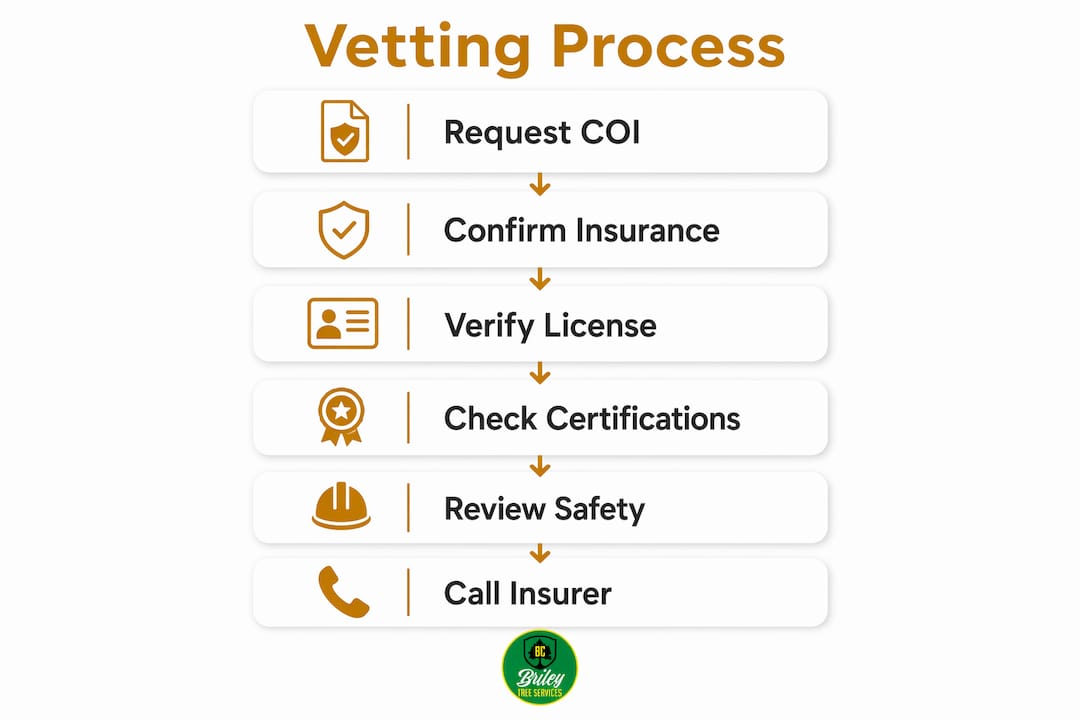
- Request documentation first. Before discussing price, ask for the COI (Certificate of Insurance), business license number, and the name of the ISA Certified Arborist who will be on-site.
- Verify credentials independently. Call the insurer listed on the COI, check the state contractor licensing board, and confirm the arborist's credential in the ISA directory.
- Obtain an itemized written estimate. The estimate must break down labor, equipment, debris removal, and stump disposition separately. Verbal agreements are insufficient and create billing disputes.
- Confirm on-site oversight and insurance activation. Verify that the certified arborist named in step one will actually be present, and confirm the policy covers the specific dates of your project.
- Supervise payment terms and closeout. Agree on deposit limits, a final payment trigger tied to cleanup completion, and a written warranty before signing.
Pro Tip: Never accept a COI that the contractor hands you as a PDF. Ask to have it emailed directly from the insurer, then call the insurer's phone number listed on the certificate to confirm the policy is active and covers tree work specifically. This single step eliminates the most common insurance fraud scenario.
What should you verify in detail before hiring?
Insurance: what the COI must show
Legitimate providers carry two active policies: general liability insurance coverage at industry-standard levels and workers' compensation covering on-site employees. Check the COI for policy numbers, effective dates, named insured, and policy type. Confirm the policy covers tree removal and aerial work, not just general landscaping. General landscaping policies often exclude the higher-risk operations involved in tree work.
Workers' compensation is required by employers in 49 states. If a contractor lacks it and a crew member is injured on your property, you may be held liable for medical costs and lost wages. Reviewing insurance requirements in detail before signing anything is one of the highest-value steps you can take.
Licensing: verify the name matches
State contractor licensing boards and local permit offices are the primary verification points for license status, complaint history, and disciplinary actions. Search by the exact business name on the bid, not just the owner's name. A mismatched name between the license and the contract is a disqualifying red flag.
Certifications: ISA is individual, not company-wide
ISA Certified Arborist status belongs to a person, not a company. A business can list ISA credentials on its website while employing only one certified arborist who never visits job sites. Always ask for the name and certification number of the arborist who will be on-site, then verify that individual in the ISA directory at TreesAreGood.org. For commercial or complex removals, TCIA Accreditation is a company-level audit that adds another layer of accountability.
Safety practices and contract clauses
| Verification Area | What to Check | Why It Matters |
|---|---|---|
| Safety standards | — | Reduces crew injury risk on your property |
| Equipment | Rigging, truck-mounted equipment for large removals | Inadequate gear increases structural damage risk |
| Scope of work | Itemized labor, equipment, debris, stump disposition | Prevents post-work billing disputes |
| Cleanup obligations | Written debris disposal and haul-away terms | Avoids abandoned debris and extra charges |
| Payment schedule | Deposit limit, final payment tied to completion | Protects against contractors who disappear mid-job |
| Indemnity and warranty | Who pays for permits, workmanship warranty period | Defines recourse if work causes damage |
Pro Tip: A bid that is dramatically lower than the others almost always reflects missing insurance, unlicensed disposal, or an untrained crew. Use a bid comparison framework to evaluate what each bid actually includes before deciding.
How do you actually verify a contractor's claims?
Turn the checks above into concrete actions. Here is what to ask and who to contact:
On your first call or email, request:
- COI to be sent directly from the insurer (not a contractor-forwarded PDF)
- Business license number and the issuing agency
- Name and ISA certification number of the arborist who will be on-site
- A sample contract or scope-of-work template
- Two or three references from jobs completed in the past 12 months
Who to contact for verification:
- Insurer: Call the phone number printed on the COI. Ask whether the policy is active, whether it covers tree removal and aerial work, and whether it covers the dates of your project.
- State licensing board: Search by business name and license number. Check for complaints or disciplinary actions.
- ISA directory: Go to TreesAreGood.org and search the individual arborist's name or certification number.
- Local building or permit office: Confirm whether a permit is required for your specific job and whether the contractor has pulled it.
Sample email to send before accepting a bid:
Disqualifying outcomes:
- Contractor refuses to provide a COI or license number
- Insurer confirms the policy is expired or does not cover tree work
- ISA certification number does not appear in the ISA directory
- Business name on the license does not match the name on the bid
Pro Tip: When you call the insurer, also ask whether the COI review process for contractor work requires you to be listed as an additional insured. For larger jobs, this adds direct protection if a claim arises.
What mistakes do property owners make when vetting tree services?
The most common error is choosing the lowest bid without examining insurance and crew qualifications. A low price often hides inadequate coverage or unsafe practices that become your liability the moment something goes wrong.
Accepting a contractor-forwarded PDF as proof of insurance is one of the most frequent vetting failures. Fraudulent and canceled COIs exist. The only reliable verification is a certificate emailed directly from the insurer, confirmed by a phone call to the agent.
Other red flags that should stop a hire:
- Perfect online reviews with no complaints: A spotless reputation can be suspicious. The stronger signal is how a company responds to negative feedback and resolves issues. Look for documented resolution, not just a five-star average.
- Door-to-door post-storm solicitation: After severe weather, many illegitimate providers use door-to-door tactics and "sign today" pressure. Reputable local companies typically have backlogs and do not pressure immediate decisions.
- Cash-only requests or full payment up front: Legitimate contractors accept standard payment terms. Full cash up front before work begins is a significant warning sign.
- Mismatched business names: If the name on the truck, the license, and the contract are all different, stop the process and ask for a clear explanation before proceeding.
- Refusal to sign a written contract: No written contract means no legal recourse. This is a disqualifying condition, not a negotiating point.
For guidance specific to emergency situations, the emergency tree service contract process has its own considerations worth reviewing before storm season.
How long does vetting take, and what drives tree work costs?
Paperwork verification takes two to four hours if the contractor is responsive. Scheduling a legitimate, vetted contractor typically takes two to seven days under normal conditions. After a major storm, that window extends because reputable local companies have backlogs. Rushing that timeline is exactly when storm-chaser scams succeed.
Cost drivers for the work itself include:
- Tree size and species: Larger trees and hardwoods require more equipment and labor time.
- Proximity to structures: Work within 10 feet of a building, utility line, or fence increases rigging complexity and risk.
- Equipment required: Crane or bucket truck access for large removals adds cost but also reflects proper safety practice.
- Stump removal vs. grinding: These are separate line items; confirm which is included.
- Permit requirements: Some municipalities require permits for removals above a certain diameter. The contractor should pull the permit; confirm who pays for it in the contract.
- Debris disposal fees: Haul-away and disposal are sometimes excluded from base bids. Require them to be itemized.
Printable vetting checklist and ready-to-use scripts
Pre-hire checklist
- COI received directly from insurer (not contractor-forwarded)
- COI confirmed active by phone call to insurer
- Policy confirmed to cover tree removal and aerial work
- Workers' compensation confirmed for all crew members
- Business license number obtained and verified on state board
- License name matches the name on the bid and contract
- ISA Certified Arborist name and number verified in ISA directory
- Arborist confirmed to be on-site for the job
- Itemized written estimate received (labor, equipment, debris, stump)
- Written contract signed before work begins
Documents to collect at bid time
- Certificate of Insurance (insurer-sent)
- Business license copy
- Signed written contract with scope, dates, payment schedule, and cleanup terms
- Photos of similar completed jobs
- Two to three references with contact information
Sample phone script for calling the insurer
Key Takeaways
Proper tree service vendor vetting requires verifying active general liability insurance, workers' compensation, a matching business license, and ISA Certified Arborist oversight before authorizing any work.
| Point | Details |
|---|---|
| Insurance is non-negotiable | Require a COI sent directly from the insurer and confirm it covers tree removal, not just landscaping. |
| Workers' comp protects you | Required by employers in 49 states; if missing, you may be liable for crew injuries on your property. |
| ISA is an individual credential | Verify the specific arborist who will be on-site in the ISA directory, not just the company's marketing claims. |
| Low bids carry hidden costs | Dramatically low bids often reflect missing insurance, unlicensed disposal, or untrained crews. |
| Brileytreeservice meets these standards | Brileytreeservice carries verified insurance, employs ISA-credentialed oversight, and provides itemized written contracts for every job in the Shreveport area. |
Why the vetting checklist reflects real field practice
Brileytreeservice follows every item on this checklist as standard operating procedure. The company carries active general liability and workers' compensation coverage, provides itemized written estimates before any work begins, and ensures ISA-credentialed oversight on jobs that require it. Written contracts are not optional at Brileytreeservice; they are the starting point for every engagement, covering scope, cleanup obligations, payment terms, and warranty. These practices exist because they protect property owners from billing disputes, liability exposure, and substandard work. They also make the job go more smoothly for everyone involved. Transparent pricing and documented scope reduce disagreements after the fact, which is why Brileytreeservice treats them as standard, not exceptional.
Brileytreeservice serves Shreveport with verified credentials and written contracts
Property owners in Shreveport, Bossier City, and Northwest Louisiana who want a vetted, insured tree service provider can contact Brileytreeservice directly. The company specializes in tree removal, tree trimming, stump grinding, and emergency storm cleanup for residential and commercial properties. Every job starts with a free written estimate, and the company's insurance documentation is available on request.
Brileytreeservice carries the insurance, licensing, and written contract process this article describes. If you want to verify credentials before committing, the team will provide documentation without hesitation. Request a free estimate and see why property owners across the Shreveport area rely on Brileytreeservice for tree care that is done safely, completely, and on time.
Authoritative sources for credential verification
Use these resources to verify any tree service contractor's credentials independently:
- ISA Credential Verification: TreesAreGood.org. Search by arborist name or certification number to confirm ISA Certified Arborist status. Free and publicly accessible.
- State contractor licensing boards: Search your state's Department of Business and Professional Regulation or equivalent agency by business name and license number. Check for active status, expiration dates, and complaint history.
- Insurer contact (from the COI): The phone number on the Certificate of Insurance connects directly to the issuing agent. Call to confirm the policy is active and covers tree work.
- U.S. Department of Labor (DOL): The DOL provides general guidance on workers' compensation requirements by state, useful for confirming whether a contractor's exemption claim is legitimate.
- TCIA Accreditation directory: The Tree Care Industry Association maintains a searchable list of accredited companies. Fewer than 10% of U.S. tree care companies hold this credential, making it a meaningful signal for commercial or high-complexity jobs.
- Local building or permit office: Confirms permit requirements for your specific job type and jurisdiction, and whether the contractor has already pulled the required permits.