

Every commercial property needs a written emergency tree plan. If you manage a multi-tenant building, retail center, office park, or industrial site, a fallen tree or suspended limb is not just a landscaping problem. It is a safety incident, a liability event, and a business-continuity threat, all at once. The first step you can take today: schedule a documented tree inspection with a licensed, insured arborist and secure a priority service agreement with a qualified commercial tree contractor.
Relevant standards and guidance come from the International Society of Arboriculture (ISA), FEMA's Public Assistance program, OSHA safety rules for contractors, and NFPA life-safety codes. Brileytreeservice works directly with commercial property managers in Shreveport, Bossier City, and North Louisiana to build and execute exactly this kind of plan.
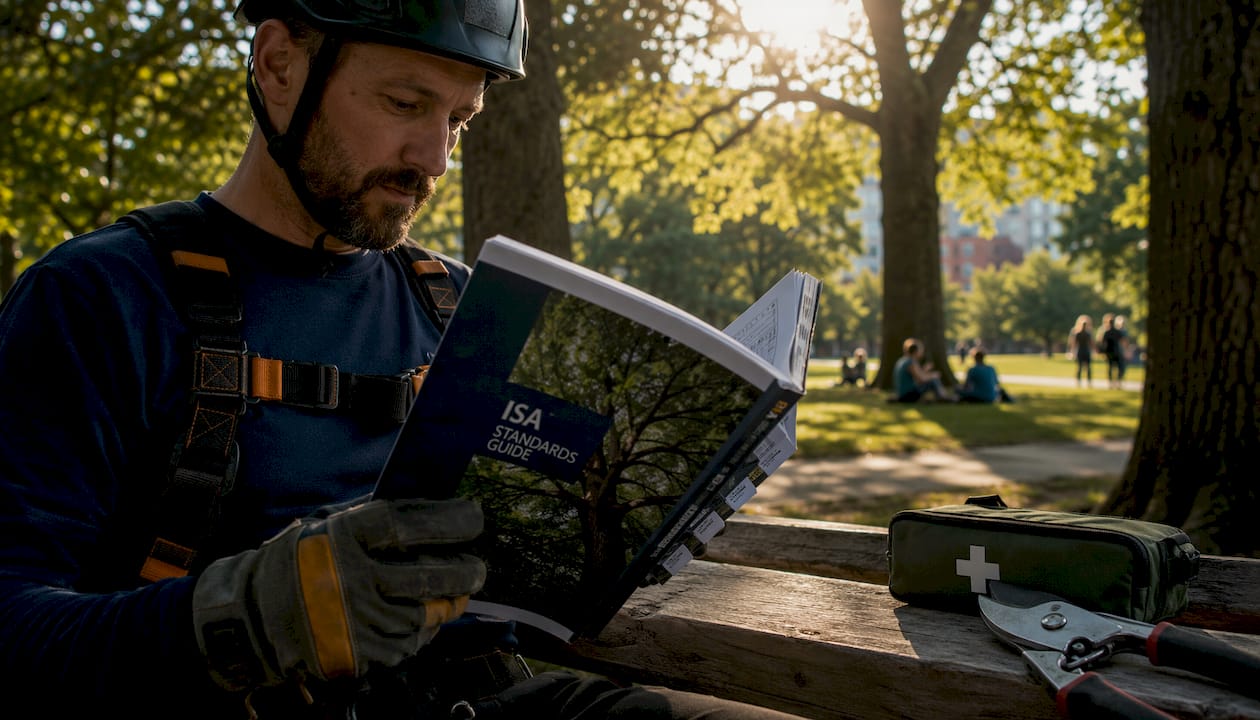
Table of Contents
- Why commercial properties need an emergency tree plan
- What counts as an emergency on a commercial site
- What to include in a commercial emergency tree plan
- How to build and maintain the plan step by step
- What to expect when you call out an emergency tree crew
- Costs, budgeting, and insurance for tree events
- How to choose and verify an emergency tree contractor
- Evidence that proactive planning saves time and money
- Key Takeaways
- The logistical reality most property managers underestimate
- Brileytreeservice supports commercial property managers in North Louisiana
- Useful sources and authoritative references
Why commercial properties need an emergency tree plan
Commercial properties carry a different level of risk than residential sites. Tenants, customers, delivery drivers, and employees move through your property every day. A single tree failure can block a fire lane, injure a pedestrian, stop deliveries, and trigger a negligence claim before the crew even arrives.
- Safety: A suspended "widow-maker" limb over a walkway or parking lot is an immediate liability. OSHA requires employers to maintain safe premises, and property managers share that duty of care.
- Liability: Regular, documented tree inspections and a formal emergency response plan demonstrate due diligence. Without that paper trail, a single injury claim can be difficult to defend.
- Business continuity: A blocked entrance or delivery route costs real money by the hour. Keeping those corridors clear is an operational priority, not a landscaping preference.
- Insurance defensibility: Insurers expect documented maintenance. Photo logs, arborist reports, and signed invoices form the record that determines claim outcomes.
- Reputation: A hazardous tree left standing at a public-facing property signals neglect to tenants and customers alike.
According to Purdue Extension, emergency removal after a tree failure can cost two to three times more than scheduled removal identified during a routine inspection. That cost differential alone makes a proactive plan worth building.
What counts as an emergency on a commercial site
Not every tree problem requires an immediate call-out. Knowing the difference helps you act fast when it matters and schedule appropriately when it does not.
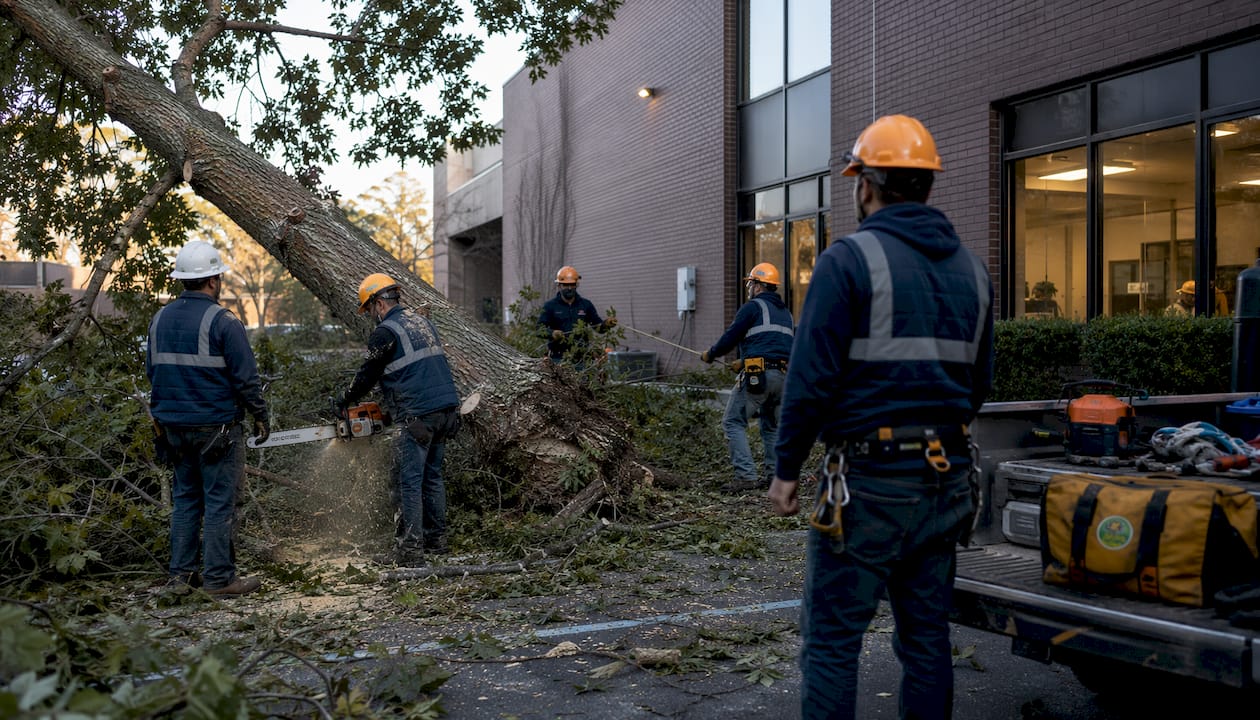
Immediate emergencies require same-day response:
- A fallen tree blocking an entrance, fire lane, or delivery route
- Suspended limbs hanging over walkways, parking areas, or occupied structures
- A tree leaning into a building or utility line after wind or soil saturation
- Trees contacting or down on power lines
- Root heave cracking ADA-accessible sidewalks or ramps, creating a trip hazard
Scheduled-attention situations are serious but not same-day:
- Significant deadwood in the canopy that has not yet dropped
- Minor limb drop away from high-traffic zones
- Trees showing early signs of structural decline (included bark, co-dominant stems)
Pro Tip: The moment you identify a potential hazard, isolate the area with cones, caution tape, or temporary fencing before calling a contractor. Keeping people away from the zone is the single fastest way to reduce your liability exposure while you wait for a crew.
What to include in a commercial emergency tree plan
A written plan does not need to be long. It needs to be complete. These are the components that matter:
Tree inventory and risk ratings
- A documented inventory of every significant tree on the property, with species, size, condition, and an assigned risk level (low, moderate, high) based on an ISA-standard Level 1 or Level 2 assessment.
Priority zone map
- A site map marking entrances, fire lanes, delivery routes, ADA paths, and utility corridors. Trees near these zones get the highest inspection and maintenance priority.
Inspection schedule
- Annual inspections at minimum, with a post-storm walkthrough trigger after any wind event above 40 mph or significant rain. Commercial tree maintenance best practices recommend biannual inspections for high-canopy sites.
Contractor contact list and priority service agreement
- Name, license number, certificate of insurance (COI), and a documented response-time SLA for your primary contractor. An advance readiness contract locks in priority response before a storm hits.
Emergency access and staging instructions
- Written directions for equipment access: gate codes, weight limits, preferred staging areas, and ground-protection mat requirements to avoid cracking hardscape.
Documentation requirements
- Before-and-after photos, arborist reports, signed invoices, debris manifests, and a copy of the contractor's COI. These documents support insurance claims and legal defensibility.
Operational controls
- Tenant-notification templates, traffic control plans, and a debris-disposal process that complies with local ordinances.
Pro Tip: Pre-identify your utility contacts (electric, gas, telecom) and store those numbers in the plan. Local permitting and utility coordination are frequently required in commercial emergency removals, especially when trees impact power lines or streets. Having those contacts ready saves hours during an active incident.
The American Planning Association recommends integrating a site-specific storm mitigation plan into your overall hazard management framework, noting that advance readiness contracts increase recovery speed and may improve eligibility for debris-removal cost reimbursements after declared disasters.
How to build and maintain the plan step by step
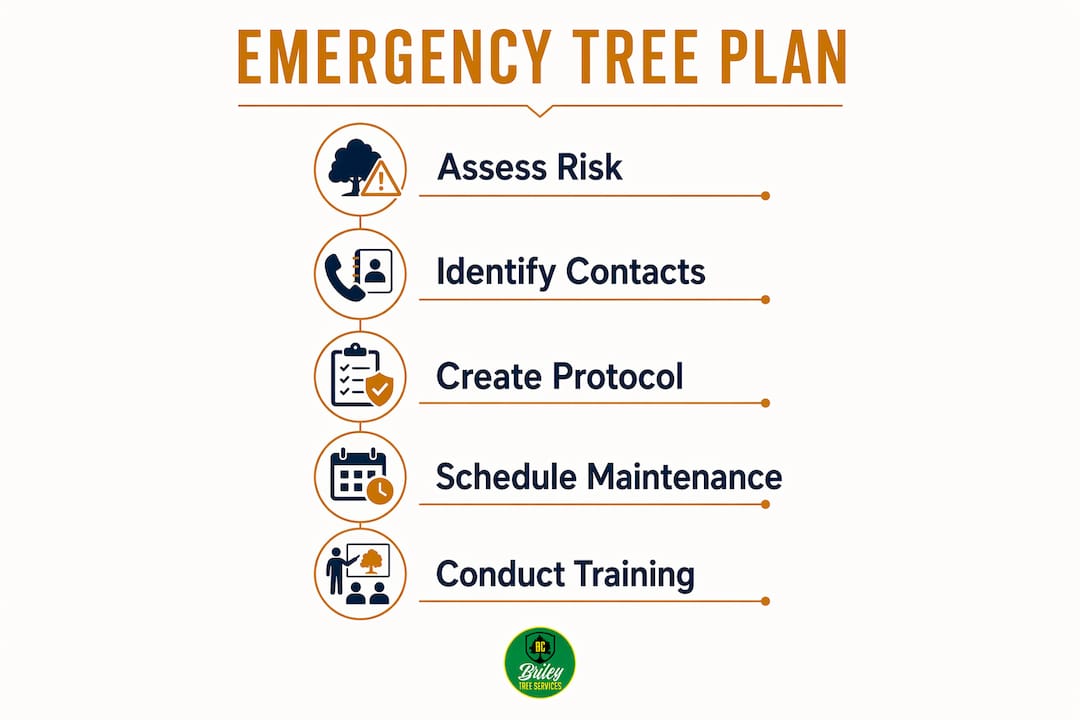
- Conduct an initial tree inventory and risk assessment. Hire an ISA-certified arborist to walk the entire property, document every significant tree, and assign risk ratings. This is the foundation of everything else.
- Rank trees and prioritize work. Start with high-risk trees near priority zones. Schedule pruning, cabling, or removal based on risk level and proximity to people and structures.
- Secure a commercial service agreement. Sign an advance readiness contract with a licensed, insured contractor before storm season. Clients with established service agreements typically receive priority response during regional storm events when ad-hoc callers wait days.
- Create on-property access maps. Document gate codes, weight-rated access points, staging areas, and any hardscape restrictions. Share these with your contractor before an incident occurs.
- Set your inspection cadence. Annual inspections for stable sites, biannual for high-canopy or storm-exposed properties, and a post-storm walkthrough after any significant weather event. Setting up a recurring trimming service is one practical way to build this cadence into a contract.
- Communicate with tenants. Create a simple notification template so tenants know what to expect when work is scheduled or an emergency occurs.
- Review the plan annually. Update the tree inventory, refresh contractor COIs, and revise the priority zone map after any significant site changes.
Pro Tip: Schedule non-emergency pruning and removal during off-hours or in staged zones to minimize disruption to tenants and customers. Planning tree removal to minimize business disruption covers the logistics in detail.
What to expect when you call out an emergency tree crew
Understanding the workflow helps you manage the site and your tenants during an active incident.
- Site stabilization. The crew establishes exclusion zones, sets up traffic control (cones, signage, flaggers if needed), and assesses the full scope before cutting begins.
- Hazard removal. Priority cuts address the immediate threat: suspended limbs, trees on structures, or anything blocking emergency access. This phase may require cranes, bucket trucks, or rigging for tight commercial sites.
- Debris processing. Industrial chippers reduce volume on-site. Large logs may be sectioned and hauled. Ground-protection mats protect asphalt and concrete from equipment damage.
- Stump grinding and final cleanup. Stumps left in commercial areas are trip hazards. Grinding to below grade and raking the area clean are standard final steps.
- Documentation handoff. Request before-and-after photos, a written work summary, a debris manifest, and a copy of the contractor's COI before the crew leaves.
What a qualified commercial contractor should provide without being asked:
- Utility coordination if lines are involved
- A written safety protocol and exclusion zone plan
- Proof of workers' compensation and general liability insurance
- Itemized invoices suitable for insurance submission
Costs, budgeting, and insurance for tree events
Emergency removal after a tree failure can cost two to three times more than the same work identified and scheduled during a routine inspection. The cost drivers that push emergency work higher include:
| Cost Driver | Why It Increases Emergency Cost |
|---|---|
| Tree size and species | Larger trees require more equipment and crew time |
| Site complexity | Tight access, active tenants, and hardscape require specialized rigging |
| Equipment needs | Cranes and bucket trucks add significant day-rate costs |
| Debris volume | Large commercial sites generate debris that requires multiple haul loads |
| Time of day | After-hours and weekend rates apply to most emergency calls |
| Storm demand | Regional events create contractor backlogs; pre-arranged clients get priority |
Insurance documentation checklist:
- Contractor's COI (general liability and workers' compensation)
- ISA-certified arborist report documenting the hazard and recommended action
- Before-and-after photos with timestamps
- Signed invoices and debris manifests
- Records of prior inspections and maintenance (demonstrates due diligence)
Notify your insurer as soon as a tree failure causes structural damage or personal injury. Documented maintenance records showing regular inspections and scheduled pruning can directly affect how a claim is evaluated. How tree trimming reduces liability exposure explains the documentation standards insurers expect.
How to choose and verify an emergency tree contractor
Not every tree company is equipped for commercial work. The stakes are higher, the equipment requirements are greater, and the documentation standards are stricter.
Vendor checklist:
- State contractor's license and current general liability plus workers' compensation insurance
- ISA-certified arborist on staff or available for assessments
- Heavy equipment capability: cranes, bucket trucks, industrial chippers, stump grinders
- Documented commercial references from property managers or facility directors
- 24/7 availability or a written SLA for storm-response time
- Experience coordinating around active tenants, security, and traffic
Questions to ask during vetting:
- What is your typical on-site response time after a storm call?
- Can you provide a COI naming our property as an additional insured?
- Do you handle permit applications and utility notifications?
- How do you manage debris disposal, and can you provide a manifest?
- What is your process for protecting hardscape from equipment damage?
On contract structure: Request advance readiness language that specifies response time, equipment availability, and priority status during declared storm events. A written priority service agreement is the single most effective way to avoid waiting days for a crew after a regional storm. Why commercial properties need arborists covers ISA certification requirements in detail.
Evidence that proactive planning saves time and money
The case for a written emergency tree plan is well-supported by authoritative sources.
A community forest storm mitigation plan is an essential part of your community's hazard mitigation and emergency management plans and systems. The plan should focus specifically on ways to avoid or mitigate the damage trees cause during a storm or other catastrophic event. Advance readiness contracts increase speed of recovery and may improve eligibility for debris-removal cost reimbursements after declared disasters.
— American Planning Association
FEMA's Public Assistance program provides grant funding for removal of hazardous trees, limbs, and stumps that present immediate threats to life, public health, or improved property after a declared disaster. The community forest storm mitigation guidance notes that trees are the least documented piece of infrastructure, making them the most difficult to receive reimbursements for without prior documentation. Keeping an annually updated tree inventory with replacement cost values directly supports FEMA reimbursement requests.
OSHA's general duty clause requires employers to maintain worksites free from recognized hazards. A documented inspection and maintenance program is the clearest evidence of compliance. NFPA life-safety codes require unobstructed access to fire lanes and emergency exits, which tree failures can block instantly.
| Authority | Relevance to Emergency Tree Plans |
|---|---|
| ISA | Sets tree risk assessment standards (Level 1, Level 2); certifies arborists |
| FEMA | Public Assistance grants for debris removal after declared disasters |
| OSHA | General duty clause; contractor safety protocols on commercial sites |
| NFPA | Fire lane and egress clearance requirements |
| American Planning Association | Storm mitigation integration into hazard management plans |
Key Takeaways
A written emergency tree plan is the most direct way commercial property managers reduce safety risk, control costs, and protect insurance defensibility after a tree failure.
| Point | Details |
|---|---|
| Inspect and document first | Hire an ISA-certified arborist to inventory trees and assign risk ratings before a storm season. |
| Proactive costs less | Emergency removal after failure costs two to three times more than scheduled removal per Purdue Extension. |
| Secure a priority contract | An advance readiness agreement with a licensed contractor locks in priority response before regional storm demand peaks. |
| Documentation determines claims | Before-and-after photos, arborist reports, and debris manifests are what insurers and courts expect after a tree incident. |
| Brileytreeservice | Provides 24/7 emergency response, licensed and insured crews, and documented reports for commercial property managers in North Louisiana. |
The logistical reality most property managers underestimate
Commercial tree emergencies are not just bigger versions of residential ones. The access constraints alone change everything. A crew working a retail center at 7 AM has to stage equipment without blocking tenant parking, coordinate with property security, protect a concrete apron from a 60,000-pound crane, and clear the site before the first customer arrives. None of that happens smoothly without a pre-arranged plan.
The managers who recover fastest after a storm are the ones who already have a contractor's cell number, a signed priority agreement, and a site map with gate codes and staging zones on file. The ones who make ad-hoc calls during a regional event wait. Sometimes for days. That waiting period, not the tree removal itself, is where the real revenue loss accumulates.
One practical step that gets overlooked: include parking and security instructions in your service contract. Your contractor should know exactly where to stage equipment, which entrances to use, and who to call at the property before they ever arrive on an emergency call. That single detail cuts mobilization time significantly.
Brileytreeservice supports commercial property managers in North Louisiana
Commercial property managers in Shreveport, Bossier City, and the surrounding North Louisiana region have a direct option for emergency tree coverage. Brileytreeservice provides 24/7 emergency storm cleanup, licensed and insured crews, and the documentation commercial clients need: before-and-after photos, detailed work summaries, debris manifests, and COI support for insurance submissions.
Brileytreeservice also offers advance readiness agreements that give commercial clients priority response during regional storm events, along with scheduled inspection programs, tree trimming, stump grinding, and permit assistance. The practical benefit is straightforward: faster response, less downtime, and a paper trail that holds up when an insurer or attorney asks what you did to maintain the property.
Request a free estimate and set up a priority service agreement at brileytreeservice.com.
Useful sources and authoritative references
Property managers building or updating an emergency tree plan should keep the following sources and documents on file:
- ISA (International Society of Arboriculture): Sets Level 1 and Level 2 tree risk assessment standards; use to verify arborist credentials and inspection methodology at isa-arbor.com.
- FEMA Public Assistance guidance: Outlines documentation requirements for debris-removal reimbursement after declared disasters; available at fema.gov/public-assistance-policy-and-guidance.
- OSHA general duty clause: Governs contractor safety on commercial sites; relevant when hiring tree crews working around tenants and active operations.
- NFPA life-safety codes: Address fire lane and egress clearance; confirm your local authority having jurisdiction (AHJ) for applicable code editions.
- American Planning Association: Storm mitigation integration guidance for incorporating tree plans into broader hazard management frameworks.
- Purdue Extension: Cost-comparison data on proactive versus reactive tree removal at extension.purdue.edu.
Documents to store on file for insurance and legal defensibility:
- Annual ISA-certified arborist reports with risk ratings
- Signed invoices and work orders from all tree maintenance
- Before-and-after photos with timestamps for every significant job
- Debris manifests from emergency removals
- Contractor COIs (general liability and workers' compensation)
- Your written emergency tree plan and any advance readiness contracts