
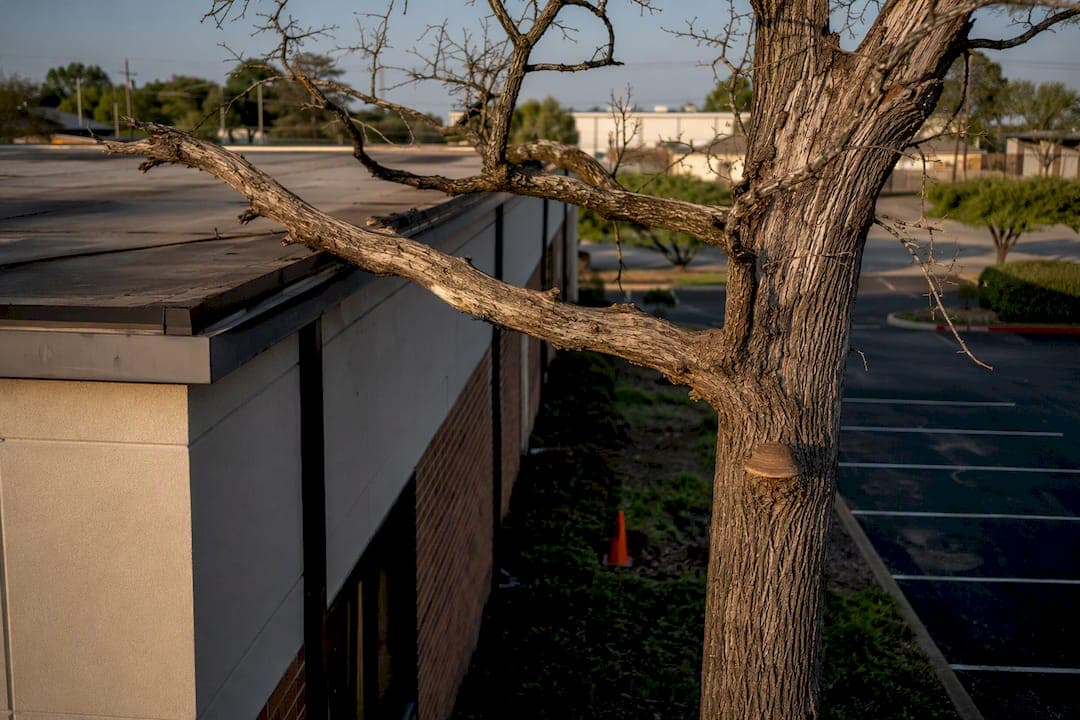
If a dead tree on your property sits within striking distance of your house, a vehicle, or a power line, dead tree liability comes down to one thing: hazard mitigation through professional removal, pruning, or stump grinding. Waiting rarely improves the odds. A licensed, insured arborist should inspect the tree and act on major defects promptly before the next storm front moves through. A licensed, insured arborist service handles this kind of assessment and removal work across Shreveport and North Louisiana.
TL;DR:
- Dead limbs over structures, vehicles, or power lines require urgent removal or mitigation, no matter their appearance or the weather conditions.
- A licensed arborist should evaluate warning signs like large dead wood, cracks, fungal decay, root issues, weak unions, cankers, or hollow cavities for hazard identification.
- Removing hazards can involve relocating items, pruning isolated defects, or full tree removal with stump grinding, depending on decay severity and risk.
- Professional tree removal involves a multi-step process, including site inspection, risk assessment, utility marking, permit checks, rigging, sectional dismantling, and debris cleanup.
- Property owners should act promptly once hazards are identified, document conditions, and obtain licensed contractor liability coverage to avoid legal and insurance issues.
Table of Contents
- How to Spot a Hazardous Dead Tree
- Fixing the Problem: Move It, Prune It, or Remove It
- What Happens During Professional Tree Removal
- Why Hiring a Licensed, Insured Crew Lowers Your Risk
- Choosing a Licensed Tree Service in Shreveport and North Louisiana
- From Quote to Completion: What to Expect
- Property Owner Responsibilities Under Louisiana Rules
- Notifying Neighbors About a Hazardous Tree
- How Fast You Should Move Once You Spot a Hazard
- Fines and Penalties for Ignoring a Hazardous Tree
- Tatum's Take: What Local Storms Have Taught Us
- Get a Free Estimate from Briley Tree Service
- Sources
How to Spot a Hazardous Dead Tree
A dead tree does not always look dangerous. Some stand bare and obviously dying; others still hold leaves on a few limbs while the trunk rots from the inside. Arborists trained in hazard assessment check for seven specific warning signs, and any one of them can turn a shade tree into a liability.
- Dead wood — branches or a crown that show no live growth, especially large limbs directly over a structure or driveway
- Cracks — vertical splits in the trunk or where major limbs meet, a sign the wood fibers are already separating
- Fungal conks or decay — shelf-like mushrooms growing on bark or roots, a visible marker of internal rot
- Root problems — heaving soil, exposed roots, or a lean that has worsened after heavy rain
- Weak unions — branches attached at tight, V-shaped angles instead of strong U-shaped joints
- Cankers — sunken, discolored patches on the trunk where bark has died back
- Hollow cavities — openings that reveal empty space inside the trunk or major limbs
Location changes everything. A dead pine in the back corner of a five-acre lot is a low-priority problem. The same tree leaning over a bedroom, a parked car, or a power line is a "strike distance" hazard that needs attention now, not next season.
Dead wood is genuinely unpredictable. Most tree failures happen during wind events over 40 mph, but the UC ANR IPM program notes that advanced decay can cause a limb or trunk to fail on a calm, windless afternoon. Dry, brittle dead wood doesn't flex the way live wood does, so it snaps rather than bends. That's the reasoning behind treating any dead limb over a home or driveway as a dangerous tree in need of assessment rather than a wait-and-see situation.
Fixing the Problem: Move It, Prune It, or Remove It
Once you've identified a hazard, you have three realistic options, and picking the wrong one wastes money or leaves the risk in place.
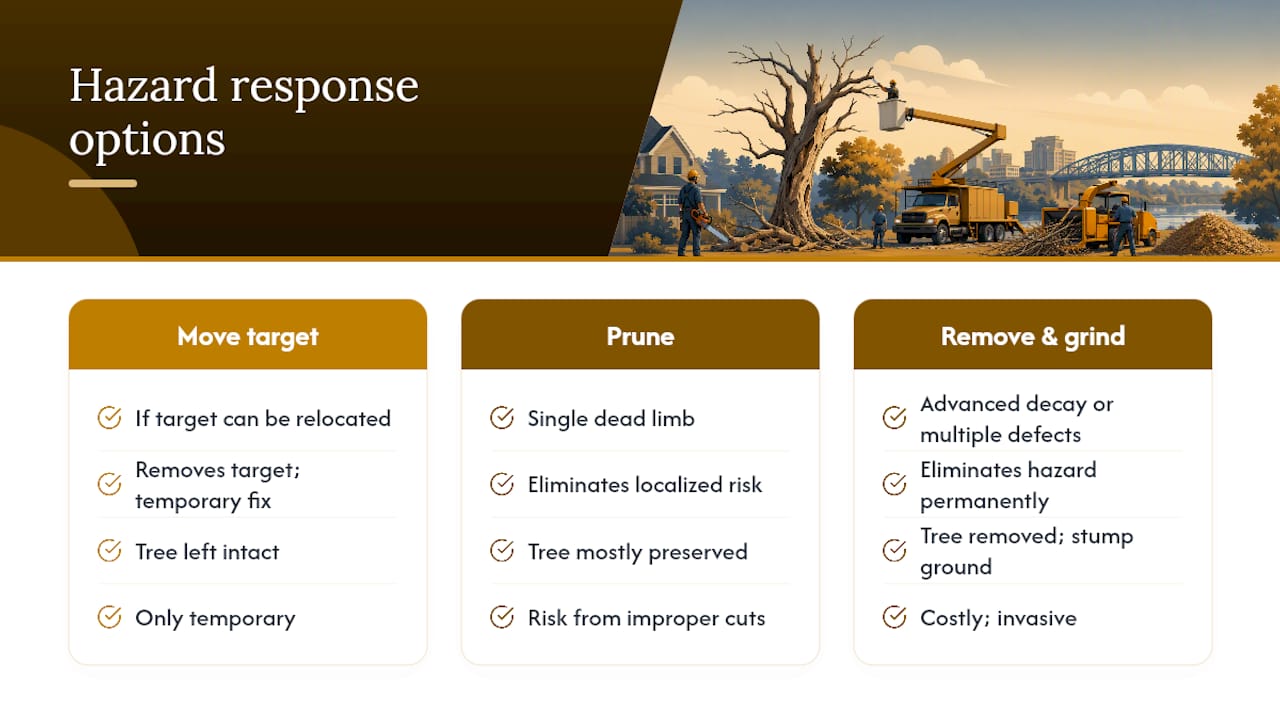
Moving the target is the cheapest fix when it's actually possible. If a dead limb hangs over a swing set, a grill, or a parked vehicle, relocating that item might buy time while you schedule an inspection. It doesn't fix the tree, but it does remove the thing the tree could fall on.
Pruning solves the problem when the defect is isolated. A single dead branch on an otherwise healthy tree usually just needs to come off. Done well, targeted pruning eliminates the immediate risk without touching the rest of the canopy. Done poorly, though, it can create new problems: improper cuts invite decay, and topping a tree often triggers weak regrowth that becomes tomorrow's hazard. This is one reason proper trimming technique matters more than speed.
Full removal and stump grinding is the option pros reach for when decay is advanced, multiple defects stack up, or the tree sits close enough to a structure that any failure mode is a problem. Government hazard-tree guidance frames removal as the option to consider once other measures won't reliably eliminate the risk, since it's the only choice that closes the hazard permanently rather than managing around it, according to federal hazard tree guidance.
Pro Tip: If you're debating between pruning and removal, ask the arborist to show you the decay, not just describe it. A sounding test or a look at exposed root flare tells you more than a verbal opinion.
For a deeper look at how professionals weigh these options, see this guide on determining if a tree needs removal.
What Happens During Professional Tree Removal
A competent crew doesn't show up and start cutting. Removal follows a sequence designed to protect the property, the crew, and everything nearby.
- On-site inspection — the arborist evaluates trunk condition, lean, root health, and surrounding targets in person, not from the street.
- Risk assessment — defects are ranked so the crew knows which cuts carry the highest fall risk.
- Utility marking — overhead and underground lines get flagged before any equipment moves in.
- Permit check — the crew confirms whether local rules require a permit for the size or location of the tree.
- Rigging setup — ropes, pulleys, and sometimes a crane are positioned to control where each section falls.
- Sectional dismantling — large trees near structures come down in controlled pieces rather than one full-length drop.
- Lowering and placement — cut sections are lowered into a cleared zone, not dropped.
- Stump grinding — the remaining stump is ground below grade so the area can be reseeded or replanted.
- Debris removal and cleanup — logs, brush, and wood chips are hauled off unless the homeowner requests otherwise.
- Final inspection — the crew checks the site and confirms the hazard is fully resolved.
Professional crews rely on rigging, cranes, and personal protective equipment to control drop zones and avoid collateral damage, according to TreePros' breakdown of the removal process. That same source notes crews use utility location services and specialized grinding equipment specifically to protect buried lines during stump removal. This matters because chainsaw injuries are common in DIY attempts, and NIOSH data on woodworking hazards points to thousands of chainsaw-related emergency room visits every year. A trained team with the right gear cuts that risk dramatically. Before work starts, ask for photos, a written scope of work, and a certificate of insurance. Reputable outfits provide all three without hesitation, as outlined in this homeowner's safety guide to tree removal.
Why Hiring a Licensed, Insured Crew Lowers Your Risk
A licensed and insured tree service absorbs the liability that comes with the job itself. If a limb drops on a fence during removal, the contractor's insurance covers it, not your homeowner's policy. Ask to see a certificate of insurance before the crew starts, not after.
Documentation matters just as much as the hire, and following a skötselplan för grönyta helps property owners document care needs and preventive maintenance. Keep these on file:
- Dated photos of the dead limbs, cracks, or decay you noticed first
- A written estimate that describes the scope of work
- The signed agreement outlining what will be removed and how
- Saved invoices and the final receipt
The University of Tennessee Extension recommends this kind of dated record specifically because it becomes important if a dispute or claim arises later. Insurers generally cover storm-caused tree failures without much friction. What they push back on is a DIY removal that damages a neighbor's fence or a power line. That's when coverage disputes start, and it's one more reason understanding your liability exposure before you pick up a chainsaw pays off.
Choosing a Licensed Tree Service in Shreveport and North Louisiana
Not every crew that shows up with a truck and a chainsaw is equipped to handle a hazardous removal safely. Before you sign anything, confirm five things.
- Certificate of insurance covering both general liability and workers' compensation. Ask to see it, not just hear about it.
- A site visit before quoting. A credible contractor walks the property and looks at the tree in person rather than pricing it from a photo or a phone call.
- A written estimate that spells out exactly what's being removed, how, and what's included in cleanup.
- Arborist credentials, ideally ISA certification or equivalent training in hazard assessment.
- References or a cleanup guarantee you can verify.
On-site, ask how they plan to handle rigging near your house, whether they'll grind the stump or just cut it flush, and how they'll protect your lawn and driveway. Vague answers are a red flag. So is a lowball quote given without ever inspecting the tree in person, which almost always signals a corner will get cut somewhere.
Pro Tip: A tree company that skips the site visit and quotes over the phone is guessing, not assessing. Decay hides behind healthy-looking bark, and that's exactly what a proper inspection is for.
For a sense of typical costs before you call, this tree risk assessment cost guide breaks down what factors into pricing.
From Quote to Completion: What to Expect
Most jobs start with a site visit within a few days of your call, followed by a written estimate on the spot or within 24 hours. Scheduling depends on urgency. A tree actively leaning over a roof usually jumps the queue ahead of routine maintenance work.
Permits typically get triggered by tree size, protected species status, or proximity to public right-of-way. Established crews handle that paperwork rather than leaving it on you.
Job duration ranges from a couple of hours for a single tree to a full day for larger jobs with dense debris. Cleanup should include hauling logs and brush, and stump grinding is usually offered as an add-on if you want the stump gone rather than left flush. Ask whether a follow-up inspection is included if you're uneasy about a neighboring tree. Preparing the yard beforehand, covered in this yard prep guide, speeds the whole process along.
Property Owner Responsibilities Under Louisiana Rules
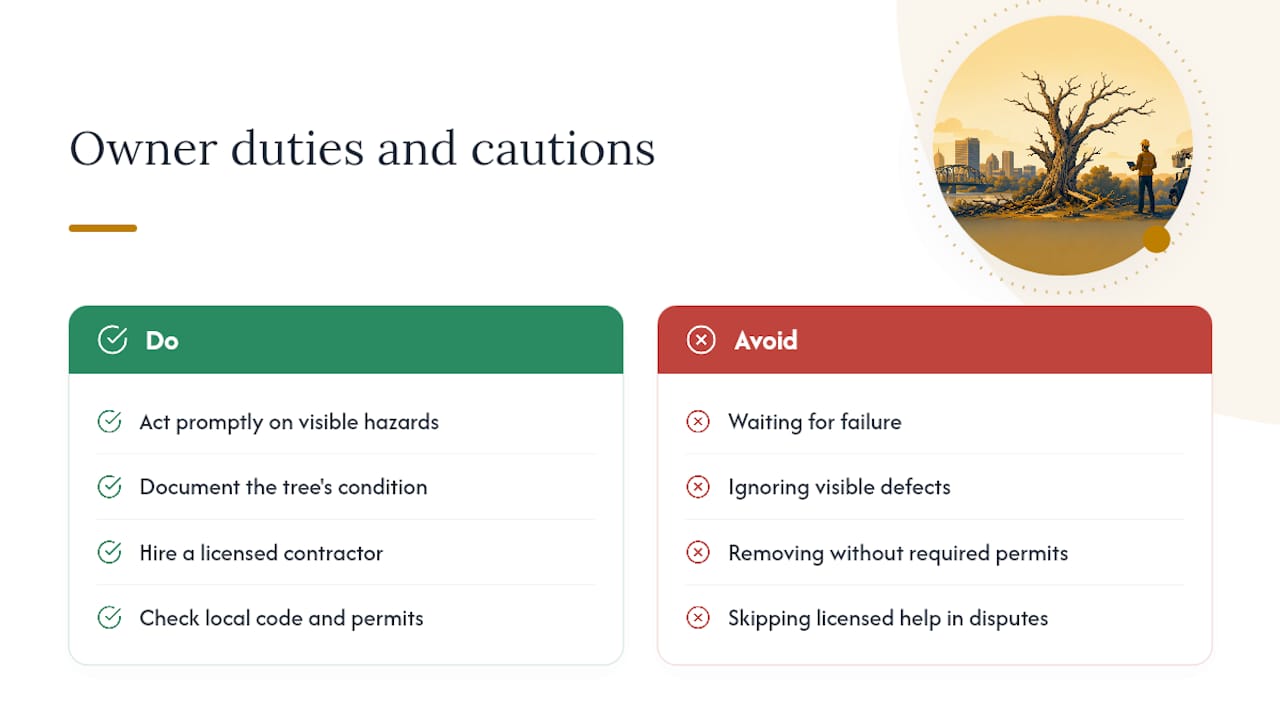
Property owners in Louisiana are generally expected to maintain trees on their land in a condition that doesn't pose a foreseeable hazard to neighbors, passersby, or public infrastructure. That expectation grows sharper once a defect is visible. A dead tree with obvious cracks or fungal conks is a different situation, legally and practically, than one that fails without warning.
Local ordinances in Shreveport and Bossier City can also govern tree work near power lines, on corner lots with visibility requirements, or within city rights-of-way, and some removals near protected zones may require a permit. Rules vary by parish and municipality, so checking with your local code enforcement office before major removal work, particularly near a property line or public sidewalk, avoids delays and fines.
None of this means every dead tree creates automatic exposure. It means that once a hazard is visible and identifiable through the warning signs covered earlier, an owner has practical reasons to act rather than wait. Acting early, documenting the tree's condition, and hiring a licensed contractor are the steps that put an owner in the strongest position if a dispute or an insurance question ever comes up. This is a general overview, not legal advice, and specific situations involving property lines, easements, or contested damage should go through a local attorney or your parish's code office.
Notifying Neighbors About a Hazardous Tree
If a dead or dying tree sits near a property line, tell your neighbor before you schedule removal, even if the tree is entirely on your side. A conversation now is cheaper than a dispute later, especially if a limb overhangs their yard or their fence sits close to the drop zone.
Keep the notification simple and in writing where possible. A text message or email that states what you observed, what you plan to do, and roughly when, creates a timestamped record. If the hazard involves a tree that straddles a property line or one you suspect belongs to your neighbor, put your concern in writing and keep a copy. A dated email saying "I noticed dead limbs on the oak near our shared fence line and wanted to flag it" does more for you than a verbal heads-up you can't later confirm.
Save any reply. If a neighbor acknowledges the hazard and doesn't act, that record matters if a limb eventually falls and causes damage. If you're the one being notified about a hazard on your property, treat it as a prompt to get an inspection scheduled rather than something to dismiss. Photographs attached to these messages, showing the specific limb, crack, or conk you're concerned about, strengthen the record further and match the documentation habits recommended for insurance purposes.
How Fast You Should Move Once You Spot a Hazard
Timelines depend on severity, not convenience. A tree with a single dead branch over open lawn can wait for a scheduled inspection within a few weeks. A tree with multiple major defects hanging over a roof, driveway, or power line needs an inspection within days, and removal soon after.
A rough triage:
- Immediate (24 to 72 hours): large dead limbs or a leaning trunk directly over a structure, vehicle, or walkway
- This week: visible fungal conks, cracks, or hollow cavities on a tree near any target, even if it hasn't shifted
- This season: dead wood in low-traffic areas of the yard with no structure or path nearby
Storm season across North Louisiana adds urgency to all three categories. Wind and saturated soil are what turn a slow-developing defect into a sudden failure, so trees flagged as moderate risk in spring deserve a second look before summer storms roll through.
Fines and Penalties for Ignoring a Hazardous Tree
Louisiana doesn't operate a statewide fine schedule specifically for neglected dead trees on private property, but that doesn't mean there's no exposure. Local municipal codes in Shreveport and Bossier City can carry citations for trees that violate sight-line requirements at intersections, encroach on public right-of-way, or create a documented nuisance that a city inspector flags after a complaint.
The bigger financial risk usually isn't a municipal fine. It's the cost of a failure itself: a fallen limb that damages a roof, a car, or a neighbor's property. If negligence is established, meaning the hazard was visible and nothing was done, the property owner can be on the hook for damages that far exceed anything a local ordinance would ever assess. That exposure grows if the tree had visible fungal conks, cracks, or a documented lean that went unaddressed for months.
Ignoring a known hazard also complicates insurance. A claim tied to a defect you could have reasonably identified beforehand invites more scrutiny than one tied to a sudden storm event. Checking with your parish or city code enforcement office for tree-specific ordinances is worth the ten-minute phone call, especially on commercial properties where liability exposure tends to be higher and inspections more frequent.
Tatum's Take: What Local Storms Have Taught Us
Water oaks and pines dominate the hazard calls we see across Shreveport after a wind event. Until help arrives: keep people and vehicles away from the drop zone, don't attempt cuts on anything leaning or under tension, and photograph the damage from a safe distance. Fast action beats a perfect plan.
— Tatum
Get a Free Estimate from Briley Tree Service
Some licensed local tree services handle the exact scenario this article covers: dead and hazardous trees close enough to a home, vehicle, or power line to matter. Unlike hiring an unlicensed crew off a flyer or waiting until a storm forces the issue, calling a licensed local outfit means the liability during the job sits with the contractor, not you. They remove dead and dying trees, prune defective limbs, grind stumps, and run emergency storm cleanup services across Shreveport, Bossier City, Ruston, and the rest of Northwest Louisiana.
When you call, you can expect a site visit, a documented written estimate, and a crew that carries insurance you can verify before work starts. Permit checks and insurance claim documentation support may also be available. If a dead limb is hanging over your driveway right now, request a free estimate or call for emergency dispatch. The sooner we look at it, the sooner it stops being your problem to manage.
Sources
- Recognizing hazardous trees — UC ANR IPM
- Hazard tree guidance — GPO (government publication)
- The step-by-step process of professional tree removal — TreePros